


Choose a jewelry-specific B2B ecommerce platform that ships structured product feeds, links directly to grading certificates, gates pricing by trade account, and connects cleanly to your storefront or PIM. Before you sign anything, confirm the vendor can hand you live feed or API access, working certificate links tied to standards like GIA, and real trade-account controls. Platforms such as JewelCloud, and trade references like Jewelers of America, are the kind of names that should show up in your evaluation.
TL;DR:
- Structured data, certificate links, and trade account gating are essential to prevent errors and verify authenticity in B2B diamond platforms.
- Integration formats like CSV, XML, or API, along with a clear SLA on inventory updates, are critical to avoid overselling and streamline workflows.
- Separator metadata for lab-grown versus natural diamonds and chain-of-custody documentation are vital due to evolving sourcing and compliance standards.
- Support response times and dispute resolution procedures should be transparent, with audit logs to facilitate quick conflict resolution.
- Pricing models vary from flat subscriptions like JewelCloud’s $1,500 monthly fee to marketplace commissions, requiring careful total cost evaluation.
Table of Contents
- What Is B2B Diamond Ecommerce, and How Is It Different From Retail?
- Core Platform Features to Require Before You Sign
- How B2B Platforms Pay Off for Suppliers and Retailers
- How Do You Choose the Right B2B Diamond Platform?
- How JewelCloud Addresses These Requirements
- What Security and Fraud Controls Actually Matter Here
- How Are B2B Diamond Platforms Priced?
- Where Does the Kimberley Process Fit Into Digital Trade?
- What Trends Are Shaping Demand in This Market?
- How Should Disputes and Support Work in Trade Transactions?
- Editor Perspective: When a Jewelry Vertical Beats a Generic B2B Platform
- Ready to Simplify Your Diamond Distribution?
- Sources
- FAQ
What Is B2B Diamond Ecommerce, and How Is It Different From Retail?
A B2B diamond ecommerce platform moves inventory between suppliers and trade buyers, not between a brand and a shopper with a credit card. That distinction shapes everything about how these systems are built. You’ll run into three general models: trade-only marketplaces that list diamonds from multiple sellers, vendor-feed platforms that pipe structured product data into a retailer’s own site, and merchant-hosted B2B storefronts built directly on Shopify or Magento with wholesale access controls layered on top.
The workflows look different too. Retail checkout is instant and final. Trade transactions run on memo and quote cycles: a retailer requests a stone on memo, holds it for inspection or a client showing, then either buys it or sends it back, all of it tracked against a certificate number. Grading and certificate handling has to survive that back-and-forth, and so does inventory status. Add lab-grown diamonds into the mix and your listing metadata needs to separate origin, growth method, and certificate type cleanly, or your retail partners will field confused questions from their own customers.
Core Platform Features to Require Before You Sign
Not every “B2B jewelry portal” on the market actually delivers trade-grade data. Before committing, insist on capabilities in four areas.
Inventory and product data. You want structured attributes (cut, color, clarity, carat, fluorescence, measurements) delivered in a consistent schema, high-resolution imagery, direct links to grading reports, and support for both SKUs and memo-specific identifiers. A feed that dumps unstructured text descriptions into a single field will break your search filters and your retailer’s trust.
Commercial terms. Look for trade account gating so pricing only shows to verified buyers, MAP (minimum advertised price) support if your brand enforces it, net payment terms, and consolidated invoicing so a retailer isn’t reconciling forty separate charges a month.
Technical integration. Confirm the platform works with your PIM or OMS, and ask exactly what feed formats it exports: CSV, XML, JSON, or a direct API. If you’re running Shopify B2B jewelry storefronts or a Magento B2B jewelry catalog, ask whether the vendor has a built connector or whether your team builds custom middleware from scratch.
Fulfillment and risk controls. Insured shipping, consolidated shipment options for multi-item orders, a clear memo and returns policy, and a certificate verification step before goods ship.
- Structured attributes and grading report links, not free-text descriptions
- Trade account gating with MAP and net-terms support
- Native or plugin-based integration with your storefront and PIM/OMS
- Insured, trackable fulfillment with a documented memo and returns process
Pro Tip: Ask any prospective vendor for a sample data payload before you commit. If they can’t produce one in under a day, that tells you how mature their feed infrastructure actually is.
How B2B Platforms Pay Off for Suppliers and Retailers
The return looks different depending on which side of the transaction you’re on, but both sides win when the data is clean.
Suppliers get distribution without a bigger sales team. A feed-based model puts your catalog in front of qualified retail buyers automatically, cuts down on manual listing work every time you add a new collection, and shortens the runway between cutting a new line of stones and having it live on partner storefronts.
Retailers get assortment without carrying the stone. A jeweler can expand into fancy shapes or lab-grown categories without buying inventory upfront, launch new product pages in days instead of weeks, and hand customers grading data they can trust because it traces back to the certificate, not a sales pitch.
- Suppliers: broader qualified reach, fewer manual listings, faster collection launches
- Retailers: bigger assortments with no carrying cost, quicker page launches, verifiable grading data
- Both sides: fewer catalog errors, smoother replatforming projects, and sales teams who can act as agents placing memos on a retailer’s behalf without waiting on email chains
That last point matters more than it sounds. A platform that lets a sales rep place an order or memo directly on a retailer’s behalf closes the gap between digital self-service and the relationship-driven selling this industry still runs on.
How Do You Choose the Right B2B Diamond Platform?
Run every vendor through the same ranked checklist, and don’t skip the uncomfortable questions.
- Data quality first. Ask to see a live sample feed. Check whether every stone links to a grading report, whether attributes are structured or dumped as text, and whether images meet a resolution you’d actually publish.
- Certificate visibility. Confirm certificate numbers resolve to a real, checkable report from a recognized lab. If a vendor can’t answer this cleanly, move on.
- Integration effort. Get specific: what feed formats do they support, do they have a Shopify or Magento connector, and what’s the estimated engineering lift on your end?
- Uptime and freshness SLA. Ask how often inventory syncs and what happens when a stone sells elsewhere before the feed updates. A vague answer here means overselling risk later.
- Commercial terms and dispute process. Get the fee structure, net-terms policy, and returns process in writing before you integrate a single SKU.
Ask every vendor these exact questions: What feed formats do you support, and can I see a sample payload? What’s your SLA on inventory freshness? Can every listing link to its grading certificate? Who is the merchant of record on a disputed transaction, and what’s the resolution timeline?
Watch for red flags: a vendor who can’t export structured data, listings with no certificate link, or a fee model nobody can explain in one sentence.
Pro Tip: If a vendor dodges the “who is merchant of record” question, that’s your answer. Someone has to own the transaction when a certificate dispute comes up, and it shouldn’t be a mystery.
How JewelCloud Addresses These Requirements
JewelCloud was built around the exact friction points wholesale buyers and suppliers run into everywhere else: messy data, manual listing work, and certificate details that don’t survive the trip from supplier to storefront.
The JewelCloud® Product Feed structures and standardizes vendor data before it ever reaches a retailer’s site, which cuts down on the SKU errors that come from inconsistent formatting across suppliers. DiamondLink® handles diamond-specific listing and certificate linking, so retailers aren’t stitching that logic together themselves. For suppliers who also need a storefront presence, Websites for Diamond Suppliers pairs vendor web design with the same structured data backbone.
- Structured, standardized feeds reduce catalog errors and manual re-entry
- DiamondLink® centralizes certificate and diamond-attribute handling
- Vendor web design support means suppliers don’t need a separate agency for a trade-facing site
- Retailers get expanded assortments without carrying physical inventory
The result is fewer listing lifecycle headaches on both sides of the transaction, which is the entire point of a jewelry-specific platform instead of a generic B2B tool retrofitted for stones.
What Security and Fraud Controls Actually Matter Here
Diamond fraud in B2B channels usually isn’t dramatic. It’s a mismatched certificate, a stone substituted after grading, or a shipment that “got lost” between memo and return. The controls that actually stop this are unglamorous but essential.
Certificate verification has to happen at multiple points: at listing, at memo issuance, and again at final sale, not just once at intake. Audit logs on every memo and shipment give you a paper trail if a stone’s status gets disputed later, showing exactly who held it, when, and under what terms. Vetted supplier onboarding, meaning a platform actually checks business credentials and trade references before granting a seller account, keeps bad actors from listing stones they don’t have rights to sell.
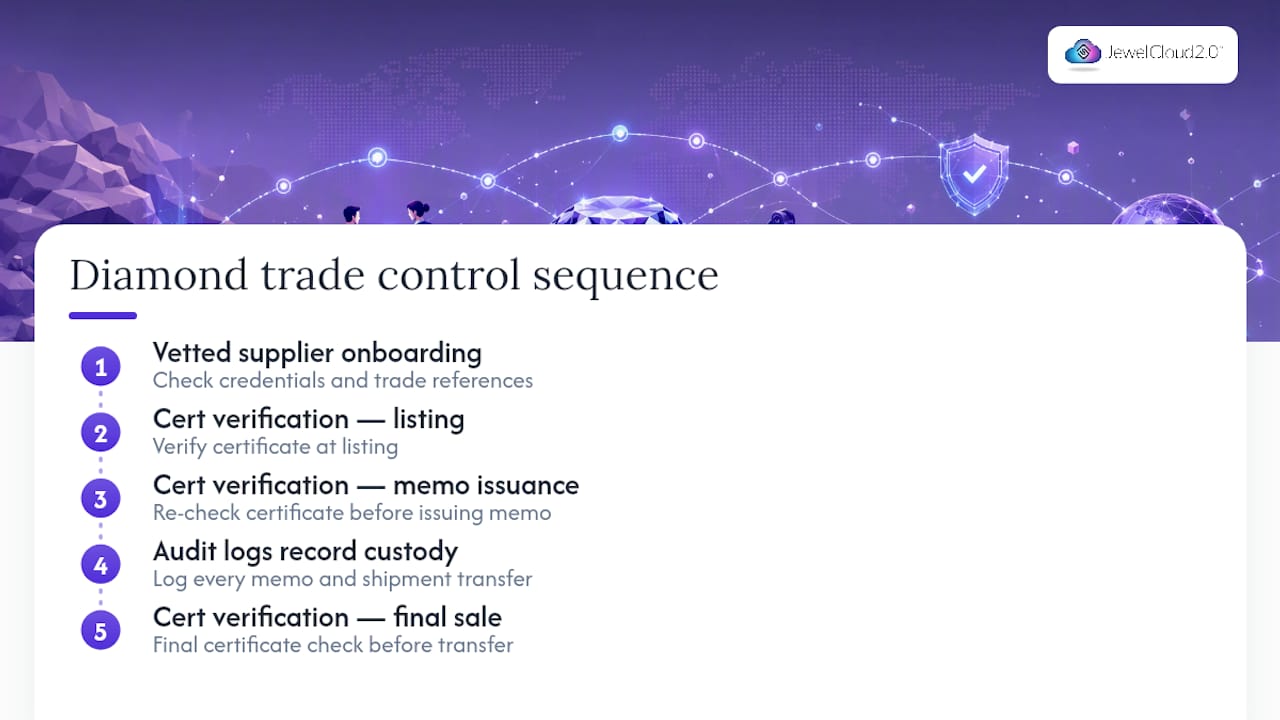
Payment security follows standard ecommerce practice: tokenized payment data, two-factor authentication on trade accounts, and role-based access so a junior staffer can’t approve a six-figure memo release. But the diamond-specific layer is the traceability piece. A platform that logs every certificate check and every memo transfer gives you something a generic B2B tool never will: a chain of custody you can produce if a transaction goes sideways.
How Are B2B Diamond Platforms Priced?
Pricing in this space breaks into a few recognizable models, and knowing which one you’re signing up for changes how you budget.
Subscription or membership fees are common for vendor-feed platforms, where suppliers pay a recurring fee for distribution access and product feed infrastructure. JewelCloud’s own Jewelry Vendor Membership, Silver tier, runs $1,500 per month, while the Gold tier’s pricing is available on request through JewelCloud directly.
Transaction or commission fees show up on marketplace models, where the platform takes a percentage of each completed sale rather than charging a flat subscription. This model shifts risk toward the platform operator but can get expensive at scale if your margins are thin.
Setup and integration fees apply when a platform requires custom development work, like connecting a proprietary feed format to your existing PIM, or building a custom storefront on top of vendor data.
Before comparing two vendors on price alone, map out the total cost: subscription or commission, plus any integration lift your team has to absorb, plus what happens to pricing if your order volume doubles. A platform that looks cheap on the subscription line can get expensive fast if every new SKU needs manual cleanup on your end.
Where Does the Kimberley Process Fit Into Digital Trade?
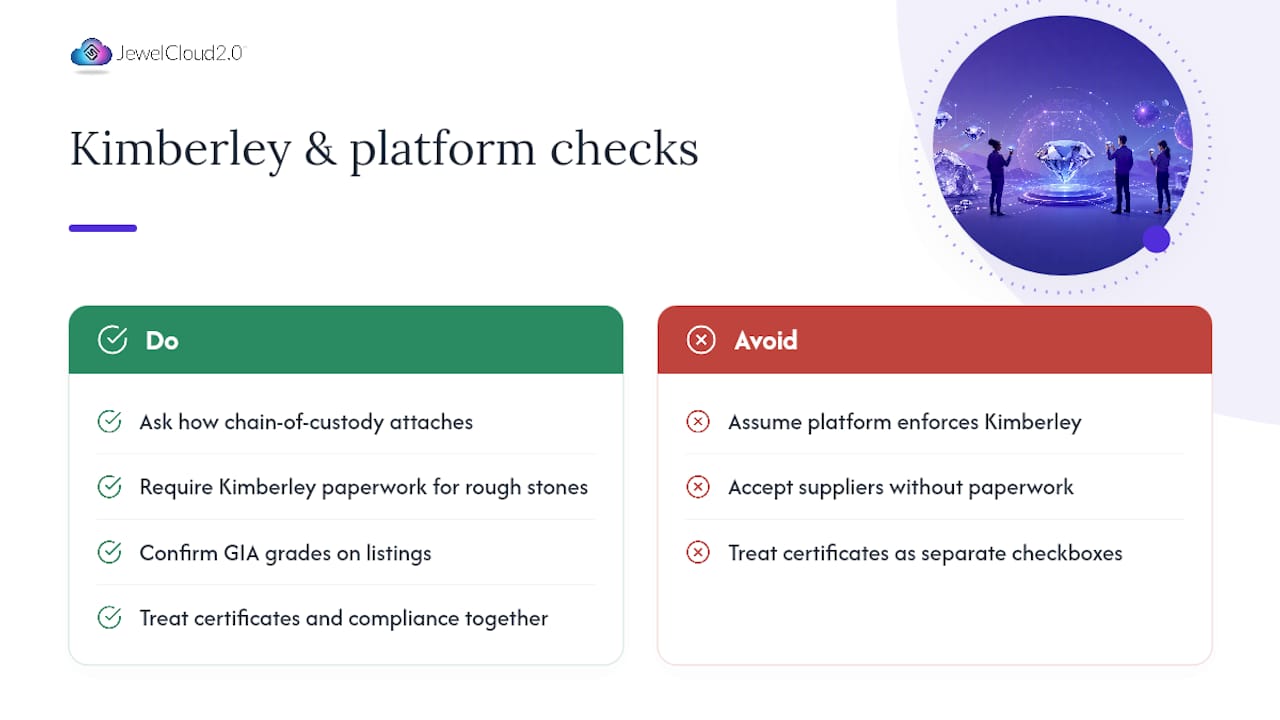
The Kimberley Process Certification Scheme governs the international trade of rough diamonds, requiring exporting countries to certify shipments as conflict-free before they cross borders. It applies to rough stones moving between countries, not directly to the ecommerce platform layer where cut and polished diamonds change hands between suppliers and retailers.
That doesn’t make it irrelevant to your platform choice. A serious B2B jewelry ecommerce provider should support documentation that traces a stone’s chain of custody back through its polished-goods invoicing, even if the platform itself isn’t the compliance body. Ask any vendor how they handle chain-of-custody documentation and whether that data can attach to a listing or memo record. If a supplier can’t produce Kimberley Process paperwork on request for rough-sourced stones, that’s a sourcing problem no platform feature can fix.
Beyond Kimberley Process, grading standards from GIA function as the de facto verification layer for polished stones, and trade groups like Jewelers of America publish standards that inform how retailers vet suppliers before granting a trade account. Treat certificate and compliance documentation as inseparable parts of the same due diligence, not two separate checkboxes.
What Trends Are Shaping Demand in This Market?
Lab-grown diamonds have changed how listing metadata needs to work, full stop. Retailers now expect platforms to separate natural and lab-grown inventory clearly, with distinct certificate types and pricing tiers, rather than lumping everything into a single “diamonds” category the way catalogs did a decade ago.
Marketplace models are also expanding. Industry coverage of platforms like Get-Diamonds shows tender-style trading gaining ground alongside traditional fixed-price wholesale listings, giving retailers more ways to source than a static catalog alone. That variety means the “best” sourcing model increasingly depends on what a specific retailer needs: consistent recurring inventory versus opportunistic tender-based buying.
On the demand side, retailers are asking suppliers for faster turnaround between a design going into production and it appearing live on a storefront. That pressure is pushing more suppliers toward feed-based distribution instead of manual catalog updates, simply because manual listing can’t keep pace with how quickly retail buyers want new collections online. Expect that gap between manual and automated distribution to keep widening as retail buyers get used to feed-driven catalogs elsewhere in their sourcing.
How Should Disputes and Support Work in Trade Transactions?
A retailer holding a memo stone that doesn’t match its certificate needs a resolution path measured in hours, not weeks. That’s the baseline for support in this category, and it’s worth confirming before you ever place a first order.
Ask any platform directly what their dispute resolution timeline looks like and who has final authority to approve a return or credit. The strongest platforms designate a clear merchant of record on every transaction, someone who owns the outcome when a certificate discrepancy or shipping issue comes up, instead of routing the buyer and supplier into a finger-pointing loop.
Support responsiveness matters just as much on the supplier side. A vendor whose inventory feed goes stale during a peak buying window, without any proactive notice, creates overselling problems that damage retailer trust fast. Look for platforms that publish an actual freshness SLA and treat a breach of it as a support priority, not an afterthought.
Audit logs help here too. A documented trail of memo transfers, certificate checks, and communication timestamps turns a “he said, she said” dispute into a five-minute resolution, which is exactly the kind of infrastructure a jewelry-specific platform should treat as a baseline, not a premium feature.
Editor Perspective: When a Jewelry Vertical Beats a Generic B2B Platform
A generalized commerce provider will always require more of your team’s engineering time. When your catalog is complex, certificate-driven, and dispute-sensitive, that trade-off rarely pays off. The verdict holds: jewelry-specific data infrastructure beats retrofitted generic tools for anyone selling diamonds at trade volume.
— Anthony
Ready to Simplify Your Diamond Distribution?
Everything covered above, structured feeds, certificate linking, trade account gating, agent-ready memo workflows, is what JewelCloud was built to handle rather than bolt on as an afterthought.
If you’re a supplier looking to get in front of qualified retail partners without rebuilding your listing process from scratch, start with the Jewelry Vendor Membership, Gold page to see what onboarding involves. Retailers looking to expand assortment without carrying inventory can review JewelCloud for Retailers to see how feed access works on their end. And if certificate-linked diamond listings are your specific pain point, DiamondLink® is built exactly for that. Reach out through any of those pages to request a walkthrough of how your catalog would look once it’s live.
Sources
FAQ
What Is the Best Platform for Selling Diamonds Online in B2B?
The strongest choice is a jewelry-specific platform offering structured product feeds, certificate verification, and trade account controls rather than a generic ecommerce tool retrofitted for diamonds. JewelCloud is built specifically around those requirements for suppliers and retail partners.
Who Is the Biggest Diamond Supplier?
Diamond supply is fragmented across major mining companies, polished-goods wholesalers, and thousands of independent trade suppliers, so there’s no single dominant name that applies to B2B ecommerce sourcing decisions. Your sourcing choice should hinge on certificate transparency and data quality, not supplier size alone.
Who Will Pay the Most for Diamonds?
Buyers willing to pay the highest prices are typically retail jewelers and specialty buyers seeking certified, well-documented stones with clear grading provenance, since verified certificates from labs like GIA support higher resale confidence. Uncertified or poorly documented stones consistently sell for less regardless of buyer type.
What Is the Best Online Diamond Retailer?
That depends on whether you’re asking as a consumer or a trade buyer. This article focuses on the B2B side of that question: platforms and feeds that let retailers source diamonds at wholesale with verified data, not consumer-facing retail sites.
Does JewelCloud Charge a Monthly Fee?
JewelCloud’s Silver vendor membership is priced at $1,500 per month, while Gold tier pricing is available on request directly through JewelCloud.