


The single thing a B2B jewelry website must deliver is a PIM-first wholesale portal: dealer accounts with tiered pricing, MOQ enforcement, and credit-term workflows, all built on EDI-ready architecture. Get that foundation right and you get controlled margins, faster retailer onboarding, and far fewer manual order corrections. Get it wrong, and you’re stuck bolting wholesale logic onto a consumer cart that was never built to hold it. JewelCloud was built around exactly this priority, and it’s the lens Anthony brings to everything below.
TL;DR:
- A wholesale jewelry site must be built around a PIM-driven architecture to support tiered pricing, MOQ enforcement, and EDI integration from the start.
- Core integrations include ERP systems for inventory sync, EDI middleware for document flow, and payment workflows tailored for net terms rather than consumer cards.
- Large catalogs require fast, mobile-optimized search, structured certification display, and support tools such as reorder lists and account management features.
- Budget allocation should prioritize data architecture and supplier feed normalization early to ensure scalability, with project timelines typically spanning a few months.
- Choosing a vendor depends on their experience with EDI and PIM, ownership rights, and ability to support long-term growth, not just storefront design.
Table of Contents
- What Core Features Does a B2B Jewelry Website Design Need?
- How Should You Architect the Technical Integrations?
- What Will the Project Timeline and Budget Actually Look Like?
- How Do You Choose the Right Development Partner?
- What Support Infrastructure Do B2B Dealers Actually Need?
- How Do You Handle Cross-Border Dealer Relationships?
- What Security and Compliance Standards Apply Here?
- Why Does Mobile Performance Matter for Dealer Portals?
- What Marketing Approach Works for Wholesale Jewelry Sites?
- Where Do Most Wholesale Jewelry Site Projects Go Wrong?
- How Does JewelCloud Address These Wholesale Requirements?
- Sources
What Core Features Does a B2B Jewelry Website Design Need?
A wholesale jewelry site isn’t a retail storefront with a login screen bolted on. It behaves more like an ERP with a commerce layer on top, where invoice terms, sales-rep approvals, and credit workflows drive the experience far more than a “buy now” button ever will. That distinction should shape every line item in your requirements document.
Here’s what belongs in that document, at minimum:
- Dealer accounts and gated catalogs. Retailers log in to see their own negotiated pricing, not a public price list. SKU-level overrides matter because a dealer’s margin on a specific diamond cut can differ from your default tier.
- MOQ and pack-size enforcement. Server-side logic should block orders that fall under minimums rather than relying on a note in the product description. This has to happen at checkout, not as a manual review step afterward.
- Quote-and-approve workflows. Big retailers rarely check out instantly. They request a quote, route it through internal approval, and expect a formal RFQ process that mirrors how they already buy from other suppliers.
- PIM-driven catalog sync. Daily incremental syncs, attribute normalization across supplier feeds, and automated image pipelines keep thousands of SKUs consistent without a staff member manually retyping specs every morning.
- Cert and provenance display. GIA, IGI, and AGS certification numbers need a structured field, not a PDF attachment, so they display consistently and filter correctly across the catalog.
- Bulk order and sales-rep tools. Reorder-favorites lists and rep-managed carts let a sales team place orders on behalf of a dealer, which is standard practice in wholesale but almost never exists in off-the-shelf retail templates.
- Jewelry-specific faceted search. Filtering by metal purity, stone shape, carat range, and setting style needs to stay fast even as your catalog grows into the tens of thousands of SKUs.
Wholesale portals commonly need this exact mix, dealer logins, MOQ enforcement, and quote-and-approve flows, rather than a standard consumer cart. Skip any one of these and you’ll feel it later, usually in the form of a retailer support ticket asking why their price doesn’t match what your rep quoted them.
How Should You Architect the Technical Integrations?
The features above only work if the plumbing underneath supports them. A PIM-first architecture should be your starting assumption, not an afterthought layered in during phase three. Attribute normalization and asset pipelines rank among the highest-priority technical requirements once you’re managing feeds from multiple suppliers with inconsistent naming conventions for the same stone shapes and metal grades.
Plan your integration stack in roughly this order:
- ERP connection first. Map how inventory counts, cost basis, and per-dealer pricing tiers sync between your ERP and the storefront. This determines whether “in stock” on your site actually means in stock in your warehouse.
- EDI middleware second. Retailers of any real size expect EDI 850 (purchase order), 855 (order acknowledgment), and 856 (shipment notice) document flows. Middleware platforms like SPS Commerce, TrueCommerce, or an AS2 connection handle the translation layer so you’re not building EDI parsing from scratch. EDI middleware and standard document flows are now common integration requirements for wholesalers scaling into national retail accounts, and automating them cuts manual order entry dramatically.
- Payment and credit workflows third. Most B2B jewelry buyers run on net-30 or net-60 terms, not credit cards at checkout. A Stripe ACH setup paired with an invoicing system that mirrors your quote-to-order flow works better than a consumer payment gateway forced into a role it wasn’t designed for.
- Search index and CDN last. High-resolution jewelry photography is heavy, and a slow-loading catalog page kills conversion faster than almost anything else. A dedicated CDN and a proper search index (not a database query dressed up as search) keep large catalogs fast.
Pro Tip: Build a validation layer that quarantines corrupted supplier feeds and auto-notifies the vendor, rather than letting bad data publish live. Catching feed errors before they reach the storefront saves your team from manually hunting down mismatched carat weights across a catalog of ten thousand SKUs.
One more thing worth flagging early: EDI readiness often becomes the deciding factor in whether a national retailer will even onboard you, so don’t treat it as a “phase two” feature if big-box accounts are part of your growth plan.
What Will the Project Timeline and Budget Actually Look Like?
Most wholesale-grade builds typically take a few months from kickoff to launch, broken into logical phases. Discovery (weeks 1 to 2) maps your existing supplier feeds, ERP structure, and dealer pricing logic. Architecture and data modeling (weeks 2 to 4) is where PIM schema and attribute normalization get designed before any storefront work starts. Build and integration (weeks 4 to 9) is the longest phase, covering the storefront, EDI middleware, and payment workflows in parallel. Testing and dealer onboarding (weeks 9 to 12) validates pricing tiers, quote flows, and feed syncing with real supplier data before go-live.
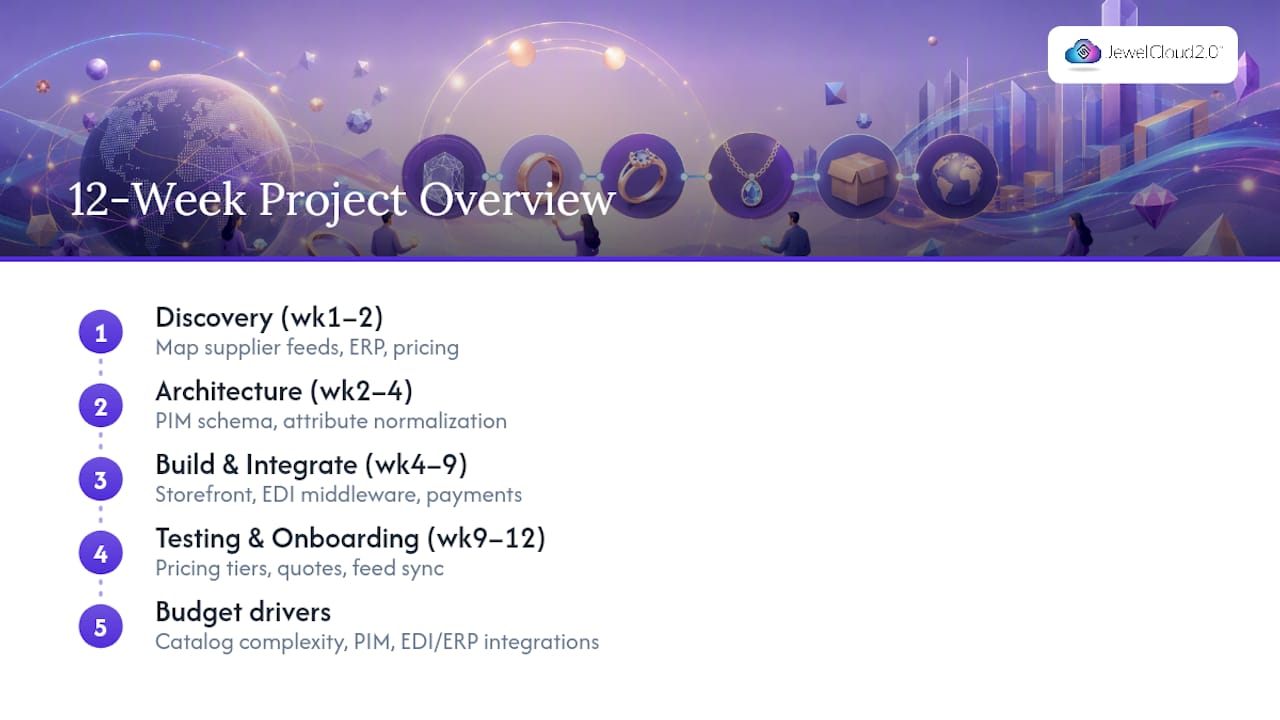
Cost scales with catalog complexity more than page count. A full-featured wholesale build with PIM integration and EDI readiness costs meaningfully more than a simple retail storefront, because the engineering hours go into data architecture, not visual design. Smaller catalogs with basic dealer pricing sit at the low end of that range; large multi-supplier operations with EDI and ERP integration push toward the top.
Budget for an ongoing retainer after launch, covering EDI spec updates and supplier feed maintenance. Tie vendor payments to milestones, discovery sign-off, architecture approval, integration testing, and go-live, rather than a lump sum upfront.
How Do You Choose the Right Development Partner?
Not every web design agency that says “we do jewelry sites” has actually built EDI-compliant wholesale infrastructure. Before you shortlist anyone, run their proposal through a short capability check.
- Ask for PIM case studies, specifically. A generic e-commerce portfolio doesn’t prove they’ve normalized supplier attribute data across mismatched feeds.
- Ask who owns your data and code after launch. Some agencies build on proprietary frameworks that quietly lock you into their support contract forever.
- Ask who handles EDI spec changes when a retailer updates their requirements. Retailers do this more often than vendors expect, and someone needs to own that maintenance.
- Ask for a data migration plan, not just a launch plan. Moving thousands of SKUs with certs and imagery intact is its own project phase.
- Ask for SLA terms in writing. “We’ll get to it” is not a service level.
Deciding between a custom build, an agency partnership, or a platform-based approach comes down to three factors: ownership, time to market, and long-term scalability. A platform gets you live faster but may cap how deeply you can customize dealer pricing logic. A full custom build gives you total control but costs more upfront and takes longer. Reviewing a firm’s portfolio and prior wholesale case studies before signing anything is one of the more reliable trust signals in this space, and any firm dodging that request is worth a second look.
Pro Tip: If a vendor can’t name a single retailer-specific EDI integration they’ve completed, don’t let a slick storefront demo distract you. Storefront design is the easy 20% of the project; the EDI and PIM plumbing is the hard 80% that determines whether the site actually works at scale.
What Support Infrastructure Do B2B Dealers Actually Need?
Wholesale buyers don’t want a chatbot script reading them return policy language. They want a real answer about whether a specific SKU is still available at their negotiated price, and they want it fast enough to close a deal with their own retail customer.
Live chat matters here, but it needs to route to someone who can see the dealer’s account, pricing tier, and order history in real time, not a generic support queue. Account management tools should let your sales reps log in as a dealer to troubleshoot a quote or place a reorder on their behalf, since many wholesale buyers still prefer a phone call or email to a self-service portal for anything above a routine reorder.
Build a tiered support structure: self-service for order status and catalog browsing, live chat for pricing and availability questions, and a named account rep for anything involving credit terms or custom quotes. The retailers who generate the most repeat revenue are usually the ones who need the least hand-holding once onboarded properly, which makes a smooth onboarding experience worth the investment on its own.
How Do You Handle Cross-Border Dealer Relationships?
If you’re selling to dealers outside your home market, currency display alone will make or break trust. Showing prices in USD to a Canadian or European buyer forces them to do mental math on every quote, which slows down purchasing decisions more than most vendors realize.
Multi-currency pricing needs to reflect your actual wholesale tiers in each currency, not a live exchange-rate conversion slapped onto a USD base price. Exchange rates fluctuate daily; your dealer pricing agreements shouldn’t. Decide upfront whether you’re quoting fixed prices per currency or a formula tied to a periodic rate update, and state that policy clearly in your terms.
Tax handling varies by destination and buyer type. B2B jewelry sales crossing borders often qualify for different VAT or duty treatment than consumer sales, and the rules depend on the buyer’s registration status and the specific countries involved. Don’t assume a rule that applies to one dealer’s country applies to the next; that’s a compliance question for a customs broker or tax advisor familiar with the destination, not a default site setting.
Shipping logistics for jewelry add another layer: insured, trackable, often signature-required freight, with customs documentation that needs to match your product data exactly. A mismatched HS code or missing certification paperwork can hold a shipment at customs for days, so your PIM’s structured cert and origin data should feed directly into your shipping labels and customs forms rather than being retyped by hand.
What Security and Compliance Standards Apply Here?
A B2B jewelry site holds two categories of sensitive data: buyer financial information and high-value inventory details that, in the wrong hands, function as a shopping list for theft. Both need to be treated as compliance priorities, not afterthoughts bolted on before launch.
Payment data should never touch your own servers directly. Routing card and ACH transactions through a PCI-compliant processor means you’re not the one storing account numbers, which limits your liability and your attack surface at the same time. Any credit-term or invoicing data, buyer credit applications, tax IDs, banking details for ACH, needs encryption at rest and in transit, with access limited to staff who actually need it for order processing.
Dealer account credentials deserve the same scrutiny. Two-factor authentication for dealer logins isn’t overkill when a compromised account could let someone view your entire wholesale price list or place fraudulent orders against a legitimate dealer’s credit line. Role-based permissions matter too: a retail sales associate logging in on behalf of a dealer shouldn’t necessarily see that dealer’s full credit terms or payment history.
On the inventory side, high-resolution product imagery and detailed cert data are valuable enough that some vendors watermark catalog images or restrict bulk image downloads to verified dealer accounts only. It’s a smaller concern than payment security, but worth building into your access-control policy from day one rather than retrofitting later.
Why Does Mobile Performance Matter for Dealer Portals?
Dealer portals get checked from trade show floors, retail counters, and delivery trucks just as often as from a desk. If your site loads slowly on a phone with mediocre signal, a dealer standing in front of their own customer loses the ability to confirm availability in real time, and that’s a lost sale that has nothing to do with your product.

Jewelry catalog pages are image-heavy by nature, which makes performance optimization harder than for most B2B verticals. Serving properly compressed, responsive images through a CDN rather than full-resolution files cuts load times dramatically. Lazy-loading images below the fold, caching catalog data that doesn’t change hourly, and keeping your search index separate from your primary database all contribute to a portal that stays fast even as your SKU count climbs into the tens of thousands.
Responsive design for a wholesale site means more than resizing product grids. Quote approval screens, bulk order forms, and rep-managed carts all need to function cleanly on a phone screen, not just display without breaking. A dealer trying to approve a quote from their phone between customers shouldn’t need to pinch and zoom to find the approve button.
What Marketing Approach Works for Wholesale Jewelry Sites?
Marketing a wholesale jewelry site looks nothing like marketing a consumer jewelry brand, because your buyer isn’t searching Instagram for engagement ring inspiration. They’re searching for suppliers by category, cert type, or minimum order quantity, often during trade show season or when a retail partnership review comes up.
SEO for a wholesale catalog should target the terms actual buyers type: “wholesale loose diamonds GIA certified,” “bridal jewelry manufacturer minimum order,” category and cert-specific phrases rather than broad consumer keywords. Structured cert and attribute data doubles as SEO fuel here, since search engines reward pages with genuinely structured, specific product information over generic descriptions.
Retention marketing matters more than acquisition in this space. A dealer who reorders quarterly is worth more than a dozen one-time signups, so email flows built around reorder reminders, new-collection announcements to existing dealers, and personalized quote follow-ups tend to outperform generic newsletter blasts. Trade publications and industry directories still drive meaningful qualified traffic too, often more reliably than paid search for a niche B2B audience this specific.
Where Do Most Wholesale Jewelry Site Projects Go Wrong?
The pitfall Anthony sees most often isn’t a bad design decision. It’s budget misallocation, pouring money into storefront polish while underfunding the PIM and integration work that actually determines whether the site functions at scale. Allocate serious time to integration testing and supplier feed normalization early, before the visual design phase even starts. The catalogs that scale cleanly are the ones where data architecture got the attention it deserved from week one, not week ten.
— Anthony
How Does JewelCloud Address These Wholesale Requirements?
Everything covered above, PIM-driven catalog sync, dealer-gated pricing, EDI readiness, cert display, is what JewelCloud was built to handle from the ground up rather than retrofit onto a retail template.
JewelCloud gives suppliers and manufacturers structured, standardized product data feeds that solve the exact problem this article walks through: mismatched supplier attributes, inconsistent imagery, and pricing that doesn’t hold up across dealer tiers. For vendors who need more than catalog syndication, JewelCloud’s vendor web design service builds custom B2B sites with gated catalogs, per-dealer pricing, and EDI-ready architecture from the start. Retailers sourcing through the platform get access to real, structured product data from participating brands without carrying the inventory themselves, detailed on the JewelCloud for Retailers page. If you’re weighing how to package or resell custom design work to your own trade clients, resources like Payhip’s web design marketplace tools are worth a look as a packaging model.
If your current site can’t handle a per-dealer price list without a support ticket, that’s the sign to act. Visit JewelCloud to see the platform in action, or reach out through the vendor web design page to scope a custom wholesale build.