


Diamond certificate management is a centralized, lot-linked digital system that stores verified lab reports, automates retrieval from grading labs, and surfaces treatment and origin disclosures at the point of sale. The recommended architecture pairs a lot-wise ledger with direct lab integrations and role-based access controls. Get this right, and verification takes seconds instead of a search through folders, pricing stays accurate, and compliance stops being a fire drill.
TL;DR:
- Linking certificates to a persistent lot or parcel ID ensures accurate tracking through all stages of purchase, sale, and return.
- Automated lab API integrations eliminate manual data entry errors by directly importing grading and ownership data, including tamper-proof digital certificates.
- Disclosing treatment and origin information must be integrated into the sales process, with validation steps to prevent omissions and ensure legal compliance.
- Origin claims rely on upstream documentation like origin reports and physical markers such as girdle inscriptions and QR codes for traceability.
- Role-based permissions, audit trails, and regular reconciliations help maintain data integrity and prevent unauthorized edits or losses.
Table of Contents
- What Diamond Certificate Management Actually Requires
- Automating Certificate Retrieval With Lab APIs
- Compliance and Disclosure at the Point of Sale
- Verification and Provenance Best Practices
- Locking Down Access and Audit Trails
- Certificate Workflows for Memo, Sales, and Listings
- Common Certificate Management Mistakes
- How JewelCloud and DiamondLink® Support This System
- Updating and Correcting Certificate Records
- Managing Physical Certificates Alongside Digital Records
- Disaster Recovery and Backup for Certificate Data
- Training Staff on Certificate Protocols
- Author Perspective: Start With This 30 to 60 Day Pilot
- Put Your Certificate System on JewelCloud
- Sources
- FAQ
What Diamond Certificate Management Actually Requires
Most dealers already have certificates. What they lack is a system that ties each one to the specific stone it describes, at the moment someone needs it. Real diamond certificate management starts with a schema, not software.
Every certificate record needs a minimum set of metadata fields to be useful: stock ID, lab report number, issuing lab name, the 4Cs, lot or parcel ID, memo status, treatment flags, an origin field (even if blank), and links to both the PDF and stone imagery. Miss any one of these and someone on your team ends up re-checking the physical report by hand, which defeats the entire purpose of going digital.
File naming matters more than most dealers assume. A convention like LOTID_LABREPORTNUMBER_CARAT_DATE.pdf (for example, L2214_GIA2185551234_1.52ct_2026-03.pdf) lets anyone search by lot, report number, or date without opening a single file. Store the PDF and any images together in a folder or record tied to the lot, never scattered across shared drives or someone’s downloads folder.
The bigger architectural decision is lot-wise linkage. Tying certificates to a generic SKU works until a stone moves between memo, sale, and return status, at which point the SKU tells you nothing about where the physical stone actually sits. A lot or parcel ID that persists through the entire purchase, memo, and sale lifecycle keeps the certificate attached to the truth on the ground, which is why treating certificate management as part of your inventory ledger rather than a separate filing task pays off fast.
- Stock ID and lot/parcel ID (the anchor for everything else)
- Lab report number and issuing lab
- 4Cs, treatment flags, and origin field
- Memo status and PDF/image links
Pro Tip: Build the metadata fields before you migrate a single old certificate. Retrofitting naming conventions onto thousands of existing PDFs costs far more time than defining the schema up front and applying it only to new intake.
Automating Certificate Retrieval With Lab APIs
Manual data entry is where certificate management breaks down. A dealer typing 4Cs from a PDF into a spreadsheet will eventually transpose a number, and that error follows the stone into a listing, an invoice, or a customer’s hands.
Lab integrations solve this at the source. Platforms built for gemological workflows can pull certificate PDFs and structured data automatically once a report number is entered, removing the manual scan-and-type step entirely. IGI’s Digital Diamond Certificate takes this further by storing grading and ownership data on blockchain, which lets a dealer deliver a tamper-proof digital certificate straight to a buyer’s wallet or generate a QR code for instant verification.
The practical setup looks like this:
- Enter the lab report number into your inventory system
- The system queries the lab’s API or database automatically
- Grading data and the certificate PDF attach directly to the lot record
- A verification link or QR code generates for use on product pages or in customer communication
Blockchain-backed records earn their keep in resale, insurance claims, and provenance disputes, where a buyer or underwriter needs proof that the digital record matches the physical stone without relying on a scanned PDF that could be edited.
Compliance and Disclosure at the Point of Sale
Regulatory risk in this business rarely comes from bad intent. It comes from a treatment flag that never made it from the lab report onto the invoice. The FTC Guides for the Jewelry Industry require prominent disclosure of any treatment affecting a diamond’s value or care, and that obligation attaches at the point of sale, not just in the certificate file.
CIBJO’s guidance goes further, recommending conspicuous full written disclosure on every commercial document tied to a treated stone, including invoices, not just certificates.
Build these behaviors into the system rather than relying on staff memory:
- Auto-populate treatment and origin fields on invoices and web listings directly from the certificate record
- Require a treatment flag validation step before a lot can go live in a listing
- Route any certificate missing an origin or treatment field into a manual review queue instead of publishing by default
Verification and Provenance Best Practices
Origin claims need documentation, not just a line on a spec sheet. GIA issues a Diamond Origin Report only when rough analysis was performed at intake, and the service includes a girdle inscription plus enhanced images as supporting proof. If a stone didn’t go through that process at the rough stage, an origin report isn’t retroactively available, so dealers sourcing for provenance-sensitive buyers need to plan for it upstream.
Physical-to-digital linkage is what makes provenance claims checkable. A girdle inscription paired with a QR code lets a buyer scan the stone and pull up its digital record instantly, a pattern De Beers has built into its Tracr™ traceability platform and IGI has built into its DDC system.
- Request origin reporting at intake, not after cutting and polishing
- Use girdle inscriptions plus QR codes to bind a physical stone to its digital file
- Reference SCS-007 traceability requirements when a buyer asks about sustainability chain-of-custody
Blockchain-enabled certificates shift the entire function of a diamond certificate from an archival document into active proof a buyer can check years later during resale or an insurance claim.
Locking Down Access and Audit Trails
A certificate system that anyone can edit without a trace is a liability, not an asset. Role-based permissions should determine who can upload, edit, or share a certificate record, and shared PDFs sent to customers or partners should carry watermarks and expiring links rather than permanent, forwardable attachments.
Every upload or edit needs a timestamp and a user ID attached to it. That version history becomes the evidence you need if a report number ever gets disputed or a treatment flag gets questioned months later.
- Set role-based permissions separating who can view, edit, and approve certificate records
- Use expiring, watermarked links for any certificate shared outside your team
- Maintain immutable logs of every upload, edit, and access event
- Define retention rules and revoke access immediately during staff offboarding
Pro Tip: Run a quarterly audit log review even if nothing seems wrong. Catching an access pattern anomaly early is far cheaper than discovering it during a dispute.
Certificate Workflows for Memo, Sales, and Listings
Certificate management only proves its value inside daily workflows, not as a standalone filing system.
- Memo workflow: Attach the certificate to the memo record the moment a stone leaves on consignment, set a return condition flag, and track lab issue and return dates against the same lot ID.
- Sales workflow: Auto-populate invoice disclosures directly from the certificate’s treatment and origin fields, then attach the PDF to the customer’s sales documentation automatically.
- Web listing workflow: Pull certificate fields into your product feed so report numbers, grading data, and verification links appear on product pages without manual re-entry.
Each step reuses the same lot-linked record instead of creating a fresh document trail, which is the entire point of moving off folders.
Common Certificate Management Mistakes
Folder chaos and mismatched report numbers top the list. The fix is enforcing metadata validation on intake so a lot can’t be filed without a report number that matches the certificate itself.
Missing treatment flags come next, usually from copying old listing data instead of pulling fresh fields from the lab. Require a fresh lab field pull for every new lot. The third failure, no audit trail, gets solved by enabling immutable logging and scheduling a monthly reconciliation between physical inventory and digital records.
How JewelCloud and DiamondLink® Support This System
JewelCloud structures product data with the fields this playbook depends on: stock ID, 4Cs, lot references, and feed-ready certificate attributes that don’t need reformatting for every retail partner. DiamondLink® handles the lot-level integration piece, syncing inventory to retailer feeds so certificate data moves with the stone rather than living in a separate system.
A sensible pilot: pick 50 lots, connect one lab integration, and publish to a single B2B feed. Measure time-to-serve-certificate and mismatch rate before expanding further. Small, measurable pilots expose gaps in metadata discipline long before they become expensive at scale.
Updating and Correcting Certificate Records
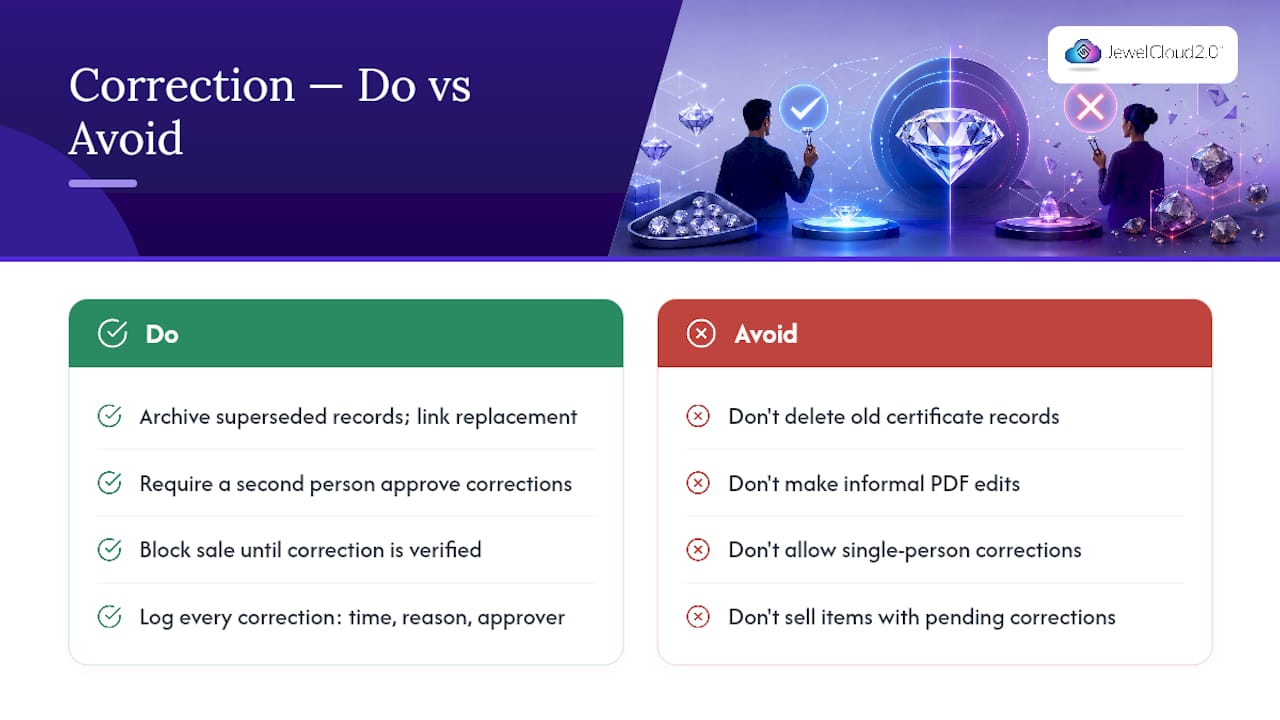
Certificate data changes more often than dealers expect. A stone gets recut and requires a new report, a lab issues a corrected grading, or a data entry error surfaces during an audit. The correction process needs the same discipline as the original intake, not an informal edit to a PDF.
When a lab reissues a report, the old certificate record should be archived, not deleted, with a clear flag marking it superseded and a link to the replacement. Deleting old records erases the audit trail a buyer or auditor might need later to understand why a stone’s documentation changed.
Any manual correction, such as fixing a typo in carat weight or a misfiled lot ID, should require a second person’s approval before it goes live. This single rule catches most transcription errors before they reach a customer invoice or product listing.
Set a standard turnaround for corrections tied to your sales cycle. A stone with a pending correction shouldn’t sell until the fix is verified against the physical lab report, even if that means pulling a listing temporarily. Log every correction with a timestamp, the reason for the change, and who approved it. That log becomes the single source of truth if a customer or partner questions a certificate’s history months after the sale.
Build a monthly reconciliation habit where someone cross-checks a sample of certificate records against physical reports still on hand. This catches drift between what the system says and what’s actually true, before it becomes a compliance problem or a customer complaint.
Managing Physical Certificates Alongside Digital Records
Most dealers still hold physical lab reports for a portion of their inventory, and that isn’t going away soon. The goal isn’t eliminating paper. It’s making sure the physical and digital versions never contradict each other.
Every physical certificate should get scanned and uploaded the same day it arrives, tied immediately to its lot ID. Waiting creates a window where a stone sits in inventory with no digital trace, which is exactly when reports go missing or get filed under the wrong lot.
Store physical certificates in a locked, fireproof location separate from general paperwork, ideally organized by the same lot ID scheme used digitally. When a stone sells or ships on memo, the physical certificate should travel with a printed copy while the digital record stays behind as the permanent reference. Never let the only copy of a report leave your building with a stone.

For high-value stones or those with GIA Diamond Origin Reports, consider keeping the physical document in a safe deposit arrangement while the digital scan handles daily operational needs. This split protects against loss or damage without slowing down day-to-day verification.
Reconcile physical and digital inventories on a set schedule, monthly for high-turnover categories, quarterly for slower-moving stock. A mismatch between what’s in the safe and what the system says is often the first sign of a filing error, not fraud, but it needs to get caught early either way.
Disaster Recovery and Backup for Certificate Data
A single server failure or a flooded storage room shouldn’t be able to erase your entire certificate history. Backup strategy for certificate data needs the same seriousness as backup strategy for financial records, because functionally, that’s what these documents are.
Follow a three-copy standard: the primary digital record in your inventory system, an automated cloud backup, and a periodic offline or cold storage export. Cloud backups should run daily at minimum, not weekly, given how often new certificates get added or existing ones corrected.
Test your recovery process at least twice a year by actually restoring a sample of records from backup, not just confirming the backup file exists. A backup nobody has tested is a backup nobody can trust when it actually matters.
For physical certificates, disaster recovery means fireproof, waterproof storage at minimum, and ideally an offsite duplicate of your digital scans in case the primary location is compromised. Insurance carriers increasingly ask for proof of documented backup procedures when underwriting high-value diamond inventory, so having a written policy isn’t just an internal best practice.
Assign one person ownership of the backup schedule and recovery testing. When responsibility is shared across a team, it tends to fall through the cracks the first time everyone assumes someone else handled it.
Training Staff on Certificate Protocols
A well-designed system fails the moment someone skips a step because they weren’t shown why it mattered. Training needs to cover the reasoning behind each rule, not just the click-by-click process.
New hires should learn the metadata schema first: what stock ID, lot ID, and report number mean, and why a mismatch between the certificate and the physical stone stops a sale rather than getting waved through. Pair this with a short review of the disclosure requirements under the FTC Guides so staff understand that treatment flags aren’t optional paperwork. They’re a legal disclosure obligation.
Run a hands-on session covering the actual workflows: how to attach a certificate to a memo record, how to pull data through a lab integration, and what to do when a report number doesn’t match on the first check. Reading a policy document rarely sticks the way walking through a live example does.
Refresh training whenever a lab integration changes or a new disclosure requirement gets published, and build in a quarterly spot check where a manager reviews a handful of recent certificate uploads for completeness. Staff turnover is the biggest threat to consistency here. A system is only as reliable as the last person who touched it, so document every protocol somewhere more permanent than institutional memory.
Author Perspective: Start With This 30 to 60 Day Pilot
Pick one inventory slice, standardize its metadata, connect a single lab sync, and publish it to one feed. Track time-to-serve-certificate and mismatch rate. If both improve, expand. If neither moves, your metadata schema needs fixing before your tooling does.
— Anthony
Put Your Certificate System on JewelCloud
Spreadsheets and shared drives get diamond dealers through the early years, but they buckle the moment inventory scales past a few hundred lots. The advantage lies in structural features: certificate fields, lot IDs, and 4Cs integrated into standardized product data tailored to jewelry’s complexity rather than generic e-commerce templates.

If you’re a diamond dealer or supplier ready to move off manual certificate tracking, DiamondLink® handles lot-level integration so certificate data syncs automatically with retailer feeds instead of getting re-entered for every partner. Pair that with the JewelCloud® Product Feed to push verified certificate fields straight to product pages across your retail network. Suppliers who want full platform access can review the Vendor Membership - Silver plan at a monthly membership fee, or reach out through the Gold membership page for pricing tailored to larger catalogs. Start with a small pilot lot, connect one lab integration, and see how much manual work disappears.
Sources
- IGI — Blockchain-Based Digital Diamond Certificate (DDC)
- GIA — Diamond Origin Report service
- SCS Standards — SCS-007 Sustainably Produced Gemstones
- Lims
FAQ
What Are the Top Diamond Certifications?
The most recognized diamond grading reports come from GIA, IGI, AGS, HRD, and GCAL, each grading the 4Cs against its own lab standards. GIA and IGI are the two most widely accepted in the U.S. wholesale and retail trade, with IGI also offering blockchain-backed digital certificates for instant verification.
How Much Does a Diamond Certificate Cost?
Certificate costs vary by lab, carat weight, and report type, and current pricing is best confirmed directly with the issuing lab since fees change over time. A GIA Diamond Origin Report typically costs more than a standard grading report because it requires rough-stage analysis and supporting documentation.
What Is the Most Trusted Diamond Certification?
GIA is generally regarded as the most trusted grading lab in the U.S. trade due to its long-standing consistency and strict internal standards, with IGI a close second for volume and blockchain-verified digital certificates. Trust ultimately depends on consistent grading standards and how easily a dealer or buyer can verify the report against the physical stone.
Which Certification Is Best for Diamonds Sold Online?
For online and B2B sales, a certificate paired with a verification link or QR code, like IGI’s DDC, tends to work best because buyers can confirm authenticity without handling the physical stone. Structured certificate data through a platform like JewelCloud’s product feed also makes it easier to display verified grading details directly on product pages.
How Do I Verify a Diamond Certificate Is Authentic?
Check the report number directly on the issuing lab’s website, GIA or IGI both offer free online report lookups, and confirm the grading details match the physical stone’s girdle inscription. Digital certificates linked by QR code, as used by IGI’s DDC and De Beers’ Tracr™ platform, let you skip the manual lookup entirely.