


A diamond search engine, in the B2B sense, is a system that indexes suppliers’ live product feeds, structured attributes, and certification data so retailers, dealers, and brands can find, filter, and syndicate certified diamonds without ever picking up the phone. It’s built for sourcing, not shopping.
You benefit from this if you:
- Source diamonds wholesale for a retail storefront or bridal counter
- Manage inventory across multiple supplier relationships
- Need to syndicate stones onto Shopify, WooCommerce, or a custom site fast
The payoff is straightforward: faster sourcing, fewer returns caused by mismatched specs, and better odds of showing up when an AI shopping agent goes looking for a diamond with typical attributes like carat size, clarity, and certification.
Key Takeaways
A diamond search engine only works when supplier feeds carry structured, certified, machine-readable attributes that both retailers and AI agents can filter reliably.
| Point | Details |
|---|---|
| Definition stays B2B | A diamond search engine indexes supplier feeds for wholesale discovery, not consumer shopping. |
| Attributes drive results | Carat, cut, color, clarity, certification number, and lab-grown flags must exist as structured fields. |
| Controlled vocabularies fix filters | Enumerated values for size, purity, and treatment prevent mismatched search results. |
| Sync cadence prevents oversells | Near-real-time updates and conflict resolution keep availability accurate across channels. |
| JewelCloud runs the full pipeline | DiamondLink® and the JewelCloud Product Feed handle ingestion, syndication, and storefront sync for suppliers and retailers. |
Table of Contents
- How Does a Diamond Search Engine Differ From a Consumer Marketplace?
- What Attributes Does a Diamond Search Engine Need to Work?
- How Does the Search Engine Connect to Retailer Platforms?
- What Should Be on Your Diamond Data Implementation Checklist?
- What ROI Does Structured Diamond Data Actually Deliver?
- How Does JewelCloud Handle Diamond Feeds and Vendor Onboarding?
- Frequently Asked Questions
- Sources
How Does a Diamond Search Engine Differ From a Consumer Marketplace?
A data-first diamond search engine reads structured feeds. It doesn’t crawl retail pages and guess at specs the way a consumer comparison tool might. Suppliers push their inventory through a Product Information Management (PIM) export, a scheduled file transfer, or a direct API connection, and the engine ingests fields like carat weight, certificate number, and lab-grown status as structured data rather than scraped text.
That distinction matters for anyone buying wholesale. You’re not filtering marketing copy. You’re filtering machine-readable attributes tied to a real certificate and a real supplier account.
Three things separate this from a shopper-facing tool:
- It indexes live inventory feeds, not static product pages, so stock status stays current
- It supports certificate numbers, lab-grown flags, and machine-readable size ranges as searchable fields, not free text buried in a description
- It surfaces through multiple channels: a search UI for your team, an API for syndication, storefront apps, and ring-builder tools your customers touch directly
What Attributes Does a Diamond Search Engine Need to Work?
Search only performs as well as the data behind it. If a supplier feed is missing half its attributes, your filters return junk, and so does any AI agent trying to match a customer request to your inventory.
The product-data gap across jewelry and watch catalogs is well documented: missing metal purity, absent certification numbers, and vague sizing fields all suppress discovery, whether the searcher is a human buyer or an algorithm parsing your feed. A title that reads “14K Gold Earrings” tells a search index almost nothing; a title enriched with metal purity, gemstone, total carat weight, and setting type gives it something to actually match against.
Here’s the attribute list that separates a searchable diamond record from a dead one:
- Stone fundamentals: carat, cut, color, clarity, and precise measurements
- Certification data: issuing lab (GIA, AGS, IGI), certificate number, and a link to the certificate PDF
- Origin and treatment: natural vs. lab-grown flag, any treatment disclosure, fluorescence grade
- Commerce fields: SKU, price, live availability, setting status (loose vs. mounted), metal type and purity
- Visual proof: high-resolution images, ideally multiple angles and a certificate scan
Pro Tip: Don’t let “size” stay a free-text field. Model it as a controlled enumeration or range, the same way you’d standardize metal purity. A search engine can’t filter what it can’t parse.
Controlled vocabularies matter as much as the fields themselves. If one supplier writes “lab created” and another writes “man-made,” your index treats those as two different attributes unless they’re normalized into a single enumerated value. Enumerations, not free text, are what let a filter actually filter.
How Does the Search Engine Connect to Retailer Platforms?
Getting a diamond from a supplier’s warehouse into your storefront filter involves a few concrete handoffs. Understanding them helps you spot where data quality breaks down.
- Ingestion: Feeds arrive as CSV or XML exports, through a PIM connector, or via direct API push. Each method carries different latency, so a supplier on a nightly CSV export won’t reflect intraday stock changes the way an API push does.
- Validation and enrichment: Before anything gets indexed, incoming fields get mapped to a standard schema and enumerated values get normalized. This is where “lab created” and “man-made” become one value instead of two.
- Consumption: Retailers pull results through storefront search and filter UIs, a ring-builder tool, or an API that syndicates approved inventory straight into Shopify or WooCommerce.
- Ongoing operations: Sync frequency, price mapping, and backorder handling all need rules. Near-real-time multi-channel sync with clear conflict resolution is what keeps a stone from showing “available” on your site after it sold somewhere else an hour earlier.
Get the ingestion and validation steps wrong, and everything downstream, your filters, your ring builder, your syndicated feed, inherits the error.
What Should Be on Your Diamond Data Implementation Checklist?
Most data quality problems trace back to a handful of decisions made (or skipped) at setup. Fix these before you go live, not after a buyer complains about a mismatched cert.
- Adopt controlled vocabularies for metal purity, gemstone treatment, and certifying lab, no free text where an enumeration will do
- Model ring sizes and chain lengths as machine-readable ranges or variant groups instead of a description field
- Attach the certificate number to every stone record and link directly to the certificate PDF
- Normalize lab-grown flags and treatment disclosures across every supplier feed, not just your largest one
- Automate feed validation and error reporting so a broken supplier export gets flagged, not silently indexed
- Set a sync cadence that matches how fast your inventory actually moves, and test conflict resolution before launch
Pro Tip: Run a handful of realistic queries, “1.2ct round, VS clarity, GIA certified, lab-grown,” through your search before launch. If an AI shopping agent or a floor associate can’t get a clean result on that query, a real customer won’t either.
Retailers who map supplier fields into shoppable collections early tend to skip months of after-the-fact cleanup.
What ROI Does Structured Diamond Data Actually Deliver?
Structured feeds convert better, and not by a small margin conceptually, by category. When metal purity, certification numbers, and size ranges exist as searchable fields instead of buried prose, both AI shopping agents and human buyers can actually match your inventory to a request.
Standardized, machine-readable catalog data converts meaningfully better for AI-driven discovery than scraped or prose-heavy listings, and brands that structure their feeds show up more often in AI agent recommendations.
The operational upside compounds from there. Fewer returns happen when certification and sizing data match reality instead of a vague description. Sourcing gets faster once buyers can filter your catalog instead of emailing for a quote sheet. Margin control improves when pricing and availability stay synced instead of drifting between systems.
How Does JewelCloud Handle Diamond Feeds and Vendor Onboarding?
Jewelcloud built its platform around the same problem this article has been walking through: diamond data only works when it’s structured, standardized, and kept current across every retailer touchpoint. Suppliers load inventory once, and that data becomes searchable, filterable, and syndicated wherever a retail partner needs it.
Here’s what’s live today:
- DiamondLink®, a purpose-built tool for connecting diamond inventory into retailer search and filter experiences
- A structured product feed with a Shopify app that automates syncing curated jewelry data into storefronts
- Vendor sign-up paths for suppliers who want distribution without building their own retailer network from scratch
- Presence at trade events like JCK 2026, where the vendor and product-feed tools get demonstrated directly
| What you get | Where it lives |
|---|---|
| Diamond search and syndication | DiamondLink® |
| Automated storefront sync | JewelCloud Product Feed (Shopify app) |
| Supplier onboarding | Diamond Vendor Sign Up |
| Retailer and manufacturer resources | JewelCloud for Retailers, Vendors, Manufacturers and Trade Organizations |
An editorial note on what to fix first
Every catalog cleanup I’ve watched unfold in this industry starts with good intentions and stalls on the same detail: nobody standardized the size field before launch. Fix cert numbers and size ranges before anything else, everything downstream, filters, syndication, AI discovery, depends on those two fields being clean. The vendor sign-up and product-feed pages are the fastest way to see what a corrected version of your catalog could look like.
Ready to Test Your Diamond Feed?
If your diamond inventory currently lives in spreadsheets your sales team emails on request, that’s the exact gap a structured feed closes, no more manual quote sheets, no more waiting on a supplier callback to confirm a stone is still available.
Before you sign up, gather three things: a current catalog export (CSV or your PIM’s native format), a sample set of certificates for a handful of stones, and a list of the storefront platforms you sell through. With those in hand, the Diamond Vendor Sign Up process maps your fields against JewelCloud’s schema, and the Jewelry Vendor Benefits page walks through what distribution looks like once your feed goes live. Suppliers who want a fully custom storefront to go with it can also look at Vendor Web Design. Start with the vendor sign-up form, and you’ll know within days whether your current catalog is ready for syndication or needs a cleanup pass first.
Frequently Asked Questions
What makes a diamond search engine different from a general jewelry search tool? A diamond search engine indexes stone-specific attributes, carat, cut, clarity, color, certification number, that a general jewelry search tool may not capture in structured form. Diamonds carry more granular grading data than most other jewelry categories, so the schema needs dedicated fields.
Can small retailers use a diamond search engine, or is it built for large dealers only? Structured feeds scale down as easily as up. A retailer with a handful of supplier relationships benefits from the same standardized attributes as a large dealer managing dozens, since the value comes from data quality, not catalog size.
Does a diamond search engine replace a POS or inventory system? No. It sits alongside your point-of-sale and inventory tools, pulling supplier data in and syndicating approved inventory out to your storefront, ring builder, or API connections rather than replacing back-office systems.
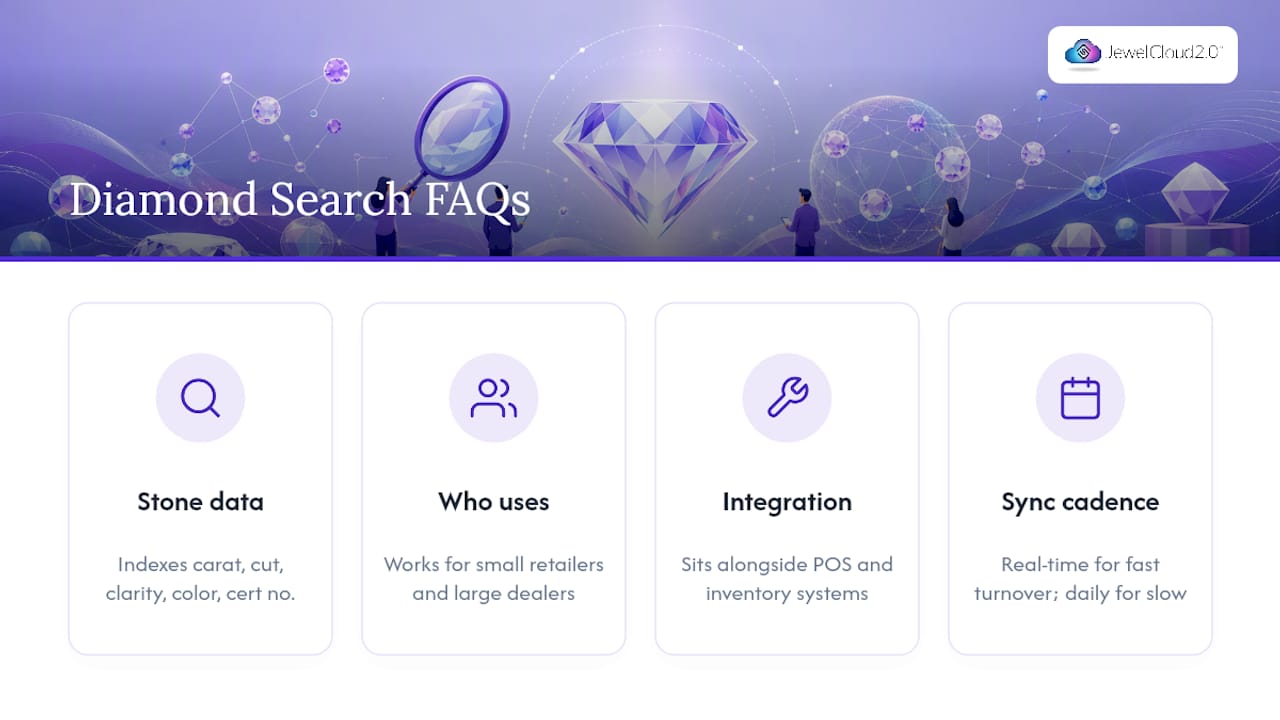
How often should diamond inventory feeds sync? Sync frequency should match how fast your inventory actually turns over. High-velocity categories need closer to real-time updates, while slower-moving specialty stones can tolerate a daily batch sync without much risk of overselling.
Sources
- Jewelry & Watches brands have a product-data problem — and 2026 is when it costs sales