


For U.S. diamond suppliers and wholesalers, the fastest path to digitized inventory and B2B distribution is a supplier-focused platform that combines structured product data, memo/consignment controls, and live marketplace integrations. Jewelcloud, with its DiamondLink® feature set, fits that profile directly. Marketplace connections to RapNet, Nivoda, and VDB, combined with GIA certification support and B2B customer portals, are the decisive factors separating purpose-built diamond supplier software from generic ERP tools.
Your immediate next steps:
- Request a live demo and ask the vendor to show a working RapNet, Nivoda, or VDB feed in real time.
- Ask for a sample data feed with full certificate fields (GIA number, carat, cut, color, clarity, images).
- Request a written migration timeline with milestones and a named contact responsible for your data.
Pro Tip: Before your first demo call, export your current inventory to CSV and count how many stones have complete 4Cs data and GIA certificate numbers. That number tells you exactly how much data cleanup you face before any migration can begin.
Table of Contents
- What does diamond supplier software actually do?
- Feature checklist every diamond supplier needs
- What marketplace integrations should you demand?
- How do cloud deployment and data migration actually work?
- What security controls should your vendor provide?
- How do you evaluate vendors and spot red flags?
- Why Jewelcloud fits U.S. diamond suppliers
- What does diamond supplier software cost, and how long does it take?
- How do you verify vendor claims before you commit?
- Key Takeaways
- The gap between a demo and a working integration
- Jewelcloud makes it straightforward to get your diamonds in front of buyers
- Useful sources and integrations to verify
What does diamond supplier software actually do?
Specialized diamond supplier software centralizes multi-location inventory tracking, automates memo/consignment workflows, and integrates with marketplaces like RapNet, Nivoda, and VDB to keep inventory synchronized. That is the core promise, and it is a meaningful departure from running your operation on spreadsheets or a generic ERP.
The functional areas that matter most to suppliers:
- Multi-warehouse inventory: Track every stone across locations with serialized records, 4Cs attributes, measurements, and certificate links.
- Memo/consignment lifecycle: Issue, track, and close memos automatically, with alerts when stones are overdue or at risk of oversell.
- Certification data: Store GIA, IGI, and other lab certificate numbers, PDFs, and grading fields directly against each stone record.
- Quoting and price-per-carat: Generate quotes tied to live Rapaport price feeds and convert them to invoices without re-entering data.
- B2B customer portals: Wholesale jewelry software vendors emphasize portals that let retailers place orders 24/7, turning your back-office system into a proactive sales engine.
- Marketplace-ready feeds: Publish structured data to RapNet, Nivoda, and VDB with the fields those platforms require.
The business outcomes are concrete. Reduced stock exposure comes from real-time memo visibility. Faster order fulfillment follows from automated quote-to-invoice conversion. Marketplace sell-through improves when your feed is clean, complete, and updated continuously. The move from general-purpose ERPs to specialized diamond software stems from the complexity of diamond grading and memo management. The major benefit is consolidating financial exposure and stock status in a single view.
Pro Tip: Prioritize systems that provide RapNet, Nivoda, and VDB-ready data structures out of the box. Retrofitting a generic ERP to output the correct certificate fields and price-per-carat format is expensive and error-prone.

Feature checklist every diamond supplier needs

Not every platform advertises its gaps. Use this checklist as a scorecard during vendor demos, and map each answer to the comparison table below.
Inventory and stone records:
- 4Cs attributes (carat, cut, color, clarity), measurements, and fluorescence
- Serialized stone records with unique IDs
- GIA, IGI, and GCAL certificate number fields and PDF storage
- Photo and video attachment per stone
- Barcode and QR code support for physical handling
Memo and consignment:
- Full memo lifecycle: issue, track, extend, close, and return
- Automated overdue alerts and financial exposure reports
- Aging reports by customer and stone value
Sales and operations:
- Multi-currency support and Rapaport price feed integration
- Automated quote-to-invoice conversion
- Returns and repairs tracking
- Reconciliation reports for accounting integration
Sales enablement:
- B2B customer portal with 24/7 ordering
- API and CSV feed export for marketplace distribution
- Ring-builder or mounting catalog integration to create fully purchasable SKUs
| Dimension | What to expect from a strong vendor |
|---|---|
| Core feature coverage | Full 4Cs, cert fields, memo lifecycle, aging, and multi-location sync |
| Marketplace integrations | Native RapNet, Nivoda, and VDB feeds; no manual CSV uploads required |
| Deployment & hosting | SaaS/cloud with documented uptime SLA; on-prem option if required |
| Data migration speed | Structured import from Excel/CSV; full migration in 2–8 weeks |
| Pricing model | Transparent subscription plus setup fee; no hidden per-listing charges |
| Support & SLA | Named support contact, documented response times, and backup policy |
| B2B portal features | Retailer login, live inventory browse, quote request, and order placement |
What marketplace integrations should you demand?
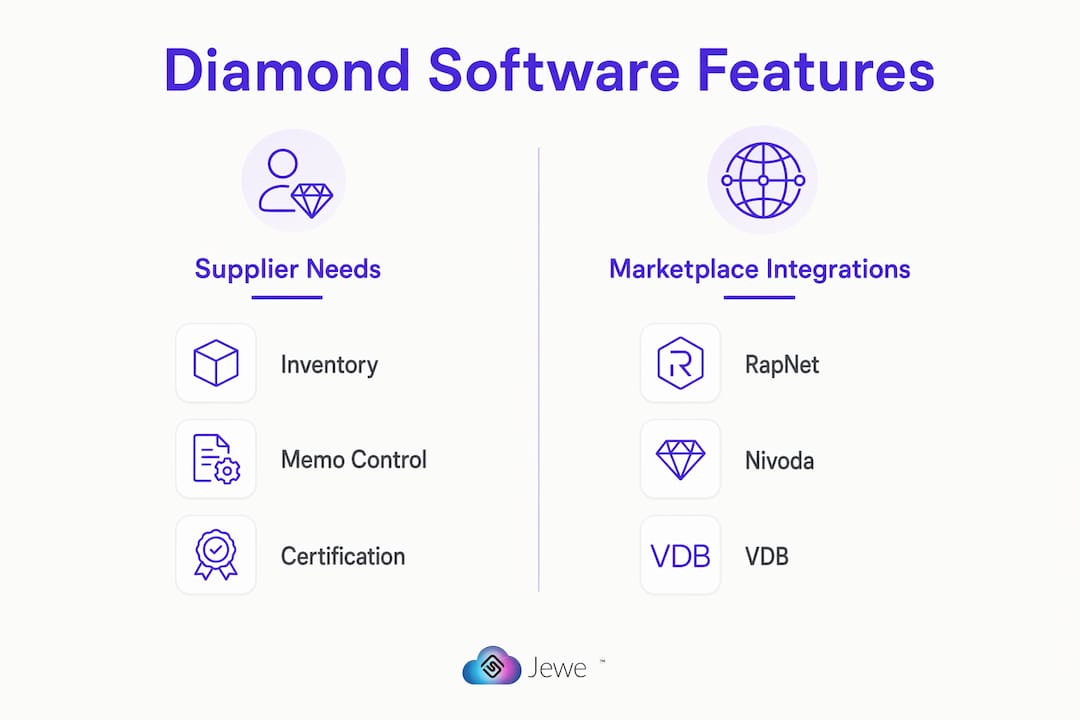
Connecting to Nivoda, VDB, and RapNet lets retailers browse real, purchasable stones with certificate data, price-per-carat sync, and availability updated continuously. Marketplace integration is now a prerequisite for competitiveness. Connecting to these networks shifts suppliers from holding physical stock to serving real-time, data-driven distribution.
Integration types to verify:
- GraphQL or REST APIs (Nivoda’s GraphQL API provides real-time access to diamond availability, pricing, and specification fields)
- CSV or FTP feeds for platforms that do not support live APIs
- Middleware connectors for Shopify, WooCommerce, and Magento storefronts
- Bespoke supplier API connections for custom retail partners
Fields that must sync correctly:
- Carat, cut, color, clarity, and measurements
- Certificate body and number (GIA, IGI, GCAL)
- Price-per-carat and total price
- Images, video links, and availability status
What to ask during demos:
- Show me a live feed to RapNet, Nivoda, or VDB right now.
- How often does availability sync, and what happens when a stone sells on one channel?
- What monitoring or alerts exist when a feed fails or a schema changes?
- Can I see rollback controls for price or availability mismatches?
API integrations require ongoing maintenance. Feed schema changes and internal attribute updates mean a technical owner should monitor syncs to prevent customer-facing oversells. That is not a warning to avoid integrations; it is a reason to confirm the vendor provides feed monitoring tools and that you assign an internal owner.
Pro Tip: Ask every vendor for a sample feed file before the demo ends. A vendor who cannot produce one in 24 hours likely does not have a production-ready integration.
How do cloud deployment and data migration actually work?
Deployment choices and trade-offs:
- SaaS/cloud (multi-tenant): Lowest maintenance burden, automatic updates, and accessible from any location. The right choice for most U.S. suppliers.
- Private cloud: More control over data residency and access, at higher cost. Suitable for larger operations with compliance requirements.
- On-premise: Full control, but you own patching, backups, and uptime. Rarely the right fit for a supplier without a dedicated IT team.
Migration steps in order:
- Export current inventory data (Excel, CSV, or SQL backup) and audit for completeness.
- Clean 4Cs data and add missing certificate numbers before import.
- Map memo history: open memos, outstanding balances, and customer relationships.
- Link certificate records (GIA numbers) to stone records in the new system.
- Migrate images and video files to the new platform’s storage.
- Run a test sync to RapNet, Nivoda, or VDB and validate feed output.
- Complete user acceptance testing (UAT) with your team before going live.
- Train staff on memo workflows, feed monitoring, and reporting.
Some vendors advertise immediate implementation, but practitioners recommend prioritizing the mapping of memo history and vendor/customer master data before go-live to preserve business continuity. Fast transitions (as short as one business day) are possible for limited data sets, but full migrations typically run 2–8 weeks depending on data history and customizations.
Migration timeline callout: Data cleaning and memo mapping drive most delays. Suppliers who complete their inventory audit before the vendor kickoff call consistently reach go-live faster.
Pro Tip: Map your memo history and vendor/customer master data before you sign a contract. If a vendor cannot tell you how they will handle open memos at cutover, that is a gap in their onboarding process.
What security controls should your vendor provide?
High-value diamond inventory and pricing data require more than a cloud login. Enterprise-grade diamond platforms include encrypted cloud infrastructure, role-based permissions, automated backups, and audit trails to protect inventory and price data.
Minimum security features to require:
- Role-based access control (RBAC) so staff see only what their role requires
- Encrypted storage and data in transit (TLS)
- Multi-factor authentication (MFA) for all user logins
- Automated daily backups with documented retention periods
- Audit trails for every memo change, price update, and stone movement
Operational security practices:
- Feed monitoring with alerts when a sync fails or a field value falls outside expected ranges
- Secure certificate and document storage (GIA PDFs or verified links)
- Reconciliation reports to catch duplicate records and prevent oversells
Contractual items to negotiate before signing:
- Written uptime SLA with a defined percentage and remedies for downtime
- Backup retention policy (minimum 30 days is a reasonable baseline to request)
- Incident response process and notification timeline
- Data ownership and portability clauses so you can export your data at any time
Pro Tip: Request the vendor’s security documentation in writing before your final evaluation meeting. A vendor who hesitates to share hosting details, encryption standards, or backup cadence is telling you something important.
How do you evaluate vendors and spot red flags?
A structured evaluation process saves you from a costly switch 18 months after go-live. Work through this sequence:
- Build your scorecard using the comparison dimensions from the feature checklist table above.
- Schedule live demos with 2–3 vendors and require a working marketplace feed in each session.
- Ask for reference customers in the same role (wholesaler or supplier) and contact at least one.
- Run a sandbox pilot with a small subset of your real inventory for two weeks.
- Review the contract for SLA terms, data portability, and total cost of ownership before signing.
Questions to ask in every demo:
- Walk me through a complete memo lifecycle from issuance to close.
- Show me a reconciliation report between your system and our accounting software.
- What happens to my data if I cancel my subscription?
- Who is my named support contact, and what is your response time SLA?
Red flags that should stop your evaluation:
- Opaque or bundled pricing with no itemized breakdown
- No sample feed available during or after the demo
- Memo tracking is manual or handled outside the core system
- GIA certificate number is not a native field in stone records
- Audit trails are absent or cannot be exported
- The vendor cannot name a reference customer in a similar role
Why Jewelcloud fits U.S. diamond suppliers
Jewelcloud is built for exactly the distribution challenge U.S. diamond suppliers face: getting certified stone data in front of qualified retail buyers without requiring physical stock transfers. The DiamondLink® feature is the core of that capability, providing a structured digital diamond inventory that is marketplace-ready and retailer-accessible.
What Jewelcloud provides for suppliers:
- DiamondLink® for digital diamond inventory with structured, standardized product data
- B2B portals that give retail partners 24/7 access to your catalog, pricing, and availability
- Ring-builder and setting-catalog integration to create complete, purchasable SKUs
- Shopify, WooCommerce, and Magento plugins for retailer storefronts
- Structured data feeds formatted for RapNet, Nivoda, and VDB-ready distribution
- Custom B2B website design for suppliers who need a bespoke digital storefront
Business benefits for U.S. suppliers:
- Faster assortment expansion for retail partners without physical consignment risk
- Improved retailer access to GIA-certified stone data with full grading fields
- Reduced physical stock requirements through digital showcase and drop-ship models
- Stronger retailer relationships through a professional, data-rich B2B portal
What to request in your Jewelcloud demo:
- A sample DiamondLink® feed showing certificate fields, 4Cs data, and availability status
- A case study or reference from a U.S. diamond supplier or wholesaler
- A migration plan with a timeline, milestones, and named responsibilities
Pro Tip: Ask Jewelcloud to show you how a retailer on their network sees your DiamondLink® inventory. The retailer experience is your sales pitch. If it looks polished and the data is complete, your stones get considered. If it looks sparse, they move on.
What does diamond supplier software cost, and how long does it take?
Pricing in this category is not standardized, and vendors rarely publish full cost structures. Understanding the shape of costs helps you ask the right questions.
Common pricing models:
- SaaS subscription: Monthly or annual fee covering core platform access. Entry-level tiers typically cover basic inventory and feed access; higher tiers add integrations and portal features.
- Setup and integration fees: One-time charges for data migration, marketplace integration configuration, and custom field mapping.
- Per-listing or per-transaction fees: Some marketplace-adjacent platforms charge per stone listed or per order processed.
- Customization charges: Bespoke API integrations, custom reporting, or ring-builder catalog setup carry additional project fees.
| Implementation tier | Typical scope | Estimated timeline |
|---|---|---|
| Proof of concept | Limited inventory, basic feed test | 1–2 weeks |
| Standard migration | Full inventory, memo history, 1–2 integrations | 2–8 weeks |
| Enterprise rollout | Multi-location, custom integrations, full UAT | 2–8 weeks |
Always ask vendors for a total cost of ownership (TCO) estimate that includes subscription, setup, integration, training, and first-year support. The subscription line is rarely the largest cost for a supplier with complex memo history or multiple marketplace integrations.
Timeline callout: The tasks that drive schedule overruns are memo history mapping, certificate linking, feed validation, and staff training. Budget time for each explicitly in your project plan.
How do you verify vendor claims before you commit?
Vendor claims during demos are marketing. Verification is your job. Here is how to do it systematically:
Proof to request from every vendor:
- Written reference from a U.S. wholesaler or supplier using the platform today
- Sample RapNet, Nivoda, or VDB feed file with real certificate fields populated
- Security documentation: hosting provider, encryption standard, and backup cadence
- Written SLA with uptime percentage and incident response timeline
- A sandbox account with a small subset of your real inventory loaded
Verification steps in order:
- Contact the reference customer directly and ask about memo tracking accuracy and feed reliability.
- Open the sample feed and confirm GIA certificate numbers, 4Cs fields, and image links are present.
- Review the security documentation against your minimum requirements from the checklist above.
- Read the SLA and data portability clauses in the contract before signing.
- Run a two-week sandbox pilot and track how many sync errors or data mismatches occur.
Feed formats must preserve certificate metadata — certificate body, number, and full grading fields — so integrations to RapNet, VDB, and Nivoda remain useful to retail buyers. A feed missing those fields is not a working integration; it is a placeholder.
Pro Tip: During your sandbox pilot, intentionally update a stone’s price and availability and then check how quickly the change appears in the marketplace feed. That latency number tells you more about the integration than any demo slide.
Key Takeaways
The right diamond supplier software combines marketplace integrations (RapNet, Nivoda, VDB), memo/consignment controls, and GIA certification support — and Jewelcloud’s DiamondLink® delivers that combination for U.S. suppliers ready to digitize their distribution.
| Point | Details |
|---|---|
| Marketplace integrations are non-negotiable | Demand live RapNet, Nivoda, and VDB feeds in every demo; a sample file is the minimum proof. |
| Memo controls protect your financial exposure | Full memo lifecycle tracking with automated alerts prevents oversells and relationship friction. |
| Migration planning drives go-live speed | Clean your 4Cs data and map memo history before the vendor kickoff to hit the 2–8 week window. |
| Security requires more than a cloud login | Require RBAC, encrypted backups, audit trails, and a written SLA before signing any contract. |
| Jewelcloud DiamondLink® fits U.S. suppliers | DiamondLink® provides structured, marketplace-ready diamond data with B2B portals and retailer access. |
The gap between a demo and a working integration
Most suppliers who switch diamond software do so because their first choice looked good in a demo and fell apart in production. The pattern is consistent: the vendor showed a polished interface, the migration took longer than promised, and the marketplace feed had gaps that only surfaced after go-live.
The fix is not to distrust vendors. It is to shift your evaluation from features to evidence. A vendor who can show you a live feed, hand you a reference contact, and give you a sandbox account in the same week as your demo is telling you something real about their operational maturity. A vendor who asks for three more weeks to “prepare the demo environment” is telling you something too.
Jewelcloud’s approach—centering on structured product data through DiamondLink® and a B2B network that retail partners already use—addresses the distribution problem directly rather than wrapping it in a generic ERP. For U.S. suppliers who need their certified stone data in front of qualified buyers quickly, that focus matters. The question to ask yourself after every demo is simple: did I see my data, in the marketplace, working? If the answer is no, keep looking.
Jewelcloud makes it straightforward to get your diamonds in front of buyers
If you are a U.S. diamond supplier ready to move beyond spreadsheets and disconnected feeds, Jewelcloud gives you a direct path. DiamondLink® structures your inventory data for marketplace distribution, your diamond vendor benefits include B2B portal access for retail partners, and the platform supports the integrations your buyers already rely on. You do not need a six-month implementation to see results. Suppliers on Jewelcloud can get their catalog in front of qualified retail jewelers faster than a traditional ERP rollout allows, without carrying physical stock or managing complex consignment logistics manually.
To get started, visit the Jewelcloud vendor sign-up page and request a tailored demo. Ask for a DiamondLink® sample feed, a migration estimate for your current inventory, and a reference from a supplier in a similar role. That conversation will tell you everything you need to know about whether Jewelcloud is the right fit for your operation.
Useful sources and integrations to verify
When you are evaluating diamond supplier software, these are the resources and platforms worth checking directly.
Certification bodies to verify certificate field support:
- GIA (Gemological Institute of America) — the primary certificate standard most U.S. buyers expect
- IGI (International Gemological Institute) — widely used for lab-grown diamonds
- EGL Laboratories — additional lab reference for grading documentation
- American Gem Society — industry standards and consumer trust benchmarks
Marketplace integrations to verify during demos:
- RapNet — confirm live feed support, price-per-carat sync cadence, and certificate field mapping.
- Nivoda — verify GraphQL API access, real-time availability, and full grading field output.
- VDB — check feed format compatibility, image link support, and availability update frequency.
- GIA certificate verification — confirm the vendor supports direct GIA report number lookup or PDF storage.
Jewelcloud resources for next steps:
- DiamondLink® overview — understand the feed structure and marketplace readiness
- Platform overview for vendors — full capability summary for suppliers and manufacturers
- Vendor membership and pricing — entry point for subscription and onboarding