


A diamond wholesaler website design that works is B2B-first and feed-driven, not a dressed-up retail template. It syncs live inventory, supports secure wholesale ordering with tiered pricing, and puts certification, grading data, and provenance right on the product page. Get those four pieces right and everything else, from SEO to visual polish, has something solid to build on.
TL;DR:
- Wholesale diamond websites must prioritize live inventory sync and tiered pricing, with product listings showing price per carat, certificate, and grading data upfront.
- Technical integrations require real-time API connections to inventory, certificates, and POS systems, with proper error handling and ongoing data quality management.
- The interface for professional buyers should emphasize saved searches, quick quotes, bulk actions, and a checkout process aligned with trade workflows, not consumer standards.
- Trust signals include visible downloadable certificates, clear trade terms, verified partner logos, and account-tier protected net pricing to assure professionalism.
- Visual content must be high-quality, with consistent catalog templates, fast-loading images, and a mix of cinematic landing visuals versus dense search grids to support buyer decision-making.
Table of Contents
- What Should a Diamond Wholesaler Website Design Include?
- What Technical Integrations Does a Wholesale Diamond Website Need?
- How Should the Site Be Designed for Professional Buyers?
- What Trust Signals Do B2B Diamond Buyers Look For?
- How Do You Make a Diamond Site Look as Good as the Product?
- How Long Does a Wholesale Diamond Website Project Take?
- Why a Jewelry-Specialist Platform Changes the Equation
- What Support Should a Wholesale Buyer Expect From Your Site?
- What SEO Strategies Work for Diamond Wholesale Websites?
- What Content Builds Trust With B2B Jewelry Buyers?
- What Security and Compliance Steps Matter Beyond Checkout?
- What Analytics Should Wholesalers Track on Their Site?
- What Do Well-Designed Supplier Sites Look Like?
- What I’d Prioritize First if I Were Building This Site
- Ready to Build a Site Your Retail Partners Trust?
- Sources
- FAQ
What Should a Diamond Wholesaler Website Design Include?
Your catalog structure has to match how diamonds are actually bought and sold, which is different from selling a ring off a shelf. Every listing needs a clear SKU or parcel identifier, carat weight and price displayed before anything else, then the 4Cs (cut, color, clarity, carat), followed by certificate number and lab. Buyers scan for price-per-carat first; bury it under marketing copy and you’ll lose them to a competitor’s spreadsheet.
Progressive filtering matters more here than on a consumer site. A retail buyer might browse; a wholesale buyer is often sourcing against a client order with a tight budget window, so faceted search by shape, carat range, color, clarity, and certificate lab needs to narrow results fast without forcing them through a dozen screens. Design guidance for jewelry sites recommends exactly this kind of progressive filtering paired with high-zoom imagery and rotation video, and both matter even more in a B2B context where the buyer can’t hold the stone.
Your product detail pages need to function as verification tools, not just listings. That means:
- Direct links to certificate lookup (GIA, IGI, or the relevant lab)
- Downloadable grading reports and any provenance documentation
- HD imagery with zoom and, where possible, 360° or rotation video
- Clear net weight, measurements, and treatment disclosures
On the ordering side, tiered pricing by account level, net terms for approved accounts, sample or memo order options, and bulk-add with CSV export are what separate a real wholesale platform from a glorified brochure site.
What Technical Integrations Does a Wholesale Diamond Website Need?
Real-time inventory sync is not optional for diamonds the way it might be for costume jewelry. A single stone sold twice because two systems weren’t talking is a lost retailer relationship and, often, a canceled account. Industry-standard technical requirements for wholesaler sites point to API integrations that connect inventory directly to retailer platforms, point-of-sale systems, and search tools, keeping feeds accurate as stones move in and out of stock.
The integration points that matter most:
- Product feed export to retailer platforms and marketplaces, structured and standardized so attributes map cleanly.
- Diamond digitization links (a service like DiamondLink® handles this) that pull live certificate and imagery data into the feed.
- POS/ERP sync so a sale on one channel updates availability everywhere else within minutes, not hours.
- Marketplace API connections for any third-party trade platforms you distribute through.
Before any of that goes live, run a short technical checklist: confirm authentication method (API key, OAuth), agree on sync cadence, build error handling and alerting for failed feed pushes, keep a change log for schema updates, and assign someone to own ongoing data quality. Skipping this step is how suppliers end up with a beautiful site showing stones that sold three days ago.
How Should the Site Be Designed for Professional Buyers?
Trade buyers don’t browse the way consumers do. They search with intent, often against a client brief, and they expect the interface to keep pace with that urgency. Saved searches, custom collections, and bulk actions aren’t nice extras. They’re baseline expectations for anyone who sources diamonds for a living.
The interface features that actually get used:
- Bulk-add to cart and CSV download of selected stones
- Saved filters tied to a buyer’s account so repeat searches take seconds
- Quick-quote requests that don’t require a full checkout flow
- HD media with rotation video accessible without leaving the results grid
Checkout should follow the trade sequence, not the consumer one: quote request, purchase order confirmation, application of net terms for approved accounts, then invoicing. Forcing a wholesale buyer through a consumer-style credit card checkout is a signal that the site wasn’t built for them.
Pro Tip: Give returning buyers a “reorder from history” option pulling from past purchase orders. Wholesale buying is repetitive by nature, and cutting the search time on repeat orders is one of the fastest ways to increase order frequency.
What Trust Signals Do B2B Diamond Buyers Look For?
Professional buyers verify before they commit, and your product pages need to make that verification effortless. Lab certificates should be visible and downloadable directly from the product page, not buried in a separate documents tab. Grading sheets, video verification where you have it, and a visible certificate number all shorten the distance between “interested” and “ordered.”
Beyond the individual product, trust lives at the company level too:
- Clear shipping insurance and liability terms for high-value stones
- A published sample or memo policy so buyers know the return window before they ask
- Trade terms spelled out (net 30, net 60, deposit requirements) rather than hidden behind a login
- Verified partner or association logos displayed where buyers naturally look, near the footer or an “about” section, without overstating what they represent
Net pricing should sit behind account-tier access, not open to anyone who lands on the page. That protects your margin structure and signals to serious buyers that the pricing they’re seeing is meant for them specifically, which builds the kind of trust architecture professional buyers are already primed to look for before they’ll open an account.
How Do You Make a Diamond Site Look as Good as the Product?
A stone that looks flat in a photo will read as low quality regardless of its actual grade, so visual investment isn’t vanity here. It’s accuracy. High-resolution zoom that shows facet clarity, 360° rotation video, and a curated lookbook section for finished pieces all do more to convey quality than descriptive copy ever will.

Pacing matters as much as the visuals themselves. Reserve cinematic hero content, full-bleed video and large imagery, for landing pages and collection launches. Once a buyer is in search mode, switch to dense, information-rich catalog grids where they can scan carat and price fast. Mixing the two on the same screen slows down the exact buyers you’re trying to convert.
When pages generate programmatically from a product feed, keep a consistent template for typography, spacing, and certificate placement so thousands of auto-generated listings still feel like one brand. Compress images to next-gen formats, lazy-load anything below the fold, and keep Core Web Vitals in check. A visual storytelling approach that’s consistent across every page does more for brand recognition than any single hero image.
How Long Does a Wholesale Diamond Website Project Take?
Most projects follow the same sequence: product information management (PIM) and data cleanup first, then design, integration, quality assurance, and launch. Skipping straight to design before your data is standardized is the single most common reason projects run over schedule.
Realistic timeline ranges, based on scope:
- PIM-first builds with feed integration: roughly 8 to 12 weeks, following the approach outlined for supplier-focused B2B builds.
- Shopify Plus builds with feed integration: roughly 8 to 14 weeks, depending on catalog size and app complexity.
- Heavy custom integrations (multiple ERPs, custom configurators, headless architecture): 12 to 20 weeks or more.
Cost drivers track closely with these phases. Data cleanup scales with how many SKUs you’re standardizing and how messy your current attributes are. Custom configurators like ring builders, headless setups, and the number of retailer integrations you need all add time and budget. Build in contingency for integration work specifically. Third-party APIs change, and a feed that worked in testing can break after a retailer platform update, so ongoing maintenance budget matters as much as the initial build.
Why a Jewelry-Specialist Platform Changes the Equation
Generic e-commerce agencies can build you a pretty site. Few of them understand why a diamond’s price-per-carat needs to lead the listing, or why a broken feed sync means a stone gets sold twice. That gap is exactly what a jewelry-specific platform is built to close.
JewelCloud’s Product Feed structures and standardizes vendor product data so it distributes cleanly to retail partners without manual reformatting on either end. DiamondLink® handles the digitization layer that keeps certificate and imagery data current across every connected retailer. And a build through Websites for Diamond Suppliers applies the B2B catalog, live inventory, and secure ordering features covered above from day one, rather than retrofitting them onto a retail template later.
If you’re evaluating where to start, run an honest audit of your current product data first. Most suppliers find their biggest bottleneck isn’t design at all. It’s inconsistent attributes across SKUs that no feed integration can fix on its own.
What Support Should a Wholesale Buyer Expect From Your Site?
Wholesale relationships run on responsiveness, and your site needs to reflect that or buyers will assume you’re slow everywhere else too. Live chat staffed during business hours handles the quick questions, stock confirmation, a certificate lookup, a shipping timeline, that would otherwise mean an email sitting unanswered for a day.
For accounts placing regular or high-volume orders, a named account manager beats a shared support inbox every time. Retailers sourcing diamonds repeatedly want to know who to call when a client needs a rush order or a specific cut isn’t showing up in search. Publish that contact directly on the account dashboard, not three clicks deep in a help center.
A few support features worth building in from the start:
- Live chat with a real-time inventory lookup, not just a canned response bot
- Dedicated account manager contact info visible on every logged-in page for tiered accounts
- A ticketing system for certificate disputes or shipping issues, with visible status tracking
- Self-service order history so buyers can check a past purchase order without calling anyone
The goal is to reduce the number of reasons a buyer has to leave your site to get an answer. Every question answered inside the platform is one more reason they keep sourcing from you instead of a competitor’s catalog.
What SEO Strategies Work for Diamond Wholesale Websites?
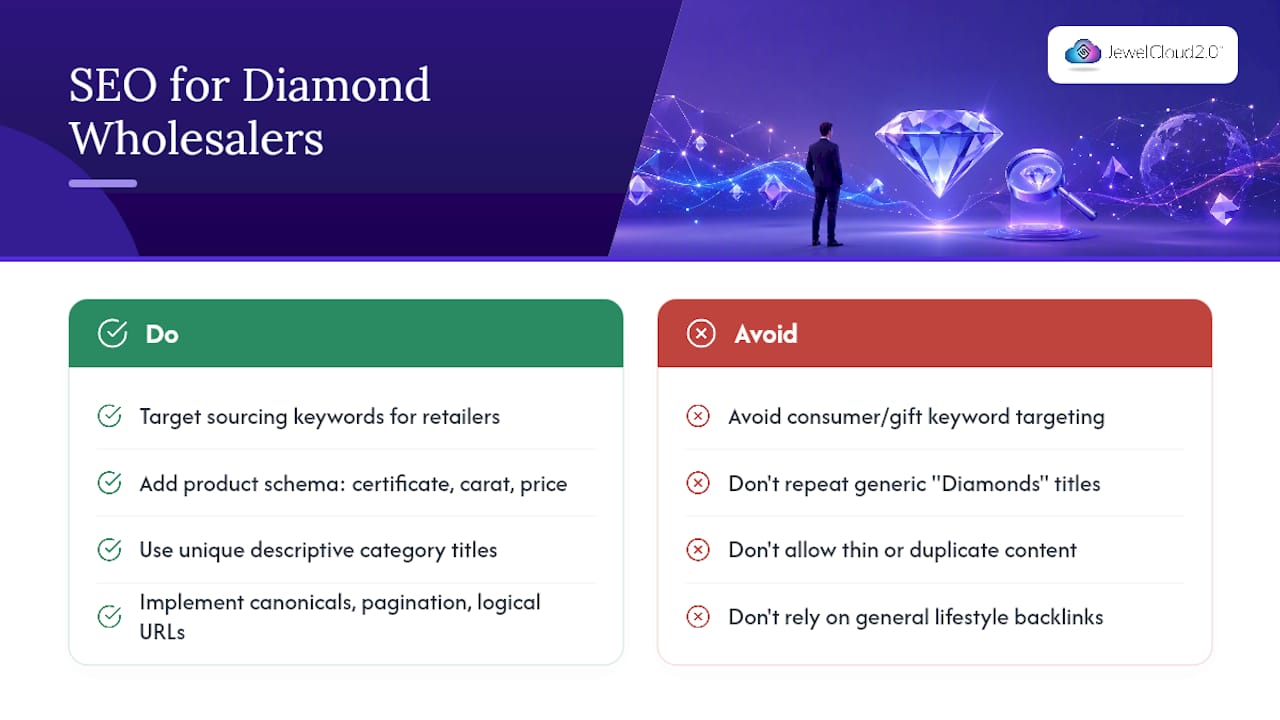
SEO for diamond wholesalers looks different from consumer jewelry SEO because the buyer intent is different. Retailers searching for a diamond supplier are typing phrases like “loose diamond wholesale supplier” or “certified diamond dealer for retailers,” not “engagement ring under $2,000.” Your content and metadata need to speak to sourcing intent, not gift intent.
Structured data matters enormously here. Product schema markup that includes certificate number, carat, and price range helps your listings surface correctly in search results and in any B2B marketplace crawlers that index supplier catalogs. Category and collection pages generated from your product feed should carry unique, descriptive titles rather than generic “Diamonds” tags repeated across hundreds of URLs, since duplicate title patterns are one of the fastest ways to tank organic visibility on a large catalog.
Technical SEO deserves particular attention because wholesale catalogs tend to be huge. Thousands of individual stone pages can create thin-content and duplicate-content problems if templates aren’t built carefully. Canonical tags, clean pagination, and a logical URL structure by shape and carat range all help search engines understand what’s actually unique on each page versus templated.
Link building in this niche works best through trade associations, industry directories, and B2B publications rather than consumer press. A backlink from a jewelry trade association carries far more relevance signal for a wholesaler than a mention on a general lifestyle blog. Pair that with location-specific landing pages if you serve particular regional markets, and you have a foundation that actually matches how retailers search.
What Content Builds Trust With B2B Jewelry Buyers?
Educational content does real work for a wholesaler site beyond ranking in search. A retailer deciding between suppliers is often making that decision based on who seems most knowledgeable, and a content library that explains grading standards, certificate types, and sourcing practices signals expertise before a single sales conversation happens.
Practical topics worth building out:
- Guides explaining the difference between lab certification bodies and what each grading scale actually measures
- Explainers on ethical sourcing practices and how your supply chain documentation works
- Market context content, like how carat price bands shift, that helps retailers price their own inventory confidently
Publishing this kind of content on a regular cadence, tied to actual events in the trade rather than generic filler, does more for long-term authority than any single blog post. A B2B relationship building approach that treats content as part of the partnership, not just a marketing checkbox, tends to earn the kind of retailer loyalty that survives price competition from other suppliers.
What Security and Compliance Steps Matter Beyond Checkout?
Payment security gets most of the attention, but data protection for a wholesale platform extends well past the checkout page. Retailer account data, pricing tiers, order history, and any documents tied to certification all need protection that goes beyond a standard SSL certificate.
Access control is where most gaps show up. Net pricing and account-specific discount tiers should be locked behind authenticated logins with role-based permissions, so a retailer’s junior staff member doesn’t see the same pricing view as the owner. Audit logs tracking who accessed pricing data and when matter for larger accounts, particularly if you’re operating across multiple retail partners with different negotiated terms.
Data handling compliance depends on where your retailers and buyers are located, and rules vary by jurisdiction and by the type of data collected, so it’s worth confirming your specific obligations with a qualified compliance professional rather than assuming one blanket policy covers every account. What you can control directly: encrypt data in transit and at rest, limit third-party integrations to those with clear data handling agreements, and review API access permissions regularly since a stale integration with excessive permissions is a common vulnerability point on B2B platforms that have grown organically over several years.
What Analytics Should Wholesalers Track on Their Site?
Tracking the right metrics on a wholesale site means going past standard e-commerce analytics like page views and bounce rate. Those numbers tell you almost nothing about whether a retailer buyer is close to placing an order or stuck somewhere in your catalog.
The metrics that actually predict revenue:
- Search-to-quote conversion rate, how often a filtered search leads to a quote request
- Repeat order frequency by account, which flags your most valuable relationships early
- Time-to-fulfillment from purchase order to invoice, a direct signal of operational friction
- Abandoned quote requests, which often reveal a pricing or stock availability problem worth fixing
Account-level reporting matters more here than aggregate site traffic. Build dashboards that surface account behavior to whoever owns that relationship, ideally the account manager, so a slowdown gets a phone call before it becomes a lost account.
What Do Well-Designed Supplier Sites Look Like?
The strongest supplier sites share a visual discipline that’s easy to spot once you know what to look for. Homepage hero sections use large, cinematic imagery or short video loops to establish quality and brand tone, then transition almost immediately into dense, functional catalog grids once a visitor starts browsing inventory.
Product detail pages across well-built supplier sites follow a consistent hierarchy: large zoomable imagery at the top, price and carat data immediately visible, then certification and grading details below the fold but still one scroll away. Specialist jewelry web design firms position exactly this combination, high-fidelity media paired with functional diamond search, as the core differentiator that separates a purpose-built supplier site from a generic template.
Case studies and portfolio pages tend to work best when they show side-by-side before-and-after screenshots of a catalog page, since retailers evaluating a new supplier relationship want to see how organized and navigable the inventory actually is, not just a polished homepage. A supplier build example on Shopify Plus illustrates how platform choice shapes what’s achievable at a given catalog size, which matters when you’re comparing your own scope against what a vendor is showing you in a portfolio.
What I’d Prioritize First if I Were Building This Site
Data and integrations come before visual polish, every time. A gorgeous homepage sitting on top of a stale feed will lose more retailer trust in one double-sold stone than a plain catalog page ever could. I’d steer any supplier away from template builders that can’t support live feed syncing or automated certificate delivery, no matter how appealing the price point looks upfront.
If you’re planning a build, start with a PIM audit and an integration feasibility check before you touch design. It’s the least glamorous step and the one that determines whether everything after it actually works.
— Anthony
Ready to Build a Site Your Retail Partners Trust?
Jewelcloud is the alternative to a generic e-commerce build for diamond wholesalers: your product data gets structured specifically for jewelry’s complexity, then distributed directly to qualified retail partners instead of sitting in a static catalog nobody syncs. The JewelCloud® Product Feed standardizes your inventory for accuracy and scale, DiamondLink® keeps certificate and imagery data current across every connected retailer, and RingBuilder® adds interactive configuration for finished pieces without extra development work on your end.
Getting started typically means a short onboarding call to review your current product data, followed by a scoped plan for feed setup or a full site build through Web Design for Jewelers. If you’re ready to distribute your inventory through a platform built for diamond suppliers specifically, the Jewelry Vendor Membership is the place to start, and the Silver membership plan offers an entry point into the same network; current prices are available on the pricing page.
Sources
FAQ
What Is the Best Wholesale Jewelry Website Design?
The best design is B2B-first: live inventory feeds, tiered wholesale pricing, and certificate data visible on every product page. Platforms like JewelCloud’s supplier websites build these features in from the start rather than adding them to a retail template later.
How Much Does a Wholesale Diamond Cost?
Wholesale diamond pricing varies by carat, cut, clarity, color, and certificate lab, with price-per-carat as the standard comparison metric across suppliers. Because pricing shifts constantly with market conditions, most serious wholesale sites display current price-per-carat directly on each listing rather than a fixed catalog price.
What Is the Best Website to Sell Diamonds On?
There’s no single best platform. It depends on catalog size, integration needs, and whether you need a custom build or a platform like Shopify Plus with a structured feed layered on top, as outlined in platform guidance for jewelry sites. A jewelry-specialist platform such as JewelCloud is worth evaluating specifically because it handles the feed standardization and B2B ordering features generic platforms don’t offer out of the box.
Where Can I Find Wholesale Diamonds Online?
Wholesale diamonds are typically sourced through supplier websites with verified trade accounts, industry trade platforms, or direct relationships with certified dealers. Look for sites that display live inventory, lab certificate links, and clear net pricing terms behind an account login, since those are the strongest signals of a legitimate wholesale operation.
How Long Does It Take to Build a Diamond Wholesaler Website?
A PIM-first build with feed integration typically takes 8 to 12 weeks, while a Shopify Plus build with similar integrations runs 8 to 14 weeks. Heavier custom integrations involving multiple retailer platforms or configurators can take 12 to 20 weeks or more, depending on data cleanup needs.