


For U.S. retail jewelers, diamond dealers, and manufacturers evaluating a white-label configurator, the clearest path forward is Jewelcloud’s RingBuilder®: a feed-driven, brandable engagement ring builder with standardized supplier data, intelligent constraint logic, and cache-and-validate inventory architecture. Request a pilot before committing to full integration.
Your three immediate next steps:
- Complete a technical discovery questionnaire covering your current POS, e-commerce platform, and supplier feed formats
- Confirm your attribute schema is standardized (metal purity, stone shape, GIA or AGS certification fields, supplier SKU) before any vendor conversation
- Request a RingBuilder® pilot demo from Jewelcloud with two live supplier feeds connected
Pro Tip: Lock your canonical attribute schema before you evaluate any vendor. A configurator built on inconsistent data will fail regardless of how polished the UI looks.
Table of Contents
- What does a B2B engagement ring builder actually do for your store?
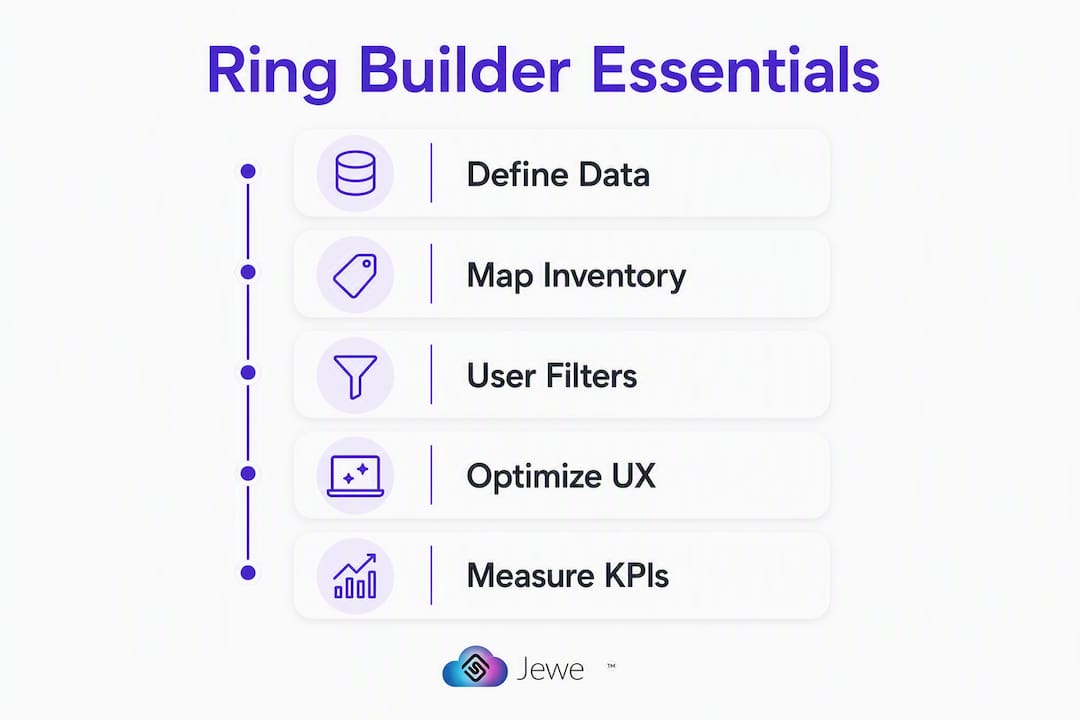
- What features must your ring builder include?
- How do you integrate a ring builder with your existing tech stack?
- How do you design the configurator to convert, not confuse?
- What does a realistic rollout look like?
- How do you model the cost and ROI of a ring builder?
- How do you keep supplier feeds clean and orders flowing?
- Why does RingBuilder® by Jewelcloud address the checklist above?
- Key Takeaways
- The data model is the real project
- Ready to pilot RingBuilder® with your own supplier feeds?
- Useful sources and next documents to review
What does a B2B engagement ring builder actually do for your store?
A B2B engagement ring builder, sometimes called a ring configurator or custom jewelry configurator, is not a consumer DIY toy. It is a white-label SaaS tool that sits on your storefront, pulls normalized product data from your suppliers, and lets shoppers build a ring from your curated inventory while your brand stays front and center.
The business outcomes it must deliver:
- Brandable experience: your logo, your color palette, your tone throughout the flow
- Standardized product data: controlled vocabularies for metal purity, stone shape, carat, color, clarity, and certification number
- Reliable inventory: real-time or near-real-time availability, not stale catalog data
- Drop-ship support: order routing to the correct supplier without manual intervention
- Lower time-to-market: onboard new supplier feeds without rebuilding the UI
KPIs to track from day one: configurator session conversion rate, average order value (AOV) uplift versus non-configurator purchases, feed sync accuracy (target 99%+), and time-to-first-order during your pilot window.
Unstructured product data reduces discoverability and increases returns. A canonical attribute schema is not a nice detail; it is the foundation every other metric depends on.
What features must your ring builder include?
High-converting configurators function as decision systems, not visual showcases. The features below are ranked by their impact on conversion and operational reliability.
| Feature | Priority | Why It Matters |
|---|---|---|
| Unified product model (canonical diamond + setting schema) | Must-have | Prevents downstream filter failures and return spikes |
| Constraint logic (valid metal/stone combinations only) | Must-have | Stops impossible orders before checkout |
| Supplier feed normalization | Must-have | Merges multi-vendor data into one browsable catalog |
| Cache-and-validate inventory | Must-have | Fast browsing + accurate availability at checkout |
| Pricing engine with revalidation | Must-have | Surfaces price changes within a defined tolerance at checkout |
| White-label theming | Must-have | Preserves brand trust on high-AOV purchases |
| Multi-platform plugins (Shopify, WooCommerce, Magento) | Should-have | Reduces custom dev cost |
| Order routing and split fulfillment | Should-have | Automates supplier PO generation |
| Behavioral analytics and CRM integration | Nice-to-have | Enables retargeting and guided follow-up |
Most configurators fail because they are treated as UI features rather than conversion infrastructure. Behavioral intelligence, which tracks hesitation patterns and high-intent combinations, lets the builder guide buyers toward purchase rather than leaving them to wander.
Pro Tip: Limit simultaneous filter choices to three or four at any step. More options at once increases drop-off, not engagement.
How do you integrate a ring builder with your existing tech stack?
Your API and data checklist before signing any vendor contract:
- Normalized feed endpoints that accept delta and full sync payloads
- Webhook support for inventory status changes
- Supplier identity fields (supplier_id, supplier_sku) on every record
- Certification fields: cert (GIA, AGS, IGI) and cert_number as machine-readable required fields
- SKU mapping rules documented and tested against your POS
- Order validation endpoints that recheck availability and price at checkout
Canonical attribute schema for a diamond record:
| Field | Example Value |
|---|---|
| shape | Emerald Cut |
| carat | 1.52 |
| color | F |
| clarity | VS1 |
| cut_grade | Excellent |
| cert | GIA |
| cert_number | 2486752391 |
| supplier_sku | GIA-EC-152-F-VS1 |
Normalizing supplier field variants into a single internal schema is the highest-leverage technical decision in the entire project. Get it wrong and every downstream feature, from filters to order routing, inherits the error.
Performance targets: use scheduled full syncs with high-priority delta updates, store normalized stones in a fast key-value or edge cache (Cloudflare Workers KV is a common pattern), and revalidate at checkout. Target p75 response times under 400ms for browsing queries. Avoid querying live supplier APIs on every page render; the latency alone will break the UX.
A unified jewelry-specific platform reduces the maintenance burden of point integrations between your POS, website, and marketing tools significantly.
How do you design the configurator to convert, not confuse?
The entry point sets the tone. Start shoppers with shape or budget, not a full attribute grid. Progressive disclosure, revealing the next filter only after the previous choice is made, keeps the decision flow manageable.
- Entry point: shape selector or budget range (two choices, not twelve)
- Stone selection: filtered by the chosen shape, sorted by value
- Setting selection: constrained to compatible metals and prong styles for the chosen stone
- Personalization: metal finish, engraving, ring size
- Summary and hold: display full specs, cert badge, and a 48-hour hold confirmation
Trust signals that move shoppers past hesitation: GIA or AGS certification badges on each stone card, a “held for you” confirmation with a clear expiration window, and transparent pricing that resolves at checkout within a small tolerance band. Holding a matched stone for a short, defined window creates commitment without forcing immediate payment.
A/B test ideas worth running in your first 90 days: guided flow versus open exploration, hold-time messaging variants, and an alternative suggestion panel when a preferred stone goes out of stock.
Pro Tip: Show a sample product listing with full specs at every step, for example “14K White Gold 3 Stone Emerald Cut Diamond Engagement Ring, 1.52ct F VS1 GIA #2486752391.” Shoppers who see complete data convert at higher rates than those who see summary cards.
What does a realistic rollout look like?
Phase 1: Discovery (Weeks 1–2)
- Audit your existing product data for attribute completeness
- Inventory supplier feed formats (CSV, API, EDI) and identify normalization gaps
- Define your canonical attribute schema and get supplier sign-off
- Map integration points: POS, e-commerce platform, order management system
Phase 2: Pilot (Weeks 3–8)
- Load sample SKUs from two suppliers into the normalized schema
- Connect live feeds with cache-and-validate architecture
- Configure constraint logic for valid metal/stone combinations
- Run QA against your success metrics: feed sync accuracy, p75 response time, checkout revalidation
Phase 3: Launch and Scale
- Automate supplier onboarding with documented attribute mapping templates
- Expand to additional supplier connections after pilot metrics are confirmed
- Run performance load testing before peak traffic periods
- Deliver staff training and enablement documentation
| Milestone | Owner | Target Date |
|---|---|---|
| Attribute schema finalized | Data/Ops lead | End of Week 1 |
| Two-supplier pilot live | Dev + Supplier team | End of Week 4 |
| Pilot success metrics reviewed | Commercial lead | End of Week 8 |
| Full launch | All teams | Weeks 3–8 |
How do you model the cost and ROI of a ring builder?
Cost components to budget:
- SaaS subscription or licensing fee (monthly or annual)
- Setup and integration fees for platform plugins or custom API work
- Supplier API access costs (some suppliers charge per-call or per-seat)
- Hosting and cache infrastructure (edge cache storage and compute)
- Ongoing maintenance, feed monitoring, and staff training
Simple ROI model:
- Estimate your monthly configurator sessions (start conservatively with 20–30% of current ring-related traffic)
- Apply a realistic conversion uplift versus your current non-configurator flow
- Multiply by your average ring AOV
- Subtract incremental margin cost and monthly platform fee
- Divide total investment by monthly net gain to get payback in months
Vendor negotiation levers: ask for pilot pricing with a capped API call volume, a staged feature rollout so you pay for capabilities as you activate them, and a clear SLA for feed sync accuracy with remedies if it falls below your agreed threshold.
How do you keep supplier feeds clean and orders flowing?
Supplier onboarding checklist:
- Provide each supplier with your canonical attribute mapping template
- Validate a sample data file (minimum 50 SKUs) before connecting the live feed
- Confirm cert and cert_number fields are populated on every diamond record
- Document edge cases: split fulfillment rules, out-of-stock handling, and resizing policies
Order flow: when a shopper completes the configurator, the system checks whether the stone is in your merchant inventory or routes to the supplier. A purchase order generates automatically for supplier-sourced stones, and status updates reconcile back to your order management system.
Pro Tip: Never query live supplier APIs at page load. Use your cached feed for browsing and reserve the live API call for checkout-time revalidation only. This protects your UX from supplier API downtime and rate limits.
Structured attributes like certification and metal_purity as machine-readable required fields prevent the cascading failures, poor filtering, incorrect product pages, and manual reconciliation, that plague stores with free-text data.
Why does RingBuilder® by Jewelcloud address the checklist above?
Jewelcloud’s RingBuilder® maps directly to the technical and commercial requirements covered in this guide. Here is how the checklist aligns:
| Checklist Item | RingBuilder® / Jewelcloud Capability |
|---|---|
| Canonical attribute schema | Standardized product data model across all participating suppliers |
| Supplier feed normalization | Structured, normalized feeds from Jewelcloud’s vendor network |
| Cache-and-validate inventory | Feed-driven architecture with checkout revalidation |
| Constraint logic | Configured valid combinations for metal, stone, and setting |
| White-label theming | Brandable UI for your storefront |
| Multi-platform support | Shopify, WooCommerce, Magento, and custom API |
| Supplier onboarding | Manufacturer and vendor onboarding through Jewelcloud’s platform |
| Order routing | Automated supplier PO generation and status sync |
Sample product listing demonstrating rich attribute modeling: 14K White Gold 3 Stone Emerald Cut Diamond Engagement Ring | Center: 1.52ct F VS1 Emerald Cut, GIA #2486752391 | Side stones: 0.38ctw | SKU: RB-14KW-3ST-EC-152
When you request a demo, ask specifically about: feed mapping documentation, cache strategy and sync cadence, hold policy duration and price tolerance rules, and support SLA response times.
Pro Tip: Bring a sample of your own supplier data to the demo. Watching the normalization process run against your actual feed is more informative than any slide deck.
Key Takeaways
A B2B engagement ring builder succeeds when the data model is locked first, the inventory architecture uses cache-and-validate, and constraint logic prevents impossible orders before they reach checkout.
| Point | Details |
|---|---|
| Data model first | Finalize your canonical attribute schema before evaluating any vendor or writing a line of integration code. |
| Cache-and-validate architecture | Store normalized feeds in an edge cache for browsing; revalidate availability and price at checkout only. |
| Constraint logic is non-negotiable | Valid metal/stone/setting combinations must be enforced by the system, not by the shopper. |
| Pilot with two suppliers | A four-to-six-week pilot with two live feeds gives you real feed accuracy and performance data before full rollout. |
| Jewelcloud RingBuilder® | Maps to every checklist item above; request a pilot demo with your own supplier feed samples to validate fit. |
The data model is the real project
Most teams spend their first weeks debating UI and pricing. The teams that launch on time spend those same weeks on the attribute schema. Every filter, every constraint rule, every order routing decision downstream depends on whether your canonical data model is clean and agreed upon by all suppliers before the first line of integration code is written.
The second thing teams underestimate is governance. A configurator with three suppliers is manageable. One with twelve, each sending slightly different field names for the same attribute, becomes a reconciliation problem that no UI can hide. Assign one person as the product data steward before the pilot starts. That person owns the canonical schema, approves supplier mapping templates, and reviews feed accuracy daily during the pilot window. Without that role, feed hygiene degrades quietly until it shows up as customer complaints.
The third pitfall is treating the pilot as a proof of concept rather than a production rehearsal. Run it against real traffic, real supplier feeds, and real checkout flows. Measure feed sync accuracy, p75 response time, and configurator conversion rate from day one. Those three numbers will tell you everything you need to know before committing to a full rollout.
Ready to pilot RingBuilder® with your own supplier feeds?
Jewelcloud gives U.S. retailers a concrete alternative to building a custom configurator from scratch. Where a custom build takes months and requires ongoing connector maintenance, RingBuilder® arrives with a normalized data model, multi-platform plugins, and a supplier network already structured for feed-driven inventory. Your brand stays front and center; the infrastructure is already built.
To request a demo, bring the following to your first conversation with the Jewelcloud team:
- A sample data export from at least one supplier (50+ SKUs, including cert and cert_number fields)
- Your current monthly ring-related traffic estimate and target launch date
- Your e-commerce platform (Shopify, WooCommerce, Magento, or custom)
- Your success metrics for the pilot (feed sync accuracy target, conversion rate baseline, AOV goal)
Request your RingBuilder® pilot and see how your supplier data maps to the canonical schema before you commit to anything.
Useful sources and next documents to review
Core technical references:
- Building a real-time engagement-ring configurator across four diamond suppliers — cache-and-validate architecture, canonical diamond schema, and performance SLA guidance
- Why Most Jewellery Configurators Fail — behavioral intelligence and conversion infrastructure checklist
- The Complete Ring Builder: Architecture, Psychology, and Conversion Engineering — guided decision flows, hold-time UX, and progressive disclosure patterns
- System Integration for Jewelry Stores — POS, website, and marketing tool integration failure patterns and unified platform benefits
- Jewelry and Watches brands have a product-data problem — structured attribute requirements and the cost of free-text data
- Streamlining Supplier Data Management for Jewelry Retailers — PIM-based supplier data centralization for retailers
- RingBuilder® by Jewelcloud — product page, capabilities, and demo request
- Ring configurator software: B2B comparison guide — feature tradeoffs for procurement teams
Internal preparation checklist before your vendor evaluation:
- Export a sample product file from your primary supplier in its native format
- Compile a list of all supplier contacts and their current feed delivery methods
- Document your staging environment requirements (platform version, API credentials, test payment gateway)
- Define your go/no-go criteria for the pilot: minimum feed sync accuracy, maximum acceptable p75 response time, and target configurator conversion rate