


The FTC Jewelry Guides, codified at 16 CFR Part 23, interpret Section 5 of the FTC Act and require every metal, gemstone, and treatment claim to pass the net-impression standard. That means correcting karat and fineness language, disclosing non-permanent treatments, using precise lab-grown terminology, dropping unsupported “Made in USA” claims, and making online disclosures clear and conspicuous before checkout, not buried in a footnote.
TL;DR:
- Jewelry claims about metal purity, origin, or treatments must pass the net-impression standard, considering the overall message created by images and text.
- Accurate disclosure, especially for gemstone origins and treatments, is crucial, with a focus on clear, conspicuous language placed close to the claim.
- “Made in USA” claims require strict qualification and documentation demonstrating that all or nearly all processing and components occurred domestically.
- Regular audits and structured product data help prevent compliance drift caused by copy-paste errors and ensure claims remain accurate across all platforms.
- Enforcing agencies focus on misleading net impressions, hidden treatments, and unqualified origin claims, making thorough documentation essential to defend marketing claims.
Table of Contents
- What the FTC Jewelry Guidelines Actually Cover
- Precious Metals: Getting Karat, Fineness, and Plating Claims Right
- Naming Gemstones, Diamonds, and Pearls Without Misleading Buyers
- The “Made in USA” Trap Most Jewelry Sellers Fall Into
- Making Digital Disclosures Clear and Conspicuous
- Building an Internal Compliance Audit Process
- What the 2018 Revisions Changed and Why Enforcement Risk Persists
- How Structured Product Data Reduces Compliance Risk
- Why Conservative Product Copy Is a Business Advantage, Not a Compliance Burden
- Get Your Product Data Compliance Ready with JewelCloud
- Primary Sources Worth Bookmarking
- Sources
What the FTC Jewelry Guidelines Actually Cover
The Jewelry Guides apply to a broader category of merchandise than most sellers assume. Coverage extends to precious metals (gold, silver, platinum, and their alloys), pewter, natural and laboratory-created gemstones, diamonds, pearls, and the findings and components used to assemble finished pieces. If you manufacture, wholesale, or retail any of these, the Guides apply to your product pages, hangtags, ad copy, and sales scripts alike.
Legally, the Guides are not a standalone statute. They are the FTC’s administrative interpretation of Section 5 of the FTC Act, which prohibits unfair or deceptive acts in commerce. The Commission uses the Guides to explain how it will evaluate jewelry marketing claims during an investigation or enforcement action, and courts and administrative law judges give them substantial weight because they reflect decades of case-specific guidance distilled into one reference document.
The core legal test underneath all of it is the “net impression” standard. The FTC does not evaluate a single word in isolation. It looks at the overall impression created by text, images, product names, and even the emotional tone of an ad, and asks whether a reasonable consumer would be misled by that combined picture. A statement in the 2018 revision’s Statement of Basis and Purpose makes this explicit: marketers can be technically accurate on a word-by-word basis and still violate the Guides if the overall presentation misleads.
Consider a product photo showing a heavily rhodium-plated ring under studio lighting that makes it look solid platinum, with a product title that says “Platinum-Style Ring” in small type. Each individual element might survive a literal reading. Together, they can create a false impression of solid platinum content, and that combination, not any single claim, is what the FTC would examine in an enforcement review.
In practice, enforcement actions tend to follow a consistent pattern. The FTC identifies a marketing claim (a metal purity statement, an origin claim, a treatment omission), evaluates the net impression it created for a reasonable consumer, and then determines whether the seller had a reasonable basis to make that claim at the time it was published. Sellers who kept supplier certifications, assay results, or written treatment disclosures on file tend to fare far better than those who relied on verbal assurances from a manufacturer three tiers up the supply chain.
Precious Metals: Getting Karat, Fineness, and Plating Claims Right
Metal claims are where most jewelry compliance problems start, largely because sellers copy supplier language without checking whether it meets FTC precision standards.
Gold. Karat and fineness must be stated together or in a way that leaves no ambiguity. “14K gold” is acceptable when the metal genuinely contains 585 parts per thousand of pure gold, allowing for the standard permissible tolerance. Vague qualifiers like “gold-tone” or “gold-finish” are only acceptable when the product is not gold at all, and even then, the Jewelry Guides require that the qualifier be at least as conspicuous as the word “gold” itself.
Sterling silver. You may use “silver” alone only when the item meets the 925 parts-per-thousand minimum fineness. If an alloy falls below that threshold, the Guides permit the word “silver” only when paired with an equally conspicuous fineness disclosure, such as “800 silver,” placed in the same type size and location as the word itself, not in a smaller footnote below it.
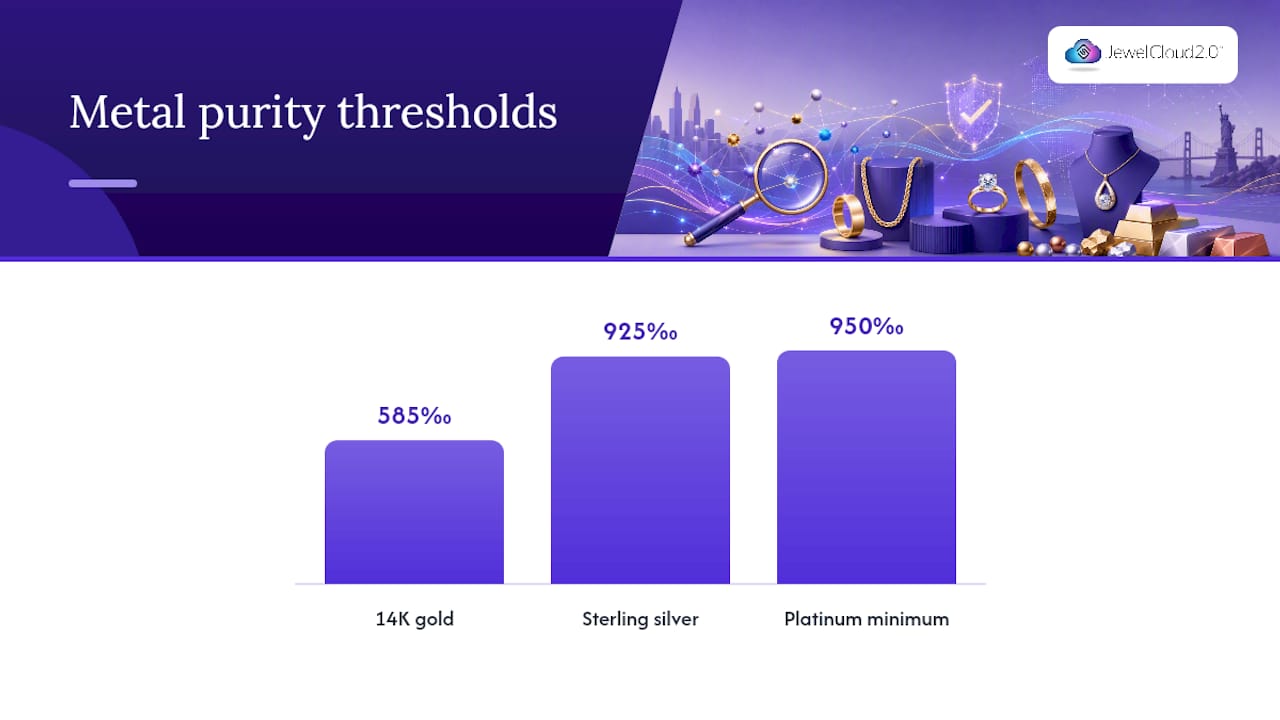
Platinum and alloys. Platinum group metal claims require disclosure of the actual alloy composition when the piece contains less than 950 parts per thousand pure platinum. Rhodium plating over white gold or silver is common in the industry, but if the surface finish is rhodium rather than the base metal itself, that needs disclosure, since a shopper assuming solid platinum durability from a rhodium-plated piece is exactly the kind of net-impression gap the FTC watches for.
Vermeil, plated, filled, and overlay. These terms are not interchangeable, and mixing them up is one of the most common compliance mistakes on independent product pages.
- Vermeil requires a sterling silver base with a gold layer meeting specific minimum thickness standards.
- Gold plated describes a thin electroplated gold layer over a base metal, with no minimum karat requirement for the base.
- Gold filled requires a mechanically bonded gold layer meeting a defined minimum weight ratio, typically far thicker than plating.
- Gold overlay is used when the gold layer is thinner than what qualifies for “filled” status but still mechanically bonded rather than electroplated.
Pro Tip: Run a quarterly spot-check comparing your product-page metal claims against your supplier’s most recent assay certificate. Language drifts over time as copywriters “simplify” descriptions for SEO, and that drift is exactly what turns an accurate listing into a misleading one.
Naming Gemstones, Diamonds, and Pearls Without Misleading Buyers
Gemstone and diamond terminology carries some of the strictest qualifier requirements in the entire Jewelry Guides, largely because a single missing word can change a buyer’s understanding of what they’re purchasing.
Lab-grown diamonds and laboratory-created gemstones must always carry a clear qualifier identifying their origin. “Diamond” alone implies a natural, mined stone. Acceptable phrasing includes “lab-grown diamond,” “laboratory-created diamond,” or “man-made diamond,” with the qualifier placed immediately adjacent to the stone name, not relegated to a specs tab three clicks deep on the product page. The same rule applies to created sapphires, rubies, and emeralds.
Varietal and trade names create a subtler risk. Calling a piece of glass a “Bohemian ruby” or a synthetic spinel a “soft emerald” borrows the prestige of a genuine gemstone name while describing something else entirely, and that kind of naming choice sits squarely inside net-impression territory even if a small disclaimer exists elsewhere on the page.
Pearls have their own three-tier naming structure that sellers frequently collapse into one term:
- Natural pearl: formed without human intervention, exceedingly rare in commercial jewelry.
- Cultured pearl: formed with human intervention (a nucleus inserted into a living mollusk) but still a genuine organic pearl.
- Imitation pearl: manufactured from glass, plastic, or shell, with no organic pearl material.
Nearly everything sold as “pearl jewelry” at mainstream price points is cultured, and the word “cultured” needs to appear with the same prominence as “pearl” itself.
Treatment disclosure is the other half of this section, and it’s the part sellers most often skip. The Guides require disclosure of any treatment that is not permanent, that creates special care requirements, or that significantly affects the stone’s value, and treatments to pearls specifically must be disclosed clearly and conspicuously when they meet those criteria. Dyeing, coating, irradiation, and clarity-filling with glass or resin all fall under this requirement. Compliant wording looks like “Ruby, clarity enhanced with glass filling” placed directly in the product title or opening description, not buried in a returns policy.
The “Made in USA” Trap Most Jewelry Sellers Fall Into
Unqualified “Made in USA” claims are riskier for jewelry than almost any other product category, and most sellers who use the phrase are not actually eligible to.
The FTC’s Made in USA standard requires that final assembly happen in the U.S., that all significant processing occur domestically, and that all or virtually all components be of U.S. origin. Jewelry almost never clears that bar cleanly, because loose diamonds are frequently cut overseas, base metals are often refined internationally before reaching a domestic caster, and findings like clasps and jump rings are commonly imported even when the final assembly happens in a U.S. workshop.
That doesn’t mean U.S.-based manufacturers have no origin claim available to them. It means the claim has to be qualified to match reality:
- “Assembled in USA from imported and domestic materials” works when assembly is genuinely domestic but components are mixed-origin.
- “Set in USA with imported diamonds” is accurate and specific when only the setting labor happens domestically.
- Avoid “American Made” or “Made in USA” outright unless you can document that virtually every input, down to solder and findings, traces to domestic sourcing.
Substantiating any origin claim, qualified or not, requires paperwork you can produce on demand. Keep supplier country-of-origin declarations, casting and cutting invoices, and a bill of materials that traces each component back to its source. If an FTC inquiry ever asks you to back up an origin claim, “our supplier told us it was domestic” is not documentation; a dated, signed declaration is.
Making Digital Disclosures Clear and Conspicuous
The FTC has been explicit that digital advertising and social media are held to the exact same truth-in-advertising standard as print catalogs and in-store signage, and that disclosures have to be clear and conspicuous wherever the underlying claim appears, not just somewhere on the site.
- Match the disclosure to the claim’s location. If a treatment or plating disclosure lives only in a specs accordion, but the treated stone is featured in the hero image and headline, the disclosure isn’t conspicuous where it matters.
- Size and placement matter as much as wording. A qualifier in six-point gray text under a bold black product name will not satisfy the standard, regardless of what it says.
- Apply the same rule to short-form content. Instagram captions, TikTok product videos, and Pinterest pins carrying jewelry claims need the qualifier in the visible caption or on-screen text, not just in a linked landing page.
- Cover influencer and sponsored content. Anyone paid or gifted product to promote a piece must disclose the relationship, and any metal, gem, or origin claims made in that content are subject to the same Jewelry Guides standards as your own marketing.
Pro Tip: Before a product video or influencer post goes live, run it through the same checklist you’d apply to a printed catalog page: metal claim accurate, treatment disclosed, origin qualified, disclosure visible without a click. If it wouldn’t pass in print, it won’t pass on video either.
Building an Internal Compliance Audit Process
A working audit process catches drift before it becomes an enforcement problem, and it doesn’t need to be complicated to be effective.
- Audit every live product page quarterly against current supplier documentation, checking metal fineness, gemstone origin language, and treatment disclosures line by line.
- Cross-check marketing copy against product-data fields, since ad creatives and social captions often get written by a different team than the one maintaining the core catalog.
- Retain supplier declarations, assay certificates, and treatment disclosures in a searchable file tied to each SKU, not scattered across email threads.
- Synchronize product-data fields across every channel (site, marketplace listings, ad platforms) so a correction made in one place doesn’t leave three stale versions elsewhere.
- Require a sign-off step before any new listing or ad creative goes live, with a named person accountable for confirming the metal, gem, and origin claims.
| Compliance area | What to retain | Review frequency |
|---|---|---|
| Metal fineness claims | Assay certificates, refiner statements | Quarterly |
| Gemstone origin and treatment | Lab reports, supplier treatment disclosures | Quarterly |
| Pearl classification | Cultivation/source documentation | Quarterly |
| Origin (“Made in USA”) claims | Bill of materials, country-of-origin declarations | Annually or per new SKU |
| Digital ad creatives | Screenshot archive with publish date | Per campaign |
What the 2018 Revisions Changed and Why Enforcement Risk Persists
The 2018 revisions to the Jewelry Guides modernized language the FTC hadn’t touched in years, and several of those changes are exactly where sellers still trip up today. The update clarified alloy disclosure requirements for platinum group metals, added specific guidance for composite and manufactured gemstones, tightened lab-grown diamond and gemstone terminology, and expanded disclosure expectations for pearl and gemstone treatments.
Enforcement patterns since then cluster around a few recurring themes. Net-impression violations, where technically true claims combine into a misleading overall picture, remain the most common trigger. Hidden or under-disclosed treatments, especially clarity-filled or coated stones sold without qualifier language, show up repeatedly in complaint data. Unqualified origin claims are the third major category, particularly among smaller manufacturers who assume domestic assembly alone justifies “Made in USA” language.
If your business gets contacted by a regulator or receives a consumer complaint referencing a specific claim, the right first move is to pull the documentation behind that exact claim, not to revise the listing first and explain later. Preserve the original product page, ad, or post as it existed at the time of the complaint, gather the supplier records that supported the claim, and involve counsel before responding substantively. Businesses that can produce a clean paper trail resolve inquiries faster and with far less exposure than those scrambling to reconstruct sourcing after the fact.
How Structured Product Data Reduces Compliance Risk
Most compliance failures aren’t intentional deception. They’re copy-paste drift: a karat claim that was accurate on the original supplier sheet gets rewritten by a marketing intern, posted to three marketplaces, and never reconciled again. That’s an operational problem, not a legal one, and it needs an operational fix.
A structured product-data model addresses this gap by giving suppliers and retailers discrete fields for karat, fineness, gemstone treatment flags, and origin, rather than a single free-text description box where claims drift with every rewrite. When a supplier updates a treatment disclosure or fineness value at the source, that change flows through to every connected retail listing instead of living in one outdated page.
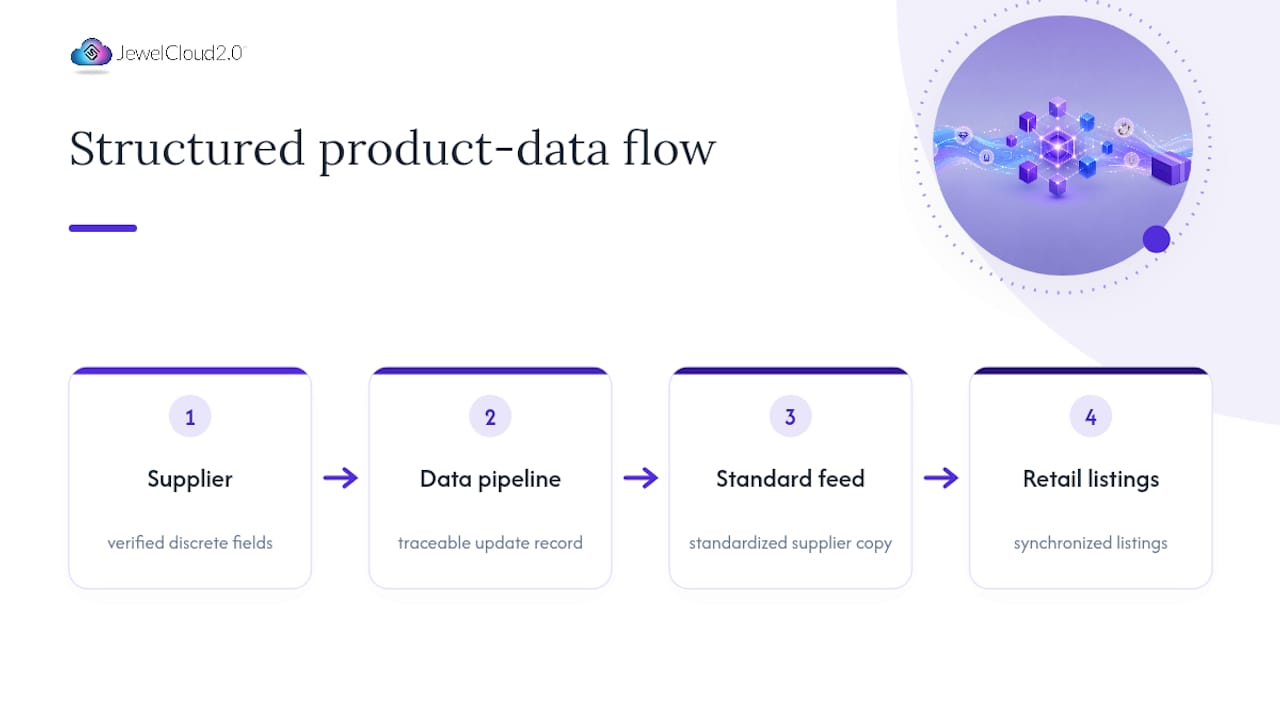
The vendor data pipeline also creates a traceable record of what was claimed, when, and by whom, which is precisely the kind of documentation an FTC inquiry asks for. Retailers pulling product descriptions from a standardized feed inherit consistent, supplier-verified language instead of writing their own from scratch, which cuts down on the inadvertent misstatements that tend to accumulate across a growing catalog. Consistency at the data layer becomes consistency in what shoppers actually see.
Why Conservative Product Copy Is a Business Advantage, Not a Compliance Burden
The same handful of listing errors show up across the jewelry industry over and over: a “diamond” without a lab-grown qualifier, a rhodium-plated ring described as if the plating were incidental, a “Made in USA” claim resting on domestic assembly alone. None of these come from bad intent. They come from copy written once, under deadline, and never revisited as suppliers or sourcing changed.
The conventional wisdom treats compliance as a legal cost center, something the marketing team tolerates because legal insists on it. That framing gets it backward. Conservative, accurate product descriptions protect margin as much as they protect against enforcement risk, because returns, chargebacks, and review disputes tied to “not as described” complaints cost real money long before any regulator gets involved. A shopper who feels misled about plating or treatment doesn’t file an FTC complaint. They leave a public review and never buy from you again.
The businesses that treat precise, well-documented product data as a competitive asset rather than a compliance checkbox tend to spend less time firefighting both regulatory risk and customer trust problems.
— Anthony
Get Your Product Data Compliance Ready with JewelCloud
Rewriting every product description by hand across your site, marketplace listings, and ad creatives is how compliance drift happens in the first place. The platform gives suppliers and retailers a shared, structured catalog where karat, fineness, treatment, and origin fields live in one place and sync everywhere products appear, instead of getting rewritten independently by every team that touches them.
For manufacturers and wholesalers, joining the JewelCloud vendor network means your verified product data reaches retail partners exactly as you specified it, with no game of telephone between your spec sheet and a buyer’s screen. Retailers pulling from standardized feeds inherit accurate, supplier-backed descriptions rather than writing new copy from scratch for every SKU. None of this replaces legal advice or a genuine compliance review of your specific claims, but it does remove the operational chaos that causes most unintentional violations. If you’re ready to see how a centralized product-data workflow fits your catalog, explore JewelCloud’s platform and request a walkthrough of how vendor and retailer data connect.
Primary Sources Worth Bookmarking
For the actual rule text, definitions, and specific examples, go straight to 16 CFR Part 23 on eCFR. For the Commission’s reasoning behind the 2018 changes, including lab-grown terminology and treatment disclosure updates, read the Federal Register final rule. For plain-language business guidance and enforcement context, the FTC’s jewelry industry page is the best starting point, and for origin claims specifically, consult the FTC’s Made in USA standard before publishing any domestic-sourcing language.
Sources
- eCFR :: 16 CFR Part 23 – Guides for the Jewelry, Precious Metals, and Pewter Industries
- Guides for the Jewelry, Precious Metals, and Pewter Industries | Federal Register (Aug 16, 2018)
- Complying with the Made in USA standard | Federal Trade Commission