


If you’re searching for jewelpads.com alternatives in the B2B jewelry product-data space, Jewelcloud is the recommended first stop for structured feeds, inventory sync, and digital wholesale catalogs. Here’s the short list of platform categories to evaluate:
- Jewelry-first B2B catalog platforms (Jewelcloud): best for retail jewelers and suppliers who need structured, jewelry-specific product feeds and fast retailer onboarding.
- Enterprise wholesale marketplaces (NuORDER, JOOR, Brandboom): best for brands distributing across many retail accounts and needing order management at scale.
- Dropship and fulfillment-centric networks (Handshake, Faire): best for retailers who prioritize product discovery and low inventory risk over data control.
- ERP-integrated catalog systems: best for manufacturers and large wholesalers who need production, weight-based stock, and purity tracking alongside distribution.
Request a sandbox or sample feed before committing to any platform.
Table of Contents
- Which jewelpads.com alternatives match your technical needs?
- What does each platform category actually do for you?
- How do you evaluate and choose the right platform?
- What product data fields should you insist on?
- What does onboarding actually look like, and what drives the cost?
- Key Takeaways
- The part of this evaluation most buyers skip
- Jewelcloud gives you the feeds, sync, and catalogs your buyers expect
- Useful sources
Which jewelpads.com alternatives match your technical needs?
The table below compares the four platform categories on the dimensions that matter most for jewelry B2B operations.
| Capability | Jewelry-first B2B platform (Jewelcloud) | Enterprise wholesale marketplace | Dropship/fulfillment network | ERP-integrated catalog |
|---|---|---|---|---|
| Best for | Retailers, brands, diamond dealers needing structured feeds | Multi-brand order management at scale | Discovery-led retail expansion, low inventory risk | Manufacturers needing production + distribution |
| Integrations | Shopify, WooCommerce, Magento, custom API | Shopify, custom EDI, ERP connectors | Shopify, limited custom | ERP-native; custom API for ecommerce |
| Feed formats | CSV, XML, JSON, API, webhooks | CSV, EDI, API | Proprietary feed, limited export | XML, EDI, proprietary ERP export |
| Inventory sync | Real-time / near-real-time | Batch or near-real-time | Supplier-dependent, often delayed | Real-time within ERP; ecommerce sync varies |
| Jewelry-specific data | Full: stones, metals, karats, sizes, HUIDs, serial IDs | Partial: SKU and variant support, limited stone fields | Minimal: title, image, price | Full: weight-based, purity, hallmark, repair workflows |
| Order routing / dropship | Supported | Supported | Core feature | Limited |
| Pricing model | SaaS subscription + platform fee | Subscription + transaction fee | Commission per order | License + implementation fee |
| Onboarding time | Days to weeks | Weeks to months | Days | Months |
| Security / data ownership | Supplier retains data ownership | Marketplace retains transaction data | Platform controls catalog | ERP-native; data stays in-house |
Three tradeoffs to keep in mind as you compare:
- Feed normalization effort: platforms without jewelry-specific field mapping push that work onto your team. Vendor data sync that is automated and standardized reduces manual errors and speeds replenishment decisions.
What does each platform category actually do for you?
How do you evaluate and choose the right platform?
Work through this checklist before your first demo call.
- Define your data requirements. List every field your product catalog needs: SKU, stone attributes, metal type, karat, ring sizes, and serial/HUID numbers. Any platform that cannot map to these fields natively will cost you time in normalization.
- Confirm integration compatibility. Verify the platform connects to your storefront (Shopify, WooCommerce, Magento, or custom) via API or a maintained plugin, not a manual export.
- Test sync frequency. Ask for a live demo of inventory sync. Real-time or near-real-time sync across locations is a core capability for jewelry retailers managing memo, consignment, and live ecommerce simultaneously.
- Understand the pricing model fully. Get a written breakdown of subscription fees, transaction fees, onboarding costs, and any SLA or priority-support tiers.
- Evaluate onboarding support. Ask whether a sandbox or test environment is available before go-live, and who owns the data-mapping work.
Demo questions to ask on the call:
- What is your API latency for a catalog update, and how is that measured?
- Can you show me a sample feed with stone weight, cut, color, clarity, and serial ID populated?
- How does your system handle memo and consignment lifecycle flags?
- What happens to my data if I cancel?
Red flags to watch:
- No jewelry-specific data fields (stone, metal, karat) in the standard schema.
- Inventory sync is manual or batch-only with no real-time option.
- Pricing is not disclosed until after a sales call.
- No sandbox or test environment available before contract signing.
Use a simple scoring rubric: mark each criterion as must-have, nice-to-have, or dealbreaker. Any vendor with a dealbreaker on jewelry data fidelity or sync frequency should be removed from consideration before the second call.
What product data fields should you insist on?
Jewelry inventory platforms must support RFID, serialized IDs, memo and consignment tracking, and real-time ecommerce sync. When you evaluate a feed, check for every field below.
| Field category | Required fields |
|---|---|
| Identification | SKU, UID/serial number, barcode, RFID tag |
| Title & description | Product title, long description, collection name |
| Metal | Metal type, karat/purity, finish, hallmark, HUID |
| Stone(s) | Stone type, weight (ct), cut, color, clarity, total carat weight |
| Components | Mounting SKU, stone SKU (component-level) |
| Dimensions | Length/width/depth (mm), ring size, bracelet length |
| Imagery | Front, side, back, scale reference, lifestyle |
| Pricing | Wholesale price, currency, live metal-rate linkage |
| Inventory | Location, quantity available, memo/consignment flag |
| Lifecycle | Repair status, consignment flag, aging flag |
For feed format, CSV works for bulk uploads and is the easiest for initial data mapping. JSON is preferred for API-driven real-time sync. XML remains common for EDI-based wholesale integrations. Normalization rules matter most for metal variants (e.g., “14K Yellow Gold” vs. “14KY”) and stone attributes (e.g., “VS1” vs. “VS-1”). Agree on a data dictionary with your vendor before the feed goes live.
Pro Tip: Insist on serial/UID fields and an audit trail in every feed. Without them, cross-channel reconciliation and shrink tracking become manual headaches that grow with your catalog size.
Digital B2B catalogs built for jewelry must handle complex SKU structures across metal variants, gemstone types, and size variants, and allow private, filterable views for trade buyers. If a platform cannot filter by stone type or metal karat, your buyers will struggle to find what they need.
What does onboarding actually look like, and what drives the cost?
Most jewelry platform implementations follow these phases:
- Discovery (1–2 weeks): Audit your existing catalog, identify data gaps, and agree on field mapping with the vendor.
- Data mapping and normalization (1–3 weeks): Clean and standardize your product data. This is where most projects run long.
- Sample feed push and validation (1 week): Push a sample of 50–200 SKUs and verify field accuracy, image delivery, and pricing.
- Integration build (1–4 weeks): Connect the platform to your storefront via API or plugin. Custom integrations take longer.
- Testing and reconciliation (1 week): Confirm inventory counts match across systems and sync triggers work correctly.
- Staff training (2–3 days): Train your inventory manager, ecommerce manager, and any purchasing staff on the new workflow.
- Go-live and post-launch support (ongoing): Monitor sync logs, resolve edge cases, and confirm SLAs are being met.
Primary cost drivers:
- Feed cleanup and normalization (the biggest variable, especially for older catalogs).
- Custom API or plugin development beyond standard connectors.
- Image production if your existing assets do not meet platform specs.
- Onboarding hours billed by the vendor.
- Priority support or SLA tiers above the standard plan.
Internal stakeholders to involve from day one: your IT lead, inventory manager, ecommerce manager, and accounting contact for pricing and tax-rate fields.
Key Takeaways
Jewelcloud is the recommended jewelry-first B2B platform for retailers and suppliers who need structured product feeds, real-time inventory sync, and jewelry-specific data fields without a multi-month implementation.
| Point | Details |
|---|---|
| Jewelry data fidelity | Insist on stone, metal, karat, serial/UID, and HUID fields in every platform’s standard schema. |
| Sync frequency matters | Real-time or near-real-time inventory sync is a must-have for memo, consignment, and live ecommerce. |
| Pricing model tradeoff | Subscription models offer predictable costs; commission or transaction-fee models erode margin at volume. |
| Onboarding cost driver | Feed cleanup and normalization is the biggest variable; budget time and resources before signing. |
| Jewelcloud recommendation | Jewelcloud delivers jewelry-specific feeds, fast onboarding, and Shopify/WooCommerce/Magento integrations for retailers and suppliers. |
The part of this evaluation most buyers skip
The comparison tables and demo checklists in this article cover the mechanics well. What buyers consistently underestimate is the cost of bad data, not bad software.
Most platform evaluations focus on features: does it have an API, does it connect to Shopify, does it support dropship? Those questions matter. But the real implementation risk sits in your existing catalog data. A platform with every feature on your checklist will still fail if your product records are inconsistent, your stone attributes use three different naming conventions, and half your SKUs are missing images.
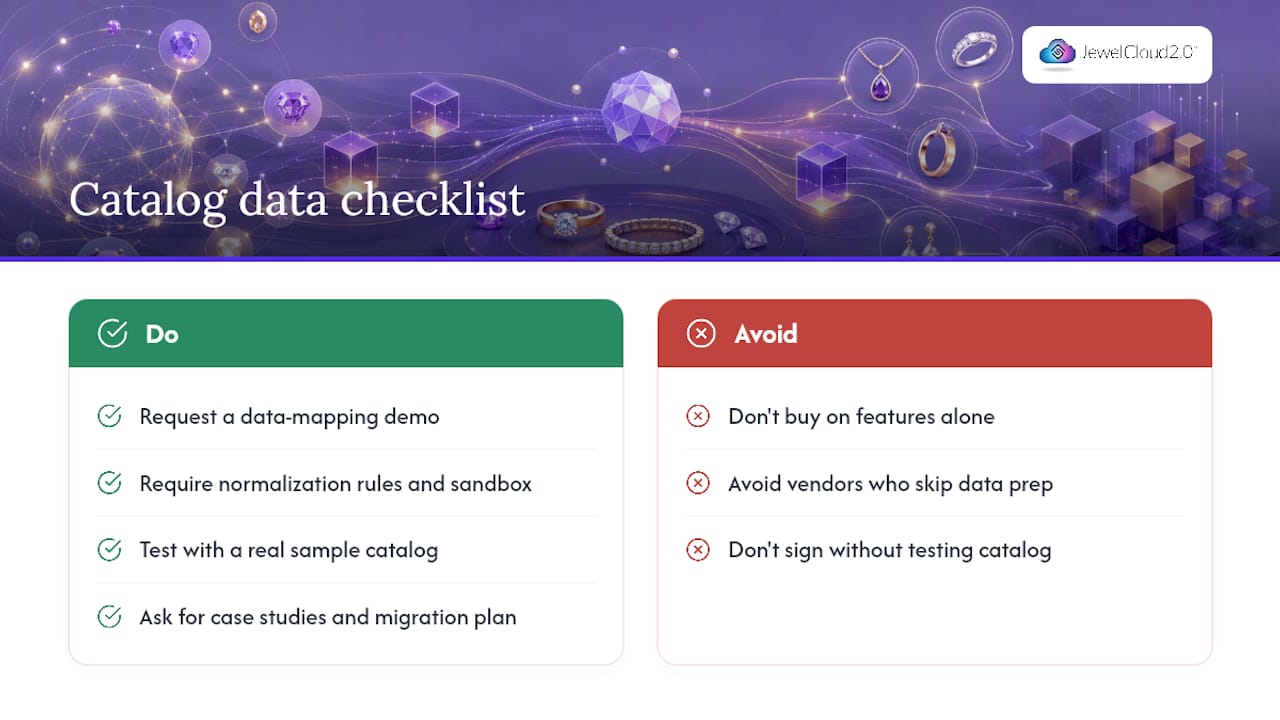
The vendors who deserve your business are the ones who show you a data-mapping tool, walk you through normalization rules, and give you a sandbox to test a real sample of your catalog before you sign. Any vendor who skips that step is selling you a promise, not a product.
Jewelcloud’s approach of structuring and standardizing product data at the platform level is exactly the right model for jewelry. The complexity of the category (metal variants, stone combinations, size runs, serial tracking) means that generic wholesale platforms will always require more normalization work on your end. Jewelry-first platforms absorb that complexity by design.
Ask for case studies from jewelers or suppliers in your segment. Ask for a migration plan if you are moving from another system. Schedule a technical review with your IT lead before the commercial conversation goes further.
Jewelcloud gives you the feeds, sync, and catalogs your buyers expect
Jewelry retailers and suppliers who need structured product data without a six-month implementation have a direct path with Jewelcloud. The platform delivers standardized product feeds, real-time inventory sync, and digital wholesale catalogs built for jewelry’s complexity, with native integrations for Shopify, WooCommerce, and Magento. Suppliers gain a digital distribution channel that puts their catalog in front of qualified retail partners. Retailers gain the ability to expand their online assortment using real product data, without carrying physical inventory.
Ready to see what your catalog looks like on a jewelry-first platform? Explore vendor membership to get your products in front of retail buyers, or visit the vendor benefits page to review what the platform includes before your first conversation.
Useful sources
- Jewelry Inventory Management (2026 Complete Guide) | WJewel
- Jewellery Inventory Management: Why Spreadsheets Fail and ERP Works - Joolet ERP
- Jewellery Inventory Management Software for Retailers
- 5 Challenges Facing Retail Jewelers Today - Stuller Blog
- Why Jewellery Brands Should Build a Digital Catalog Before IIJS – JewelCloud2](https://jewelcloud.com)
- [JewelCloud for Vendors – JewelCloud2](https://jewelcloud.com/pages/jewelcloud-for-vendors)