


Plan your jewelry assortment around three performance roles, not just product categories: staple pieces that sell every week, bridal and occasion pieces that carry high tickets, and statement pieces that drive attention. Track sell-through, turn, and GMROI on each role every cycle, keep your price bands consistent from entry to premium, and hold back a slice of open-to-buy so you can test newness without betting the whole season on it.
TL;DR:
- Stock staples in a wide range of sizes and metals to avoid missing sales on your most reliable items, while limiting statement pieces to prevent slow inventory.
- Use a core set of bridal styles and vendor catalogs for customization, relying on quick build-to-order options rather than owning every SKU upfront.
- Establish three price bands—entry, core, and premium—and track their sales metrics monthly to optimize inventory depth and customer progression.
- Balance breadth in trend-driven categories with deep inventory in fit-critical items, adjusting reorder frequency and vendor collaboration accordingly.
- Regularly review sell-through, turn, and GMROI metrics by attribute, and keep minimal open-to-buy for testing new styles without risking core cash flow.
Table of Contents
- What Is Jewelry Assortment Planning?
- Core, Bridal, and Statement: Assigning Performance Roles
- Building a Bridal Assortment Without Owning Every SKU
- How to Build Price Bands That Actually Convert
- Deciding Where to Go Wide and Where to Go Deep
- Using Sell-Through, Turn, and GMROI to Guide Every Buy
- Deciding What to Own vs. What to Access
- Merchandising by Story, Not Just by Product Type
- Reserving Capacity to Test New Ideas Safely
- Auditing the Assortment Through Your Customer’s Eyes
- Buying Smarter at Trade Shows and Markets
- Making Assortment Best Practices Work With Better Product Data
- What Separates a Good Buyer From a Great One
- Put Your Assortment Plan Into Action With JewelCloud
- Sources
What Is Jewelry Assortment Planning?
Jewelry assortment planning is the process of deciding what your store carries, in what depth, at what price points, and why, based on how your customers actually shop rather than what a vendor’s line sheet happens to include. It’s the discipline that separates a case full of pretty pieces from a case that converts. Done well, it connects your buying decisions directly to your shopper’s habits and your store’s cash flow.
Start with who walks through your door or clicks into your site. A few segments show up in nearly every jewelry business, including everyday self-purchasers who buy on impulse, gift buyers shopping within a budget, bridal and occasion shoppers requiring guidance, and collectors seeking statement or design-forward pieces.
Map those segments to three shopping moments: quick self-treat purchases, considered gift purchases, and milestone purchases like engagements or anniversaries. Each moment should point to a specific assortment role. Category anchors (your signature hoop style, your best-selling solitaire setting, your go-to tennis bracelet) give buyers and staff a fast answer to “what do we lead with,” which keeps merchandising decisions consistent even when the team changes.
Core, Bridal, and Statement: Assigning Performance Roles
Every SKU in your case should have a job. Assigning roles up front stops you from buying reactively at every trade show.
- Staples (core) move fast, replenish often, and should represent your deepest inventory. Think classic studs, tennis bracelets, and simple bands. Carry every popular size or metal variant here because a missing size is a lost sale on your most reliable earner.
- Bridal and occasion pieces carry your highest average ticket and lowest turn. Depth matters less than range: a handful of settings across a few price points, backed by access to more through memo or vendor catalogs rather than owned stock.
- Statement pieces exist to pull people into the case and build your design reputation. Buy shallow, one or two units per style, and rotate frequently. Price them boldly and display them like art, not like backstock.
Getting this mix wrong is the single most common assortment mistake. Overbuying statement pieces ties up cash in slow-moving inventory. Underbuying staples starves your most dependable revenue line.
Building a Bridal Assortment Without Owning Every SKU
Bridal is where over-investment hurts the most. You don’t need physical stock of every setting to serve a serious bridal shopper. You need selection, guidance, and a fast path to fulfillment.
- Own a tight core of your best-converting settings and a range of center stone sizes for immediate purchases.
- Lean on memo, vendor catalogs, or build-to-order for anything outside your core, letting suppliers carry the risk on slower-moving combinations.
- Build appointment-based selling around this: a private consultation, a ring sizer, and a “try three, order one” workflow converts far better than an open case.
- Follow up after the sale. Engagement customers become wedding band, anniversary, and push-present customers if you stay in touch.
Pro Tip: Set up a simple “virtual vault” of vendor catalog styles you can pull up on a tablet during a bridal appointment. Customers rarely notice the difference between owned stock and a same-week special order when the presentation feels seamless.
How to Build Price Bands That Actually Convert
A coherent price ladder does more selling than any single hero piece. Define three to four bands, entry, core, mid, and premium, and give each one a job and a minimum SKU count so shoppers can move up as their budget or occasion changes.
- Entry band: low-commitment pieces (under $150) that convert browsers into buyers and build your customer list.
- Core band: your bread-and-butter price point, typically where most transactions happen.
- Premium band: fewer SKUs, higher margin per unit, reserved for statement and bridal roles.
Mejuri built its Interconnected collection around exactly this logic, spanning entry and premium materials so customers could step up through the line without switching brands or aesthetics. Track average selling price, gross margin, and conversion rate by band each month. If your premium band converts well but sells thin, that’s a signal to add depth there, not to abandon the tier.
Deciding Where to Go Wide and Where to Go Deep
Breadth and depth decisions should follow how much fit and personal taste matter to the category. Trend-driven, low-friction categories reward breadth: more styles, shallow stock on each. Fit-critical categories reward depth: fewer styles, more size and variant coverage.
- Go wide: stud earrings, layering necklaces, and fashion rings, where style variety drives repeat purchases more than exact sizing.
- Go deep: engagement rings and chains sold by length, where a missing size or length kills the sale on the spot.
- Split the difference: bracelets, where wrist size matters somewhat but style range still drives browsing.
Operationally, breadth categories need frequent small reorders; depth categories need fewer, larger buys with tighter size-curve accuracy from your vendor.
Using Sell-Through, Turn, and GMROI to Guide Every Buy
Three metrics should drive every reorder and markdown decision: sell-through rate indicating how well styles are selling, inventory turn reflecting how often stock is sold annually, and GMROI showing how effectively inventory generates gross margin. Low values in these metrics suggest adjustment is needed.
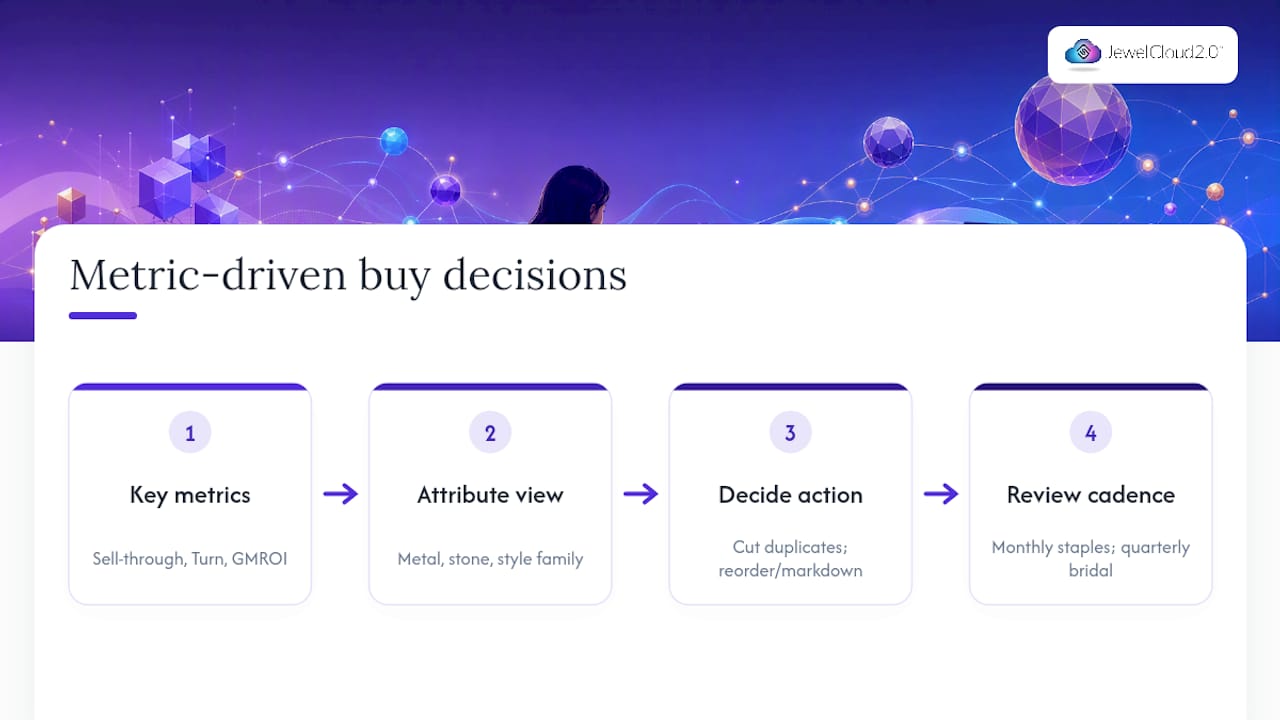
Review these by attribute, not just by category. Break sell-through down by metal, stone type, and style family to catch patterns a category-level view misses, like yellow gold consistently outselling white gold in your market. This is where Oracle Retail’s work with Helzberg Diamonds offers a useful lesson: their platform’s demand-transference features helped the retailer identify and cut duplicative SKUs, freeing up capital for styles with genuinely unique demand rather than five versions of the same idea. Set a review cadence, monthly for fast-moving staples, quarterly for bridal and statement, so aging stock gets flagged before it becomes dead weight.
Deciding What to Own vs. What to Access
Not every piece in your assortment needs to sit in your case as owned inventory. Four models cover most sourcing decisions:
- Owned stock for your fastest-turning staples, where immediate availability drives the sale.
- Memo for higher-ticket or bridal pieces, letting you display without full cash exposure until sold.
- Dropship or vendor catalogs for breadth categories where customers browse online before committing.
- Build-to-order for bridal and custom work, where the customer expects to wait anyway.
Weigh each option against cash exposure, vendor lead time, margin retention, and the customer experience you’re promising. A checklist worth running quarterly: which SKUs tie up the most cash relative to their turn, and could any of them shift to memo or catalog access without hurting the customer experience?
Merchandising by Story, Not Just by Product Type
Cases organized strictly by product type (all rings together, all earrings together) make shoppers work harder to see how pieces relate. Story-led merchandising groups pieces by occasion, aesthetic, or outfit, which naturally invites add-on purchases.
- Build shoppable sets: a necklace, earring, and ring combination styled for a specific look, priced individually but displayed as a set.
- In small stores, rotate one case or window around a seasonal story monthly. In omnichannel setups, mirror that story across in-store displays and digital showcase pages so the online experience matches the counter.
- Train staff to suggest the second piece, not just close the first sale. A stacking ring next to a solitaire, a chain extender next to a pendant.
Pro Tip: Photograph your best-selling piece styled three different ways once a quarter. Those images do double duty: in-store lookbooks and online product pages both benefit from the same shoot.
Reserving Capacity to Test New Ideas Safely
Hold back 10 to 15 percent of your open-to-buy specifically for testing.
- Run small test buys, six to twelve units, on unproven styles before committing to a full order.
- Use memo or a single-store regional pilot to gauge demand before rolling a trend chainwide.
- Give tests four to six weeks, then scale winners into your core reorder and cut losers before they become aged stock.
This keeps trend chasing from cannibalizing the capital your staples and bridal roles depend on.
Auditing the Assortment Through Your Customer’s Eyes
Walk your own case like a shopper monthly. In-store, check that entry-price pieces sit near the door, bridal samples are clean and current, and the story groupings still make sense together. Online, verify that filters work, product data is consistent across metal and stone attributes, and every variant has a real image. A fifteen-minute weekly walkthrough, physical or digital, catches friction points before they cost you a sale.
Buying Smarter at Trade Shows and Markets
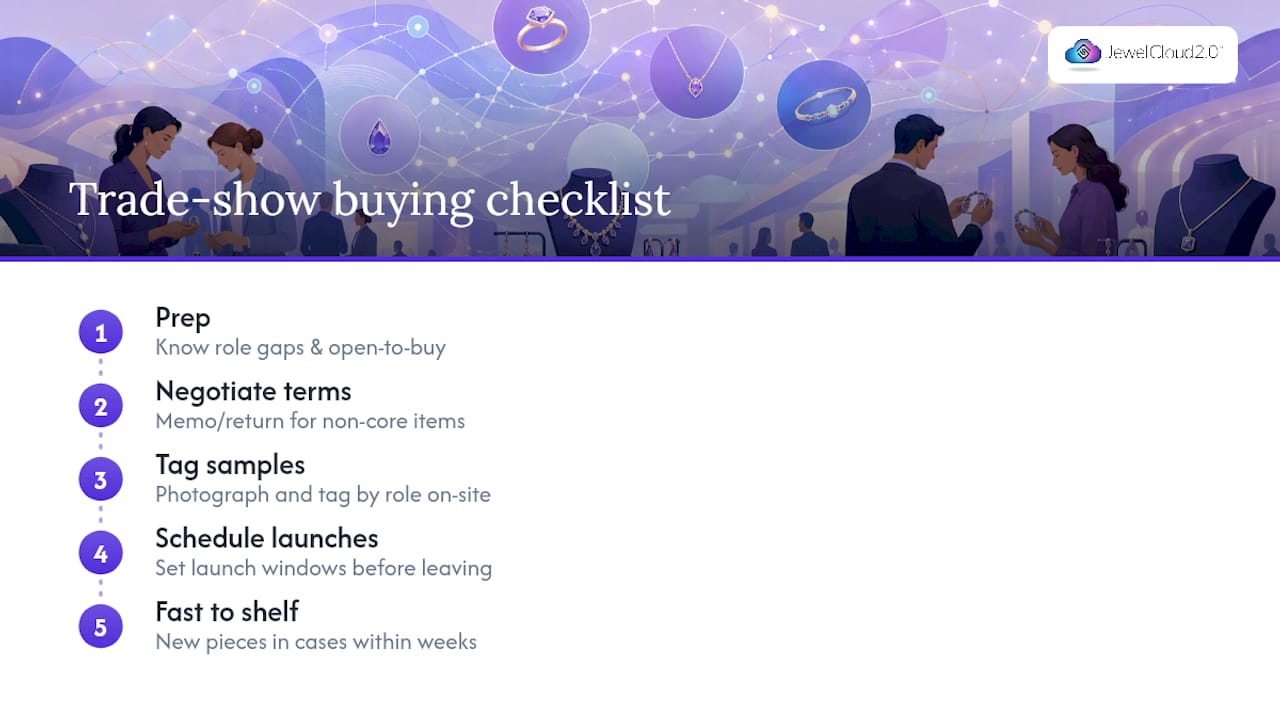
Trade-show buying compresses months of decisions into days, which is exactly when a clear assortment plan pays off. Walk in knowing your role gaps (staple, bridal, statement) and your open-to-buy by band before you see a single booth. Negotiate memo or return terms on anything outside your proven core, a practice that helped Helzberg Diamonds manage assortment risk at scale. Photograph samples on-site, tag them by role immediately, and plan launch windows before you leave the show floor so new pieces hit the case within weeks, not months.
Making Assortment Best Practices Work With Better Product Data
Standardized product data is the quiet infrastructure behind every strategy in this guide. A Jewelry PIM that stores full item cards, metal type, karat, stone specs, certification numbers, and consistent imagery, cuts intake time dramatically and makes online filtering actually work for shoppers.
- Vendor catalogs and digital drop-in feeds let you expand online assortment without pre-buying every SKU, supporting memo and dropship models directly.
- Real-time inventory sync, the kind jewelry-specific inventory platforms provide, keeps in-store and online stock numbers matched, avoiding oversells.
- A realistic timeline for launching a new collection using integrated vendor data and a connected inventory system runs 8 to 12 weeks from selection to storefront, far faster than manual data entry allows.
What Separates a Good Buyer From a Great One
The best buyers I’ve studied treat assortment health as a weekly habit, not a seasonal event. They glance at sell-through every Monday, trust their eye on what’s beautiful, and let the numbers veto what isn’t working. Three non-negotiables show up again and again: never let bridal depth exceed actual appointment volume, never let a statement piece sit past its second markdown cycle, and never skip the monthly walkthrough of your own case.
— Anthony
Put Your Assortment Plan Into Action With JewelCloud
Everything in this guide, from testing newness to accessing bridal styles without owning every SKU, gets easier when your product data is already structured and your vendor connections are already built. Jewelcloud gives retail buyers a direct line to standardized wholesale catalogs from participating designers and manufacturers, so you can expand your online assortment and launch new collections without carrying the inventory risk yourself.

That means less time reconciling spreadsheets and more time on the merchandising decisions that actually move your GMROI. Explore the JewelCloud platform to see how connected vendor data and digital catalogs fit into your next buying cycle, and reach out to schedule a walkthrough of how it applies to your store.
Sources
For deeper reading on the ideas covered here: Oracle’s Helzberg Diamonds case study on demand-transference in practice, JCK’s coverage of Mejuri’s tiered collection strategy, WJewel’s overview of RFID-enabled inventory tracking, and Uploadify’s breakdown of modern jewelry PIM features for catalog management.
- Helzberg Diamonds | Oracle Retail customer story
- Mejuri Interconnected collection
- Jewelry Inventory Software | Real-Time Stock & RFID Tracking | WJewel
- The Modern Jewelry Inventory Software | Uploadify