


Jewelry brand wholesale retail expansion is the process of growing your wholesale order volume, retail footprint, and supplier partnerships to drive sustainable revenue. The wholesale channel is not a secondary revenue stream. For Kendra Scott, wholesale drove demand as the foundational layer beneath retail and e-commerce, helping build a $1 billion brand. This guide covers SKU discipline, supplier sourcing, digital distribution, and omnichannel store growth so you can scale with confidence and control.
How does jewelry brand wholesale retail expansion actually work?
Wholesale retail expansion in jewelry means growing your distribution through two parallel tracks: placing your products with more retail partners and opening or activating more retail touchpoints yourself. The two tracks reinforce each other. More retail exposure builds brand recognition, which makes wholesale buyers more willing to carry your line.
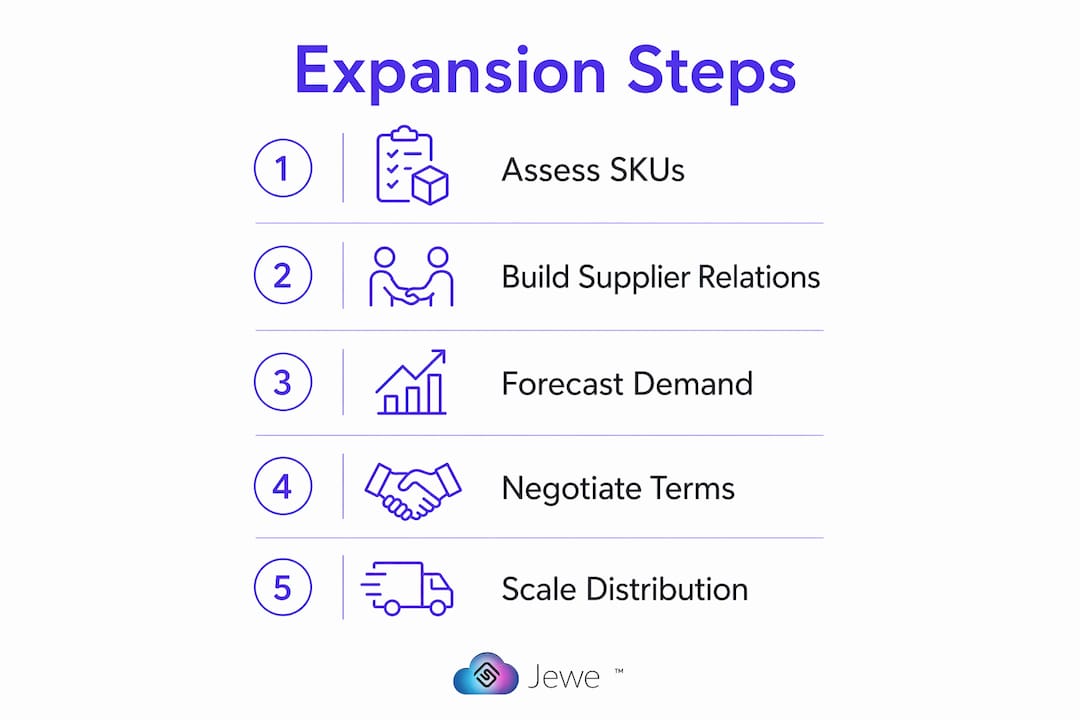
SKU discipline sits at the center of both tracks. Retailers who try to scale with too many styles spread their cash across slow-moving inventory and strain supplier relationships. The most effective approach is to identify your best performers first, then build outward from that core.
Supplier relationships are the other pillar. Your ability to negotiate better terms, secure production capacity, and maintain consistent quality depends entirely on how you manage those partnerships over time. Getting both tracks right before you scale is what separates controlled growth from expensive mistakes.

How to identify profitable jewelry SKUs before scaling inventory
The 20/80 principle applies directly to jewelry inventory. SKU discipline means focusing your inventory investment on the 20% of styles that generate 80% of your revenue. That focus protects cash flow and keeps your factory relationships stable.
Before you commit to larger wholesale orders, evaluate sell-through velocity over a 60–90 day window. A style that sells through 70% of its units in 60 days is a reorder candidate. A style sitting at 30% after 90 days is a cash drain, regardless of how much you like the design.
When launching or testing a new category, start with 8–12 styles. That range gives you enough variety to read customer preferences without overcommitting capital. Use that test window to identify which styles earn repeat purchases, which price points perform, and which materials generate the fewest returns.
Balancing trend responsiveness with core inventory is a real tension in jewelry. Trend pieces attract attention and drive traffic, but core styles drive reorders and wholesale volume. A healthy assortment holds roughly 70% core and 30% trend-driven styles.
- Sell-through velocity: Track units sold per week per style, not just total units sold.
- Return rate by style: High return rates signal fit or quality issues before they become supplier disputes.
- Reorder frequency: Styles reordered by retail partners within 60 days are your wholesale anchors.
- Price point performance: Identify which price bands move fastest in each retail channel.
- Customer repeat rate: Styles that drive repeat purchases signal brand loyalty, not just novelty.
Pro Tip: Before placing your next wholesale reorder, pull your 60-day sell-through report by style. Reorder only the top performers. Let slow movers exit naturally rather than discounting them into margin loss.
Best practices for sourcing wholesale jewelry and managing MOQs
Choosing the right supplier type determines your minimum order quantity (MOQ), your unit cost, and your flexibility to test new styles. MOQs vary significantly by supplier tier: trade companies offer flexible low MOQs, mid-tier factories require 100–500 pieces per style, and large factories set MOQs at 500–2,000 pieces per style. Matching your supplier type to your current sales volume prevents you from overcommitting to inventory you cannot move.
Budget allocation should match your brand’s growth stage. First-order budgets range from $500 for initial testing with 8–12 styles, to $1,500 for a soft launch with 12–20 styles, to $5,000 for established boutiques carrying 20–40 styles. These ranges reflect realistic entry points, not aspirational targets.
- Define your supplier tier. Match your current order volume to the right supplier type. Starting with a large factory when you need 50 units per style wastes negotiating leverage and locks up capital.
- Request samples before committing. Quality control starts before the purchase order. Inspect metal weight, clasp durability, stone setting, and finish consistency on every new style.
- Negotiate payment terms, not just price. Net-30 or Net-60 terms improve your cash position more than a 5% price reduction on a small order.
- Build a reorder program. Identify your top three to five styles and set a reorder schedule based on sell-through data. Predictable orders give suppliers a reason to prioritize your production.
- Document quality standards in writing. Specify acceptable tolerances for metal weight, stone clarity, and finish before production begins. Written standards prevent disputes after delivery.
Pro Tip: Share a 90-day sales forecast with your supplier before negotiating your next order. Proven sell-through data earns volume pricing and reserved production slots that new buyers cannot access.
| Brand stage | Budget range | Style count | Supplier type |
|---|---|---|---|
| Initial testing | $500 | 8–12 styles | Trade company, low MOQ |
| Soft launch | $1,500 | 12–20 styles | Mid-tier factory |
| Established boutique | $5,000 | 20–40 styles | Mid-tier to large factory |
How do digital tools help you reach more retail jewelers?
Digital product distribution is now the fastest way to increase jewelry wholesale order volume without adding headcount. Integrating product catalogs directly into retailer websites via platforms like Jewelcloud’s native Shopify integration gives brands instant access to retail distribution at scale. That means your product data, images, and pricing appear on retail partner sites without manual uploads or duplicate data entry.
Jewelcloud structures and standardizes product data for the specific complexities of jewelry, including metal type, stone weight, carat, and finish. Retailers get accurate, consistent information. Suppliers get visibility across a qualified retail network without maintaining separate feeds for each partner.
- Real-time inventory feeds: Retailers see current availability, reducing oversell errors and customer disappointment.
- Standardized product data: Consistent attributes like metal type, stone weight, and finish improve search performance on retail sites.
- Reduced onboarding friction: Retailers can add new supplier lines without manual data entry, which speeds up the decision to carry your brand.
- Centralized catalog management: Update pricing or product details once and changes propagate across all connected retail partners automatically.
Jewelry-specific retail operations also require specialized tools for consignment tracking, special order management, and serial number logging. Scaling retailers who skip jewelry-specific POS software create operational gaps that grow more expensive as volume increases. A general retail POS cannot handle the nuances that jewelry transactions require.
Pro Tip: Use a jewelry supplier catalog integrated directly into your retail website to keep product data current across every channel without manual updates.
What does disciplined omnichannel retail expansion look like?
Physical retail expansion works when it follows a methodology, not an opportunity. Disciplined retail growth requires location analytics, demographic assessment, lease negotiation, and supply chain readiness before a new store opens. Skipping any one of those steps creates a location that underperforms and drains resources from your better-performing outlets.
The speed of expansion matters less than the quality of execution. One omnichannel jewelry brand added 14 new stores in 40 days, growing from 57 to over 75 locations. That pace is only possible when the supply chain, inventory systems, and brand standards are already locked in before expansion begins.
Before opening a new retail location, verify these conditions:
- Inventory depth: New locations need enough SKU depth to fill the floor and support reorders within 30 days of opening.
- Supply chain readiness: Your supplier must be able to fulfill reorders on the timeline your new location requires.
- Brand consistency: Visual merchandising standards, pricing, and customer experience must match existing locations from day one.
- Lease terms: Negotiate exit clauses and rent escalation caps before signing. A bad lease in a good location still destroys margin.
- Local demographic fit: Validate that the target customer profile exists in sufficient density within a 5-mile radius of the proposed site.
Omnichannel consistency is what protects brand equity during rapid expansion. Customers who buy online and pick up in-store, or who browse in-store and complete the purchase online, expect the same product information, pricing, and experience across every touchpoint. Platforms that unify jewelry retail growth across wholesale, physical stores, and e-commerce make that consistency achievable without a large operations team.
Key Takeaways
Successful jewelry brand wholesale retail expansion requires SKU discipline, supplier alignment, digital distribution, and methodical store growth working together from the start.
| Point | Details |
|---|---|
| SKU discipline drives cash flow | Focus reorders on the 20% of styles generating 80% of revenue before scaling inventory. |
| Budget matches brand stage | Allocate $500–$5,000 for first orders depending on whether you are testing, launching, or scaling. |
| Supplier terms improve with data | Share 60–90 day sell-through forecasts to earn volume pricing and reserved production capacity. |
| Digital feeds scale distribution | Catalog integration through platforms like Jewelcloud removes manual data entry across retail partners. |
| Retail expansion needs a methodology | Validate location analytics, supply chain readiness, and brand standards before opening each new outlet. |
What I’ve learned about scaling jewelry wholesale without losing control
The brands I’ve watched struggle with expansion almost always made the same mistake: they scaled the number of SKUs before they scaled the systems to support them. A retailer carrying 200 styles with no sell-through data is not growing. They are accumulating risk.
The counterintuitive truth is that fewer, better-performing SKUs give you more leverage with suppliers, not less. When you can show a factory that three styles sell through consistently every 60 days, you earn terms that a buyer with 50 slow-moving styles never will. Discipline in the catalog is what funds the next phase of growth.
Digital distribution changed the math on wholesale visibility. Before platforms like Jewelcloud connected supplier catalogs directly to retail websites, getting your product in front of qualified retail buyers required trade shows, sales reps, and months of relationship building. Now a supplier can be live on a retail partner’s site within days. That speed changes how you think about vendor benefits and what it costs to grow a wholesale network.
The retailers who scale well treat their data as a living asset. They review sell-through weekly, adjust reorders monthly, and share forecasts with suppliers quarterly. That rhythm is not complicated. It is just consistent. Consistency is what separates the brands that reach 75 locations from the ones that stall at five.
— Anthony
Jewelcloud helps jewelry brands scale wholesale and retail reach
Expanding your wholesale and retail presence requires the right infrastructure behind your catalog. Jewelcloud is a B2B jewelry platform built for designers, manufacturers, and diamond dealers who want their products in front of qualified retail partners without the burden of manual distribution.
Through Jewelcloud’s product feed technology, your inventory data reaches retail jewelers digitally with standardized attributes, real-time availability, and consistent brand presentation. Retailers can source, showcase, and sell your products without carrying physical stock. For suppliers, that means broader visibility and stronger retail relationships built on accurate data. Explore jewelry vendor membership options to see how Jewelcloud connects your catalog to a growing network of retail partners ready to carry your line.
FAQ
What is jewelry brand wholesale retail expansion?
Jewelry brand wholesale retail expansion is the process of growing distribution through more retail partners and more retail locations simultaneously. It requires SKU discipline, supplier alignment, and consistent product data across every channel.
How many SKUs should I start with for wholesale?
Launch with 8–12 tested styles for initial wholesale testing. That range gives you enough variety to read demand without overcommitting capital to slow-moving inventory.
How do I negotiate better terms with jewelry suppliers?
Prove stable sell-through over 60–90 days and share a realistic sales forecast before negotiating. Suppliers offer volume pricing and reserved production capacity to buyers who demonstrate predictable demand.
Why do jewelry retailers need specialized POS software?
General retail POS systems cannot handle consignment tracking, special order management, or serial number logging. Jewelry-specific POS software prevents operational gaps that grow more costly as transaction volume increases.
How does Jewelcloud help with wholesale distribution?
Jewelcloud integrates supplier catalogs directly into retail partner websites using standardized product data. That connection gives suppliers immediate visibility across a qualified retail network without manual data entry or duplicate catalog management.