


Jewelry data cleansing means cleaning, normalizing, and standardizing product attributes and inventory records so feeds, marketplaces, and integrations actually work. The immediate next step is a schema audit: pull 50 to 200 sample records, log the top 10 missing or inconsistent attributes, and canonicalize your SKUs before touching anything else. JewelCloud and standards like schema.org’s additionalProperty give you a concrete target format to audit against.
TL;DR:
- Proper schema auditing and standardization are essential, focusing on attributes like metal purity, stone type, and certification, before normalization.
- Missing or inconsistent structured data can hinder discoverability, especially as AI shopping agents and marketplaces prioritize complete, machine-readable product fields.
- Fixing common data issues involves mapping variants to controlled values, standardizing weights, and capturing certification details as separate data fields.
- Ongoing validation and governance, including schema checks and feed rejection monitoring, are necessary to maintain data quality over time.
- Using jewelry-specific tools and prebuilt templates helps quickly achieve clean, syndicate-ready product feeds, reducing manual effort and reducing errors.
Table of Contents
- Why Jewelry Data Cleansing Matters for Discoverability in 2026
- Step-by-Step Jewelry Data Cleansing Workflow
- Fixing Common Data Problems: Normalization Rules That Work
- How to Validate and Govern Clean Jewelry Data Long-Term
- Data Enrichment Techniques to Fill Missing Attributes
- Error Detection and Automated Correction Methods
- Tools and Software for Jewelry Data Cleansing
- JewelCloud’s Playbook for Clean, Syndicated Jewelry Data
- Get Your Jewelry Catalog Feed-Ready Faster With JewelCloud
- Sources
Why Jewelry Data Cleansing Matters for Discoverability in 2026
Search engines and shopping algorithms no longer read your product descriptions the way a customer does. They scan for structured, machine-readable fields, and if your metal purity, stone type, or certification details are buried inside a paragraph of marketing copy, that data is often invisible to filters and AI agents. A ring described beautifully in prose but missing a stone_certification field simply won’t surface when a shopper filters by GIA-certified diamonds.
The stakes are rising fast. Industry analysis shows jewelry and watch catalogs are frequently thin on attributes, and that gap correlates with weaker discoverability and higher returns, since shoppers who can’t verify specs before buying return more of what they order.
Three forces make this urgent heading into 2026:
- AI shopping agents parse structured fields, not adjectives, to match buyer intent.
- Marketplaces increasingly reject or bury listings with incomplete required attributes.
- Retailers who standardize attributes early gain a compounding advantage as competitors scramble to catch up.
Clean data isn’t a back-office chore anymore. It’s the difference between a listing an algorithm can rank and one that quietly disappears.
Step-by-Step Jewelry Data Cleansing Workflow
Treat this like any inventory renovation: audit first, standardize second, deploy last. Here’s the sequence that works for a catalog in the 200 to 1,000 SKU range.
- Audit a sample set. Pull 50 to 200 records across your product mix and log every missing attribute, every instance of free-text dumping (where specs are written into a description instead of a field), and every inconsistent value format.
-
Define your controlled attribute taxonomy. Lock down field names and accepted values for
metal_purity,stone_type,stone_certification,carat_weight,size, and yourSKUformat before you normalize a single record. A recommended jewelry product data model includes gross and net weight in grams, stone weight in carats, certification identifiers, and channel-aware pricing components as a starting reference. - Normalize SKUs and titles. Resolve vendor-code aliasing (the same ring sold under three different supplier codes) and merge duplicate listings under one canonical SKU.
- Extract structured fields from prose. Pull metal type, carat weight, and certification out of descriptions and into dedicated fields. Standardize units and decimal precision as you go.
-
Map fields to each sales channel. Match your taxonomy to marketplace feed templates and to schema.org’s
additionalPropertypattern, then run a sandbox dry run before going live. - Reconcile inventory ownership. Separate memo stock from owned inventory and set a sync cadence, real-time for high-turnover items, batch for the rest.
- Estimate your timeline honestly. For a catalog of 200 to 1,000 SKUs, this typically runs 1 to 3 weeks, depending heavily on how messy your source data is going in.
- Roll out in stages. Validate a small sample, deploy, monitor for feed rejections, and iterate weekly until rejections drop to near zero.
Pro Tip: Don’t backfill your entire catalog in one pass. Populate your top 50 SKUs by revenue first, validate them against a live feed, then backfill the rest, so you catch mapping errors before they multiply across a thousand records.
The jewelry ecommerce catalog management guide walks through how to structure this taxonomy work in more detail if you’re building it from scratch.
Fixing Common Data Problems: Normalization Rules That Work
Most jewelry data messes trace back to the same handful of habits. Here’s how to fix each one with a specific rule, not a vague instruction.
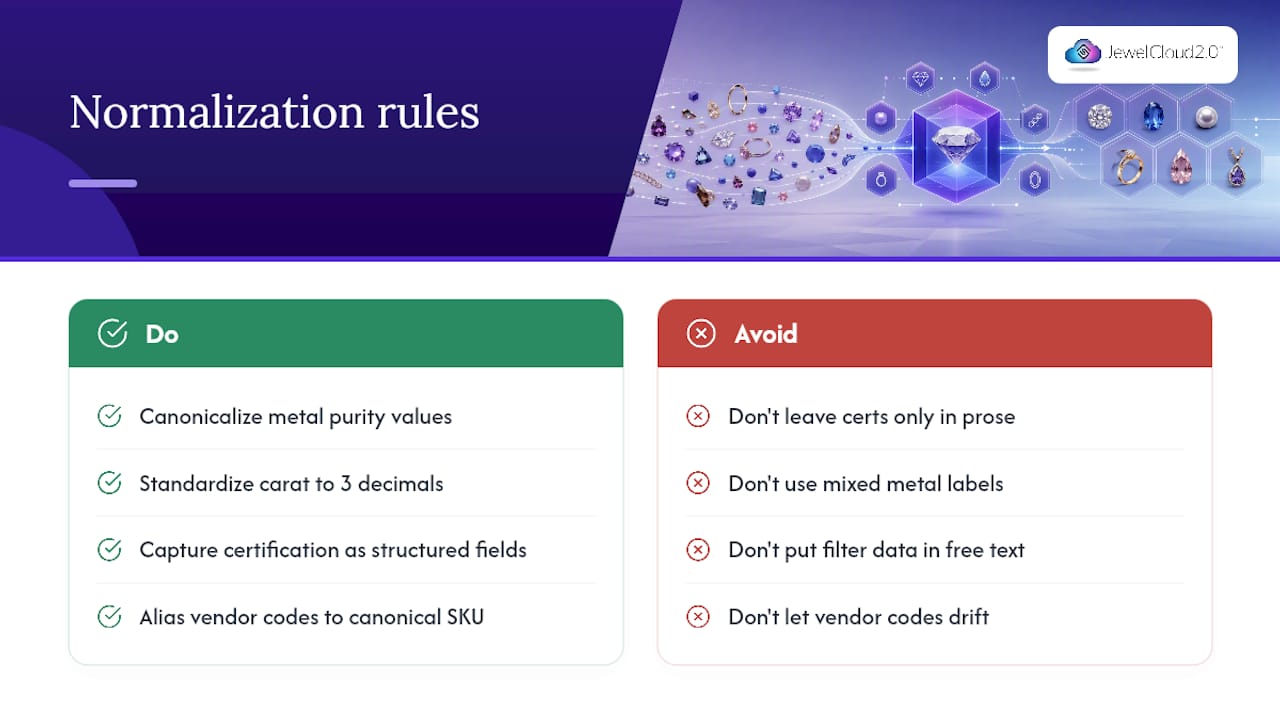
Metal purity canonicalization. Map every variant to a single controlled value: “14 kt,” “14k,” and “14 karat” all become 14k. Build a simple find/replace table covering 10k, 14k, 18k, 22k, platinum, and sterling silver, then run it against your entire catalog in one pass.
Carat and weight precision. Standardize carat weight to three decimal places (0.750 ct, not “3/4 carat” or “0.75ct”) and report metal weight in grams consistently across every listing.
Certification as structured data, not prose. Instead of writing “GIA certified” in a description, capture it as a paired field: issuer (GIA, IGI) plus certificate number. This is exactly the kind of controlled-value normalization that produces real interoperability across channels instead of manual exception handling for every order.
Title versus description versus structured fields. Titles should carry the searchable essentials, metal, stone, style. Descriptions carry the story. Structured fields carry everything a filter or an AI agent needs to match intent. Don’t let any of the three do another’s job.
Image alt text and filenames. Use consistent, descriptive patterns: 14k-yellow-gold-solitaire-ring-1ct-front.jpg beats IMG_4471.jpg every time a feed parser touches it.
Vendor aliasing. Store every supplier’s product code as an alias keyed to one canonical SKU, so a code change on the vendor side never orphans your inventory record. This single habit resolves most of the duplicate-listing headaches retailers fight for years.
Free-text stuffing, fragmented custom-order records, and inconsistent vendor codes remain the top operational drags on jewelry catalogs, and every one of them has a normalization fix that takes minutes, not months, once you know the rule.
How to Validate and Govern Clean Jewelry Data Long-Term
Cleansing data once and never checking it again is how you end up back here in eighteen months. Validation and governance are what make the fix stick.
Run this checklist before and after every major import:
- Schema checks against your defined taxonomy, catching missing required fields before they reach a feed.
- Feed validator runs specific to each marketplace’s template.
- Sandbox listings on the marketplace itself, not just internal QA.
- Sample checks on 10 to 20 products before a full-catalog push.
Watch these KPIs monthly, not annually:
| KPI | Why it matters |
|---|---|
| Feed rejection rate | Flags taxonomy or formatting errors early |
| AI/search surfacing for category queries | Confirms structured fields are actually being read |
| Conversion rate on structured listings | Measures buyer confidence from complete data |
| Return rate | Thin attribute coverage tracks with higher returns |
| Inventory mismatch count | Catches sync failures between vendor and storefront |
Automate what you can: quarantine imports that fail schema checks instead of letting them publish, route flagged records to a human review queue, and alert on any SKU missing a required field. On cadence, backfill your top 50 SKUs by revenue first, run vendor syncs weekly, and schedule a full catalog audit quarterly.
Data Enrichment Techniques to Fill Missing Attributes
Not every gap in your catalog needs a manual fix. Vendor-supplied spec sheets are the fastest enrichment source. If your supplier already lists metal purity and stone weight on an invoice or product sheet, mapping that document to your taxonomy is quicker than researching each SKU from scratch.
Certification lookups are the second lever. If a piece carries a GIA or IGI report number but your record only has the number, not the issuer or grade details, a lookup against the certifying body’s public database fills the gap without guesswork.
Pattern inference works for gaps in older records.
Cross-referencing similar SKUs from the same vendor catches attributes that got dropped during a prior migration. If a vendor’s other rings in the same collection all list stone clarity and one doesn’t, that’s a signal to go back to the source, not to leave the field empty.
The rule across all four techniques: enrichment fills a gap, it doesn’t invent a fact. Flag anything estimated or inferred so your review queue catches it before it ships as verified data.
Error Detection and Automated Correction Methods
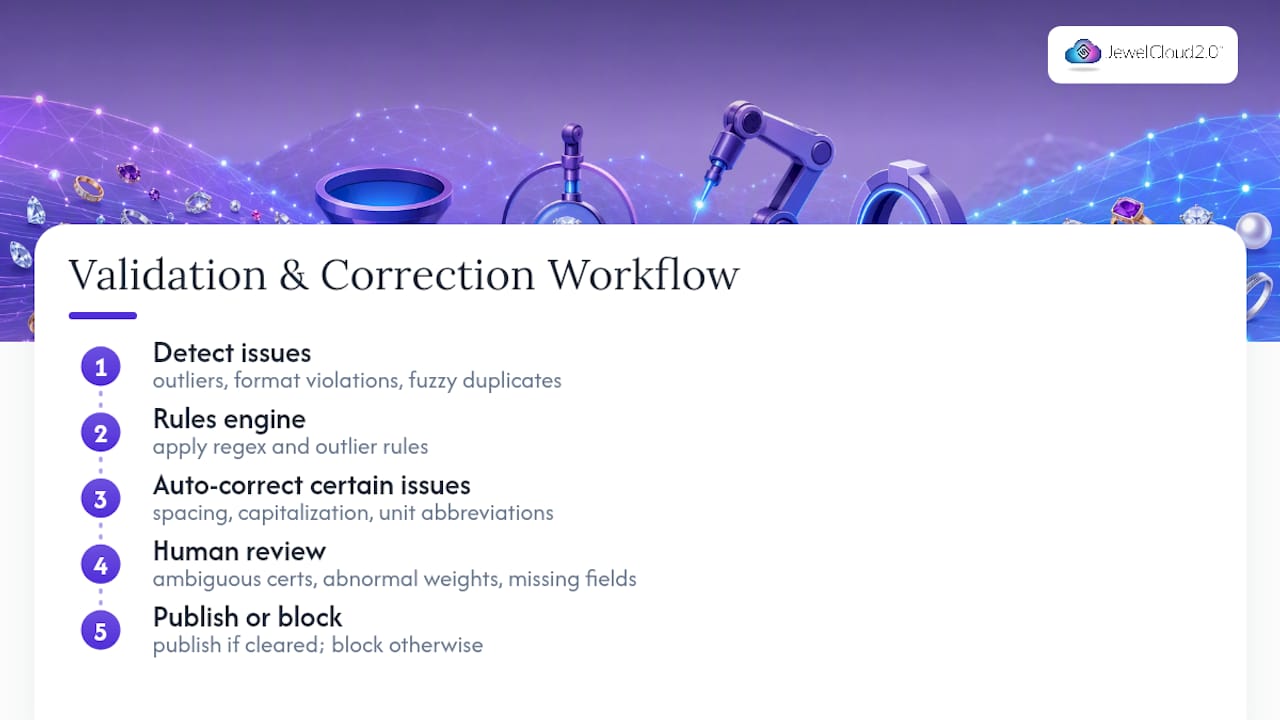
Catching bad data before it reaches a feed is far cheaper than fixing it after a marketplace rejection. Build rules that flag statistical outliers automatically, a “14k” ring priced like platinum, or a carat weight of 15.000 on a stud earring, are almost always typos, not inventory.
Format validation catches the rest. A regex rule that rejects any metal_purity value outside your controlled list (10k, 14k, 18k, 22k, platinum, sterling) stops “14 KT” and “14kt gold” from ever reaching production. The same logic applies to certification numbers: if a GIA report number doesn’t match the expected digit pattern, quarantine it for review instead of publishing it.
Duplicate detection deserves its own pass. Fuzzy matching on title plus metal plus stone weight catches near-duplicate listings that exact-match SKU comparison misses, especially after a vendor catalog migration.
Automated correction should stay narrow. Auto-fix formatting issues you’re certain about (spacing, capitalization, unit abbreviations). Route anything ambiguous, a missing certification field, a weight that falls outside your normal range, to a human review queue rather than guessing. The catalog and compliance management approach that most feed-optimization specialists recommend follows this same split: automate the mechanical, escalate the judgment calls.
Tools and Software for Jewelry Data Cleansing
General-purpose data cleaning tools miss jewelry’s specific complexity, carat precision, certification pairs, metal purity variants, so purpose-built approaches matter more here than in most retail categories.
Product information management (PIM) platforms built for jewelry, like JewelCloud, come with pre-structured taxonomy templates for metal, stone, and certification fields, which skips the weeks you’d otherwise spend defining a schema from scratch. Generic PIM tools can be adapted, but you’ll spend real effort building jewelry-specific validation rules that a specialized platform already ships with.
Feed validators specific to each marketplace catch formatting errors before submission rather than after rejection. Spreadsheet-based bulk editors, even something as basic as a well-structured Google Sheet with data validation rules, work fine for catalogs under 500 SKUs if you’re disciplined about controlled values.
Schema markup testing tools verify your additionalProperty implementation renders correctly for search engines and AI agents before you push it live. PIM approaches that prioritize controlled attribute names and consistent schema mapping reduce feed rejections measurably compared to ad hoc spreadsheet cleanup, mainly because the validation rules are baked into the tool rather than left to manual review.
JewelCloud’s Playbook for Clean, Syndicated Jewelry Data
We built JewelCloud around the same problem this article walks through: vendor data arrives messy, and retailers pay the price in rejected feeds and invisible listings. Our approach standardizes attribute taxonomy through prebuilt templates for metal, stone, and certification fields, then onboards vendors against that same structure so data arrives consistent instead of getting normalized after the fact.
Batch normalization and channel mapping run against validation rules before anything syncs to a retail partner’s storefront, which is what shortens the timeline suppliers and retailers both feel most. Heading into 2026, our advice to any supplier onboarding is simple: prioritize certification fields first, expose your additionalProperty arrays fully for AI agents, and run sample validation checks on your top SKUs before assuming the rest of the catalog is fine.
— Anthony
Get Your Jewelry Catalog Feed-Ready Faster With JewelCloud
Cleaning your own catalog by hand works, but it costs weeks of staff time you probably don’t have sitting idle. Some platforms shorten that timeline by giving suppliers pre-built attribute templates, vendor sync tools, and channel mapping already configured for marketplace and schema.org requirements, so you’re not building a taxonomy from a blank sheet.
Retailers get access to a wider assortment sourced from vendors who’ve already run through a standardization process, which means richer product pages without carrying the inventory yourself. Suppliers get a distribution channel where data is structured once and syndicated everywhere, instead of reformatted separately for every retail partner. If your catalog is the size where a manual cleanup would eat a month of staff time, request a data audit through JewelCloud and see what a structured taxonomy would look like against your own SKUs before you commit a single hour to fixing it yourself.