


Jewelry design scalability is defined as the ability to grow production volume, expand collections, or increase customization options without losing quality or brand consistency. For designers and brand owners, understanding what is jewelry design scalability means recognizing that growth requires more than creative ambition. It demands structured design practices, disciplined manufacturing workflows, and the right technology infrastructure. The industry term most professionals use is “production scalability,” and it covers everything from modular component libraries to purpose-built ERP systems. This guide breaks down the principles, tools, and practical steps that make scaling a jewelry brand both achievable and profitable.
What is jewelry design scalability and why does it matter?
Jewelry design scalability is the capacity to increase output or product variety while keeping defect rates low and brand identity intact. Without it, growth creates chaos: mismatched finishes, inconsistent stone settings, and ballooning production costs. Scalable jewelry design balances creative authenticity with systematic production controls to deliver predictable quality at any volume.
The stakes are real. Prototyping costs for scalable jewelry design typically range from $150 to $300 per piece, with defect rates kept below 3% through proactive engineering. That 3% threshold is the industry benchmark. Exceeding it at higher volumes means rework costs compound fast and eat directly into margins.
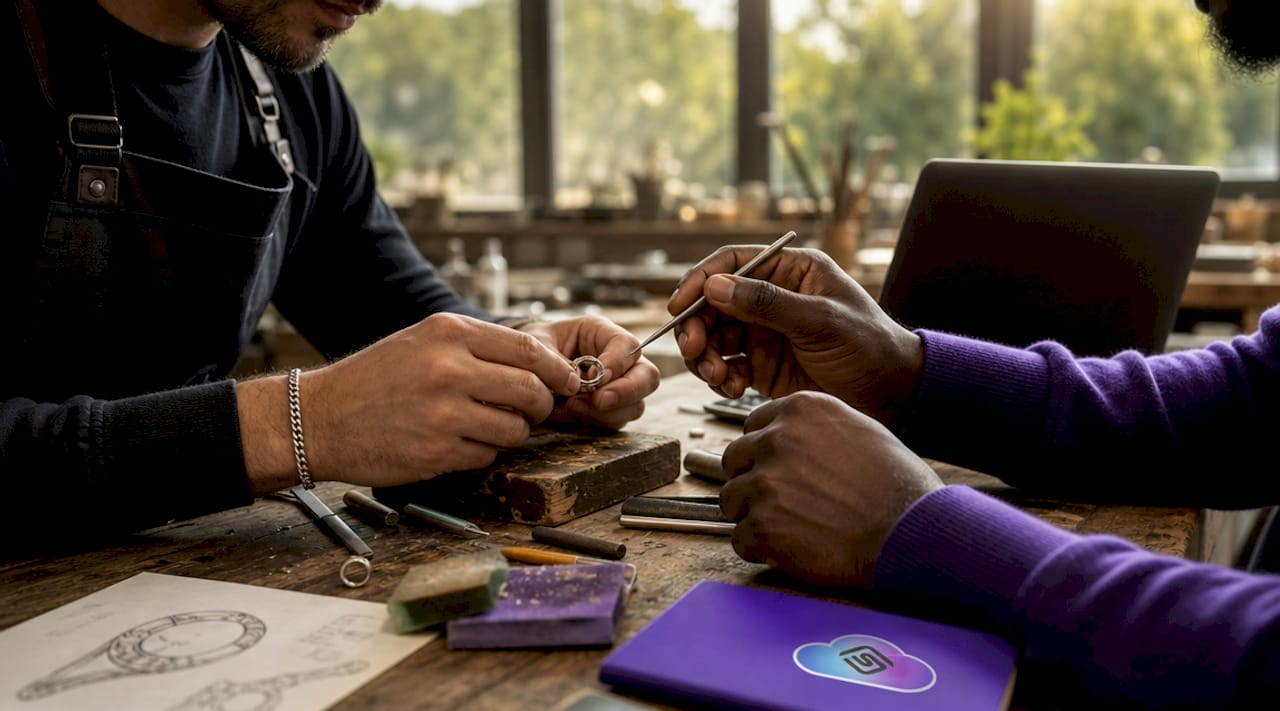
Scalability also shapes how quickly you can respond to market demand. A brand that has locked in its design standards and production tolerances can launch a new collection in weeks rather than months. One that has not will spend that time firefighting quality issues instead of selling.
What are the key principles that support scalable jewelry design?
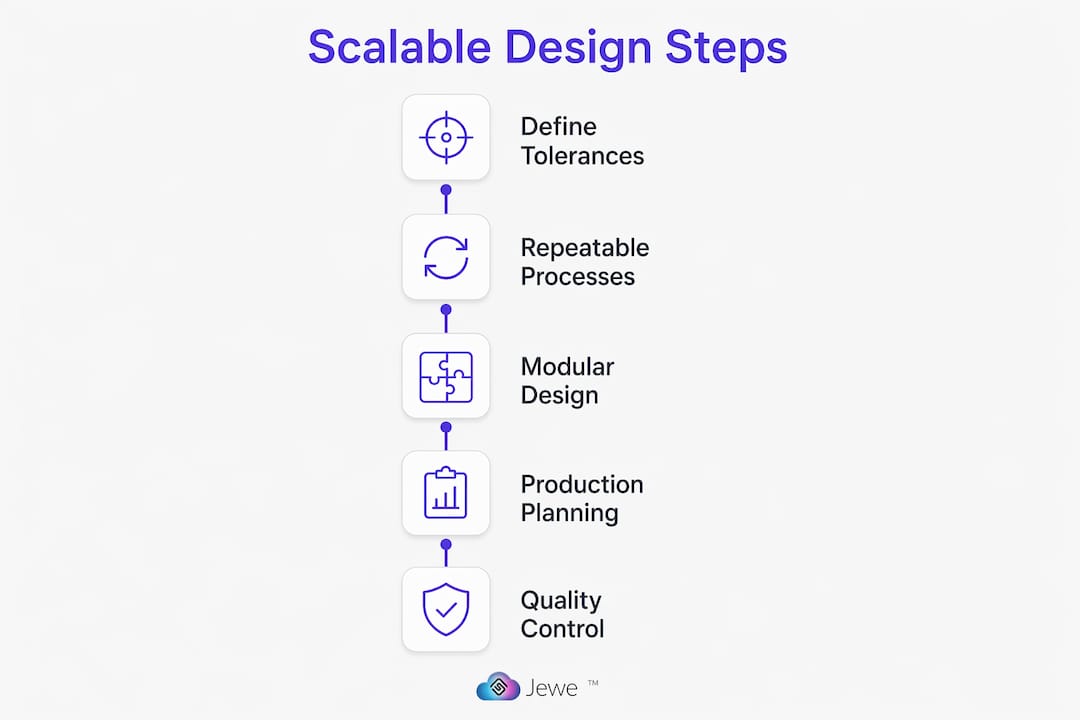
Scalable jewelry design rests on three foundational principles: defined tolerances, repeatable processes, and modular design standards. Each one reduces the variables that cause quality to slip when volume increases.
Defined tolerances set the acceptable range for dimensions, metal thickness, and finish quality across every piece. Without written tolerances, each craftsperson interprets “good enough” differently. At 50 units, that variation is manageable. At 500, it becomes a quality crisis.
Repeatable processes mean every production stage follows a documented sequence. This includes:
-
Standardized CAD file formats and naming conventions
-
Fixed casting parameters for each alloy type
-
Documented stone-setting procedures by setting style
-
Written QC checkpoints at casting, finishing, and final inspection
Modular design standards allow you to maintain a consistent brand identity across an expanded catalog. Structured capsule collections with shared molds and standardized gemstone sizing lower manufacturing costs while preserving the visual language your customers recognize.
Pro Tip: Before scaling any collection, document your design standards in a single reference file. Include metal thicknesses, stone size tolerances, and finish specifications. This file becomes your quality anchor as production volume grows.
How does modular design enable scalable customization?
Modular design is the primary industry strategy for growing a jewelry line without proportional cost increases. The concept is straightforward: build a library of interchangeable components, then combine them to create unique pieces. Modular design reduces design time by up to 80% compared to fully bespoke approaches.
The numbers behind modular systems are striking. A system using just 22 components across five band styles, five settings, eight stone shapes, and four accent styles generates over 800 unique combinations. That means premium custom pricing with standardized manufacturing efficiency. Your production team works with familiar components. Your customers experience genuine personalization.
The practical benefits extend across the entire production chain:
-
Prototyping costs drop because new designs reuse existing molds and components
-
Lead times shorten because component inventory is predictable and pre-stocked
-
Order capacity increases because workers build speed on repeated assembly sequences
-
Client personalization scales without requiring bespoke design time for every order
Minimum order quantities for low-risk scaling typically start at 50 to 100 pieces. Modular systems make those MOQs easier to hit because you can mix combinations within a single production run rather than committing to one design.
Pro Tip: Build your modular library around your three best-selling silhouettes first. Expanding from proven designs reduces adoption risk and gives your production team a familiar starting point.
What manufacturing workflows support scaling jewelry design effectively?
Manufacturing capacity planning is where most jewelry brands hit their first serious wall. The design looks great. The samples pass QC. Then volume doubles and suddenly casting yields drop, stone-setting backlogs pile up, and delivery dates slip. Scaling jewelry production is non-linear. What works at 100 units often fails at 1,000 due to bottlenecks in material handling, mold wear, or quality control.
The solution is a data-continuous production workflow. Purpose-built jewelry ERP systems maintain a thread from CAD file to retail tag, managing karat conversion, alloy mixing, and worker output to support accurate costing and traceability. Generic ERP platforms miss the jewelry-specific details. They cannot track scrap reconciliation by alloy type or flag when a stone parcel weight does not match the setting count. Jewelry manufacturing software must track karat conversion and scrap reconciliation to prevent material loss that generic systems simply cannot see.
A typical production cycle follows this sequence:
-
Design review and CAD finalization
-
Prototype casting and sample approval
-
Production casting in approved alloy
-
Stone sourcing, grading, and parcel allocation
-
Setting, finishing, and polishing
-
QC inspection against documented tolerances
-
Serialization, tagging, and inventory entry
A typical custom jewelry production cycle runs 15 to 30 days after sample approval. Complex tooling or new design elements add 7 to 14 days. Total lead time from concept to delivery spans 4 to 10 weeks. Planning your production calendar around these benchmarks prevents the overpromising that damages client relationships.
Effective inventory and metal/stone weight reconciliation rely on serialization and continuous auditing rather than annual physical checks. This data-driven approach protects margins in high-value jewelry production and is critical to scaling profitably.
Real-time reconciliation also catches shrinkage early. A 1% metal loss rate that goes unnoticed at small volumes becomes a significant cost at scale. Jewelry inventory management production systems that audit continuously give you the visibility to act before losses compound.
What practical steps improve jewelry brand scalability?
Growing a jewelry brand at scale requires deliberate sequencing. Rushing volume before your systems are ready amplifies every weakness in your process.
-
Build a structured capsule collection first. Start with 8 to 12 designs that share components, molds, and stone sizes. This creates a manageable production footprint before you expand.
-
Create a modular design library. Document every component with technical drawings, tolerances, and supplier codes. This library is your production team’s reference point.
-
Implement batch controls. Group similar production tasks into batches to reduce setup time and cross-contamination risk. Batching and workflow discipline reduce inspection burden and enable smoother scaling.
-
Invest in purpose-built production management tools. Generic spreadsheets cannot track alloy weights, stone parcels, and worker output simultaneously. A jewelry-specific system does.
-
Plan realistic production lead times. Build your client-facing timelines around the 4 to 10 week benchmark, then add a buffer for your first three production runs at any new volume level.
-
Lock design specs before scaling. Centralized standards and shared documentation mitigate the non-linear risks that come with adding volume or new production sites.
Pro Tip: Run a “scale test” before committing to a large order. Produce 50 units of a new design and measure your actual defect rate, lead time, and material yield. The results will tell you exactly where your process needs work before the stakes get higher.
Key Takeaways
Jewelry design scalability requires modular systems, documented tolerances, and purpose-built production tools working together to maintain quality as volume grows.
| Point | Details |
|---|---|
| Define tolerances first | Written specs for metal thickness, finish, and stone sizing prevent quality drift at higher volumes. |
| Use modular design systems | A library of 22 components can generate over 800 unique combinations, cutting design time by up to 80%. |
| Plan for non-linear scaling | Production bottlenecks appear between 100 and 1,000 units; batch controls and locked specs reduce this risk. |
| Track inventory continuously | Serialization and real-time reconciliation protect margins and catch material loss before it compounds. |
| Match lead times to reality | A typical production cycle runs 4 to 10 weeks from concept to delivery; build client timelines around this benchmark. |
The discipline gap most jewelry brands ignore
Most designers I talk to understand that scaling requires process. What they underestimate is how early that process needs to start. The brands that scale cleanly are not the ones with the most creative output. They are the ones that treated their first 50-piece run like a 500-piece run in terms of documentation and discipline.
The uncomfortable truth is that creativity and manufacturability are not natural partners. A design that photographs beautifully can be a production nightmare at volume. Thin prongs that a skilled bench jeweler handles with ease become a defect source when the same design runs through a production line. The solution is not to limit creativity. It is to build manufacturability checks into your design review process from the start.
Technology helps, but it is not a substitute for process discipline. A purpose-built ERP system gives you visibility into karat conversion, scrap rates, and worker output. That visibility only matters if you act on it. The brands that scale profitably are the ones that review their production data weekly, not quarterly.
The modular design approach also changes how you think about your catalog. Instead of launching 30 new designs each season, you launch 8 designs with 100 combinations each. Your customers experience more choice. Your production team experiences less chaos. That trade-off is the core of what jewelry brand scalability actually means in practice.
— Anthony
How Jewelcloud helps jewelry brands scale with confidence
Scaling a jewelry brand means managing more products, more suppliers, and more retail relationships simultaneously. Jewelcloud is built for exactly that challenge.
Jewelcloud’s B2B platform lets designers, manufacturers, and diamond dealers load their merchandise at wholesale, giving retail partners access to a structured, standardized product catalog without the burden of physical inventory. For vendors, it functions as a digital distribution channel that increases visibility and strengthens relationships with qualified retail buyers. The vendor benefits on Jewelcloud include structured product data, standardized feeds, and tools designed around the real complexities of jewelry production. If you are ready to put your catalog in front of more retail partners, explore the Jewelcloud platform and see how it fits your growth plan.
FAQ
What is jewelry design scalability in simple terms?
Jewelry design scalability is the ability to grow production volume or expand a collection without losing quality or brand consistency. It relies on modular design systems, documented tolerances, and purpose-built manufacturing workflows.
What is a realistic jewelry production lead time?
A typical custom jewelry production cycle runs 15 to 30 days after sample approval, with total lead times of 4 to 10 weeks from concept to delivery depending on design complexity and tooling requirements.
How does modular design support jewelry production scalability?
Modular design uses a library of interchangeable components to generate hundreds of unique combinations from a small number of parts. This approach reduces design time by up to 80% compared to fully bespoke methods and keeps manufacturing costs predictable.
Why does jewelry inventory management matter for scaling?
Continuous serialization and real-time metal and stone reconciliation protect margins by catching material loss early. Annual physical checks are not sufficient at production scale because shrinkage compounds faster than yearly audits can detect.
When does jewelry production scaling become non-linear?
Scaling becomes non-linear between 100 and 1,000 units, where bottlenecks in material handling, mold wear, and quality control appear. Locked design specs, batch controls, and centralized documentation reduce this risk significantly.