


Jewelry ecommerce catalog management is the practice of organizing, standardizing, and maintaining accurate product data across every channel where you sell. Done well, it reduces returns, improves search visibility, and builds shopper trust before a single word of marketing runs. Done poorly, it quietly drains revenue: inaccurate product data causes nearly 40% of jewelry retail returns, and fixing those discrepancies can cut return rates by 40–50%. Jewelcloud structures and standardizes product data for exactly this reason, treating catalog quality as a commercial asset rather than a back-office task.
What is jewelry ecommerce catalog management, and why does it matter?
Jewelry ecommerce catalog management covers every decision about how products are named, categorized, attributed, and published across your sales channels. The stakes are higher in jewelry than in most retail categories because the products are complex. A single ring SKU can vary by metal type, metal purity, gemstone type, gemstone cut, ring size, and finish. Each variation needs its own accurate data record.
Marketplace platforms make the stakes concrete. 7% of all products on Google Shopping are disapproved due to critical errors, and 48% of merchants suffer from invalid GTINs that suppress visibility. Those numbers mean a significant portion of your catalog may be invisible to shoppers before you even run an ad.
Accurate product data also replaces the role of the in-store salesperson. Online, your data fields answer the questions a knowledgeable sales associate would handle in person: “Is this 14k or 18k gold?” “What is the total carat weight?” “Does this come in a size 7?” When those fields are missing or wrong, shoppers leave. When they are complete and correct, conversion rates rise and returns fall.
What are the essential product attributes and taxonomy rules for jewelry catalogs?
Jewelry taxonomy starts with a clear distinction between fine jewelry and fashion jewelry. Fine jewelry uses precious metals (gold, platinum, sterling silver) and genuine gemstones. Fashion jewelry uses base metals and synthetic stones. That distinction determines which attribute sets apply and which marketplace categories you map to.
Within each category, the hierarchy runs product type first, then style or occasion. A correct path looks like: Rings > Engagement Rings > Solitaire. An incorrect path bloats your taxonomy with redundant subcategories that confuse both shoppers and search algorithms.
The core attributes every jewelry listing needs include:
- Metal type: gold, platinum, sterling silver, base metal
- Metal purity: 10k, 14k, 18k, 925 sterling, 950 platinum
- Gemstone type: diamond, sapphire, emerald, cubic zirconia
- Gemstone cut: round brilliant, princess, oval, cushion
- Ring size or chain length: numeric or standard sizing
- Finish: polished, matte, hammered, brushed
- Certification and hallmark data: GIA report numbers, hallmark stamps
Certifications deserve special attention. GIA report numbers and hallmark stamps are structured data fields, not footnotes in a description. Mapping prose descriptions into structured, machine-readable fields is required for marketplace indexing because algorithms ignore free-text blocks.
| Attribute | Fine Jewelry Example | Fashion Jewelry Example |
|---|---|---|
| Metal type | 14k yellow gold | Brass with gold plating |
| Gemstone | Natural diamond, 0.50 ct | Cubic zirconia |
| Certification | GIA report number | Not applicable |
| Purity marking | 585 hallmark | Not applicable |
| Size range | US ring sizes 4–12 | One size or adjustable |
Avoid category bloat. Use attributes and faceted filters to let shoppers narrow results rather than creating a new subcategory for every style variation. Ten well-defined attributes serve shoppers better than fifty subcategories.
How can jewelry businesses implement efficient catalog management workflows?
Manual catalog building breaks down fast in jewelry. A collection of 200 styles with four metal options, three gemstone choices, and eight ring sizes produces thousands of individual SKU records. Updating a single attribute, say, changing “14k gold” to “14 karat gold” for consistency, requires touching every affected record by hand if no system governs the process.

The solution is a centralized product information management (PIM) approach, whether through dedicated PIM software or an inventory-first platform like Jewelcloud. The core idea is that product data lives in one place and publishes outward to every channel from that single source.
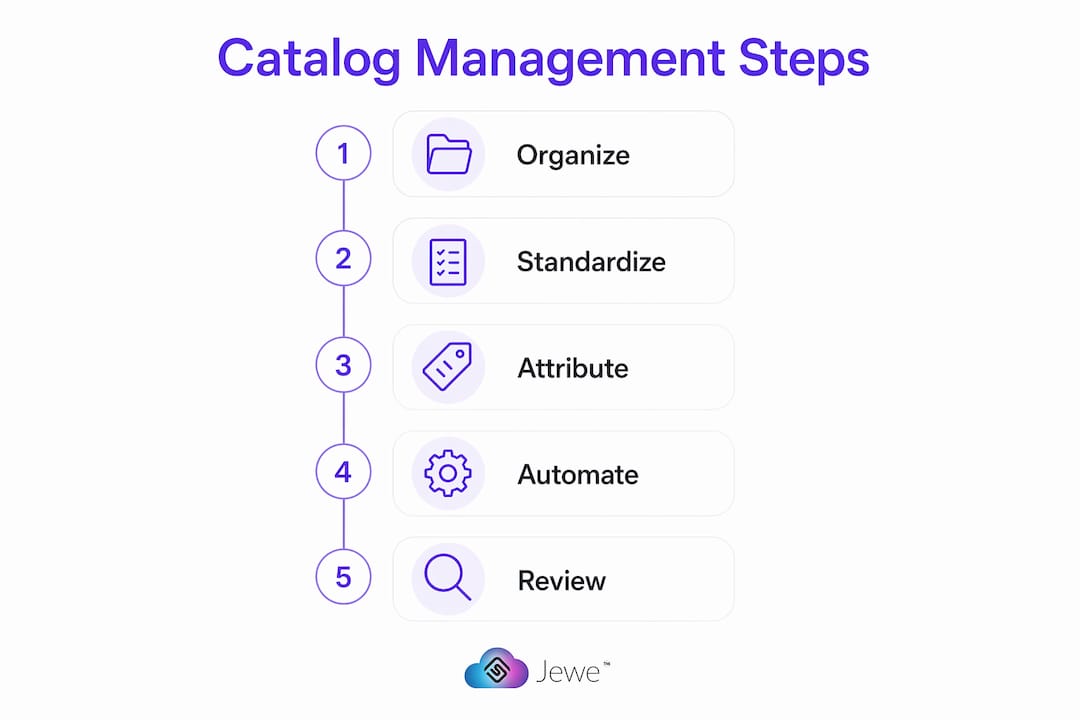
A practical workflow for jewelry catalog management follows these steps:
- Build an attribute dictionary. Define every attribute name, its accepted values, and its format before importing any data. Decide whether “metal_type” or “MetalType” is your standard, and never mix them.
- Normalize existing data. Audit your current listings for inconsistencies. Merge duplicates, correct purity notations, and standardize gemstone names.
- Map channels separately. Google Shopping, your own website, and wholesale portals each have different field requirements. Create a channel map that translates your master data into each destination’s format.
- Automate bulk updates. Once your attribute dictionary is locked, bulk attribute updates take minutes instead of days. A price change across a metal type, or a seasonal description refresh, runs without manual record-by-record editing.
- Set validation gates. Require mandatory fields before any listing goes live. A ring without a metal purity field should not publish.
Pro Tip: Start automation with your highest-volume SKU class first. Proving the workflow on 50 core styles builds confidence and surfaces edge cases before you roll it out to your full catalog.
Top B2B jewelry sellers monitor repeat orders and declined requests daily to guide procurement and catalog updates. That discipline requires a system that surfaces the data automatically, not a spreadsheet someone updates weekly.
What are best practices for organizing variants and optimizing search visibility?
Variant organization is where many jewelry catalogs quietly fall apart. The most common mistake is listing each size or metal color as a completely separate product rather than grouping them as variants of a parent SKU. Fragmented listings split your review count, confuse shoppers, and dilute your search ranking signals.
Group variants by the attributes that define the same design in different specifications. A yellow gold, white gold, and rose gold version of the same ring are variants of one parent product. A completely different setting style is a separate product.
Attribute slug consistency is equally critical. Inconsistent attribute slugs break faceted navigation and fragment search results. On platforms like Shopify or WooCommerce, “RingSize,” “ring_size,” and “ring-size” create three separate taxonomy entries instead of one. Standardize slug formats before your first import, because fixing them after the fact requires rebuilding your filter structure.
Title optimization for marketplace listings follows a clear pattern: lead with the most specific attributes first. “14k White Gold Round Diamond Solitaire Engagement Ring 0.50 ct” outperforms “Beautiful Diamond Ring in White Gold” in both search indexing and shopper scanning. Shoppers and algorithms both read left to right.
Key practices for variant and attribute discipline:
- Lock your attribute slug format in writing before any data entry begins
- Use parent-child product structures for all size and color variants
- Front-load metal type, purity, and gemstone in every product title
- Track every attribute change with a date stamp so you can audit catalog drift
- Validate titles against marketplace character limits before publishing
Pro Tip: Run a monthly attribute audit using your platform’s export function. Filter for any field containing mixed formats, then batch-correct before the inconsistency spreads to new listings.
Improving your product display quality also depends on clean attribute data feeding your front-end templates correctly.
How should jewelry managers plan inventory aligned with catalog decisions?
Inventory planning and catalog management are the same decision viewed from two angles. Your catalog defines what you sell. Your inventory plan defines how much of it you hold and when. Misalignment between the two creates deadstock on slow styles and stockouts on bestsellers.
The starting point is separating your SKU classes. Core replenishment styles, the pieces you sell year-round, need different inventory targets than seasonal drops or signature statement pieces. Inventory planning for jewelry requires SKU class-specific days-of-inventory targets: core styles target 90–120 days of supply, while signature pieces target 120–180 days given their slower, more intermittent demand.
Open-to-buy (OTB) budgeting is the tool that enforces this discipline. OTB budgets replace emotional inventory decisions with mathematical discipline, preventing the cash freeze that comes from over-buying slow categories. The basic formula is: Planned Sales + Planned End Inventory minus Beginning Inventory minus On Order = Open to Buy.
A practical inventory review cadence for jewelry ecommerce looks like this:
- Weekly: Review sell-through rates by SKU class. Flag any style below target velocity.
- Monthly: Run an OTB calculation for the next 60 days. Adjust purchase orders before commitments are locked.
- Quarterly: Audit deadstock. Identify styles that have not sold in 90 days and plan markdown or bundle strategies.
- Seasonally: Update your catalog to reflect collection drops. Archive discontinued styles rather than leaving them live with zero stock.
| SKU class | Days-of-inventory target | Review frequency |
|---|---|---|
| Core replenishment | 90–120 days | Weekly |
| Signature pieces | 120–180 days | Monthly |
| Seasonal drops | 45–60 days | Weekly during season |
| Limited editions | 30–45 days | Daily at launch |
Safety stock calculations for high-value jewelry SKUs require care. Over-buffering ties up costly cash reserves in pieces that may not move. Under-buffering on a bestselling core style loses sales you cannot recover. Use your actual sales velocity data, not category averages, to set safety stock levels.
Connecting your vendor data quality directly to your inventory system reduces the lag between a supplier update and your catalog reflecting it accurately.
Key Takeaways
Effective jewelry ecommerce catalog management requires structured product attributes, consistent taxonomy, automated workflows, and inventory planning aligned to SKU class targets.
| Point | Details |
|---|---|
| Data accuracy reduces returns | Fixing product data discrepancies can cut jewelry return rates by 40–50%. |
| Taxonomy before subcategories | Use attributes and faceted filters rather than excessive subcategories to keep catalogs clean. |
| Slug consistency is non-negotiable | Standardize attribute slug formats before import to prevent broken filters and fragmented search results. |
| OTB budgeting controls cash | Open-to-buy formulas prevent over-buying slow styles and free cash for high-velocity SKUs. |
| Multi-catalog setups add flexibility | Managing separate catalog versions per channel improves both marketing and operational consistency. |
Why I think most jewelry retailers undervalue their catalog data
After years of watching jewelry businesses build beautiful websites and then struggle to convert traffic, the pattern is almost always the same. The photography is excellent. The brand story is compelling. The product data is a mess.
The uncomfortable truth is that most retailers treat catalog management as a one-time setup task rather than an ongoing commercial discipline. They build their initial listings, launch, and then let the data drift. Metal purity notations become inconsistent. Gemstone descriptions vary by whoever entered the record. Ring sizes are listed in three different formats across the catalog. None of it is visible to the retailer until returns spike or a marketplace flags the account.
What I have found actually works is treating your attribute dictionary the way you treat your pricing policy: as a governed document that requires approval to change. When every team member follows the same slug format and the same purity notation, the catalog stays clean without heroic quarterly audits.
The other lesson I keep returning to is that multi-catalog setups are not a luxury for large brands. Jewelry retailers managing 5–10 catalog versions for different channels and presentations consistently outperform those running a single undifferentiated feed. Your wholesale catalog, your DTC website catalog, and your marketplace feed each serve a different audience with different data requirements. Building them from one clean master source is the only way to maintain consistency without doubling your workload.
Start with your attribute dictionary. Get that right before you touch automation or channel mapping. Every hour spent governing your data structure at the foundation saves ten hours of cleanup later.
— Anthony
How Jewelcloud helps you manage your jewelry catalog at scale
Jewelry catalog management gets significantly easier when your product data is structured from the source. Jewelcloud is built specifically for this: designers, manufacturers, and diamond dealers load their merchandise with standardized, channel-ready data, and retail partners access it without the burden of manual data entry or reformatting.
For retailers, that means expanding your online assortment with accurate, complete product records from day one. For suppliers, it means your catalog reaches qualified retail partners through a distribution channel that maintains your data integrity. Explore Jewelcloud’s product feed to see how structured vendor data connects to your ecommerce catalog, or visit the about Jewelcloud page for a full overview of platform capabilities and vendor membership options.
FAQ
What is jewelry ecommerce catalog management?
Jewelry ecommerce catalog management is the process of organizing, standardizing, and maintaining accurate product data across all online sales channels. It covers attribute structure, taxonomy rules, variant grouping, and multichannel publishing.
Why does product data accuracy matter for jewelry brands?
Inaccurate product data causes nearly 40% of jewelry retail returns. Fixing data discrepancies reduces return rates by 40–50% and directly improves conversion and margin.
What attributes are required for jewelry marketplace listings?
Metal type, metal purity, gemstone type, gemstone cut, size, and finish are the core required attributes. Certification data such as GIA report numbers should be entered as structured fields, not free-text descriptions.
How does open-to-buy budgeting connect to catalog management?
Open-to-buy budgeting ties purchasing decisions directly to catalog performance data. It prevents over-buying slow catalog categories and keeps cash available for high-velocity SKUs, reducing deadstock across your active product lines.
What is the risk of inconsistent attribute slugs in a jewelry catalog?
Inconsistent attribute slugs break faceted navigation and create duplicate taxonomy entries on platforms like Shopify and WooCommerce. Standardizing slug formats before import is the only reliable way to prevent this.