


A jewelry line sheet is a one or two page wholesale sales document that shows a buyer exactly what you make, what it costs, and how to order it, without a phone call or a showroom visit. Get the fields right and the outcome is simple: buyers request samples, sign credit applications, and place purchase orders on their own timeline.
A buyer-ready sheet includes:
- Clear SKU numbers and item names for every piece
- Wholesale pricing plus your payment terms (Net 30 terms, which means payment is due within 30 calendar days)
- Materials, measurements, and available variants
Key Takeaways
A buyer-ready jewelry line sheet needs standardized SKUs, clearly labeled wholesale and retail pricing, and explicit payment and shipping terms to convert browsing buyers into signed purchase orders.
| Point | Details |
|---|---|
| Include every essential field | List SKU, materials, measurements, wholesale price, and suggested retail price for each item. |
| State payment terms upfront | Specify Net 30, 2/10 Net 30, or prepayment requirements directly on the sheet, not in a follow-up email. |
| Format for scanning | Use a 4 to 8 item grid, consistent photos, and a compressed PDF under 20 MB. |
| Follow up within a week | A short, polite check-in after sending typically prompts a sample request or credit application. |
| Scale with structured data | Jewelcloud helps designers managing many retailer relationships keep pricing and inventory synced automatically. |
Table of Contents
- What Is a Jewelry Line Sheet, and Who Actually Uses It?
- The Essential Fields Every Jewelry Line Sheet Needs
- How Do You Format a Line Sheet So Buyers Can Actually Use It?
- How Should You Present Pricing and Payment Terms?
- What Shipping and Legal Terms Belong on the Sheet?
- How Do You Get a Line Sheet in Front of Buyers?
- Why Structured Product Data Speeds Up Wholesale Growth
- Common Mistakes to Avoid When Creating a Jewelry Line Sheet
- How Do You Tailor a Line Sheet for Different Buyers?
- How Often Should You Update Your Line Sheet?
- A Trade Perspective on Line Sheet Mistakes
- When It’s Time to Move Beyond a DIY Line Sheet
- Sources
What Is a Jewelry Line Sheet, and Who Actually Uses It?
A jewelry line sheet combines product photos, pricing, material specs, and ordering terms into one document a buyer can evaluate without touching the merchandise. Boutique owners, department store buyers, and independent sales reps all rely on the same document to decide, in a few minutes, whether your collection fits their shelves and their budget.
The term “line sheet” comes from the fashion trade, where a “line” refers to a designer’s full seasonal collection. Jewelry brands borrowed the format because it solves the same problem: buyers need to compare dozens of vendors quickly, and no one has time for a private showing of every collection that lands in their inbox. Some sellers call this a “product line sheet” or a “wholesale pricing sheet,” but the document and its job stay the same regardless of the label on the file.
A well-built sheet does the selling work before a human ever picks up the phone. That’s the whole point of the format, and it’s why sloppy ones cost you orders you never even know you lost.
The Essential Fields Every Jewelry Line Sheet Needs
Buyers skim. A cluttered or incomplete sheet gets closed in ten seconds, so every field earns its place by answering a question the buyer would otherwise have to email you about.
Header and cover information comes first: your brand name, the collection or season name (Spring 2026, Holiday Capsule), and a dedicated ordering email or contact separate from your general customer service inbox.
Per-item data is the heart of the document. For each piece, include:
- SKU or item number, formatted consistently across the whole catalog
- Item name, plus a short description if the piece isn’t self-explanatory
- Materials (14k gold vermeil, sterling silver, freshwater pearl)
- Measurements (chain length, ring sizes available, pendant dimensions)
- Available variants (sizes, stone colors, chain lengths)
- Wholesale price and suggested retail price, clearly labeled and separated
Ordering logistics round out the sheet: your minimum order quantity or dollar minimum, any tiered pricing for larger orders, and your sample policy if buyers can request pieces before committing.
Pro Tip: Design your SKUs to encode useful information, not just a random sequence. A code like AW26GLD014 tells you and the buyer the season, metal, and item number at a glance, which cuts down on reorder mistakes when a retailer emails you six months later asking to reorder “the gold hoops.”

Payment terms belong on the front of the sheet, not buried in a follow-up email. State plainly whether you require prepayment for new accounts or offer Net 30 terms to established buyers, since payment due within 30 calendar days is the trade standard once a relationship is proven.
How Do You Format a Line Sheet So Buyers Can Actually Use It?
Formatting decides whether your line sheet gets studied or skipped. A visually cluttered PDF signals an amateur operation even when the jewelry itself is excellent.
- Use a grid layout with a handful of items per page, typically enough to keep the sheet uncluttered and scannable, grouped by collection or material so a buyer scanning for gold pieces isn’t hunting through silver ones.
- Shoot every product on a neutral background with consistent lighting and identical image dimensions. Photos that reproduce cleanly when printed or dropped into a retailer’s own catalog software will get more attention.
- Leave white space around each entry. A sheet crammed edge to edge is harder to read at a glance, which defeats the purpose of a scannable document.
- Export as a compressed PDF sized to ensure easy email delivery without bounce backs, and name the file clearly using your brand and season, something like Brand-SS2026-LineSheet.pdf, so it doesn’t get lost in a buyer’s downloads folder.
For the actual build, Google Docs and Canva both offer free line sheet templates that handle the grid work for you. If you’re comfortable in InDesign, that gives you the most control over typography and spacing, but it’s overkill for a first version.
Pro Tip: A 20 MB ceiling isn’t arbitrary. Most major email providers cap attachments somewhere around 20 to 25 MB, so a heavier file risks bouncing before a buyer even opens it.
How Should You Present Pricing and Payment Terms?
Wholesale pricing conventions exist so buyers can trust your numbers without negotiating every line.
Label every price column explicitly. “Wholesale” and “SRP” (suggested retail price) should sit side by side so no buyer mistakes one for the other, and your currency should be stated once at the top if it isn’t obvious.
- List your opening minimum order clearly; typical opening minimums range from $500 to $2,500, often with a lower reorder minimum to reward repeat buyers.
- State payment terms in plain language: “Prepayment required for first order. Net 30 available after two completed orders.”
- Note any tiered pricing breaks (10% off orders over a certain unit count, for example).
Many designers start new accounts on prepayment and graduate trusted buyers to Net 30 once a payment history exists. Spelling this out on the sheet itself, rather than making a buyer ask, speeds up approvals and reads as more professional than terms negotiated after the fact.
What Shipping and Legal Terms Belong on the Sheet?
Shipping risk terms matter more in jewelry than almost any other wholesale category, given the value packed into a small box. State whether you ship FOB Origin or FOB Destination, since this single term determines who bears the loss if a package goes missing in transit.
- Note that you insure high-value shipments, and to what value, since this reassures buyers placing a first order sight unseen.
- List realistic production lead times separately for made-to-order pieces versus ready-to-ship inventory. Handmade collections might run two to four weeks; ready stock ships in days.
- Include a short return or exchange window, often 7 to 14 days for defects, placed near your payment terms.
- Add one line confirming that all material claims (14k gold, genuine gemstone) are accurate, since FTC advertising rules hold sellers accountable for how materials are described.
How Do You Get a Line Sheet in Front of Buyers?
- Email it directly with a short, specific note (who you are, what’s new this season) and the PDF attached or linked, after checking whether the buyer’s store has its own submission process.
- Bring printed copies to trade shows, along with a small sample selection buyers can actually handle.
- Choose public versus password-protected distribution based on how guarded your pricing is; a public PDF is easier to share, while a protected one keeps wholesale pricing away from retail customers who might stumble onto it.
- Follow up once, about a week later, with a brief, polite note. That’s the standard trade cadence, and it’s often what actually prompts a sample request, a credit application, or a first PO.
Why Structured Product Data Speeds Up Wholesale Growth
Buyers reject line sheets less often for the jewelry and more often for the paperwork. Inconsistent SKUs, missing measurements, or pricing that doesn’t match what shows up on an invoice all slow down or kill an order before it starts.
Structured product data reduces those errors and lets retailers pull listings straight into their point-of-sale or e-commerce systems instead of retyping every field by hand.
- Fewer import errors mean faster retailer onboarding after that first order is placed.
- Digital catalogs with synced inventory remove the friction that usually blocks repeat ordering.
- A platform built for jewelry vendors becomes genuinely useful once you’re managing line sheets for more than a handful of retail partners at once.
Common Mistakes to Avoid When Creating a Jewelry Line Sheet
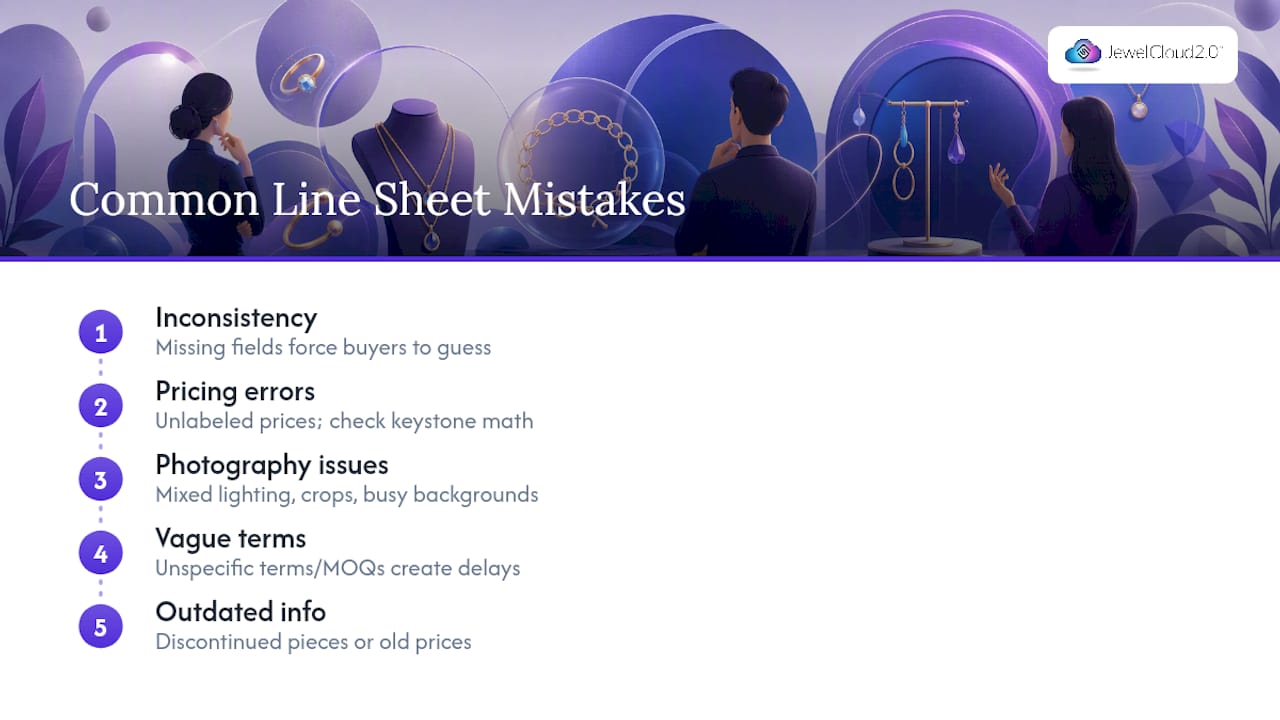
The most common failure is inconsistency, not incompetence. A sheet where half the items list “chain length” and the other half don’t forces buyers to guess, and guessing costs you the sale.
Pricing errors rank second. Listing wholesale and retail prices without labeling which is which, or worse, only showing one number, leaves buyers unsure whether they’re getting a fair margin. Fix this by labeling every column and double checking that your keystone math is consistent across the whole sheet, not just the first few items.
Photography drags down otherwise strong collections more often than designers expect. Mixed lighting, inconsistent crops, and busy backgrounds make a sheet look like a personal Instagram grid rather than a trade document. Buyers associate visual consistency with production consistency, fairly or not.
Vague terms cause the most lost time after a sheet is sent. “Terms discussed upon request” invites an email exchange that a clear Net 30 line would have avoided entirely. The same goes for missing minimum order amounts. If a buyer can’t tell whether your minimum fits their budget, they’ll often move on to the next vendor rather than ask.
Finally, watch for outdated information. A line sheet still advertising a discontinued piece, or quoting last season’s pricing, undermines trust the moment a buyer notices, and buyers notice.
How Do You Tailor a Line Sheet for Different Buyers?
A single line sheet rarely serves every type of buyer well. A boutique owner placing a small trial order needs different framing than a department store buyer evaluating your line for twenty locations.
For independent boutiques, keep the minimum order low and highlight your best-selling pieces up front, since these buyers often make fast, intuitive decisions based on what will move in their specific store.
For larger retail chains or department store buyers, lead with tiered pricing and volume breaks, since these buyers are comparing your margins against other vendors in the same category and want to see scalability built into the structure.
For international buyers, state your currency explicitly and clarify whether your pricing includes duties or shipping, since ambiguity here creates the kind of costly misunderstanding that kills a first order before it ships.
For specialty markets like bridal or estate jewelry, add a section addressing certification, appraisal documentation, or provenance, since these buyers ask about it early and a sheet that anticipates the question builds immediate credibility.
Keeping two or three versions of your core line sheet, adjusted for these buyer types, takes an afternoon to set up and saves you from awkward pricing conversations later.
How Often Should You Update Your Line Sheet?
Treat your line sheet as a living document tied to your actual inventory and pricing, not a one-time project you finish and forget. A sheet still circulating after a price increase or a discontinued item creates confusion at best and a broken order at worst.
Update it at three natural checkpoints: every new season or collection launch, whenever wholesale or retail pricing changes, and any time a material cost shift (gold prices are the obvious one) forces a repricing across the board.
Version control matters more than most designers expect. Keep your file naming consistent (Brand-SS2026-LineSheet-v2.pdf) so you’re never accidentally emailing a buyer last year’s pricing. A quick quarterly review, even when nothing major has changed, catches typos and stale product photos before a buyer does.
A Trade Perspective on Line Sheet Mistakes
The line sheets that stall out almost always bury payment terms or skip minimums entirely, forcing an email exchange that should never have been necessary. Fix those two fields first. Everything else is polish.
— Anthony
When It’s Time to Move Beyond a DIY Line Sheet
A well-built PDF gets you through your first dozen wholesale accounts. Once you’re juggling line sheets for thirty or fifty retail partners, though, manually updating pricing and photos across every version becomes its own part-time job.

Jewelcloud replaces that manual rework with structured product feeds and a digital catalog that stays synced across every retailer you work with, so a price change or a new SKU updates once instead of in a dozen separate files. It’s built specifically for jewelry designers, manufacturers, and diamond dealers who need their product data standardized and consistent, not just pretty on a PDF. When you’re ready to see what wider retailer distribution looks like without the manual overhead, check out JewelCloud’s vendor membership and start a listing with your existing catalog.
Sources
- Net 30 terms — Upflow
- Jewelry Line Sheets — Jewelry Making Journal
- How to Make a Jewelry Line Sheet for Wholesale — LegalClarity