


The jewelry manufacturer to retailer pipeline is defined as the end-to-end supply chain process that moves jewelry from raw material sourcing through production and into retail inventory. This pipeline covers every handoff: gemstone certification, casting, quality control, wholesale distribution, and final retail placement. Unlike most consumer goods supply chains, the jewelry pipeline carries unique complexity because of high-value commodities like gold and diamonds that require real-time digital inventory visibility across consignment and stock positions. Industry standards like RJC (Responsible Jewellery Council) certification and chain-of-custody frameworks such as SCS-007 define the traceability benchmarks that serious retailers and manufacturers now build their operations around. Platforms like Jewelcloud are reshaping how this pipeline connects wholesale suppliers to retail jewelers through structured, digital product data.
What are the stages in the jewelry manufacturer to retailer pipeline?
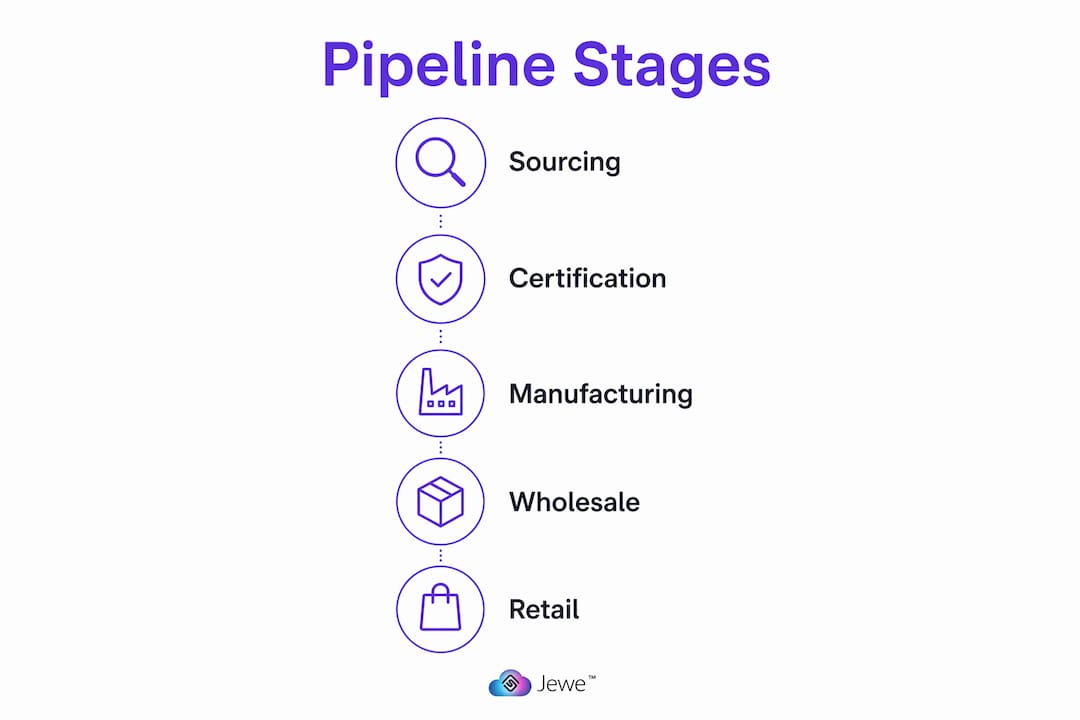
The jewelry supply chain moves through five distinct stages, each with its own actors, risks, and data requirements.
-
Raw material sourcing. Manufacturers source gold, platinum, and silver from commodity markets, while gemstones come from a far more fragmented network of miners, cutters, and brokers. Sourcing decisions at this stage directly affect cost, lead time, and the ability to make credible provenance claims.
-
Gemstone certification and quality grading. Diamonds typically carry GIA or IGI grading reports. Colored stones require additional documentation because their supply is less standardized. Brands lacking auditable chain-of-custody frameworks often make unverified sourcing claims that expose them to reputational risk.
-
Manufacturing: casting, setting, and finishing. Jewelry production moves from CAD design to wax model, metal casting, stone setting, and polishing. Each step requires skilled labor and precise material tracking. Specialized jewelry ERPs maintain a continuous data thread linking the CAD file to the specific artisan, metal lot, and stone used, which prevents inventory mismatches downstream.
-
Wholesale distribution and inventory transfer. Finished goods move from the manufacturer to a distributor or directly to the retailer. This stage involves pricing negotiation, minimum order quantities, and packaging for retail presentation. Major jewelry brands are replacing manual spreadsheets with integrated ERP and warehouse management systems to support multi-channel distribution across B2B, retail, and direct-to-consumer flows.
-
Retail placement and replenishment. The retailer receives physical or virtual inventory, assigns it to display cases or online catalogs, and manages reorder cycles. Replenishment speed depends on how well the manufacturer’s production data connects to the retailer’s point-of-sale system.
Pro Tip: Request a sample production report from any new wholesale jewelry supplier before committing to a full order. A supplier who tracks metal lots and artisan labor by SKU will cause far fewer inventory discrepancies than one who does not.
How is digital transformation changing the jewelry supply pipeline?
Technology is compressing timelines and adding accountability at every stage of the jewelry production process.
- Blockchain traceability. Over 66% of global diamond production value is now registered on Tracr, the blockchain-based provenance platform. That figure means a retailer sourcing certified diamonds can verify the mine of origin without relying solely on paper documentation.
- ERP integration from design to delivery. Purpose-built jewelry ERPs post daily karat-segregated metal ledgers and track every artisan’s labor and material use. This level of detail supports product genealogy, which is the ability to trace any finished piece back to its raw inputs.
- Virtual design approvals. Retailers and manufacturers now share CAD files and 3D renders for approval before a single gram of metal is cast. Virtual approvals and CAD-ERP integration compress collection development cycles from months to weeks.
- Real-time consignment visibility. Digital inventory feeds give retailers live data on purity, weight, and location of consignment stock. This matters because jewelry inventory is price-sensitive and a single data error on karat weight can distort margin calculations significantly.
“Retailers often misunderstand jewelry supply chains, assuming similarities to other goods. Jewelry requires continuous digital transformation for inventory and supply risk control — the commodity value, the traceability requirements, and the consignment complexity make it categorically different from apparel or electronics.”
The practical implication is clear. Retailers who invest in digital connectivity with their manufacturers gain a measurable speed advantage in getting new collections to market.
What challenges do gemstone sourcing and production variability create?

Gemstone sourcing is the primary bottleneck in the jewelry manufacturing overview, and the numbers explain why.
Up to 80% of colored gemstones originate from artisanal small-scale mining operations. Artisanal mining produces irregular lot sizes, inconsistent quality grades, and unpredictable delivery schedules. A manufacturer designing a collection around a specific shade of Montana sapphire may wait months for a usable parcel to arrive.
The table below maps the main sourcing challenges to their pipeline impact and common mitigation strategies.
| Challenge | Pipeline impact | Mitigation strategy |
|---|---|---|
| Irregular lot sizes from artisanal miners | Production delays and design changes mid-run | Build stone inventory buffers before committing to designs |
| Inconsistent color and clarity grades | Rejected stones inflate cost per finished piece | Source from multiple brokers and grade on arrival |
| Long certification timelines for colored stones | Slows retail handover dates | Pre-certify stones at the aggregation hub stage |
| Geographic concentration of supply | Single-source risk for specific gem types | Use aggregation hubs in India and China to stabilize supply before scaling |
A staged pipeline approach addresses these risks directly. Brands that route raw stones through aggregation hubs in India and China, run pilot production in Vietnam, and then scale full production have shown they can manage variability without costly overruns. The pilot run stage is particularly valuable because it surfaces stone rejection rates before a full production commitment is made.
Pro Tip: When planning a new collection with colored stones, build a stone buffer of at least 20% above your projected need before starting production. Rejection rates at the setting stage are higher than most retailers anticipate.
What operational best practices optimize the jewelry supply chain?
The most effective retailers treat their manufacturers as extended brand partners, not transactional vendors. That shift in mindset changes how contracts are written, how data is shared, and how quickly both sides respond to market trends.
- Negotiate flexible minimum order quantities. Manufacturers now offer MOQs as low as 1 piece for custom or private-label production, with lead times as short as 7 days for certain fine jewelry products. Low MOQs reduce the retailer’s inventory risk and allow faster testing of new designs before committing to volume.
- Maintain inventory buffers for high-velocity SKUs. A buffer of finished goods at the manufacturer level, held under a consignment or reserve agreement, protects the retailer from stockouts during peak selling periods like the holiday season.
- Use production data for replenishment forecasting. Retailers connected to a manufacturer’s ERP can see real-time production schedules and adjust reorder timing accordingly. This eliminates the guesswork that causes both overstock and stockout situations.
- Collaborate on design before production starts. Sharing trend data and customer purchase history with your manufacturer early in the design cycle produces collections that sell faster. Manufacturers increasingly function as brand partners who collaborate digitally on design and marketing, which shortens response times to retail trends.
- Audit your supplier’s traceability credentials. Verify that wholesale jewelry suppliers hold RJC certification or an equivalent chain-of-custody standard. Uncertified claims of responsible sourcing carry real legal and reputational exposure as consumer expectations rise.
Pro Tip: Ask your manufacturer for a live ERP dashboard view, even a read-only one, of your active orders. Visibility into production status eliminates the back-and-forth emails that delay decisions and erode trust.
Key Takeaways
The jewelry manufacturer to retailer pipeline requires digital traceability, flexible manufacturing agreements, and real-time inventory data to function at the speed modern retail demands.
| Point | Details |
|---|---|
| Pipeline has five core stages | Sourcing, certification, manufacturing, wholesale distribution, and retail placement each carry distinct risks. |
| Gemstone sourcing is the top bottleneck | Up to 80% of colored stones come from artisanal miners, causing delays that cascade through production. |
| Blockchain traceability is now mainstream | Over 66% of global diamond production value is registered on Tracr, setting a new provenance standard. |
| Flexible MOQs reduce retailer risk | MOQs as low as 1 piece and lead times as short as 7 days are now available from specialized manufacturers. |
| Manufacturer partnerships accelerate growth | Treating suppliers as brand partners and sharing design data compresses collection cycles from months to weeks. |
The pipeline shift I think most retailers are not ready for
I have spent years watching jewelry retailers manage their supply chains the same way their predecessors did: phone calls to reps, paper purchase orders, and a spreadsheet that nobody fully trusts. The retailers who are pulling ahead right now are doing something fundamentally different. They are treating their manufacturer relationships as data relationships, not just buying relationships.
The traceability piece is where I see the biggest gap. Retailers assume that a GIA certificate on a diamond or a verbal assurance from a colored stone broker is enough. It is not, and regulators in the European Union and the United States are moving toward mandatory supply chain disclosure requirements that will make uncertified sourcing claims a liability. Retailers who build certified, auditable supply chains now will have a genuine differentiator in two to three years. Those who wait will be scrambling to retrofit documentation into relationships that were never designed for it.
The second shift I find underappreciated is the move from bulk inventory to agile, data-driven assortment management. The old model was: buy a broad collection, hold it in the case, and reorder what sells. The new model is: carry virtual inventory from multiple wholesale jewelry suppliers, test designs digitally, and only commit to physical stock on proven sellers. That model requires a platform infrastructure that most independent retailers do not yet have. Building that infrastructure, whether through a direct ERP connection or a B2B platform like Jewelcloud, is the single highest-leverage operational investment a retail jeweler can make right now.
The manufacturers who will win the next decade are the ones building digital distribution capabilities alongside their production capabilities. The retailers who will win are the ones who recognize that their supply chain is also their competitive moat.
— Anthony
How Jewelcloud connects retailers to a smarter supply pipeline
Retailers who want to move from reactive sourcing to a proactive, data-driven supply model have a practical starting point with Jewelcloud.
Jewelcloud is a B2B jewelry platform that connects retail jewelers directly with designers, manufacturers, and diamond dealers at wholesale. Retailers gain access to structured, standardized product data they can use to expand their online assortment, launch new collections faster, and showcase real inventory without carrying physical stock. For manufacturers and vendors, Jewelcloud functions as a digital distribution channel that increases visibility with qualified retail partners. The platform supports flexible order quantities and custom labeling, making it practical for retailers of any size to source with precision. Learn more about how Jewelcloud works and what it means for your sourcing pipeline.
FAQ
What is the jewelry manufacturer to retailer pipeline?
The jewelry manufacturer to retailer pipeline is the end-to-end supply chain process that moves jewelry from raw material sourcing through production, wholesale distribution, and into retail inventory. It includes gemstone certification, manufacturing workflows, ERP-based inventory tracking, and logistics to the retail floor.
Why is gemstone sourcing the biggest bottleneck in jewelry production?
Up to 80% of colored gemstones originate from artisanal small-scale mining, which produces irregular lot sizes and inconsistent quality grades. This fragmentation causes production delays that cascade through the entire manufacturing and retail distribution timeline.
How does blockchain traceability improve the jewelry supply chain?
Blockchain platforms like Tracr verify diamond provenance from mine to retail, with over 66% of global diamond production value now registered on the platform. This gives retailers auditable proof of origin that paper certificates alone cannot provide.
What minimum order quantities should retailers expect from manufacturers?
Specialized manufacturers now offer MOQs as low as 1 piece for custom or private-label jewelry, with lead times ranging from 7 days to 5 weeks depending on metal type and design complexity. These flexible terms significantly reduce inventory risk for retailers testing new styles.
How can retailers improve their jewelry sourcing and supply chain efficiency?
Retailers improve sourcing efficiency by connecting digitally to manufacturer ERP systems, negotiating consignment or buffer stock agreements, and using platforms that provide real-time product data from multiple wholesale jewelry suppliers. Treating manufacturers as brand partners rather than vendors also shortens collection development cycles measurably.