


A jewelry PIM is a jewelry-first product information system that becomes the single source of truth for attributes, certificates, media, and inventory across every sales channel. If you’re running a catalog today, the first move is simple: pull ten SKUs at random and check whether metal purity, certification numbers, and dimensions are actually filled in. What you find will tell you exactly how urgent this is.
TL;DR:
- Jewelry PIM systems must validate complete records with attributes like certification numbers and metal purity to prevent inaccurate listings from publishing.
- Automated variant generation and live metal-price feeds are crucial for maintaining accurate pricing and inventory management across multiple sales channels.
- Improving data completeness and structured certification information directly increases conversion rates, reduces returns, and enhances marketplace search visibility.
- Implementing a jewelry-specific PIM typically takes 8 to 12 weeks, starting with catalog audits, phased migration, and end-to-end testing of all integrations.
- Data governance, attribute ownership, and regular audits are essential to sustain a high-quality, trustworthy jewelry catalog over time.
Table of Contents
- What Makes a PIM a Jewelry PIM
- Core Features Jewelry Teams Must Require
- What’s the Real ROI of Structured Jewelry Data
- How to Roll Out a Jewelry PIM Step by Step
- Why Jewelry Data Discipline Is the Real Differentiator
- Get Your Jewelry Catalog Structured With JewelCloud
- Sources
What Makes a PIM a Jewelry PIM
Generic product information management software was built for apparel and electronics, where a size chart and a color swatch cover most of the complexity. Jewelry doesn’t work that way. A single ring might need the 4Cs for its center stone, a metal purity stamp, a GIA or AGS certificate number, ring size range, and a treatment disclosure, all before it can legally and accurately go live. A jewelry-specific PIM models these fields as structured data rather than paragraphs of free text buried in a description box.
The attributes that matter most include:
- The 4Cs (cut, color, clarity, carat weight) for diamonds and colored stones
- Metal purity and type (14K yellow gold, 950 platinum, sterling silver)
- Certification numbers from labs like GIA, IGI, or AGS, tied to the specific stone
- Hallmarking and treatment disclosures (heat-treated, lab-grown, enhanced)
- Physical dimensions (band width, chain length, total carat weight for sets)
Parent-child modeling matters just as much. A pendant that comes in three metals and two chain lengths isn’t six unrelated products. It’s one parent style with variant children, and your system needs to understand that relationship to avoid duplicate listings and mismatched inventory counts. Media and certificate files deserve the same rigor: a PDF lab report attached loosely to a listing is not searchable, filterable, or trustworthy the way a structured certificate field is.
Core Features Jewelry Teams Must Require
Once you accept that jewelry needs its own data model, the next question is what a PIM actually has to do with that model day to day. Whether you’re evaluating vendors or specifying requirements for an internal build, these are the non-negotiables.
- Validation gates that block incomplete records. If metal purity or certification is missing, the item shouldn’t be able to publish. This single control eliminates most of the “why does this listing look broken” tickets your team fields every week.
- Automated parent-child SKU generation. When a style comes in three metals and four ring sizes, the system should generate and manage those twelve variant SKUs, not force someone to build them by hand in a spreadsheet.
- Live metal-price feeds tied to multi-tier pricing. Gold and platinum prices move daily. A PIM should recalculate wholesale, retail, and promotional pricing automatically rather than leaving margins exposed to stale data.
- Bi-directional integrations with platforms like Shopify and WooCommerce, plus marketplace adaptors that reformat your feed to match each channel’s field requirements.
- Catalog mapping tools that normalize supplier feeds, so a diamond dealer’s raw spreadsheet and a manufacturer’s XML export land in the same clean schema.
- Audit trails and provenance tracking, so certificate history and attribute changes are logged, not lost when someone edits a listing.
Specialized jewelry PIM platforms handle this level of complexity in ways that generic inventory tools typically don’t, because jewelry’s certification and variant logic simply wasn’t part of their original design brief.
Pro Tip: Ask any vendor for a live demo using your own worst SKU, the one with missing images, an old certificate number, and inconsistent sizing. How the system handles that mess tells you more than any polished sales demo ever will.
What’s the Real ROI of Structured Jewelry Data
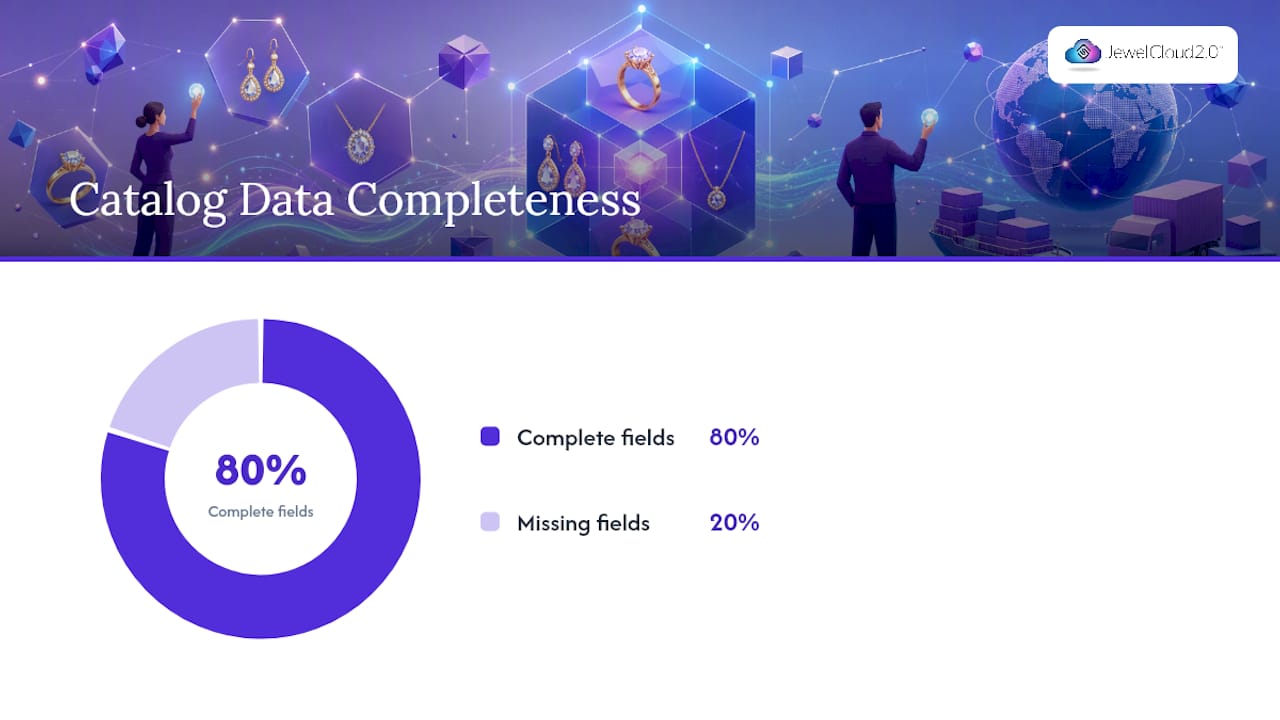
The technical features matter only because they translate into money. Jewelry catalogs commonly score around 80% data completeness against a 90% industry target, and that gap in metal purity, certification, and sizing data measurably reduces conversions and increases returns. Every incomplete listing is a customer left guessing, and a guessing customer either abandons the cart or orders the wrong size.
Structured data pays off in a few concrete ways. Collections launch faster because variant generation and attribute mapping happen automatically instead of manually. Returns and chargebacks drop when a customer sees accurate metal type and stone specs before they buy, not after the box arrives. Search visibility improves too. Structured feeds convert better with AI shopping agents and marketplace search algorithms than scraped or incomplete listings, which increasingly matters as more discovery happens outside your own website.
Track these signals as your PIM rolls out:
- Data completeness score across required fields (target 90% or higher)
- Time-to-publish for new collections, from intake to live listing
- Return rate, segmented by category, before and after structured attributes go live
- Conversion rate on listings with complete versus incomplete specs
Better structured product data across your catalog tends to move all four numbers in the same direction at once, which is rare for a single operational change.
How to Roll Out a Jewelry PIM Step by Step
Getting from a messy catalog to a clean, synced one isn’t a weekend project, but it’s also not as daunting as most retailers assume once it’s broken into phases.
- Audit your current catalog. Count SKUs, check media quality, and flag missing attributes and certificate coverage. This single step usually reveals the true scope of the problem.
- Define your attribute schema. Decide on controlled vocabularies for metal type, stone treatment, and finish, and map out parent-child relationships for every variant family.
- Plan your integration endpoints. List every system that needs to talk to the PIM: your ERP, point-of-sale, Shopify or WooCommerce storefront, and any marketplaces you sell through, along with live metal-price feed sources.
- Migrate in phases. Start with a pilot batch of SKUs, run them through validation gates, and check the outputs on every connected channel before moving the rest of the catalog.
- Set governance before you scale. Assign clear data ownership, agree on an update cadence, and build monitoring so incomplete records get caught before they publish, not after a customer complains.
Mid-market retailers with well-scoped data prep often complete this process in 8 to 12 weeks, and the data audit phase is almost always where projects either stay on schedule or fall behind.
Pro Tip: Run your pilot batch through every downstream channel, not just your website. A field that displays fine on Shopify can still break a marketplace feed if the mapping wasn’t tested end to end.
Once the pilot SKUs are clean and every channel output checks out, cutover becomes a formality rather than a leap of faith.
Why Jewelry Data Discipline Is the Real Differentiator
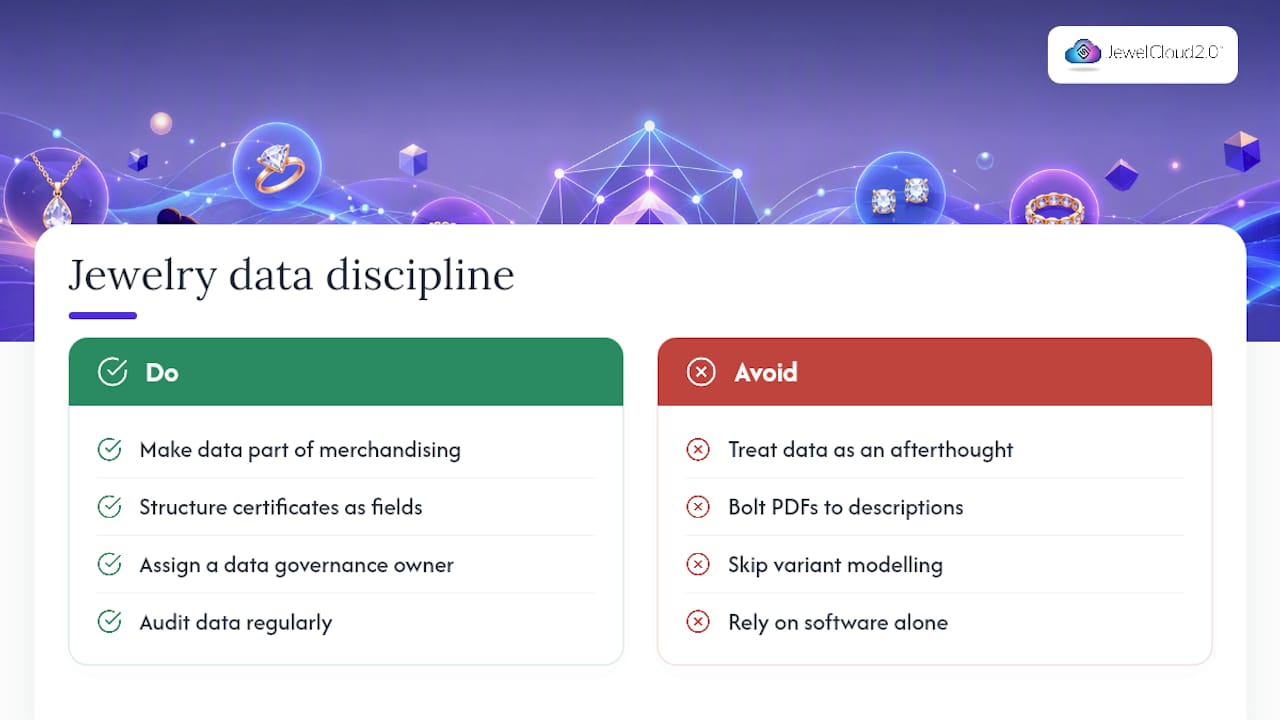
Most retailers treat product data as an afterthought, something you clean up after the collection ships. That’s backwards. The businesses seeing faster launches and fewer returns are the ones treating data structure as part of merchandising, not a chore that happens after it. Certificates and provenance documents in particular deserve to be structured fields, not PDFs bolted onto a description. Making them machine-readable builds buyer trust and makes filtering actually work, something most catalogs still get wrong.
The gap between a mediocre PIM rollout and a good one usually isn’t the software. It’s whether someone owns the governance: who approves new attributes, how often data gets audited, who catches drift before it compounds. JewelCloud’s structured approach to vendor and retailer data exists precisely because jewelry’s complexity punishes shortcuts more than almost any other product category. The platforms that treat certification and variant modeling as core infrastructure, rather than a nice-to-have, are the ones retailers will still trust in five years.
— Anthony
Get Your Jewelry Catalog Structured With JewelCloud
JewelCloud gives suppliers and retailers a shortcut past most of the checklist above: structured product feeds, vendor membership, and integrations built specifically for jewelry’s attribute complexity, not retrofitted from a generic PIM.
If you’re a supplier, JewelCloud’s vendor benefits get your catalog in front of qualified retail partners without you building distribution infrastructure yourself. If you’re further along and ready to syndicate, the JewelCloud product feed handles the certificate tracking, variant mapping, and channel adaptation this guide walks through, so your team isn’t building it from scratch. Before you reach out, pull that ten-SKU sample from your own catalog and note where the gaps sit. That sample becomes the starting point for a conversation with our team about what a clean rollout looks like for your specific catalog.
Sources
For deeper reference, the definitive guide to jewelry PIM and WISEPIM’s breakdown of 4Cs and certification handling cover the technical model in more depth. For media preparation, see this guide to 3D asset quality.
- Jewelry & Watches brands have a product-data problem — and 2026 is when it costs sales
- Jewelry PIM: 4Cs, GIA Certificates & Hallmarks | WISEPIM