


Jewelry product syndication is defined as the automated distribution of standardized product data, enriched media, and transactional information from a central source to multiple retail and digital sales channels simultaneously. This process covers everything from SKUs, pricing, and stock levels to professional photos, 360-degree videos, and SEO metadata. For jewelry retailers managing dozens of vendors and hundreds of SKUs, syndication is the difference between a catalog that stays current and one that quietly falls apart. Industry tools like Product Information Management (PIM) and Product Experience Management (PXM) systems make this possible at scale, and platforms like Jewelcloud are built specifically for the jewelry trade.
What is jewelry product syndication, and what data does it include?
Jewelry product syndication covers two distinct but connected data types, and both must travel together for the process to work. The first is transactional data: SKU numbers, pricing, carat weight, metal type, clarity grades, and real-time stock levels. The second is enriched content: professional product photography, 360-degree video, 3D models, written descriptions, SEO metadata, and customer review feeds.
The challenge is that these two data types have historically lived in separate systems. A retailer might pull pricing from one spreadsheet and images from a shared drive, then manually combine them for each channel. That approach breaks down quickly as product numbers grow. Modern syndication platforms unify both workflows into a single pipeline, so a price update and a new hero image travel together to every channel at the same time.

Channel-specific formatting adds another layer of complexity. A marketplace may require square images at 1,000 pixels, while a brand website needs lifestyle shots at 2,400 pixels. A social commerce feed may pull only three attributes, while a luxury retailer’s product page demands twenty. Jewelry syndication handles these variations automatically, reformatting and mapping data to each destination’s rules without manual intervention.
The core data types included in a complete jewelry syndication feed are:
- Transactional data: SKU, price, weight, carat, clarity, metal type, and live stock levels
- Enriched media: professional photos, 360-degree video, and 3D product models
- Marketing content: product descriptions, bullet points, and brand storytelling copy
- SEO metadata: titles, alt text, structured data markup, and keyword-tagged descriptions
- Channel-specific assets: resized images, reformatted attribute sets, and localized pricing
How does jewelry product syndication work technically?
The technical process behind jewelry syndication follows three phases. Successful syndication starts with centralizing all product data in a PIM system, then configuring channel-specific mapping rules, and finally pushing updates automatically to every connected sales channel.
Phase 1: The PIM as the single source of truth
A PIM system holds the master record for every product. When a vendor updates a diamond’s price or a designer adds a new collection, that change enters the PIM once. Every downstream channel receives the update from that single source. This eliminates the version-control problem that plagues retailers who manage product data in spreadsheets or email threads.
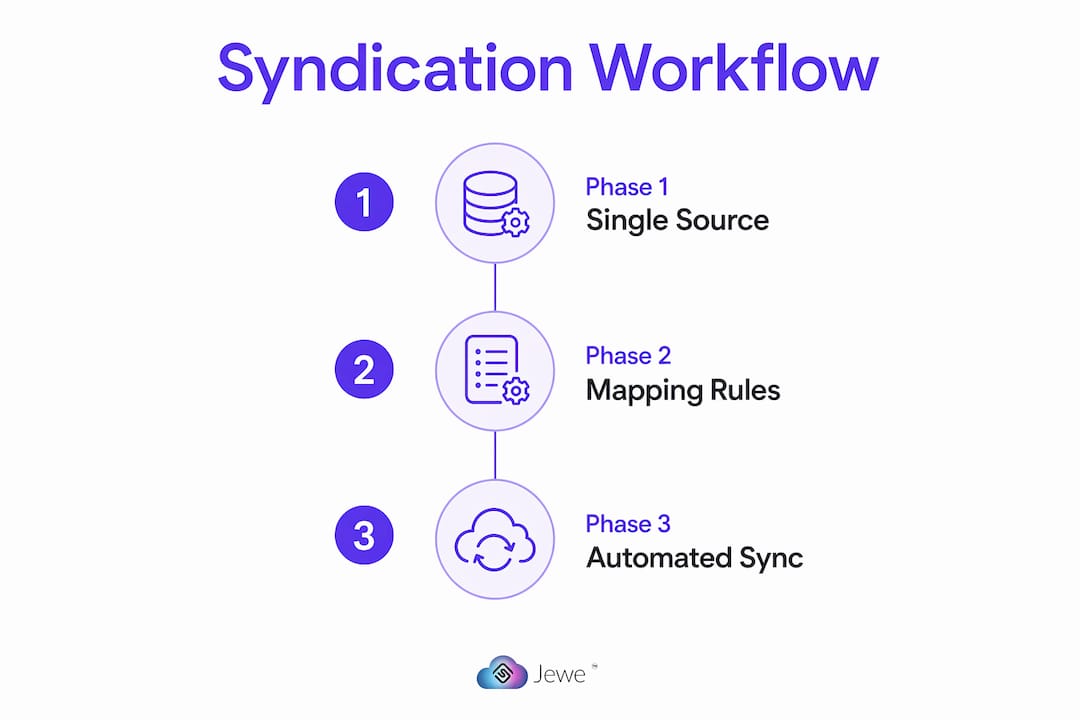
Phase 2: Channel-specific mapping rules
Each sales channel has its own attribute requirements, image specs, and content standards. Mapping rules tell the syndication system how to translate the master record into the format each channel expects. A marketplace might label the same field “metal color” while a brand site calls it “finish.” Mapping rules handle that translation automatically, without anyone touching the data manually.
Phase 3: Automated push and real-time sync
Once mapping rules are configured, the system pushes updates to all channels automatically. Prices and inventory sync in near real-time across marketplaces and brand websites. A ring that sells out at 2:00 PM is marked unavailable across every channel within minutes, not hours.
PXM tools extend this further by managing how products appear on the digital shelf. They bundle related items into “looks,” trigger dynamic media transformations, and ensure that the product display page a shopper sees matches the channel’s visual standards. For jewelry, where a single piece may be photographed in ten different settings, PXM automation is not optional. It is the only way to maintain consistency at scale.
- Centralize data in a PIM system with standardized fields for all jewelry attributes
- Configure mapping rules for each sales channel’s unique attribute and image requirements
- Automate the push so every update reaches all channels without manual re-entry
- Use PXM tools to manage product display pages, media bundles, and channel-specific presentations
- Monitor sync status to catch errors before they reach shoppers
Pro Tip: Set up validation rules inside your PIM before you configure any channel mappings. A bad data record caught at the source costs seconds to fix. The same error caught after it has syndicated to twelve channels costs hours.
What are the strategic benefits of jewelry product syndication for retailers?
The operational benefits of syndication are real, but the strategic benefits are what separate retailers who grow from those who stagnate. Treating syndication as a strategic asset rather than a data task unlocks capabilities that manual processes simply cannot replicate.
Inventory accuracy is the most immediate gain. When stock levels update automatically across every channel, you stop overselling pieces you no longer have. That matters enormously in jewelry, where a sold-out engagement ring or a one-of-a-kind estate piece cannot be substituted.
Consistent product presentation is the second benefit. A shopper who sees a sapphire pendant on a marketplace, then visits your website, should encounter the same images, the same description, and the same price. Inconsistency erodes trust. Syndication enforces consistency by design, not by discipline.
“Advanced syndication platforms use rule-based categorization and dynamic media transformation to automatically tailor content for each channel. This capability reduces workload and enhances customer experience significantly, without requiring manual intervention at each touchpoint.”
The ability to create automated product bundles and differentiated catalogs by channel is a less obvious but powerful advantage. A bridal retailer can configure a syndication rule that automatically groups a ring, matching band, and earrings into a “bridal look” for one channel, while presenting each piece individually on another. That kind of merchandising used to require hours of manual catalog work. Syndication makes it a one-time setup.
Additional strategic benefits include:
- Faster time to market: new collections reach all channels within minutes of entering the PIM
- Reduced manual errors: automation removes the copy-paste mistakes that damage product listings
- Richer SEO performance: complete metadata and structured data improve search visibility across channels
- Scalable growth: adding a new sales channel requires mapping rules, not a new data entry workflow
What common pitfalls should jewelry retailers avoid?
The most dangerous pitfall in jewelry syndication is also the most overlooked. Relying on an unreliable PIM as the source of truth means every error in that system propagates instantly to every connected channel. A wrong carat weight or an outdated price does not stay in one place. It travels everywhere, simultaneously.
The second pitfall is separating content and data workflows. Retailers who manage product descriptions in one system and images in another create a reconciliation problem every time something changes. Separating these workflows leads to disjointed customer experiences, where a shopper sees an updated price but a photo of the wrong colorway. Unified workflows prevent this.
Underestimating channel-specific requirements is the third common mistake. Every marketplace and retail partner has its own image dimensions, attribute naming conventions, and content standards. Retailers who assume one format works everywhere discover the problem only after listings are rejected or displayed incorrectly.
Manual overrides are a fourth risk. When team members bypass the syndication system to update a listing directly on a channel, they create a version that the PIM no longer controls. The next automated push may overwrite their change, or the two versions may conflict indefinitely.
Pro Tip: Run a full data audit before you connect any new channel. Incomplete or inconsistent records in your PIM will syndicate at the same speed as accurate ones. Clean data first, then connect.
How can jewelry retailers implement and optimize product syndication?
Implementation works best when it follows a clear sequence. Retailers who try to connect channels before standardizing their data create more problems than they solve.
- Build a standardized PIM first. Define every attribute your products need: metal type, stone shape, carat weight, finish, dimensions, and country of origin. Standardize the field names and acceptable values before entering a single product.
- Define mapping rules for each channel. Document what each destination calls each attribute, what image dimensions it requires, and what content standards it enforces. Build those rules into your syndication configuration.
- Integrate PXM tools for media delivery. Connect your image library and video assets to the syndication workflow so enriched content travels with transactional data automatically.
- Audit product data on a regular schedule. Monthly audits catch drift: prices that were not updated, images that were replaced in the library but not re-synced, or descriptions that no longer match the current product.
- Use syndication for differentiated merchandising. Configure channel-specific catalog rules to present curated assortments, seasonal edits, or bundled looks to different audiences without duplicating manual work.
- Track performance metrics by channel. Monitor conversion rates, return rates, and search ranking by channel to identify where product data quality is affecting sales.
Retailers who want to avoid common e-commerce errors during implementation should pay particular attention to image quality standards. Jewelry photography is high-stakes. A blurry or incorrectly cropped image on a luxury marketplace can damage brand perception faster than any pricing error.
The practical path to better syndication also runs through vendor relationships. When your suppliers load structured, standardized product data into a shared platform, your PIM starts with clean records instead of raw spreadsheets. That upstream data quality is the foundation everything else depends on.
Key Takeaways
Jewelry product syndication is the single most effective way to maintain accurate, consistent product data across multiple sales channels without multiplying manual work.
| Point | Details |
|---|---|
| Syndication definition | Automated distribution of product data and enriched media from a central PIM to all sales channels simultaneously. |
| Data types covered | Includes transactional data (SKU, price, stock) and enriched content (photos, video, SEO metadata) in one unified workflow. |
| PIM is the foundation | A standardized PIM system is the source of truth; errors there propagate instantly to every connected channel. |
| Strategic merchandising | Rule-based syndication enables automated product bundles and channel-specific catalogs without manual catalog work. |
| Implementation sequence | Standardize data first, then configure mapping rules, then connect channels to avoid propagating errors at scale. |
Why syndication is the infrastructure jewelry retail is built on
I have watched jewelry retailers invest in beautiful websites and strong vendor relationships, then lose ground because their product data was a mess behind the scenes. The catalog looked good on launch day. Six months later, prices were wrong on two marketplaces, three products showed out-of-stock images for in-stock items, and nobody could agree on which spreadsheet was current. That is not a technology problem. It is a syndication problem.
The retailers I see pulling ahead are the ones who treat their PIM as infrastructure, not as a database someone maintains when they have time. They build mapping rules once and let automation handle the rest. They connect new channels in days, not months. When a supplier adds a new collection, it appears across every touchpoint within the hour.
The terminology matters less than the outcome. Whether you call it product content syndication or data distribution or feed management, the goal is the same: one record, updated once, reaching every channel correctly. Jewelry retail is visual, detail-intensive, and trust-dependent. Shoppers notice when a description contradicts an image, or when a price on your website differs from the one on a marketplace. Syndication is what prevents those gaps.
The retailers who ignore this infrastructure do not fail dramatically. They just grow more slowly, spend more time on manual corrections, and lose sales to competitors whose product data is simply more reliable. That is a quiet but compounding disadvantage.
— Anthony
How Jewelcloud supports your syndication strategy
Jewelry retailers who want to put syndication into practice without building the infrastructure from scratch have a direct path forward with Jewelcloud.

Jewelcloud is a B2B jewelry platform where designers, manufacturers, and diamond dealers load their merchandise at wholesale. Retail jewelers gain access to structured, standardized product data they can syndicate across their sales channels without manual data entry. The platform’s product feed capabilities deliver real-time synchronization across connected channels, so your listings stay accurate as inventory moves. For vendors, jewelry vendor membership provides a direct distribution channel to qualified retail partners. For retailers, it means starting with clean, complete product data instead of raw supplier spreadsheets.
FAQ
What is jewelry product syndication in simple terms?
Jewelry product syndication is the automated process of distributing product data, images, and descriptions from one central system to multiple sales channels at once. It eliminates manual re-entry and keeps listings accurate across every platform.
What is the difference between PIM and PXM in syndication?
A PIM system stores and manages the master product record, including transactional data like SKU and price. A PXM system controls how that product appears on each channel’s digital shelf, including media bundling and display formatting.
How does syndication improve jewelry inventory management?
Syndication syncs stock levels in near real-time across all connected channels. When a piece sells, every marketplace and website reflects the updated availability within minutes, preventing overselling and customer disappointment.
What happens if my product data has errors before syndication?
Errors in the PIM source propagate instantly to every connected channel. A wrong price or incorrect carat weight appears everywhere simultaneously. Running a data audit before connecting any channel is the most effective way to prevent this.
Can small jewelry retailers benefit from product syndication?
Yes. Even retailers with a modest catalog benefit from syndication once they sell across more than one channel. The manual effort of keeping two or three platforms updated accurately grows faster than most retailers expect, and syndication removes that burden regardless of catalog size.