


A jewelry retail digital showcase is a web-based product presentation system that uses 3D rendering, augmented reality, and live inventory integration to replace static photos with interactive, photorealistic experiences. Retailers who adopt these systems see measurable results: 35% more time on site, 28% higher mobile conversion rates, and 40% faster page loads compared to standard product pages. The shift from flat images to immersive digital merchandising is no longer optional for stores that want to compete online. This guide covers the most effective jewelry retail digital showcase examples and the technologies behind them.
1. How 3D jewelry configurators drive online sales
3D jewelry configurators are the highest-ROI tool in digital merchandising for jewelry brands. Shoppers using them purchase 3 to 5 times more often than those viewing static photos. That gap exists because configurators let buyers see exactly what they are getting before they commit.
A well-built configurator lets shoppers swap metals, change stone shapes, adjust settings, and watch the ring or pendant update in real time. The visual output uses physically based rendering (PBR), a technique that simulates how light interacts with real materials. Without PBR, jewelry models appear synthetic and fail to earn buyer trust, which is fatal for high-ticket purchases.
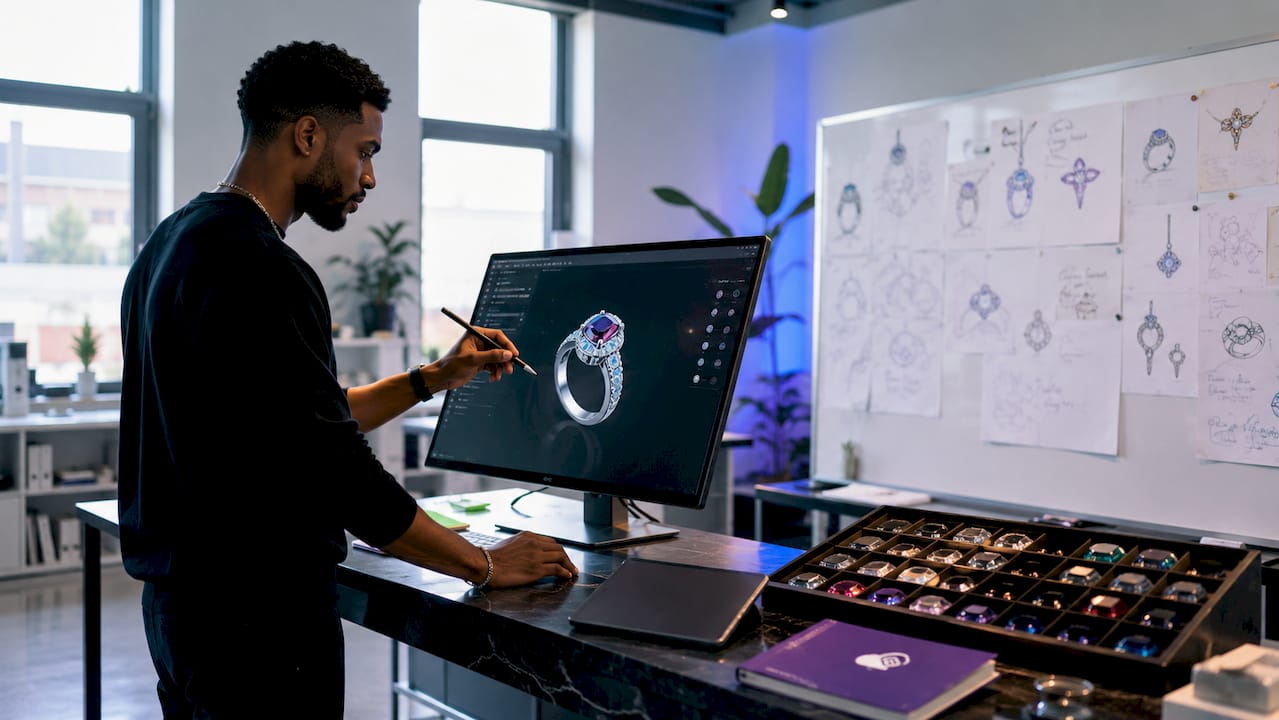
Cost is the most common barrier. Full custom configurator builds run $5,000 to $12,000. A simpler hero-section 3D upgrade costs $1,500 to $2,500 and still outperforms static photography on engagement. The right investment depends on your average order value and how central customization is to your brand.
Key features that separate effective configurators from weak ones:
- Real-time metal switching (yellow gold, white gold, platinum, rose gold)
- Accurate gem refraction shaders that simulate sparkle and depth
- Live pricing updates tied to metal weight and stone selection
- Mobile-optimized rendering that loads in under three seconds
- Clear “add to cart” or “request a quote” call to action at every step
Pro Tip: Start with a hero-section 3D upgrade on your two or three best-selling styles before committing to a full configurator build. Measure conversion lift over 60 days, then use that data to justify the larger investment.
2. Augmented reality try-on for jewelry retailers
AR try-on is the fastest-growing format in jewelry virtual try-on technology. It lets shoppers hold their phone up and see a ring on their finger or a necklace at their collarbone in real time, without downloading an app. That zero-friction entry point is what makes web-based AR so effective.
Luxury brands have deployed AR across mobile browsers, desktop web, and social platforms with strong results. The technology works by combining high-precision 3D models with real-time wrist or face tracking. Stable tracking is the technical hurdle. A ring that slides around or a necklace that floats off the skin destroys the illusion and the sale.
The business case for AR centers on shortening the decision cycle. Shoppers who can visualize a piece on their body make faster decisions and return less often. That combination lifts both conversion and post-purchase satisfaction.
What to look for in an AR try-on solution:
- WebAR delivery (no app download required)
- Sub-100ms tracking latency for natural movement
- High-resolution 3D assets with accurate metal and gem rendering
- Social sharing functionality built into the experience
- Analytics tracking for try-on sessions, dwell time, and conversion
Pro Tip: Launch AR try-on on rings first. Ring sizing anxiety is the single biggest hesitation in online jewelry purchases, and AR directly addresses it. Add necklaces and earrings once you have baseline data.
3. Connected digital inventory ecosystems for scalable merchandising
The most practical shift in jewelry e-commerce is moving from physical stock to live vendor-managed inventory. Retailers no longer need to own every piece they sell online. They need access to accurate, structured product data from the brands and suppliers they trust.
Jewelcloud operates exactly this kind of connected ecosystem. The Jewelcloud 2.0 network includes 250+ jewelry brands and enables live vendor-managed inventory alongside marketing asset distribution. Retailers get a broad digital assortment without the overhead of carrying physical stock.
The practical benefits for retailers are significant:
- Broader catalog depth without additional warehouse costs
- Consistent product data, descriptions, and imagery across all listings
- Faster launch of new collections as vendor feeds update automatically
- Reduced manual data entry and fewer listing errors
- Integration with platforms like Shopify for direct feed-to-storefront publishing
Centralized product feed management also means your merchandising stays current. When a vendor updates a price or discontinues a style, your store reflects that change without manual intervention. That accuracy builds shopper trust and reduces customer service friction.
4. Design best practices for digital jewelry showcases
Good design in a jewelry digital showcase does one job: it gets the right shopper to the right product with as little friction as possible. The challenge is that jewelry buyers have two distinct discovery behaviors. Some browse by mood and aesthetic. Others search by metal type, stone weight, or price range. Your storefront needs to serve both.
Effective storefronts use scrollytelling, a technique where narrative content and product imagery reveal together as the shopper scrolls, to engage style-driven browsers. Sub-category pathways with faceted filters serve specification-driven buyers. Both paths should be visible from the homepage without competing for attention.
| Design feature | Buyer need it serves |
|---|---|
| Scrollytelling collection intro | Style and mood-driven discovery |
| Faceted filters by metal, stone, price | Specification-driven search |
| High-resolution zoom on product images | Detail verification before purchase |
| Trust signals (certifications, reviews) | Confidence building for high-ticket items |
| Mobile-first layout with fast load times | On-the-go browsing and conversion |
Performance is not optional. A 40% reduction in page load time directly correlates with higher mobile conversions. Compress your 3D assets, use lazy loading for images below the fold, and test on mid-range Android devices, not just the latest iPhone.
Pro Tip: In-store digital signage connected to a CMS lets you run the same campaign assets online and in your physical location. High-definition displays with CMS keep content fresh without cheapening your retail atmosphere.
5. Real-world jewelry retail digital showcase examples
The strongest jewelry retail digital showcase examples from 2026 share three traits: photorealistic product presentation, frictionless UX, and live inventory depth. Here is what successful implementations look like in practice.
Premium e-commerce storefront with full UX overhaul. A 2026 case study of a high-end jewelry retailer showed that investing in a premium digital storefront with detailed product presentation and optimized UX produced a 35% increase in time on site and 28% higher mobile conversions. The retailer combined high-resolution 3D imagery, fast page loads, and clear collection navigation to achieve those numbers.
Bayam Jewelry on Shopify Hydrogen. Bayam Jewelry built its storefront on Shopify Hydrogen to serve both style-driven and specification-driven shoppers simultaneously. The build used scrollytelling and sub-category pathways to address both buyer mindsets without forcing shoppers into a single discovery flow. The result was a storefront that felt editorial and functional at the same time.
Gemist and Saban Onyx custom jewelry platform. The Gemist and Saban Onyx partnership created an end-to-end custom jewelry solution for retailers. The platform uses photorealistic visualization to let shoppers design pieces in real time, with live pricing updates. It reduces 15 to 20 hours of manual workflows per order and lifts average order values by removing the friction between design intent and purchase decision.
“Customization is no longer a premium add-on. It is what customers expect. Digital tools that deliver real-time pricing and photorealistic visualization are not just convenient. They are the difference between a sale and a lost customer.” — Gemist CEO, on the shift from manual to digital custom jewelry workflows
These examples show that the technology stack matters less than the execution. A well-integrated 3D configurator on a fast, mobile-optimized storefront outperforms a feature-heavy site with poor UX every time. You can build high-converting product displays without a seven-figure budget if you prioritize the right elements.
Key Takeaways
The most effective jewelry retail digital showcases combine photorealistic 3D rendering, web-based AR try-on, and live vendor inventory integration to reduce buyer hesitation and increase conversion rates.
| Point | Details |
|---|---|
| 3D configurators multiply purchase intent | Shoppers using configurators buy 3 to 5 times more often than those viewing static photos. |
| AR try-on shortens decision cycles | Web-based AR requires no app download and directly addresses sizing and fit anxiety. |
| Live inventory ecosystems reduce overhead | Platforms like Jewelcloud give retailers catalog depth without carrying physical stock. |
| Design must serve two buyer types | Scrollytelling serves style browsers; faceted filters serve specification-driven shoppers. |
| Page speed is a conversion lever | A 40% reduction in load time correlates directly with higher mobile conversion rates. |
What I’ve learned from watching jewelry retail go digital
The retailers who struggle most with digital showcases are the ones who treat it as a photography problem. They invest in better images and wonder why conversion stays flat. The real issue is almost always buyer confidence, not visual quality.
A shopper looking at a $4,000 ring on a white background has no reference point. They cannot feel the weight, see the scale on a hand, or understand how the stone catches light in a room. Static photos cannot solve that. 3D configurators and AR try-on can. The technology exists specifically to close that confidence gap.
What I find underappreciated is the inventory side of the equation. Retailers obsess over the front-end experience and ignore the product data feeding it. A beautiful storefront built on incomplete or inconsistent vendor data will always underperform. The jewelry e-commerce mistakes I see most often trace back to poor data hygiene, not poor design.
My honest recommendation: fix your product data first. Then invest in the visual experience. A clean, accurate catalog with good 3D imagery will outperform a visually stunning site with messy inventory data every single time. The retailers who understand that are the ones pulling ahead in 2026.
— Anthony
Jewelcloud makes digital merchandising work at scale
Jewelry retailers ready to expand their digital assortment without adding physical inventory have a direct path forward with Jewelcloud.
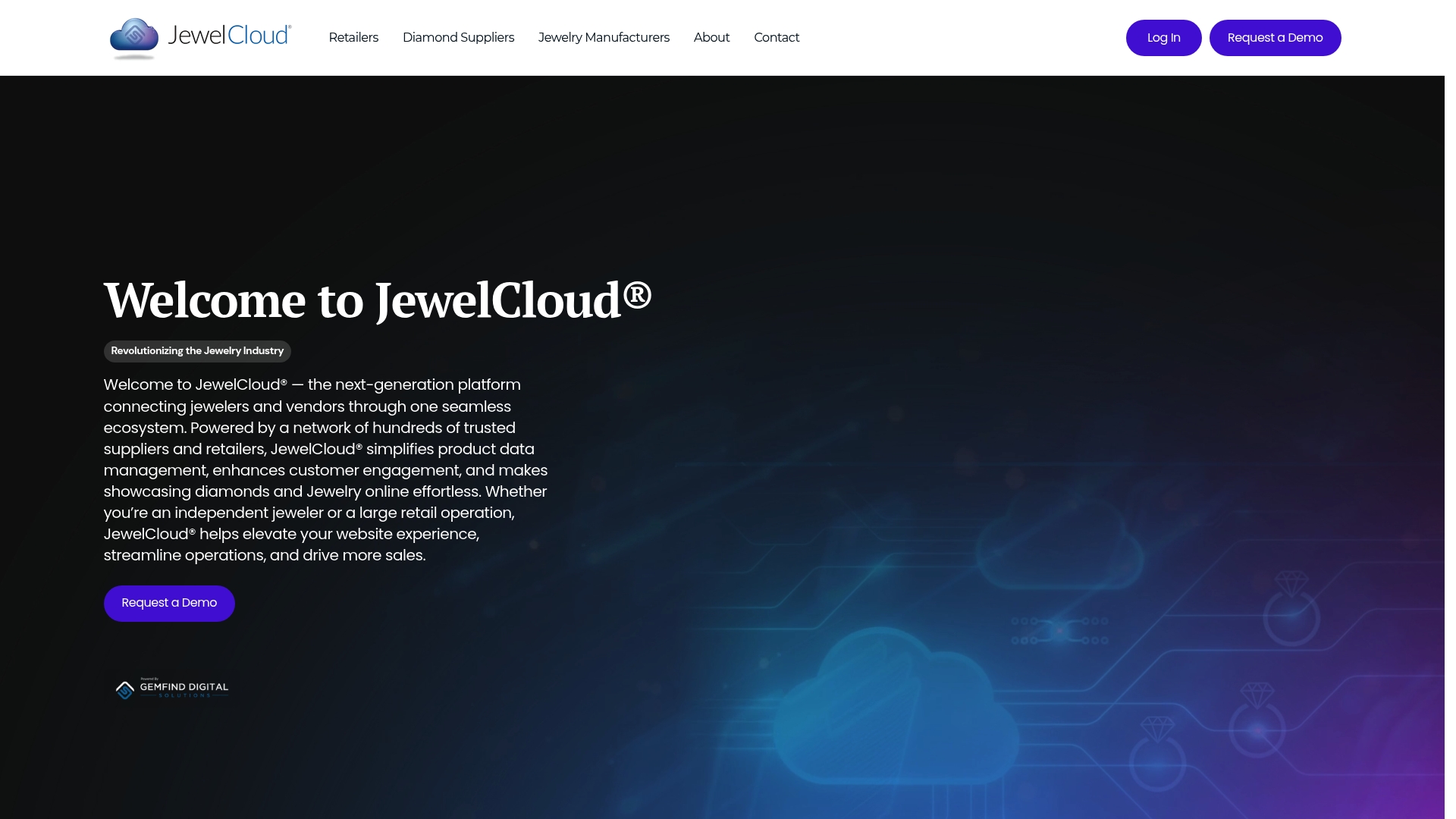
Jewelcloud connects retailers to 250+ jewelry brands through a centralized product feed that keeps listings accurate, current, and ready to publish. The platform handles vendor data sync, marketing asset distribution, and Shopify-compatible product feeds so your storefront stays live without manual updates. Whether you are building your first virtual showroom or scaling an existing catalog, Jewelcloud gives you the infrastructure to do it efficiently. Visit the Jewelcloud retailer benefits page to see how the platform fits your store’s goals.
FAQ
What are jewelry retail digital showcases?
Jewelry retail digital showcases are web-based product presentation systems that use 3D rendering, AR try-on, and live inventory feeds to replace static product photos with interactive experiences. They increase engagement, reduce buyer hesitation, and improve conversion rates.
How much does a 3D jewelry configurator cost?
Full custom 3D configurator builds range from $5,000 to $12,000. Simpler hero-section 3D upgrades cost $1,500 to $2,500 and still deliver measurable conversion improvements over static photography.
Does AR try-on require shoppers to download an app?
Web-based AR try-on operates directly in the mobile browser with no app download required. That zero-friction entry point significantly increases engagement and reduces drop-off during the try-on experience.
Why do jewelry stores offer virtual showcases?
Virtual showcases let retailers display broad product assortments without carrying physical inventory, serve shoppers 24/7, and reduce the buyer hesitation that causes cart abandonment on high-ticket purchases.
What is Jewelcloud and how does it help retailers?
Jewelcloud is a B2B jewelry platform connecting retailers to 250+ brands through live vendor-managed inventory and centralized product feeds. Retailers use it to expand their digital catalog, publish accurate listings, and offer richer online shopping experiences without additional overhead.