


Jewelry vendor management is the practice of centralizing supplier data, governing vendor relationships, and standardizing PO and invoice workflows so that every product record, certificate, and transaction flows cleanly from source to shelf. Your single most useful next step: create or import a vendor master record for your top five suppliers and flag every record missing a certification, lead time, or payment term. Do that this week, and you’ll have a working foundation to build on.
Your 7-day starter checklist:
- Audit your current supplier list and remove duplicate or inactive records
- Collect Kimberley Process certificates, Responsible Jewellery Council membership confirmations, or assay documents for any vendor missing them
- Set a data owner, one person responsible for keeping vendor records current, before adding any new suppliers
Platforms like Jewelcloud are built specifically for this kind of structured, jewelry-specific data work, and the Jewelry Industry Association (jewelers.org) offers compliance and sourcing guidance that belongs in your governance policy from day one.
Table of Contents
- What does vendor data management actually mean for a jewelry business?
- What supplier data problems are costing your business right now?
- Best practices for managing vendor data and supplier relationships
- How to onboard a new vendor without creating data problems later
- What can a platform do that your spreadsheet cannot?
- How do you vet a supplier and spot the red flags?
- Which KPIs tell you your vendor program is actually working?
- How Jewelcloud supports your vendor data management program
- Key Takeaways
- What the conventional wisdom on vendor management gets wrong
- Ready to pilot a vendor-data platform? Here’s how to evaluate one
What does vendor data management actually mean for a jewelry business?
Vendor data management in jewelry means maintaining structured, accurate records for every supplier and every product they provide, then connecting those records to procurement, pricing, inventory, and compliance workflows. It is not just a contact list. It is the operational backbone that tells your team what a supplier sells, at what price, under what terms, and with what documentation attached.
Jewelry is harder to manage than most retail categories. A single ring SKU can carry a dozen attributes: metal type, karat, stone species, carat weight, cut, color, clarity, certificate number, country of origin, hallmark status, and memo eligibility. A diamond parcel adds lot numbers, grading reports, and Kimberley Process documentation. Miss one field and you risk wrong pricing online, a failed compliance audit, or a chargeback.
Required fields for a jewelry vendor master record:
- Company legal name, address, tax ID (W-9 for U.S. vendors)
- Primary contact and accounts payable contact
- Payment terms (net 30, net 60, or prepay)
- Lead times by product category
- Minimum order quantities (MOQ)
- Preferred SKU categories and price tiers
- Certifications: Kimberley Process Certification Scheme (KPCS), Responsible Jewellery Council (RJC) membership, GIA or IGI grading reports
- Assay and hallmark documents, linked to specific product records
- Memo stock eligibility and return window
Example product record for a single SKU:
| Field | Example Value |
|---|---|
| SKU ID | RG-14K-RD-VS1 |
| Product type | Ring |
| Metal | 14K yellow gold |
| Center stone | Round brilliant diamond |
| Grading report | GIA # |
| Clarity / color | VS1 / G |
| Hallmark | 585 stamped |
| Vendor ID | VND- |
| Lead time | several business days |
| Memo eligible | Yes, 30-day window |
That level of specificity is what separates a vendor data management system from a spreadsheet with supplier phone numbers.
What supplier data problems are costing your business right now?
Most jewelry businesses don’t realize how much money bad vendor data costs until a problem surfaces at the worst possible moment: a diamond listed at the wrong price goes live on your website, a customer orders it, and you’re left eating the margin difference or issuing a refund. That scenario plays out regularly, and it almost always traces back to a data problem, not a vendor problem.
Common data failures:
- Duplicate vendor records creating split purchase histories and payment confusion
- Inconsistent SKU naming across suppliers (one vendor calls it “14K,” another “585,” another “14 karat”)
- Missing or expired certificates attached to active product listings
- Mixed units (grams vs. pennyweights, carats vs. points) causing pricing errors
- Currency or karat errors in imported product feeds
Relationship failures that compound the data problems:
- Late payments that damage your standing and reduce access to priority stock
- No forecast sharing, leaving suppliers unable to plan production for your busy season
- Single-source dependency on one supplier for a key category, creating a fragile supply chain
- Poor communication that turns minor delays into missed sales windows
Stricter sourcing rules mean certifications like the Kimberley Process and Responsible Jewellery Council membership are becoming nonnegotiable. If a supplier can’t provide the paperwork, you’re the one left answering to customers.
Maintaining a diverse supplier base while keeping a core set of trusted primary vendors reduces both stock risk and price volatility. Single-source dependency is the most common structural risk in independent jewelry retail, and it’s almost always invisible until a shipment is late.

Best practices for managing vendor data and supplier relationships
The highest-impact practices are centralization, standardization, PO automation, and regular performance reviews. Get those four right and most of the data and relationship problems above become manageable.
Implementation sequence:
- Data audit: Pull every active vendor record and product listing. Flag duplicates, missing fields, and expired certificates.
- Build master records: Standardize naming conventions, units, and field structures across all suppliers before importing anything new.
- Automate PO rules: Set reorder triggers and approval routing so purchase orders generate from stock signals, not memory.
- Establish a governance cadence: Assign a data owner, schedule quarterly record reviews, and version-control certificate updates.
- Run periodic vendor reviews: Score each supplier on delivery accuracy, quality consistency, and communication responsiveness at least twice a year.
Governance checklist:
- Assign one named data owner per supplier category
- Set a 90-day certificate expiration alert
- Define access controls (who can edit vendor records vs. view only)
- Document the update process for pricing changes and new SKUs
- Keep a version log for any certificate or compliance document
Concentrating spend with a smaller number of committed vendors yields real operational benefits: priority stock allocation, memo inventory options, exchange rights on slow movers, and better pricing over time. That’s not just a relationship nicety; it’s a procurement strategy.
Pro Tip: Ask your top two or three suppliers to run a product knowledge session for your sales staff. Suppliers are an underused training resource, and staff trained by vendors sell those lines with more confidence, which improves sell-through and strengthens the relationship at the same time.
How to onboard a new vendor without creating data problems later
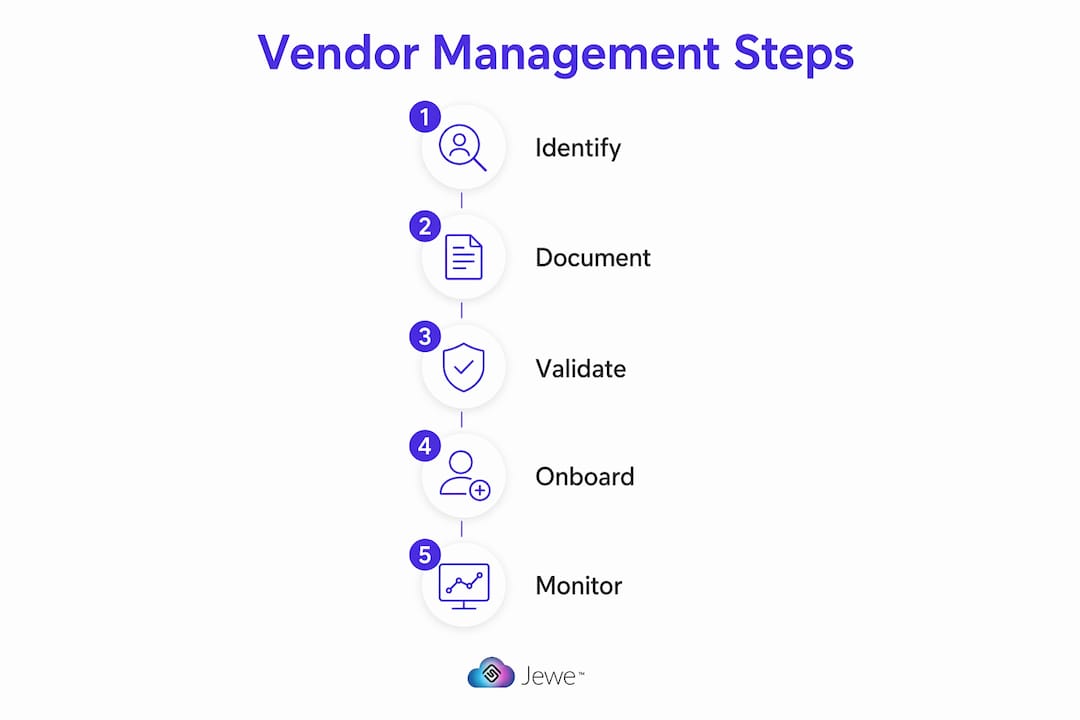
A short, repeatable onboarding flow prevents the data debt that accumulates when vendors are added informally. The sequence: collect core documents, run a sample order, set agreed SLAs, then add the vendor to your master data store.
Onboarding checklist — mandatory documents:
- Completed W-9 (U.S. vendors) or equivalent KYC documentation
- Kimberley Process certificate or GIA/IGI grading reports (for diamond or rough stone suppliers)
- Assay or hallmark certificates for metal products
- Sample product photos meeting your catalog standards
- MOQ, lead times, and payment terms in writing
- Return and dispute resolution policy
Template fields to capture at intake vs. later:
| Field | Capture at intake | Capture after first order |
|---|---|---|
| Legal name, address, tax ID | ✓ | |
| Payment terms, MOQ | ✓ | |
| Certifications (KPCS, RJC, GIA) | ✓ | |
| Lead time by category | ✓ | |
| Preferred SKU list | ✓ | |
| Actual lead time (measured) | ✓ | |
| Quality acceptance rate | ✓ | |
| Communication responsiveness score | ✓ |
Numbered onboarding steps:
- Send the vendor a data intake form covering all mandatory fields above
- Place a small test order covering one to three SKUs to verify lead time, packaging, and product quality
- Confirm SLAs in writing: lead time window, quality acceptance threshold (e.g., reject rate under 2%), and dispute resolution timeline (e.g., 5 business days to acknowledge a claim)
- Load the completed record into your vendor master and link all certificates to the vendor ID
- Schedule a 30-day check-in to review the first order’s performance against agreed SLAs
Starting with a pilot SKU or parcel reveals hidden costs like extra documentation requirements and lead-time variability before you’ve committed to large purchase volumes. It’s the lowest-risk way to validate a new supplier relationship.
What can a platform do that your spreadsheet cannot?
Platforms replace brittle, manual processes with live integrations, validation rules, and role-based access that keep vendor and product data consistent and auditable across every workflow. A spreadsheet can store data. It cannot enforce it.

Capability comparison:
| Capability | Spreadsheet | Integrated platform |
|---|---|---|
| Real-time price updates from supplier | Manual re-entry | Automated feed |
| Certificate linking to PO/product record | File attachment, easily lost | Structured link, always retrievable |
| PO automation from stock triggers | Not possible | Built-in rules engine |
| Multi-currency and multi-location | Error-prone formulas | Native support |
| Memo inventory tracking | Manual log | Dedicated workflow |
| Role-based access control | None | Configurable by user role |
| Audit trail for data changes | None | Timestamped version history |
A platform-driven workflow looks like this: a sales alert flags low stock on a best-selling solitaire setting, the system generates a draft PO against the preferred vendor’s agreed price and lead time, the vendor confirms electronically, and the goods receipt updates inventory automatically when the shipment arrives. No email chain. No manual re-entry. No risk that someone updated the price in one tab but not another.
The ROI levers are measurable. Cloud platforms consolidate procurement, product data, and store workflows into a single source of truth, reducing manual coordination and speeding decision-making. Track PO cycle time (days from trigger to vendor confirmation), data error rate (corrections per 100 records), and time-to-shelf (days from PO to live product listing) to quantify the improvement. Retailers using Jewelcloud can expand online assortments by consuming supplier-fed product data rather than building product records manually, which cuts catalog build time significantly.
How do you vet a supplier and spot the red flags?
Vet for provenance, quality, and paperwork. Any supplier who won’t share certificates or provide references is not worth the risk, regardless of pricing.
Vetting checklist:
- Request GIA or IGI grading reports for diamonds; verify report numbers on the issuing lab’s website
- Confirm Kimberley Process Certification Scheme documentation for any rough diamond or high-risk origin material
- Ask for Responsible Jewellery Council membership status and verify it at the RJC registry
- Call two or three references from other retailers, not just the names the supplier provides
- Place a small test order before any significant commitment; compare the received product against the sample and the spec sheet
- Check for a professional web presence, trade show history (JCK, JIS), and verifiable business registration
Red flags that should trigger a hold:
- Pricing significantly below market with no clear explanation
- Evasive or delayed responses to certificate requests
- Sample quality that doesn’t match bulk shipment quality
- No verifiable business address or trade references
- Inconsistent communication: fast when selling, slow when there’s a problem
Requiring certificates such as GIA/IGI grading reports and Kimberley Process proof is standard vetting practice, not optional due diligence. Keep copies of every certificate and KYC document linked directly to the corresponding PO and product record. When documentation is incomplete, hold the shipment until it’s resolved.
Pro Tip: Treat certified documentation as transactional metadata. Link grading reports, assay certificates, and KYC documents directly to POs and product records so that audits and returns take minutes, not hours.
This article provides general operational guidance and is not legal or compliance advice. Confirm current regulatory requirements with a qualified professional or primary regulatory source for your specific situation.
Which KPIs tell you your vendor program is actually working?
Track data accuracy, PO lead time, invoice match rate, and vendor on-time delivery as your primary KPIs. These four metrics cover the data, procurement, financial, and fulfillment dimensions of supplier performance and give you a clear picture of where to focus improvement effort.
| KPI | Why it matters | How to measure | Target |
|---|---|---|---|
| Data accuracy rate | Errors cause pricing mistakes and compliance gaps | Corrections per 100 records per month | Under 2 corrections per 100 records |
| PO lead time | Longer cycles mean slower inventory replenishment | Days from PO creation to vendor confirmation | Reduce within 90 days |
| Invoice match rate | Mismatches create payment delays and vendor friction | % of invoices matched to PO on first pass | a high match rate |
| On-time delivery rate | Late deliveries disrupt sales and customer commitments | % of orders delivered within agreed window | 90%+ on-time |
| Relationship-value metrics | Priority allocation and credit terms often matter more than unit price | Track priority fills, credit days granted, exclusive offers | Improve quarter over quarter |
Realistic rollout timeline:
- Days 1–30: Data audit, vendor master cleanup, assign data owner
- Days 31–60: Pilot onboarding with one to three suppliers, confirm SLA baselines
- Days 61–90: Enable PO automation for recurring SKUs, start tracking the four primary KPIs
- Days 91–180: Full rollout, governance cadence in place, first formal vendor performance review
Cost factors to budget:
- Data cleanup labor (typically the largest upfront cost)
- Platform subscription or per-vendor fees
- Integration work between the platform and your POS or ERP
- Staff training, especially for buyers and finance teams
Prioritize data cleanup first. A platform running on dirty data produces faster errors, not fewer.
How Jewelcloud supports your vendor data management program
Jewelcloud centralizes structured jewelry product and vendor data, enabling faster assortment expansion and cleaner POs for both retailers and suppliers. The platform is built specifically for the data complexity of jewelry: metal type, karat, stone attributes, certificate numbers, memo eligibility, and multi-location pricing are all native fields, not workarounds.
What Jewelcloud delivers for your vendor program:
- A vendor master that holds structured product records, certifications, and pricing from participating designers, manufacturers, and diamond dealers
- Certificate linking via DiamondLink, connecting grading reports directly to product records and POs
- Automated PO creation from supplier-fed product data, reducing manual entry and cycle time
- Memo and inventory support with defined return windows and eligibility flags
- Multi-location pricing so retailers with more than one store maintain consistent data across locations
Retailers can expand their online assortment by consuming supplier-fed product data directly from Jewelcloud rather than building records from scratch. That means a new collection can go live faster, with accurate attributes and linked certificates already in place. For suppliers, the platform functions as a digital distribution channel that puts structured product data in front of qualified retail partners without requiring physical inventory.
Expected outcomes from a Jewelcloud pilot:
- Shorter PO cycles as manual confirmation steps are replaced by structured data flows
- Fewer data errors because product attributes are validated at the source, not re-entered downstream
- Expanded online assortments without proportional increases in catalog management labor
- Priority supplier placements for vendors who maintain complete, accurate product records
Pro Tip: Start your pilot by onboarding one supplier and automating two to three SKUs. Measure PO lead time and data error rate over 60 days. Those two numbers will tell you exactly how much the platform is worth before you scale.
Key Takeaways
Effective jewelry vendor management requires clean master records, documented onboarding, automated PO workflows, and consistent KPI tracking to reduce errors and build supplier relationships that deliver priority access and better terms.
| Point | Details |
|---|---|
| Start with a vendor master | Create or import structured records for your top five suppliers before adding new ones. |
| Onboard with a test order | Place a small pilot order first to verify lead times, quality, and documentation before scaling. |
| Track four core KPIs | Monitor data accuracy, PO lead time, invoice match rate, and on-time delivery from day one. |
| Certifications are non-negotiable | Link KPCS, GIA/IGI reports, and assay documents directly to POs and product records at intake. |
| Jewelcloud as your execution platform | Jewelcloud centralizes structured vendor and product data, enabling faster assortments and cleaner POs for retailers and suppliers. |
What the conventional wisdom on vendor management gets wrong
Most guides frame vendor management as a relationship problem. Be nicer to your suppliers, pay on time, communicate better. That advice isn’t wrong, but it misses the root cause of most vendor failures in jewelry: the data is broken before the relationship even starts.
A retailer can have a warm, decade-long relationship with a diamond supplier and still lose money on every order because the product records are inconsistent, the certificates aren’t linked to the right SKUs, and no one is tracking whether the agreed lead times are actually being met. Relationship goodwill doesn’t fix a mis-tagged gemstone that goes live at the wrong price.
The fix isn’t to choose between data discipline and relationship investment. It’s to recognize that clean data is what makes a good relationship scalable. When your vendor master is accurate, your POs are clean, and your invoices match on the first pass, suppliers notice. Timely payments and predictable buying behavior increase your leverage with suppliers and improve access to the best inventory. That’s not a soft benefit; it’s a direct result of operational discipline.
The other mistake I see consistently: businesses wait until a crisis to clean their data. A shipment goes wrong, a compliance audit surfaces missing certificates, or a new platform migration reveals thousands of duplicate records. Two-week data cleanup sprints, run quarterly before they’re needed, cost a fraction of the emergency cleanup that follows a crisis. Run a “test order” policy for every new vendor regardless of how well-recommended they are. The test order isn’t a sign of distrust; it’s the fastest way to confirm that the relationship will work at scale.
Long-term relationship benefits like priority access to limited stock, flexible 30–60 day credit terms, and supplier-sourced market intelligence often outweigh marginal per-unit price savings. Negotiate payment terms from a position of demonstrated reliability, not just buying volume. And when you want priority allocation during a busy season, ask directly, with your order forecast attached. Suppliers respond to buyers who make their planning easier.
Ready to pilot a vendor-data platform? Here’s how to evaluate one
The right platform for jewelry vendor management fits your data model, handles certificate and file linking natively, automates PO creation, integrates with your existing POS or ERP, and makes vendor onboarding fast enough that your team will actually use it.
Evaluation checklist:
- Does the data model support jewelry-specific fields (karat, stone attributes, certificate numbers, memo eligibility)?
- Can certificates and grading reports be linked directly to product records and POs?
- Does PO automation work from stock triggers, or does it require manual initiation?
- How many integration points does the platform support (POS, ERP, e-commerce)?
- How long does vendor onboarding take for a new supplier?
Jewelcloud is built for exactly this workflow. Suppliers load structured product data at wholesale; retailers consume it directly, expanding their online assortments without manual catalog work. A low-risk pilot looks like this: onboard one to three suppliers, confirm two KPIs (PO lead time and data error rate) over 60 days, and evaluate the result before committing further.
Explore the jewelry vendor benefits Jewelcloud offers suppliers and retailers, or visit the about Jewelcloud page to request a demo and discuss a pilot scope that fits your current supplier mix.