


Lab grown diamond inventory, in a B2B context, means a structured SKU feed carrying attributes, stock levels, pricing, and certification links for every stone a supplier makes available to retail partners. The immediate move for retailers and suppliers alike is adopting an API or standardized CSV feed with the required diamond attributes and automated syncing baked in, rather than manually updating spreadsheets. Established platforms like JewelCloud, including its DiamondLink® tool, already handle this kind of distribution and normalization for the trade.
TL;DR:
- High-velocity sellers with frequent price and availability changes should use real-time API feeds, while slower-moving catalogs can rely on daily or weekly CSV updates.
- Every diamond SKU must include attributes such as stock level, price, carat, cut, color, clarity, certification details, origin label, and multiple image URLs for accurate filtering and search.
- Treat each unique diamond as an independent SKU rather than a variant to avoid platform variant limits and ensure precise filtering by carat, cut, color, and clarity.
- Secure feed access with scoped API keys or credentialed SFTP accounts to prevent data corruption from compromised connections.
- JewelCloud and DiamondLink® streamline diamond data distribution, normalize inconsistent supplier feeds, and enable virtual sourcing without holding physical inventory.
Table of Contents
- What Are the Best Feed Formats for Lab Grown Diamond Inventory?
- What Data Attributes Does Every Lab Grown Diamond SKU Need?
- How Do You Integrate Feeds With PIM, ERP, and Ecommerce Platforms?
- What Does a Healthy Lab Grown Diamond Feed Workflow Look Like?
- What Should a Supplier Onboarding Checklist Include?
- How Do JewelCloud and DiamondLink® Solve These Inventory Problems?
- Build vs. Buy: Where Should Teams Invest First?
- Get Your Lab Grown Diamond Catalog Distribution Ready
- Sources
- FAQ
What Are the Best Feed Formats for Lab Grown Diamond Inventory?
Your choice of delivery method should match your catalog’s size and how fast your stock actually turns over. Suppliers moving one-of-a-kind stones with frequent price and availability changes need something closer to real time. Suppliers with stable, slower-moving assortments can get by with far less overhead.
- API feeds work best for high-velocity boutiques and dealers with unique stones, since lab-grown diamond APIs deliver real-time availability, specs, pricing, and images, which supports fine-grained filtering by cut, carat, color, and clarity.
- Scheduled CSV or SFTP drops suit lower-cost, lower-velocity catalogs where daily or even weekly refreshes are enough.
- Webhooks or incremental API calls handle partial updates, so a price change on ten stones doesn’t force a full catalog reload.
- Cache with a defined TTL (time to live) protects your storefront if a feed source goes down, preventing oversells on stones that already sold.
Authentication matters more than most retailers assume. Feed access should run through scoped API keys or credentialed SFTP accounts, never shared logins, since a compromised feed connection can quietly corrupt live pricing.
Pro Tip: Set your cache TTL shorter for fast-moving loose diamond stock than for finished jewelry lines. A ring style might sit unchanged for months. A specific 1.2 carat lab-grown diamond will not.
What Data Attributes Does Every Lab Grown Diamond SKU Need?
A feed is only as useful as the fields inside it. Missing or inconsistent attributes are exactly what causes mismatched listings, failed filters, and returns you could have avoided.
Required fields for every record:
- SKU and current stock level
- List and retail price, with currency noted
- Carat weight, cut, color, and clarity
- Certification body and certificate number
- Origin label identifying the stone as lab grown
- Image URLs, ideally more than one angle
Recommended enrichment fields:
- Standardized, search-friendly titles
- Measurement fields (length, width, depth in millimeters)
- Metal purity and mounting details for finished pieces
- Descriptive alt text for accessibility and search
- Structured size ranges for configurable products
One modeling decision trips up more retailers than any other: treating a unique stone like a product variant instead of its own independent record. Most ecommerce platforms cap the number of variants a single product can carry, and a loose diamond inventory with hundreds of distinct stones will blow past that ceiling fast. Giving each stone its own SKU record, rather than nesting it as a variant, sidesteps the limit entirely and keeps filtering by carat, cut, color, and clarity precise. It’s also worth checking your feed against a detailed feed requirements checklist before you go live, since gaps here are the most common reason a feed gets rejected on first submission. Buyers browsing an outside catalog, like this platinum cubic zirconia bridal bracelet listing, expect the same level of image and attribute detail regardless of the source, so treat your feed’s presentation standards accordingly.
Controlled vocabularies matter here too. If one supplier writes “Excellent” and another writes “Ex,” your filters break silently, and shoppers stop trusting the search results.
How Do You Integrate Feeds With PIM, ERP, and Ecommerce Platforms?
The right architecture depends on how many sales channels you’re feeding and how much engineering support you have on hand.
- PIM-led integration centralizes product data before it fans out to storefronts, marketplaces, and print catalogs, which works well once you’re managing more than a couple of channels.
- ERP-led integration ties inventory directly to accounting and fulfillment, and ERP e-commerce integration synchronizes inventory, orders, and customer data across platforms, cutting down on manual entry and the stock discrepancies that come with it.
- Direct-to-ecommerce integration skips the middle layer entirely, which is fine for a single storefront but gets unwieldy fast once you add wholesale partners or a second sales channel.
Sync cadence should follow your business model rather than a one-size template. Cache-only syncing suits small, stable inventories. API-first syncing suits high-end sellers with unique, fast-turning stones. A hybrid model, fast cache for speed with background updates reconciling behind it, is the practical middle ground most retailers land on.
Reconciling in-store holds with online listings is where a lot of platforms quietly fail. Jewelry retail ERP systems reduce stockouts and unify inventory across POS and online channels, and omnichannel inventory sync should centralize stock across every sales channel, including messaging apps like WhatsApp, where a lot of high-value diamond sales still happen informally.
What Does a Healthy Lab Grown Diamond Feed Workflow Look Like?
Getting a feed live is one thing. Keeping it accurate for the next two years is the harder job, and it comes down to a repeatable operational loop rather than a one-time setup.
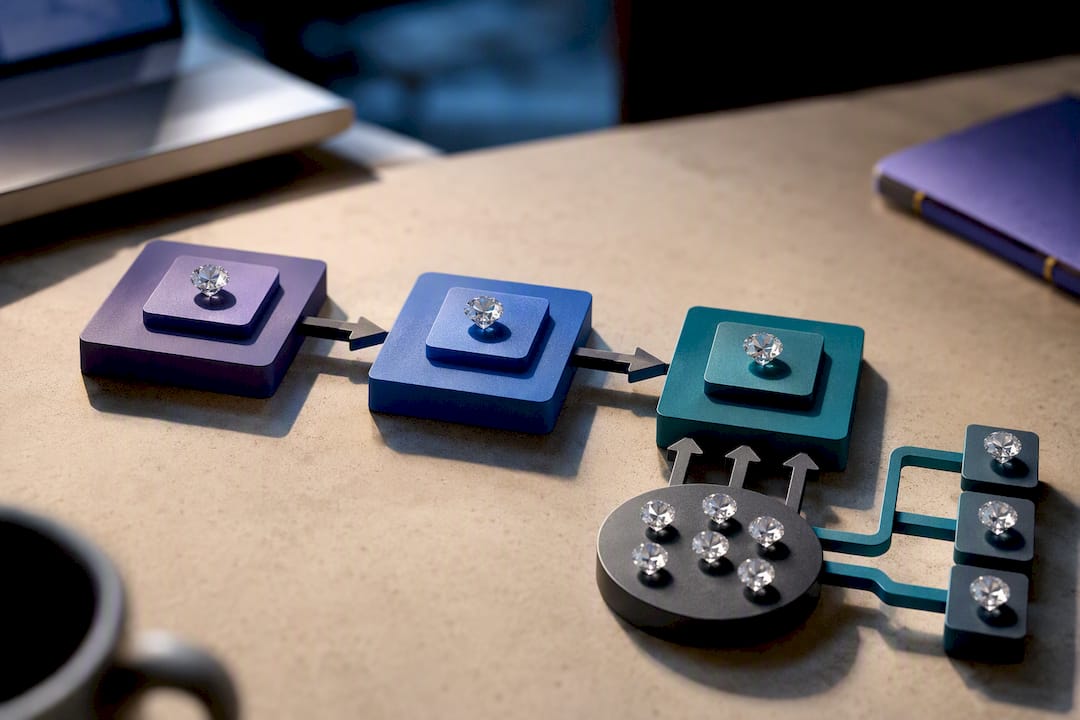
- Ingest the raw supplier feed on its scheduled interval or API pull.
- Validate against your required schema, flagging missing certs, broken image links, or malformed carat values.
- Map supplier fields to your platform’s own attribute structure.
- Stage the update in a sandbox environment before it touches the live catalog.
- Publish once validation passes, ideally through a canary release that updates a small batch first.
- Monitor sync latency and mismatch rates continuously.
- Reconcile any stones sold in store but not yet reflected online, and vice versa.
Track data completeness, sync latency, and mismatch rate as your core health metrics. Structured, complete catalog data converts meaningfully better for both shoppers and AI-driven discovery tools, and a rising return rate is often a data quality problem wearing a customer service costume.
Pro Tip: Build a rollback plan before you need one. If a canary publish reveals a mapping error, you want a one-click revert, not a scramble through yesterday’s backup file.
What Should a Supplier Onboarding Checklist Include?
Before accepting a new supplier’s feed into your catalog, run it through a short acceptance process rather than trusting it blind.
- A sample feed covering at least fifty representative SKUs
- A documented attribute mapping showing how their fields map to yours
- A full image set meeting your minimum resolution standard
- Working certification links for every stone in the sample
- Test credentials for a staging environment before production access
Set clear SLAs (service level agreements) up front: expected update frequency, error resolution turnaround, and a named contact for feed issues. Lock down credentials and scopes so a supplier’s access matches exactly what they need, nothing broader.
How Do JewelCloud and DiamondLink® Solve These Inventory Problems?
JewelCloud exists specifically to standardize the mess described above. It functions as a B2B product-data distribution platform, taking inconsistent supplier feeds and normalizing them into structured, retailer-ready catalogs. DiamondLink® handles the diamond-specific layer of that problem, giving retailers a way to source and virtually sell diamonds without carrying physical stock.
For suppliers building a feed from scratch, JewelCloud’s own guidance on normalizing attributes into a valid jewelry data feed and its walkthrough on automating diamond inventory updates cover the exact validation and mapping steps outlined in the workflow above.
Build vs. Buy: Where Should Teams Invest First?
Attribute completeness comes before visual polish, every time. A catalog with perfect photography and half-finished cert data will underperform a plain but complete one, because filters and AI discovery tools both fail on missing fields before they ever fail on mediocre images.
API-first infrastructure only earns its complexity when update velocity or stone uniqueness genuinely demands it. Otherwise, a standardized scheduled feed gets you onboarded faster and breaks less. Bring in a distribution platform once you’re managing more than a couple of retail partners manually, since that’s the point where spreadsheet-based syncing starts costing more in errors than a platform subscription would cost in fees.
— Anthony
Get Your Lab Grown Diamond Catalog Distribution Ready
Some platforms give suppliers a direct channel to retail partners without building custom integrations for every account, and provide retailers a normalized catalog instead of a dozen mismatched spreadsheets to reconcile by hand.
If you’re a supplier, the JewelCloud vendor membership puts your lab grown diamond feed in front of retail buyers actively sourcing stock, and DiamondLink® lets you offer virtual sourcing without tying up capital in physical inventory. If you’re a retailer looking to expand your assortment without carrying more stones on hand, start with the vendor sign-up page to see participating suppliers, or review the JewelCloud product feed documentation to map your existing systems against it. Either way, the next step is a five-minute look at Jewelcloud, not a multi-month integration project.
Sources
Review the diamond feed requirements checklist and JewelCloud’s automation guide before mapping ERP or PIM systems to a live feed.
- Lab Diamond Api integration | TransPacific Software
- Jewellery Inventory Sync Across Store, Website and WhatsApp
- Jewelry & Watches brands have a product-data problem — and 2026 is when it costs sales
FAQ
What Is a Lab Grown Diamond Inventory Feed?
It’s a structured B2B data feed listing lab grown diamond SKUs with attributes like carat, cut, color, clarity, certification, pricing, and stock levels for wholesale distribution to retail partners.
Should I Use an API or a CSV Feed for Diamond Inventory?
Use an API when stones are unique and prices or availability change often; use a scheduled CSV or SFTP feed for stable, lower-velocity catalogs where daily updates are sufficient.
How Often Should Lab Grown Diamond Inventory Sync?
High-velocity sellers with unique stones benefit from near real-time API syncing, while most retailers do well with a hybrid model combining a fast cache with regular background reconciliation.
Why Treat Each Diamond as Its Own SKU Instead of a Variant?
Ecommerce platforms cap the number of variants under one product, and treating each stone as an independent SKU record avoids that limit while keeping carat, cut, color, and clarity filters accurate.
How Does JewelCloud Help With Lab Grown Diamond Distribution?
JewelCloud standardizes and distributes supplier feeds to qualified retail partners, and its DiamondLink® tool supports diamond-specific inventory management and virtual sourcing without added physical stock.