


To manage jewelry marketplace listings well, you centralize every product record into one PIM or catalog hub and enforce a strict attribute schema before anything reaches a channel. That means metal purity, stone certification, and carat data live in one governed source, not six scattered spreadsheets. Platforms like jewelry B2B platforms build this exact structure for suppliers and retailers who need clean, distributable catalogs. Get that foundation right first; everything else, from pricing sync to SEO, depends on it.
TL;DR:
- Using a single governed catalog hub for jewelry data ensures consistent metal purity, stone certification, and carat information across all channels, reducing errors.
- Building a phased process with channel profiling, attribute dictionaries, and validation gates prevents chaos and improves listing quality over time.
- Standardizing jewelry attributes like metal purity, stone details, and certification IDs makes data reliable and searchable, lowering disputes and return rates.
- Automating price and inventory synchronization based on live metal rates and reservation rules minimizes overselling and maintains profitability.
- Continuous monitoring of listing completeness, conversion metrics, and feed errors supports ongoing catalog health and reduces hidden errors.
Table of Contents
- A 30 to 90 Day Checklist for Publishable Jewelry Listings
- How Do You Standardize Jewelry Attribute Data?
- How Do You Map Products to Different Marketplace Channels?
- Automating Price and Inventory Sync Without Overselling
- Publishing, Monitoring, and Fixing Listings at Scale
- Why Jewelry Photography Needs Its Own Optimization Rules
- Writing Jewelry Descriptions That Build Trust and Sell
- SEO Tactics Built Specifically for Jewelry Listings
- Do Reviews and Q&A Actually Matter for Jewelry Sales?
- What Trade-Offs Actually Matter in Jewelry Catalog Management
- How JewelCloud Helps You Manage Jewelry Marketplace Listings
- Sources
A 30 to 90 Day Checklist for Publishable Jewelry Listings
Most catalog cleanup projects fail because teams try to fix everything at once. A phased approach gets you to clean, publishable listings faster and with fewer surprises.
- Inventory your channels and pick a pilot family. List every retailer site, marketplace, and B2B portal you feed, then choose one product family, stud earrings or plain bands work well, to test your process before scaling.
- Build an attribute dictionary. Separate required fields (metal purity, stone type, carat weight) from optional ones (provenance notes, designer story), because treating this as an afterthought is what creates mapping chaos later.
- Pick your canonical data source. Decide once whether your PIM or catalog hub is the single source of truth, then stop editing product data anywhere else.
- Map two channel templates. Build one retailer-site template and one marketplace template, and set validation gates that block anything missing required fields.
- Turn on price and inventory sync. Connect live metal and stone feeds so listings update automatically instead of manually.
- Watch three metrics weekly. Track listing completeness, conversion rate, and feed errors from week one, not month three.
This isn’t a one-time project. It’s the rhythm you’ll repeat every time you onboard a new supplier line or add a channel.
How Do You Standardize Jewelry Attribute Data?
Jewelry data breaks in ways that generic product feeds never anticipate. A “size” field means nothing without units. A “clarity” value means nothing without a grading scale attached to it. Building a real attribute schema means deciding, field by field, what counts as complete.
At minimum, your schema needs:
- Metal purity, expressed consistently (14K, 18K, or 585, 750 in millesimal fineness, never mixed within one catalog).
- Stone type and treatment status (natural, lab-grown, treated, untreated) as separate fields, not buried in a description.
- Carat weight, recorded both per-stone and as total carat weight, since channels request each differently.
- Certification ID and issuing lab (GIA, IGI), ideally linked to the actual certificate scan rather than just typed as text.
- Sizing data, normalized to a single standard (US ring sizes, for example) with conversion notes for international buyers.
Controlled vocabularies matter here. If one supplier feed says “ct” and another says “carat,” and a third writes “585” while everyone else writes “14K,” your PIM needs a normalization layer that reconciles all three into one value before publish.
Enrichment follows structure. Once fields exist, you can layer in certification links and image metadata, and assign an owner to each: the supplier owns raw specs, your catalog team owns normalization, and a validation rule owns the final check before anything ships.
Pro Tip: Treat GIA and IGI certification numbers as first-class searchable fields, not description text. Linking directly to the certificate cuts down on buyer disputes and return requests tied to stone quality questions.
Governance closes the loop. Every field change needs an audit log entry, so when a listing gets flagged six months later, you can trace exactly who edited what and when.
How Do You Map Products to Different Marketplace Channels?
Your canonical product record is not what any single channel wants to see. Every retailer site and marketplace has its own required fields, character limits, and image specs, and your job is transforming one clean source into several channel-ready shapes without duplicating data entry.
Start by profiling each channel:
- Note required versus optional fields, title character limits, and minimum image resolution for each destination.
- Build a title template per channel (some want “Metal, Stone, Style, Size”; others want style name first).
- Map your internal category taxonomy to each channel’s category tree, since almost none of them match exactly.
- Decide how variants (ring sizes, engraving options, metal color) get represented, either as separate listings or as one listing with variant selectors.
A sample mapping helps make this concrete. A solitaire ring record might carry metal purity, center stone carat, certification ID, and five available sizes. One channel template pulls all five sizes into a single listing with a size selector. Another channel requires five separate listings, one per size, with inventory linked back to the same master SKU. A stud earring pair, by contrast, usually needs no variant logic at all, just accurate total carat weight and a matched-pair certification note, which is exactly why starting your pilot with earrings or bands instead of multi-stone rings keeps your first mapping test simple.
Before anything goes live, run it through a staging environment. A structured pre-publish workflow that catches formatting errors in a sandbox saves you from correcting the same mistake across a dozen live listings.
Automating Price and Inventory Sync Without Overselling
Manual price updates on jewelry are a losing game. Gold and platinum move daily, and a listing priced against last week’s metal rate either loses you margin or prices you out of a sale. Automation fixes this, but only if the rules underneath it are sound.
Your pricing formula should combine raw material cost, metal weight multiplied by the live metal price and a purity multiplier, plus a gemstone cost bucket and a configurable margin. Store the calculated retail price alongside the formula itself in your PIM, so any price can be audited back to its inputs instead of looking like a number someone typed in.
Inventory needs its own logic, especially for bespoke pieces:
- Canonicalize stock counts at the SKU level so every channel pulls from one real number, not six separate guesses.
- Build reservation logic for made-to-order or engraved pieces, so a size 7 ring reserved for engraving doesn’t also show as available on three other sites.
- Set validation gates that block publish if a required price input (metal weight, purity, current rate) is missing.
- Keep a rollback procedure ready. If a feed error pushes a wrong price live, you need to pull it back within minutes, not hours.
The cost of skipping this shows up in the numbers. Jewelry categories run a conversion rate below the ecommerce average, and average catalog data-quality scores fall short of industry targets, according to industry benchmarking on jewelry product data. Return rates for jewelry tend to be higher compared to averages across other product categories. Incomplete data isn’t a cosmetic problem. It shows up directly in lost sales and higher returns.
Monitor feed errors, return rate by SKU, and how often your listings surface in AI-driven discovery, since structured feeds convert significantly better for AI shopping agents compared to thin or scraped product pages.
Publishing, Monitoring, and Fixing Listings at Scale
Publishing a clean listing once is easy. Keeping hundreds or thousands clean over time is the actual job. That takes an operating rhythm, not a one-time cleanup sprint.
- Set completeness thresholds. Decide what percentage of required fields a listing needs before it’s allowed to publish, and don’t let exceptions become the norm.
- Run automated audits daily or weekly. Flag missing attributes, failed channel mappings, and stale price data before a shopper ever sees the problem.
- Route fixes to the right owner. A missing certification number gets fixed at the source record; a channel-specific formatting error gets fixed in the mapping template, never both in the same place.
- Re-verify after every fix. A corrected listing needs to pass the same validation gate as a new one before it re-publishes.
- Scale in phases. Move from your pilot family to a full category, then to your entire catalog, adding governance checkpoints at each stage rather than skipping straight to full volume.
Pro Tip: Review your catalog management workflow monthly, not just when something breaks. Small mapping drifts compound quietly until a whole product line looks wrong on one channel.
Track completeness, conversion, and returns as your three core dashboards, and treat any sustained dip in any of them as a signal to audit before it becomes a bigger cleanup job.
Why Jewelry Photography Needs Its Own Optimization Rules
Jewelry photos fail differently than photos of most other products. A slightly soft focus on a t-shirt is forgivable. The same softness on a diamond’s facets hides the exact clarity detail a buyer is trying to verify, and that mismatch drives returns.
Shoot against a neutral background with consistent lighting across your entire catalog, not just per product, so a shopper comparing five rings side by side isn’t comparing five different lighting setups. Multiple angles matter more in jewelry than almost any other category: a profile shot that shows ring height, a top-down shot that shows stone spread, and a macro shot that shows metal finish and prong detail. Scale reference (a hand, a ruler, a size comparison) solves the single most common jewelry return reason, pieces looking larger or smaller in person than they appeared online.
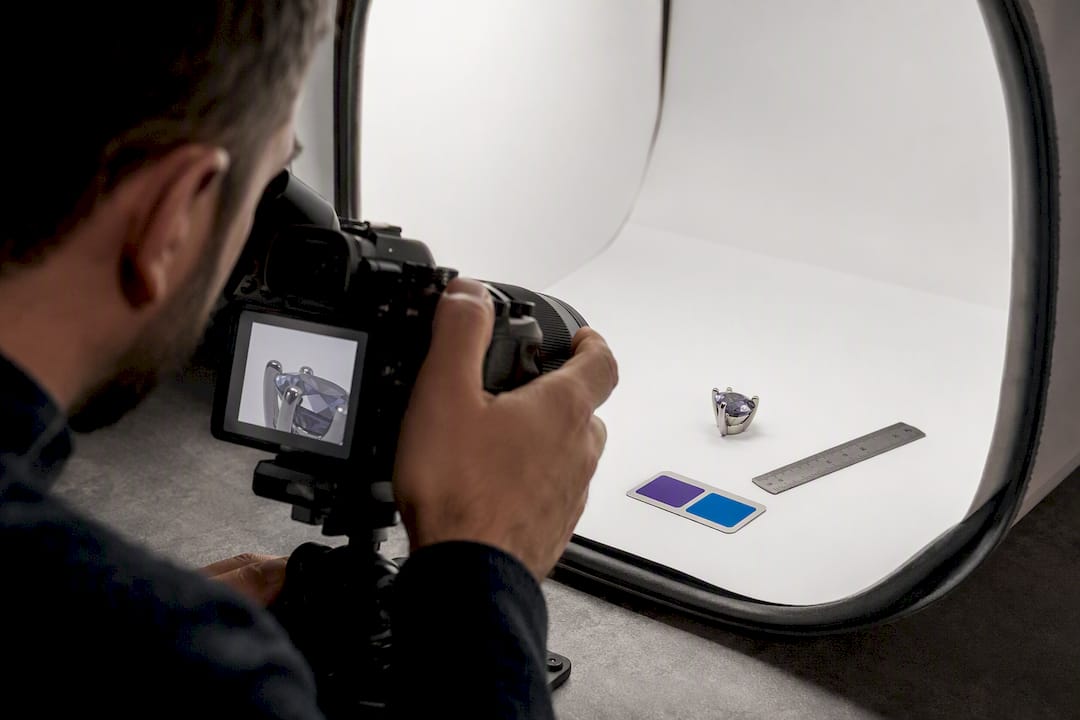
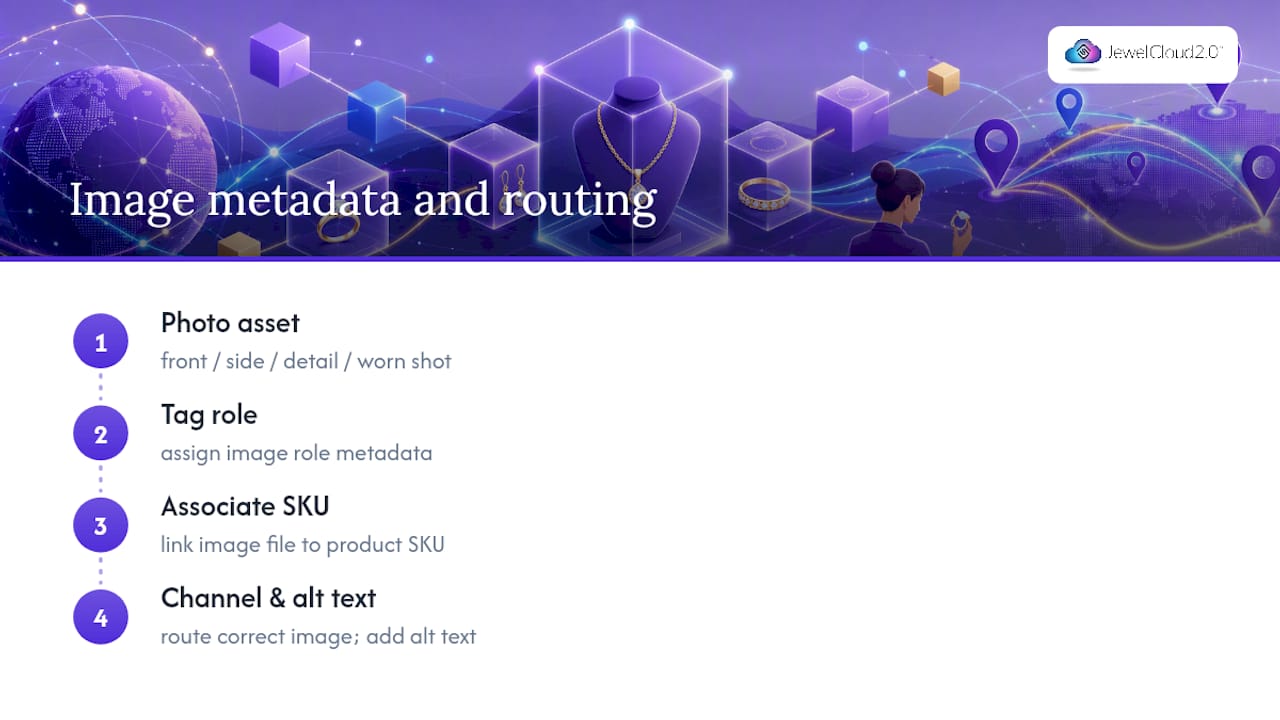
Image metadata deserves the same structure as your product attributes. Tag each image with a role (front view, side view, detail shot, worn shot) and associate it with the SKU rather than just a generic file name, so channels can surface the right image in the right context automatically. Alt text tied to that same metadata improves accessibility and gives search engines actual product context instead of a blank field.
File size matters too, but not at the cost of detail. A compressed image that hides inclusions or color variation creates the same return risk as a bad angle. Compress for load speed, but never past the point where a buyer can still verify what they’re actually purchasing.
Writing Jewelry Descriptions That Build Trust and Sell
A generic description (“beautiful gold ring, perfect for any occasion”) tells a buyer nothing they couldn’t guess from the photo. A strong jewelry description does two things at once: it states the hard facts precisely, and it gives the piece enough story that a buyer feels the value beyond the metal weight.
Lead with the specifics a serious buyer scans for first: metal purity, stone type and carat weight, certification, and sizing range. Bury these and you lose the shopper who already knows what they’re comparing against three other listings open in other tabs.
Then add provenance and craft detail, but keep it honest and specific. “Hand-set in a four-prong setting” tells a buyer something real. “Exquisite craftsmanship” tells them nothing. If a piece comes from a named collection, a specific era-inspired design, or uses a particular setting technique, name it. That’s the difference between a description that reads like a catalog entry and one that reads like it was written by someone who actually knows the piece.
Structure the description consistently across your catalog: specs first, story second, care instructions third. A retail-focused listing guide built around this order tends to perform better because buyers stop hunting for the fact they actually need before they abandon the page.
Avoid restating the title in the first sentence. It wastes the most valuable real estate on the page repeating information the buyer already read once.
SEO Tactics Built Specifically for Jewelry Listings
Generic SEO advice treats every product category the same, and that’s exactly why it underperforms for jewelry. Shoppers searching for engagement rings or certified diamonds use specific, high-intent language, and your listing data needs to match that specificity field for field.
Titles should carry the attributes buyers actually search: metal type, stone, cut, and carat weight, in the order your channel’s algorithm favors, not the order that reads prettiest. “14K White Gold 1.5 Carat Round Diamond Solitaire Ring” outperforms “Beautiful Diamond Ring” because it matches the exact query pattern a buyer typed.
Structured attribute data does double duty here. The same fields you standardized for channel mapping, purity, carat, certification, feed directly into how search engines and AI shopping agents parse your listing. That structural clarity is a meaningful part of why structured feeds convert roughly twice as well for AI-driven product discovery compared to thin, unstructured pages.
Use certification and provenance details as searchable content, not decoration. A buyer searching “GIA certified emerald cut diamond” needs that exact phrase reflected somewhere in your structured data or description, not just implied.
Keep category and variant pages distinct rather than duplicating near-identical content across ten size or metal-color variants of the same design. Search engines penalize that duplication, and consolidating variants under one canonical listing with selectors usually performs better than splitting them into competing pages. Reviewing how your catalog data converts across channels on a recurring basis helps you catch which titles and attributes are actually driving traffic versus which ones just look complete.
Do Reviews and Q&A Actually Matter for Jewelry Sales?
Jewelry is a high-consideration purchase, and buyers hesitate longer over a $2,000 ring than a $20 accessory. Reviews and buyer questions close that hesitation gap in ways product specs alone can’t.
Reviews that mention specific details, how a ring’s size ran, how a stone looked in different lighting, whether the clasp on a necklace held up, carry more weight than generic five-star ratings with no text. Encourage detailed feedback by prompting buyers with specific questions after delivery rather than a blank review box.
Q&A sections solve a different problem: they surface the questions your description didn’t anticipate. If multiple buyers ask the same sizing question, that’s a signal your description or attribute data is missing something, not a support ticket to answer once and forget. Feed common questions back into your canonical product record so the next version of that listing answers the question before it gets asked.
For certified stones, buyer trust often hinges on verification, not just sentiment. A review that says “the certificate matched exactly what was described” does more to reduce purchase anxiety on a high-value item than ten reviews praising the packaging. Make it easy for buyers to confirm certification details are accurate, since that verification loop directly reduces the dispute and return risk tied to stone quality questions.
What Trade-Offs Actually Matter in Jewelry Catalog Management
The tension every supplier and retailer runs into is speed versus completeness. Push a listing live fast with partial data, and you’ll get it in front of buyers sooner, but incomplete attribute data is exactly what drags jewelry conversion rates down and inflates returns. Wait until every field is perfect, and a competitor’s decent listing beats your excellent one to market by three weeks.
The resolution isn’t picking one side. It’s sequencing: publish once required fields pass validation, then enrich certification links, provenance detail, and secondary images afterward. Structured, normalized data does something else too, often overlooked: it makes your catalog readable to AI shopping agents that are increasingly part of how buyers discover jewelry online. A thin, inconsistent listing simply doesn’t parse the same way a structured one does.
None of this replaces judgment. Governance processes catch missing fields; they don’t catch a description that undersells a genuinely well-made piece.
— Anthony
How JewelCloud Helps You Manage Jewelry Marketplace Listings
Building this kind of governed catalog from scratch, attribute dictionaries, normalization rules, live price feeds, channel mappings, takes real engineering time most jewelry businesses don’t have spare. Some platforms give suppliers and retailers that structure already built: a standardized data model for the fields covered here, catalog distribution to retail partners, and inventory and price syncing that keeps listings accurate without manual re-entry.
The practical starting point is small. Pick one product family, stud earrings or plain bands work well as a pilot, and one retail partner, then run your data through Jewelcloud’s structure before expanding to your full catalog. That mirrors the same phased approach outlined in the checklist above, just with the infrastructure already in place instead of built in house.
If you’re a supplier looking to distribute standardized data to qualified retail partners, review Jewelry Vendor Benefits or explore Vendor Membership options to see how onboarding works. Diamond dealers can check Diamond Vendor Benefits for certification and data handling specifics. Start with the Jewelcloud platform overview to request a walkthrough of how your catalog would map into the system before committing to a full rollout.