


The right way to run a multi supplier jewelry inventory is a central master catalog that pulls in every supplier feed and applies clear rules for safety buffers and allocation. Get this right and you cut oversells, launch new collections in days instead of weeks, and keep product attributes consistent no matter how many vendors feed your site. A jewelry-specific platform handles the standardization work that generic inventory tools were never built to do.
TL;DR:
- Building canonical SKUs and classifying suppliers by volume and reliability are essential first steps to prevent broken processes and ensure proper inventory control.
- Jewelry-specific catalog logic needs to account for multiple variants per design, with standardized attributes for metal type, stone details, and sizing to avoid duplicate listings and broken links.
- Matching integration methods to supplier size and compliance requirements—using APIs for high-volume vendors, EDI for major partners, and CSV for new or small suppliers—optimizes effort and reliability.
- Safety buffers and reservation logic must reflect item value and lead times, preventing oversells especially on high-value, slow-restock pieces through prioritized sourcing and accurate sync systems.
- Common failures include inconsistent attribute naming, silent feed outages, and duplicate SKUs, which can be detected with catalog health scores and supplier reliability metrics to avoid costly errors.
Table of Contents
- Getting Multi Supplier Jewelry Inventory Under Control Fast
- Why Jewelry Needs Its Own Catalog Logic
- API, EDI, or CSV: Choosing the Right Feed for Each Supplier
- How Do You Calculate Sellable Quantity Across Suppliers?
- Supplier Onboarding Checklist and SLA Basics
- Why a Jewelry-Specific Data Platform Changes the Math
- Where Multi Supplier Inventory Actually Breaks Down
- Ready to See a Jewelry-Specific Catalog in Action?
- Sources
- FAQ
Getting Multi Supplier Jewelry Inventory Under Control Fast
You don’t need a full platform migration to stop the bleeding. You need a short list of moves, done in order, over the next 30 to 90 days.
- Build canonical SKUs first. Every supplier SKU needs to map to one internal record. Skip this and everything downstream breaks.
- Turn on supplier monitoring with SKU-level safety buffers. A $200 stud earring and a $12,000 tennis bracelet should never carry the same buffer logic.
- Classify suppliers by integration method. Rank them by volume and reliability, then decide who gets API treatment first and who stays on manual CSV uploads for now.
- Write down SLAs and build an exception queue. Someone needs to own what happens when a feed goes stale or a quantity looks wrong.
- Stand up basic monitoring. Track sellable stock, supplier reliability rate, and how fast the exception queue grows or shrinks.
None of this requires enterprise software on day one. It requires discipline about sequencing. Retailers who skip straight to automation without fixing the SKU mapping underneath just automate their mistakes faster.
Why Jewelry Needs Its Own Catalog Logic
A jewelry catalog isn’t like apparel or electronics. One design can spawn dozens of sellable variants, ring size 5 through 9, in yellow gold, white gold, and platinum, each with its own supplier SKU. A canonical product model has to hold that whole tree without losing track of which variant is which.
The mapping chain runs supplier SKU to canonical SKU to channel SKU. That middle step is where most retailers get stuck, because two suppliers often describe the identical stone cut or metal purity with different codes. A master catalog that resolves those SKU aliases prevents duplicate listings and gives dropship routing and inventory sync something reliable to work from.
At minimum, normalize these fields across every supplier:
- Metal type and purity (14k, 18k, platinum, sterling)
- Stone type, cut, clarity, and carat weight
- Size range and sizing increments
- Setting style and finish
- Certification details, where applicable
Run regular catalog health checks for missing fields, duplicate entries, and broken or missing images. A catalog with silent gaps looks fine until a shopper hits a product page with no size chart.
Pro Tip: Audit your top 50 SKUs by revenue monthly for attribute completeness. That handful of products usually drives a disproportionate share of sales, and a missing carat weight there costs more than the same gap on a slow mover.
API, EDI, or CSV: Choosing the Right Feed for Each Supplier
Not every supplier deserves the same integration effort. Match the method to the supplier’s volume and your compliance obligations, not to whatever feels most modern.
- APIs give you real-time stock and pricing, ideal for high-volume suppliers where a stale quantity means a canceled order. They take longer to build and usually need developer time on both ends.
- EDI is often non-negotiable for larger trading partners. Major retail trading partners commonly require EDI for inventory and order data, and certification with a big chain typically takes several weeks.
- CSV or scheduled feeds are the fastest to stand up. A supplier emails or uploads a file daily or weekly. It’s manual and prone to lag, but it gets a new vendor’s catalog live while you build something sturdier.
A sensible hybrid: tier your suppliers by revenue and reliability, automate the top tier with API or EDI first, and leave smaller or newer vendors on CSV until volume justifies the build. Practical integration steps for connecting wholesale catalogs to retail systems follow this same logic, sequencing effort where it pays off fastest. Jewelry brings extra wrinkles here too. Memo and consignment arrangements and serialized stone tracking need connectors built for those workflows specifically, not a generic retail EDI template.
How Do You Calculate Sellable Quantity Across Suppliers?
Sellable quantity is never just “sum every supplier’s reported stock.” That math produces oversells the first time two suppliers report the same piece as available and a customer buys it from both listings at once.
You have two aggregation models to choose from:
- Pooled inventory combines quantities across suppliers into one sellable number, useful for commodity items like plain bands where any supplier’s unit is interchangeable.
- Prioritized sourcing ranks suppliers by reliability or margin and pulls from the top-ranked one first, better suited to unique or high-value pieces where provenance and certification matter.
Safety buffers should scale with SKU value and supplier lead time, not sit at one flat percentage across the board. A conservative buffer paired with prioritized sourcing works better for expensive, slow-to-restock items than aggressive pooling, since the financial exposure of an oversold $8,000 ring is nothing like an oversold $40 charm.
Build reservation logic into the sellable count too: pending orders and channel-specific holds need to subtract from available stock the instant an order comes in, not at the next scheduled sync. Sync systems built for jewelry push these adjusted quantities to every sales channel and account for feed latency so a supplier’s delayed update doesn’t silently oversell your storefront. Variant-aware sync matters just as much here. A design with 40 size and metal combinations needs each branch of that tree tracked separately, or a single miscount cascades across every variant.
Supplier Onboarding Checklist and SLA Basics
A new supplier relationship should never start with “just send us your spreadsheet.” Set the terms before the first feed arrives.
- Define required fields and accepted formats. Spell out exactly which attributes are mandatory and whether you’ll accept API, EDI, or CSV.
- Set update cadence and maximum feed latency. Daily is a reasonable floor for most suppliers; anything slower needs a wider safety buffer.
- Agree on error handling. Decide who fixes a malformed feed and how fast, before it becomes a live-site problem.
- Run a test window. Push sample data through for one to two weeks before the supplier goes live on your storefront.
- Document reconciliation and chargeback terms. If a supplier’s bad data causes an oversell or a canceled order, the SLA should say who absorbs the cost.
Keep this checklist as a living document. Suppliers change systems, staff, and update habits, and your SLA should get revisited whenever a feed’s reliability starts slipping.
Why a Jewelry-Specific Data Platform Changes the Math
Generic inventory tools treat a diamond ring like a t-shirt with a size field. That’s where most multi supplier setups start breaking down. Jewelcloud standardizes the attributes that actually matter for jewelry, metal purity, stone certification, setting type, so supplier feeds map into one consistent structure instead of forty different spreadsheets fighting each other.
That structure pays off in a few concrete ways:
- Retailers can expand online assortment and launch new collections faster using real supplier data, without carrying the physical stock themselves.
- Suppliers get a distribution channel that puts their catalog in front of qualified retail partners without building custom integrations for each one.
- A supplier feed lands as a canonical record, then flows out to whichever channel needs it, your site, a marketplace, a showcase page, with attributes intact.
Pro Tip: When you’re evaluating a new supplier’s feed, check whether their stone certification data survives the import unchanged. That single field breaks more often than any other in jewelry data mapping.
Where Multi Supplier Inventory Actually Breaks Down
Most retailers don’t fail at the strategy level. They fail at the boring, unglamorous stuff: inconsistent attribute naming between suppliers, a feed that goes quiet for three days without anyone noticing, duplicate SKUs from a vendor who renamed their catalog mid-year. None of that shows up in a pitch deck. All of it shows up in your return rate.
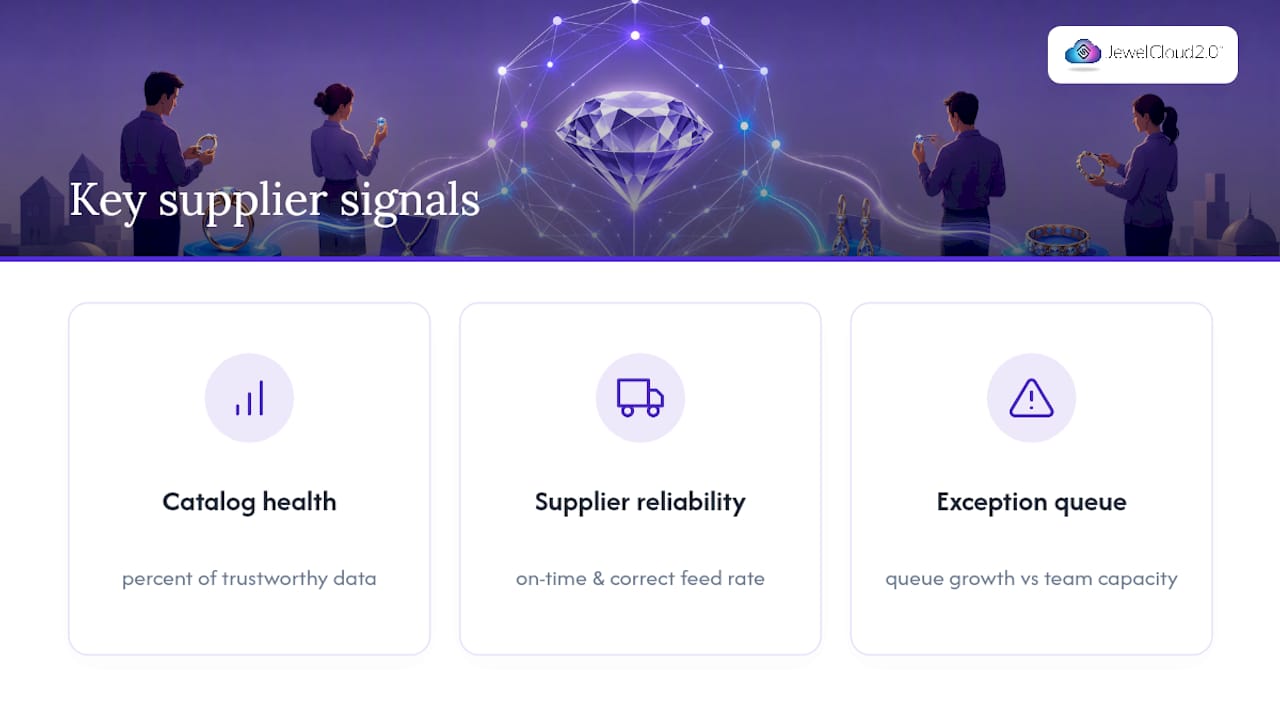
Watch three signals closely. Catalog health score tells you how much of your data is trustworthy right now. Supplier reliability rate tells you which vendors are quietly costing you sales through late or wrong feeds. Exception queue growth tells you whether your process is keeping pace with your supplier count or falling behind it.
Spreadsheets and one-off scripts work fine at three or four suppliers. Past that, the exception queue tends to grow faster than any team can manually clear it, and that’s the real trigger for moving to a managed platform, not a fixed supplier count.
— Anthony
Ready to See a Jewelry-Specific Catalog in Action?
If your team is still stitching together spreadsheets from a dozen vendors, Jewelcloud gives you what generic inventory software can’t: product data structured around jewelry’s actual complexity, metal purity, stone grading, size trees, from the start.
Jewelcloud works as a supplier network and a structured data layer at the same time. Retailers get access to standardized product feeds from participating brands and diamond dealers, so you can expand your assortment without warehousing stock you haven’t sold yet. Suppliers get a distribution channel that puts their catalog in front of vetted retail partners.
Start by reviewing the Jewelcloud platform to see how the feed structure works, then look at vendor membership options if you’re evaluating supplier-side participation. Either way, the next step is a quick look at the actual data, not another sales call.
Sources
For deeper technical detail on EDI compliance timelines, see WJewel’s EDI guide. For jewelry supply chain connectors covering memo and serialized tracking, see EDI Options.
- Inventory Management Software for Multichannel Jewelry Ecommerce | Appath
- EDI for Jewelry Business: A Practical Guide for Wholesalers and Manufacturers | WJewel
- Connecting Data Across the Jewelry Supply Chain - EDI Options for Electronic Data Interchange
FAQ
What Is a Multi Supplier Jewelry Inventory System?
It’s an operational setup where a retailer aggregates stock feeds from several suppliers into one master catalog, applying safety buffers and allocation rules so the storefront always shows an accurate sellable quantity.
Do I Need EDI to Work With Multiple Jewelry Suppliers?
Not always, but major retail trading partners commonly require it, and certification typically takes 4 to 12 weeks, so factor that timeline in before committing to a big-chain relationship.
How Do I Prevent Oversells With Multiple Suppliers?
Set SKU-level safety buffers scaled to item value and supplier lead time, use reservation logic that deducts stock the moment an order is placed, and prioritize sourcing for high-value pieces instead of pooling them blindly.
What’s the Fastest Way to Onboard a New Jewelry Supplier?
Start with a scheduled CSV feed to get their catalog live quickly, then upgrade to API or EDI once volume and reliability justify the integration work.
Can Jewelcloud Help Standardize Data From Multiple Suppliers?
Yes. Jewelcloud structures jewelry-specific attributes like metal purity and stone certification into a consistent format, which lets retailers combine feeds from different suppliers into one reliable catalog.