


Net terms in jewelry wholesale are defined as the agreed number of days a buyer has to pay a supplier after receiving an order. The most common structure is Net 30, meaning full payment is due within 30 days of delivery. Other standard durations include Net 7, Net 15, Net 45, Net 60, and Net 90, each suited to different buyer relationships and order volumes. Understanding what does net terms mean jewelry wholesale is the foundation of managing cash flow, building supplier trust, and growing your purchasing power as a retailer.
61% of business buyers use trade credit as their primary wholesale payment method. That number tells you net terms are not a niche arrangement. They are the backbone of how wholesale jewelry moves through the supply chain.
What does net terms mean in jewelry wholesale?
Net terms are a form of trade credit. The supplier ships the goods, and the buyer pays later, within the agreed window. This arrangement gives retailers time to receive, display, and even sell inventory before the invoice comes due.

In the jewelry industry, net terms carry specific weight. Jewelry is a high-value, high-trust category. Suppliers do not extend open credit to every buyer who places a first order. Net terms are typically reserved for repeat buyers with a proven payment record. New retailers should expect to complete several prepaid or deposit-based orders before a supplier offers net terms.
The practical benefit for retailers is real. Net terms let a small jewelry retailer self-fund inventory by selling stock before the invoice is due, supporting a broader assortment without tying up all available capital upfront. For suppliers, net terms attract loyal, high-volume buyers. The trade-off is accepting delayed cash receipt and taking on some credit risk.
How do net terms work for jewelry wholesale orders?
The application of net terms in jewelry wholesale depends heavily on the type of order. Stock orders and custom or bespoke orders follow different payment structures.
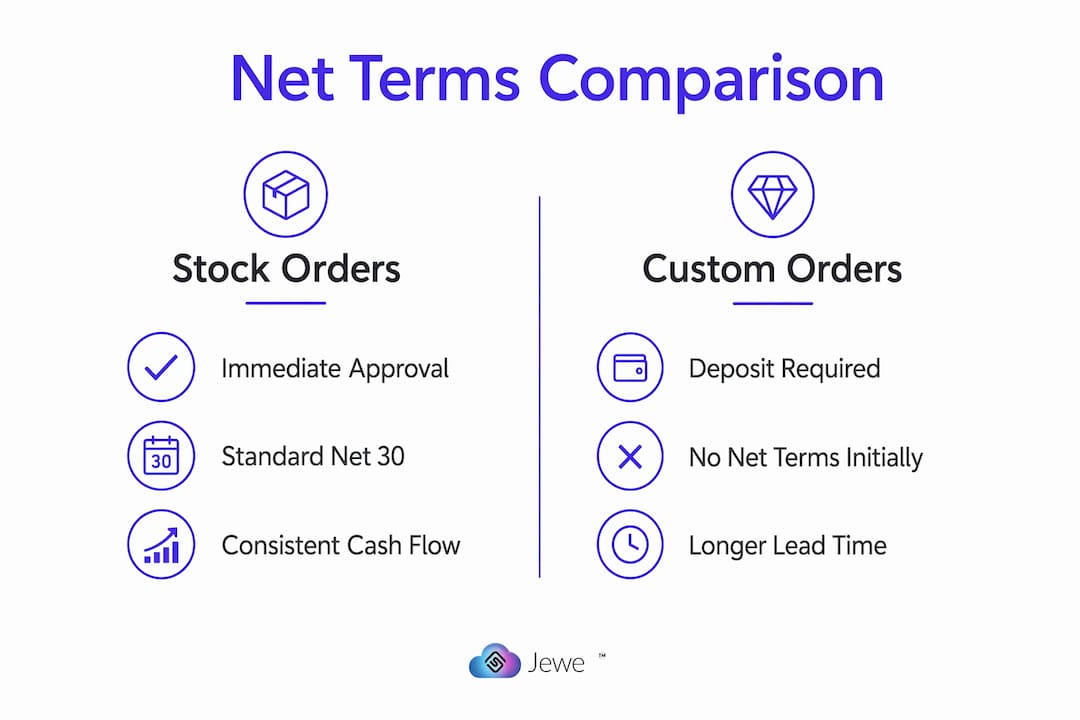
Stock orders vs. custom orders
For stock orders, established retail partners often qualify for net terms from the start of the relationship. The supplier ships from existing inventory, and the retailer pays within the agreed window, typically Net 30.
Custom or bespoke jewelry orders work differently. Deposits of 30–50% are standard for new or custom orders. The remaining balance is usually due before shipment. Net terms rarely apply to first-time custom projects because the supplier carries production risk without any guarantee of payment.
Here is how payment milestones typically break down for custom wholesale orders:
-
Order confirmation: 30–50% deposit paid upfront
-
Sample approval: Confirmation that the design meets specifications before full production begins
-
Production start: Some suppliers require a second milestone payment at this stage
-
Pre-shipment: Remaining balance paid before goods leave the supplier
-
Net terms (established partners only): Full invoice due within the agreed window after delivery
Pro Tip: Ask your supplier in writing whether net terms apply to stock orders, custom orders, or both. Many retailers assume net terms cover all purchases, then face a surprise deposit requirement on their first custom piece.
Order modifications after production starts can reset payment timing. If you change a design mid-production, expect the supplier to treat the revised order as a new project with fresh deposit requirements. Get any change requests confirmed in writing before assuming the original payment schedule still applies.
What are the differences between Net 30, Net 60, and Net 90?
Net 30 is the industry standard for wholesale transactions. Most jewelry suppliers default to Net 30 for qualified retail partners. Net 60 and Net 90 are extended to high-volume buyers with a long, clean payment history.
Benefits and risks by term length
Longer net terms benefit buyers by extending the sales window. A retailer on Net 60 has two full months to sell inventory before the invoice is due. That flexibility supports higher order volumes and broader assortment decisions.
For suppliers, longer terms create cash flow pressure. The goods are gone, the production costs are paid, and the revenue sits on paper as an account receivable. Net terms create a real tension between competitive advantage and cash flow risk. Suppliers who extend Net 60 or Net 90 are essentially lending money to their buyers.
One tool that helps both sides is the early payment discount. A common structure is “2/10 Net 30,” which means the buyer gets a 2% discount if they pay within 10 days instead of waiting the full 30. Early payment discounts benefit buyers through cost savings and benefit suppliers by pulling cash in faster. For a retailer ordering $10,000 in inventory, a 2% discount saves $200 per order. That adds up quickly across a full buying season.
The risks of extended net terms for suppliers include:
-
Bad debt exposure: If a buyer defaults, the supplier absorbs the loss
-
Cash flow gaps: Delayed payments can affect the supplier’s own production cycle
-
Administrative burden: Tracking multiple open invoices across buyers requires systems and attention
Retailers benefit most from longer terms when their inventory turns quickly. If a piece sits in the case for 75 days and you are on Net 60, you are paying before you have sold the item. Match your net term length to your realistic sell-through rate.
How to negotiate and manage net terms effectively
Building access to net terms takes time and deliberate effort. Suppliers extend credit to buyers they trust, and trust is built through consistent, on-time payments.
-
Start with prepaid orders. Place your first two or three orders on prepaid terms. Pay on time, every time. This creates a payment record the supplier can point to when approving net terms.
-
Request net terms in writing. Once you have a track record, ask your supplier directly for Net 30. Put the request in an email so both parties have a record of the agreement.
-
Clarify all payment triggers upfront. Before placing any order, confirm in writing what triggers each payment. Is the deposit due at order confirmation or at sample approval? Is the balance due before shipment or on delivery?
-
Specify the payment method. Different payment methods carry different fees and processing times. Confirm which methods the supplier accepts for each payment stage.
-
Address order modification policies. Ask what happens to your payment schedule if you need to change an order. A clear policy prevents disputes later.
Clear payment terms that specify deposit ratios, milestones, and accepted payment methods significantly reduce disputes in wholesale jewelry orders. Ambiguity is the most common source of conflict between buyers and suppliers.
Pro Tip: Review your payment history with each supplier once a year. If you have paid on time consistently, use that record to negotiate better terms. Suppliers want to keep good buyers, and a Net 60 offer costs them less than losing your account.
Suppliers also manage net terms as a credit risk tool. They may set a credit limit, meaning you can carry up to a certain dollar amount in open invoices before new orders require prepayment. Know your credit limit with each supplier and plan your order calendar around it.
What payment methods work best with net terms?
The payment method you use affects timing, fees, and the supplier relationship. Common payment methods in wholesale jewelry include T/T bank transfers, PayPal for smaller orders, and escrow arrangements for high-value custom projects.
Each method has a different risk and cost profile:
-
T/T (telegraphic transfer) bank transfers are the standard for large wholesale orders. They are direct, traceable, and widely accepted. Processing typically takes 1–3 business days internationally.
-
PayPal works for smaller orders or initial sample payments. Fees run higher than bank transfers, and PayPal’s buyer protection policies can complicate supplier relationships on large orders.
-
Escrow services suit high-value custom projects where both parties want a neutral third party holding funds until delivery conditions are met. Escrow adds cost but reduces risk for both sides.
-
Credit cards offer buyer protection and float, but suppliers often pass processing fees to the buyer. Confirm the fee structure before using a card for a large order.
Currency considerations matter for international wholesale purchases. If your supplier invoices in a foreign currency, exchange rate fluctuations between order placement and payment due date can change your actual cost. Ask whether the supplier will invoice in US dollars to remove that variable.
Key Takeaways
Net terms in jewelry wholesale are a trade credit tool that rewards buyer trust and supports inventory liquidity for retailers who use them well.
| Point | Details |
|---|---|
| Net 30 is the standard | Most jewelry wholesalers default to Net 30 for qualified retail partners. |
| Custom orders require deposits | Expect to pay 30–50% upfront on new or bespoke jewelry orders before net terms apply. |
| Trust unlocks better terms | Consistent on-time payments on prepaid orders are the fastest path to Net 60 or Net 90. |
| Early payment discounts save money | A “2/10 Net 30” structure saves buyers 2% per invoice and improves supplier cash flow. |
| Written terms prevent disputes | Specifying deposit ratios, milestones, and payment methods in writing reduces order conflicts. |
Net terms are more than a payment schedule
After years of watching jewelry retailers navigate wholesale purchasing, the pattern I see most often is this: retailers treat net terms as a finance detail and miss the bigger picture. Net terms are a liquidity management tool. Used well, they let you carry more inventory, respond faster to demand, and grow your assortment without waiting for capital to cycle back in.
The retailers who get the most out of net terms are the ones who treat their payment record as a business asset. Every on-time payment is a deposit into a trust account with your supplier. That trust converts into better terms, higher credit limits, and priority access during tight supply periods.
The part most retailers overlook is the supplier’s perspective. Extending Net 60 to a buyer is a real financial commitment. Suppliers who do it are betting on your reliability. When you pay early, even occasionally, you signal that you understand the relationship goes both ways. That kind of goodwill is worth more than any single discount.
The jewelry industry is relationship-driven in a way that most wholesale categories are not. Your payment behavior is part of your reputation. Treat it accordingly.
— Anthony
How Jewelcloud supports your wholesale purchasing
Understanding net terms is one piece of the puzzle. Finding the right wholesale partners to apply them with is another.

Jewelcloud is a B2B jewelry platform built for retail jewelers who want access to a broad range of wholesale products without the burden of carrying physical inventory. Designers, manufacturers, and diamond dealers list their merchandise at wholesale, and you get structured, accurate product data you can source, sell, or showcase digitally. Whether you are building out your online assortment or sourcing new collections, Jewelcloud connects you with qualified vendor partners who understand wholesale purchasing practices. Learn more about how Jewelcloud works for retailers at the Jewelcloud platform overview.
FAQ
What does net 30 mean in jewelry wholesale?
Net 30 means the buyer has 30 days from the invoice or delivery date to pay the supplier in full. It is the most common payment term in jewelry wholesale for established retail partners.
Do net terms apply to custom jewelry orders?
Net terms rarely apply to first-time custom orders. Most suppliers require a 30–50% deposit upfront and the balance before shipment, with net terms reserved for repeat buyers with a proven payment history.
How do I qualify for net terms with a jewelry wholesaler?
Place several prepaid orders and pay on time consistently. Once you have a payment record, request net terms in writing. Suppliers extend credit to buyers who have demonstrated reliability.
What is a 2/10 Net 30 discount in wholesale jewelry?
A 2/10 Net 30 term means you receive a 2% discount if you pay within 10 days instead of the full 30. It saves buyers money and gives suppliers faster access to cash.
What payment methods are accepted with net terms in jewelry wholesale?
T/T bank transfers are the most widely accepted method for large wholesale orders. PayPal suits smaller payments, and escrow services work for high-value custom projects where both parties want added security.