


Omnichannel jewelry retail is defined as the full integration of every sales and communication channel, including physical showrooms, ecommerce websites, social media, CRM systems, and messaging apps like WhatsApp, into one unified customer experience. Unlike multichannel jewelry shopping, where each channel operates independently, omnichannel retail connects them so that a shopper’s data, preferences, and purchase history follow them everywhere. U.S. retail sales are projected to exceed $5.23 trillion in 2026, with top jewelers adopting integrated strategies to meet rising customer expectations. That scale signals one thing clearly: retailers who treat their channels as separate silos are leaving real revenue on the table. Jewelcloud helps jewelry retailers close that gap by giving them access to structured, standardized product data across every channel they sell through.
What is omnichannel jewelry retail and how does it work?
Omnichannel jewelry retail integrates ecommerce, physical showrooms, WhatsApp, CRM systems, social media, and marketplaces into a single, unified customer experience. The key word is “integrated.” A shopper who browses a diamond ring on Instagram, asks a question over WhatsApp, and then visits your store to try it on should feel like they never left one conversation. That continuity is what separates omnichannel from simply being present on multiple platforms.
The distinction between multichannel and omnichannel matters more than most retailers realize. Multichannel means you sell in more than one place. Omnichannel means those places share data, inventory, and customer context in real time. A customer who adds a piece to their online wishlist should see it reserved correctly when they walk into your showroom. Without that sync, the experience breaks, and the customer notices immediately.
Jewelry retail adds a layer of complexity that most general retail guides ignore. Products carry emotional weight, high price points, and deep personalization. A shopper researching an engagement ring may touch your brand across six or seven touchpoints before buying. Each one needs to reflect the same product information, pricing, and availability. That consistency is the foundation of a working omnichannel jewelry brand strategy.
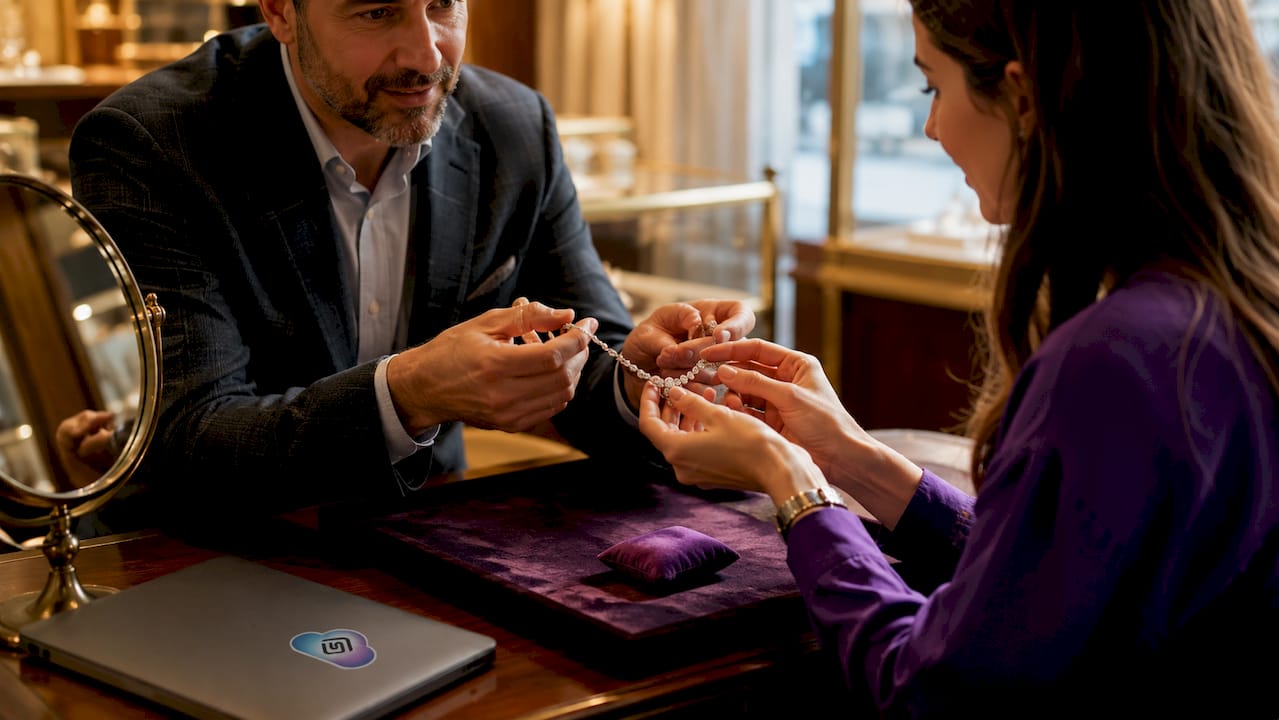
Key channels that power a unified jewelry retail experience
An effective omnichannel strategy for jewelry retail connects the following channels into one operating system:
- Physical showroom: The trust anchor. Customers come here to touch, try, and confirm. It must reflect exactly what is shown online.
- Ecommerce website: Your 24/7 catalog. Product data must be accurate, filterable, and synced with live inventory.
- Social media (Instagram, Pinterest, Facebook): Discovery and inspiration channels. Shoppable posts and ads drive traffic that must land on consistent product pages.
- Marketplaces: Broader reach for specific categories. Listings must pull from the same product data to avoid pricing or description mismatches.
- WhatsApp and messaging apps: High-conversion channels for jewelry because they allow personal, consultative selling. Order and customer data from these conversations must feed back into your CRM.
- CRM system: The connective tissue. It stores customer purchase history, preferences, and communication logs so every touchpoint feels personal.
The integration of these channels depends entirely on the quality of your product data. Inconsistent descriptions, outdated pricing, or missing stone details across channels erode trust faster than any competitor can. Jewelcloud structures and standardizes product data at the source, so what a shopper sees on your website matches what your sales associate pulls up in the showroom.
Pro Tip: Sync inventory and pricing in real time across all channels before launching any new collection. A single price discrepancy between your website and your store floor can cost you a sale and a customer.
What operational challenges do jewelry retailers face with omnichannel?
Jewelry retail carries operational complexity that generic retail platforms simply were not built to handle. Jewelry chains require omnichannel order management systems that handle serialized inventory, compliance requirements, and multi-store stock visibility to prevent costly errors. Every piece of fine jewelry is unique. A solitaire diamond ring is not a SKU you can restock like a T-shirt. It has a serial number, a hallmark certificate, and a specific stone grading report attached to it.
The most common operational failures in jewelry omnichannel retail include:
- Stock mismatches: A piece sold in-store still showing as available online, leading to double-selling and customer disappointment.
- Invoicing errors: Compliance requirements for GST and hallmark documentation vary by transaction type. Manual processes create gaps.
- Order routing failures: An online order placed for in-store pickup gets routed to the wrong location because inventory data is not centralized.
- CRM gaps: A WhatsApp conversation that converts to a sale never gets logged, so the customer’s history is incomplete for future engagement.
Generic OMS systems fail jewelry retailers because they cannot handle serialized stock, hallmark compliance, or the invoicing complexity that fine jewelry requires. A purpose-built omnichannel order management system for jewelry automates GST-compliant invoicing, routes orders based on actual inventory location, and prevents overselling across channels. That is not a luxury feature. It is the baseline for operating without constant manual correction.
Systems integration failure is the main pitfall in jewelry omnichannel retail. When inventory, pricing, and customer data do not sync live, the customer experience breaks at the exact moment it matters most. The fix is not more staff monitoring spreadsheets. The fix is choosing platforms that treat data synchronization as a core function, not an add-on.
Pro Tip: When evaluating an order management system, ask vendors specifically how they handle serialized inventory and compliance documentation. If they cannot answer clearly, the platform was not built for fine jewelry.
What metrics should jewelry retailers track for omnichannel success?
Measuring omnichannel performance requires going beyond total sales volume. Tracking metrics like customer acquisition cost, lifetime value, and conversion rates gives you the data to make channel investment decisions with confidence. Sales volume tells you what happened. These metrics tell you why, and what to do next.
Customer acquisition cost (CAC) measures how much you spend to bring one new buyer through any channel. Lifetime value (LTV) measures how much that buyer spends with you over time. The ratio between them determines whether a channel is profitable or just busy. A high-traffic Instagram campaign that drives low-LTV buyers is less valuable than a targeted email sequence that reactivates past customers.
Attribution is the hardest problem in omnichannel analytics for jewelry retailers. A customer might discover your brand on Pinterest, research on your website, ask a question on WhatsApp, and buy in-store. Attribution requires mixed media modeling combined with deterministic CRM linking to capture those multi-channel paths accurately. Without this, you will consistently undervalue the channels that start the conversation and overvalue the ones that close it.
| Metric | Definition | Why it matters |
|---|---|---|
| Customer acquisition cost (CAC) | Total marketing spend divided by new customers acquired | Shows which channels bring buyers efficiently |
| Customer lifetime value (LTV) | Total revenue from one customer over their relationship with you | Identifies your most valuable customer segments |
| Cross-channel conversion rate | Percentage of shoppers who convert after touching multiple channels | Measures how well your channels work together |
| Return rate by channel | Percentage of orders returned, segmented by where they originated | Flags channels with misaligned product expectations |
| CRM engagement score | Frequency and depth of customer interactions across touchpoints | Predicts retention and repeat purchase likelihood |
A unified CRM is the engine behind all of this. When every channel feeds customer data into one system, you can see the full picture of how shoppers move through your brand. That visibility is what turns a jewelry brand omnichannel strategy guide from theory into a tool you actually use.
How to implement omnichannel jewelry retail step by step
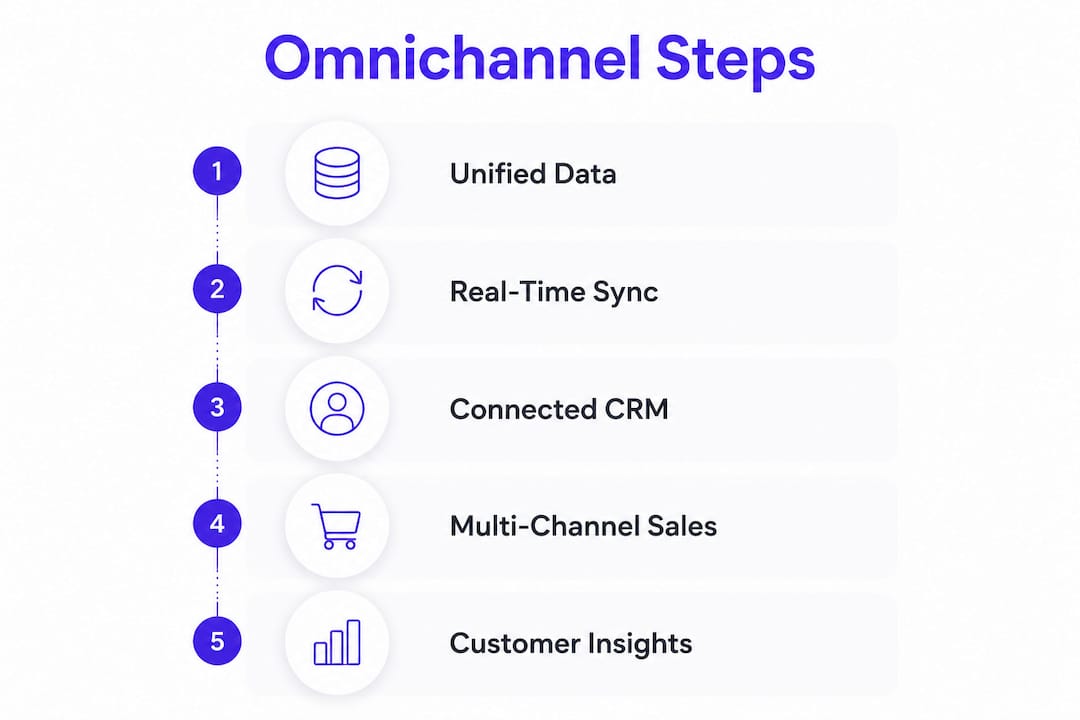
Moving from fragmented channels to a fully integrated operation takes a clear sequence. Skipping steps creates the partial integration that frustrates customers more than no integration at all.
-
Audit your current channels and data. Map every place you sell or communicate with customers. Identify where product data, pricing, and inventory are stored and whether they match across channels. Most retailers discover three or four versions of the same product information living in different systems.
-
Unify your product catalog. Choose a single source of truth for product data. Every channel must pull from this source. Jewelcloud’s structured product feed gives retailers standardized, accurate jewelry data that is ready to deploy across ecommerce, social, and in-store systems without manual reformatting.
-
Integrate your inventory system. Connect your point-of-sale, ecommerce platform, and any marketplace listings to one inventory database. Real-time updates prevent overselling and keep your showroom floor and online catalog aligned.
-
Connect your CRM to every touchpoint. Every sale, inquiry, and interaction, whether it happens on WhatsApp, in-store, or through your website, should log to the same customer record. This is what makes personalization possible at scale. Retailers who use social media and CRM together for lead generation see significantly stronger conversion rates because they can follow up with context.
-
Train your staff on the unified system. Technology only works when people use it correctly. Your sales associates need to know how to pull up a customer’s online wishlist, check live inventory across locations, and log a WhatsApp conversation as a CRM touchpoint.
-
Measure, adjust, and expand. Start with your highest-volume channels and get the integration right before adding new ones. Use the metrics from your CRM and analytics tools to identify where the customer experience breaks and fix those gaps first. Understanding your ROI across channels helps you prioritize where to invest next.
Combining digital convenience with personal brand trust reduces shipping anxiety and builds lasting customer relationships in luxury jewelry sales. That combination, the warmth of a personal jeweler with the convenience of digital access, is what omnichannel retail makes possible when it is done right.
Key Takeaways
Omnichannel jewelry retail requires unified product data, real-time inventory sync, and a connected CRM to deliver consistent customer experiences across every channel.
| Point | Details |
|---|---|
| Definition is specific | Omnichannel means integrated channels sharing live data, not just selling in multiple places. |
| Product data is the foundation | Inconsistent descriptions or pricing across channels breaks customer trust immediately. |
| Jewelry needs specialized systems | Generic OMS platforms cannot handle serialized inventory, hallmark compliance, or jewelry invoicing. |
| Metrics drive decisions | Track CAC, LTV, and cross-channel conversion rates to evaluate which channels actually perform. |
| Implementation follows a sequence | Audit, unify, integrate, and train before expanding to new channels. |
Why omnichannel is no longer optional in jewelry retail
I have watched jewelry retailers spend significant budgets on beautiful websites and social campaigns, then lose the sale because the in-store associate had no idea what the customer had already seen online. That disconnect is not a technology problem. It is a mindset problem. The assumption that online and offline are separate businesses is the root cause of most omnichannel failures I see.
Customers detect inconsistencies immediately when price consistency, catalog accuracy, and data sync fail across channels. They do not give you the benefit of the doubt. They simply move on. In fine jewelry, where trust is the entire product, a broken experience is not just a lost sale. It is a lost relationship.
The retailers I respect most treat omnichannel as infrastructure, the same way they treat their showroom lighting or their gemological training. It is not a marketing initiative. It is the operating standard. Partial integration, where you have a website and a store but they do not talk to each other, is often worse than no integration at all because it creates false confidence. You think you are omnichannel because you have multiple channels. Your customer knows you are not because their experience proves it.
The good news is that the path forward is clear. Unify your data first. Everything else, the social commerce, the WhatsApp selling, the personalized follow-ups, becomes possible once your product and customer data are clean and connected. Start there, and the rest follows.
— Anthony
Jewelcloud supports your omnichannel retail foundation
Building a connected jewelry retail operation starts with product data you can trust. Jewelcloud gives retail jewelers access to structured, standardized product information from designers, manufacturers, and diamond dealers, ready to deploy across your ecommerce site, social channels, and in-store systems without manual reformatting.
When your catalog is accurate and consistent everywhere, the rest of your omnichannel strategy has something solid to stand on. Retailers using Jewelcloud can expand their online assortments, launch new collections faster, and present real product data to shoppers at every touchpoint. Learn more about how Jewelcloud supports unified retail operations and explore the retailer benefits built specifically for jewelry professionals like you.
FAQ
What is omnichannel jewelry retail?
Omnichannel jewelry retail is the integration of all sales and communication channels, including physical stores, ecommerce, social media, CRM, and messaging apps, into one unified customer experience. Unlike multichannel retail, every channel shares live data so the customer journey stays consistent from first discovery to final purchase.
How is omnichannel different from multichannel jewelry shopping?
Multichannel means selling through more than one channel independently. Omnichannel means those channels share inventory, pricing, and customer data in real time so shoppers receive a consistent experience regardless of where they engage.
What are the biggest challenges in omnichannel jewelry retail?
The main challenges are serialized inventory management, compliance documentation, and keeping product data consistent across all channels. Generic order management systems cannot handle the specific requirements of fine jewelry, which is why purpose-built platforms matter.
Which metrics matter most for omnichannel jewelry retailers?
Customer acquisition cost, lifetime value, and cross-channel conversion rate are the three most critical metrics. Mixed media modeling combined with CRM attribution gives the most accurate picture of how channels contribute to sales.
How do I start implementing an omnichannel strategy for my jewelry store?
Start by auditing your current product data and identifying where inconsistencies exist across channels. Unify your catalog into a single source of truth, connect your inventory system, and integrate your CRM before expanding to new channels or marketing tactics.