


The most effective way to scale retail jewelry sales is to treat suppliers as strategic partners, not vendors on a purchase order. That means standardized onboarding, a pilot order before a full commitment, a 90-day scorecard, and structured product feeds ready for platforms like JewelCloud. Require documentation aligned with RJC or BPP certification before the first shipment ever leaves the warehouse.
TL;DR:
- A structured onboarding process that includes certifications, clear lead times, and data readiness reduces errors and speeds up supplier integration.
- Pilot orders should focus on small, representative SKUs tested over 90 days to verify quality consistency and fulfillment reliability.
- Clear, detailed contract terms on ownership, insurance, and payment procedures prevent misunderstandings and legal disputes.
- Dropshipping partnerships require strict fulfillment standards like blind shipping and inventory syncing to maintain brand consistency.
- Using comprehensive scorecards that track delivery, quality, responsiveness, and reorder stability enhances long-term supplier relationships.
Table of Contents
- What Are the Main Types of Retailer-Supplier Partnerships?
- What Should a Jewelry Supplier Onboarding Checklist Include?
- What Contract Terms Matter Most in Jewelry Supplier Agreements?
- How Do You Structure a Jewelry Supplier Pilot Order?
- What Fulfillment Standards Protect Your Brand in Dropship Partnerships?
- What KPIs Belong on a Jewelry Supplier Scorecard?
- How Do Co-Marketing and Training Commitments Increase Sell-Through?
- How Should You Govern the Relationship Over Time?
- How JewelCloud Puts This Playbook Into Practice
- Why Supplier Relationships Deserve the Same Rigor as Hiring
- Ready to Standardize Your Supplier Onboarding?
- Sources
- FAQ
What Are the Main Types of Retailer-Supplier Partnerships?
Retailer supplier collaboration in jewelry takes four common shapes, and picking the wrong one for your goal is where most margin gets lost before a single piece sells.
Consignment puts inventory on your floor without upfront cash outlay. The supplier retains ownership until sale, which protects your working capital but exposes you to shrinkage and insurance disputes if the contract doesn’t spell out who covers a lost ring. It works well for a new supplier you’re testing, or for higher-ticket pieces where you don’t want capital sitting in a case.
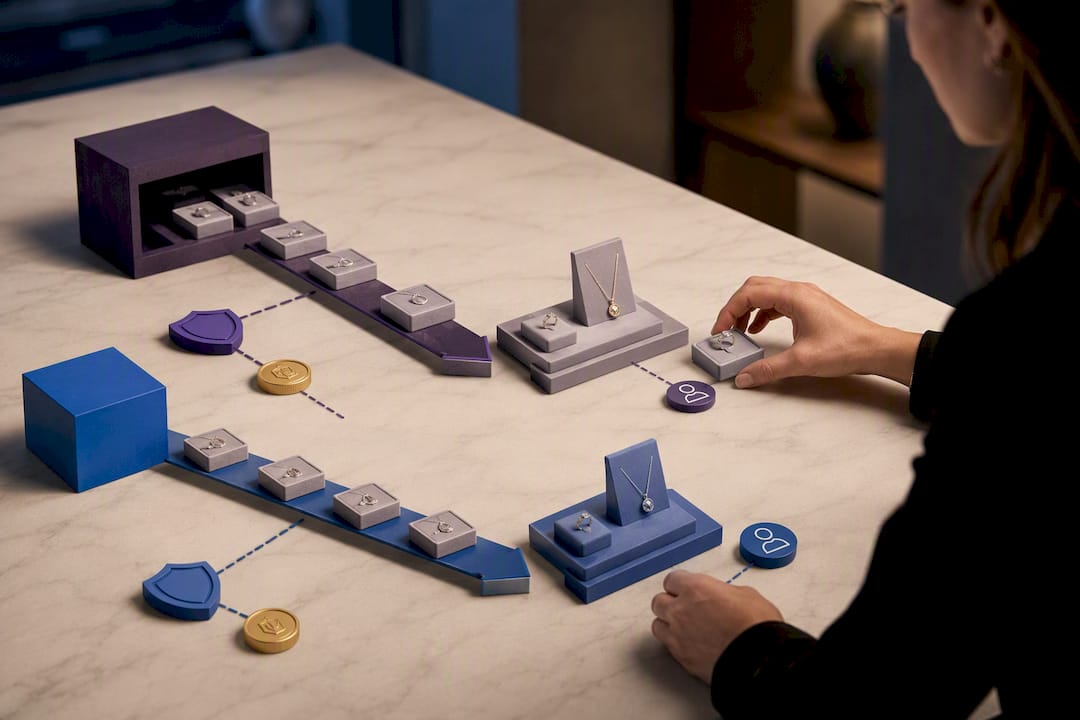
Wholesale means you buy outright, own the inventory, and set your own margin. You take more risk but keep full control over pricing and timing. This suits proven fast-sellers where you already know the sell-through rate.
Dropship lets you list a supplier’s catalog without holding stock at all, shipping directly to the customer. It’s the fastest way to expand assortment online, though it demands airtight supplier integration so tracking and returns don’t confuse the customer.
Pop-ups and collaborative collections are short-term, high-visibility plays. A designer collaboration can drive foot traffic and press for a launch weekend, but it requires more marketing coordination than any other model.
- Consignment: low capital risk, higher insurance complexity.
- Wholesale: full margin control, full inventory risk.
- Dropship: zero holding cost, dependent on supplier fulfillment quality.
- Pop-up/collab: strong marketing lift, limited shelf life.
What Should a Jewelry Supplier Onboarding Checklist Include?
Jewelry supplier onboarding is where weak partnerships get exposed early, before they cost you a season of sell-through. A disciplined checklist protects both sides and speeds up the parts that actually matter.
- Business registration and insurance. Confirm the supplier’s legal entity, liability coverage, and any product insurance that would apply to consigned goods.
- Certifications. Look for Responsible Jewellery Council (RJC) or De Beers Best Practice Principles (BPP) membership, plus APSCA-aligned social compliance audits where sourcing touches mined stones. These aren’t paperwork for its own sake. They’re the fastest signal that a supplier has already been vetted on labor and sourcing practices.
- Operational disclosures. Get lead times in writing, minimum order quantities, sample policies, and documented QC standards before you commit to a first order.
- Product-data readiness. Confirm the supplier can deliver clean SKUs, structured attributes (metal, stone, size runs), high-resolution images, and care copy in a format that plugs into a normalized data feed rather than a scanned PDF catalog.
Retailers with the most reliable pipelines run onboarding as a repeatable digital workflow: a questionnaire, a compliance review, then a profile that gets monitored on an ongoing basis, not just checked once at signing. A 12-point verification framework covering documentation, financial stability, production capacity, and responsiveness gives you a consistent scorecard for every new supplier candidate, which removes a lot of gut-feel decision-making from the process.
What Contract Terms Matter Most in Jewelry Supplier Agreements?
Consignment agreements are where ambiguity does the most damage. Spell out who owns the goods until sale, who insures them in transit and on the floor, and how shrinkage from theft or loss gets allocated. A verbal understanding about a lost item is not a contract term.
Payment timing needs the same precision. Net-30 sounds standard until a chargeback dispute or a QC failure delays payment indefinitely with no resolution clause. Build in a specific remedy: a defined return window, a remake timeline, or a partial credit schedule if pieces fail inspection.
- Define consignment ownership and insurance responsibility explicitly, not by implication.
- Set a fixed payment schedule with a documented chargeback and dispute process.
- Require a remake or replacement timeline for QC failures, not an open-ended promise.
- Flag any clause with vague returns language or unlimited liability exposure as a red flag before signing.
Pro Tip: Ask every new supplier for their standard consignment agreement before you draft your own. The clauses they leave vague usually tell you more about where they’ve had disputes before than anything they’ll say on a call.
How Do You Structure a Jewelry Supplier Pilot Order?
A pilot order is the fastest way to learn what a supplier promises versus what a supplier delivers, and it should be treated as a data-collection exercise, not a leap of faith.
- Start small and specific. Order a limited SKU range that represents your typical assortment, not just the supplier’s hero pieces.
- Run a 90-day reorder test. Track how consistently the supplier repeats quality and timing across a second and third order, not just the first.
- Collect hidden-cost metrics. Remake ratio, fulfillment accuracy, and time-to-resolve on any QC dispute reveal the true cost to serve that a sample order never shows.
- Align open-to-buy with velocity. Once fast-sellers emerge, set replenishment cadence to match actual sell-through rather than a fixed monthly reorder.
Buyers who track this data over a full 90-day window consistently catch repeatability problems that never show up in a single glowing sample shipment. A supplier who nails the first order but slips on the third tells you exactly where the relationship will break under volume.
What Fulfillment Standards Protect Your Brand in Dropship Partnerships?
Dropship only works for your brand if the customer never notices a third party was involved. That means blind shipping as a baseline, not an upgrade: no supplier packing slips, no outside branding on the box, and packaging that matches the tier of jewelry inside.
Digital integration is the other half of the equation. Your Shopify catalog needs inventory sync on a cadence tight enough that you never sell something the supplier is out of stock on, full variant support for metal and size options, and image quality consistent with the rest of your site.
- Require blind shipping and neutral packaging on every dropship order, with no exceptions for “just this one.”
- Confirm inventory sync frequency in writing, not as an assumed default.
- Verify variant mapping (size, metal, stone) matches your storefront exactly before launch.
- Test the full order lifecycle, tracking number, delivery, and return, before adding a supplier’s full catalog.
Pro Tip: Before you commit to a supplier’s full catalog, import ten sample SKUs, place three test orders yourself, and track the entire cycle. If the tracking number doesn’t update on time or the box shows a foreign address, don’t run their product feed at scale yet. A seven-layer brand-ready dropshipping standard built around blind shipping and Shopify sync has become the baseline retailers check for before onboarding any fulfillment partner.
What KPIs Belong on a Jewelry Supplier Scorecard?
Supplier scorecards turn a relationship from a feeling into a measurement, and that shift changes how you negotiate, as detailed in the role of merchandising analytics in driving sales. Track on-time delivery rate, QC pass rate, remake ratio, average response time to inquiries, and reorder consistency across at least three cycles.
- On-time delivery: percentage of orders arriving within the agreed window.
- QC pass rate: share of units passing inspection without rework.
- Remake ratio: proportion of units requiring replacement or repair.
- Response time: hours or days to resolve a support ticket or dispute.
- Reorder consistency: whether quality and timing hold steady across repeat orders.
Weight delivery and QC pass rate most heavily since they drive customer experience directly, then use a 90-day benchmark window before drawing conclusions from any single metric. A supplier scoring below threshold on two consecutive cycles should trigger a real commercial response: extra co-op marketing support to help them succeed, adjusted payment terms if cash flow is the root cause, or a termination conversation if neither moves the needle. Scorecards only matter when they connect to a decision, not just a spreadsheet.
How Do Co-Marketing and Training Commitments Increase Sell-Through?
A supplier’s product is only half the equation. What they contribute in marketing and training often determines whether that product actually moves off your sales floor.
- Push for co-op advertising dollars tied to a specific launch date, not an open-ended fund.
- Request camera-ready marketing assets (lifestyle photography, video, sizing guides) as part of the onboarding package, not an afterthought.
- Negotiate prime placement and coordinated storytelling for collection launches rather than scattering pieces across the case.
- Set a training cadence: a launch-week walkthrough for staff, then quarterly refreshers tied to new SKUs.
Retailers who combine scorecard accountability with real investment in a vendor’s success, through merchandising, training, and marketing support, consistently see stronger vendor performance than retailers who just place orders and wait. You hold more leverage over a supplier’s outcome than most retailers realize.
How Should You Govern the Relationship Over Time?
Set a weekly check-in cadence during any pilot phase, then step down to monthly once the relationship stabilizes. Assign a named owner on both sides so issues don’t get lost between departments.
- Build an escalation ladder tied to scorecard thresholds: a warning at one missed cycle, a formal remediation plan at two.
- Set a fixed remediation timeline (typically 30 to 60 days) before deciding whether to scale, hold, or exit.
- Use consistent data, not anecdote, to decide when to increase order volume or marketing spend.
- End underperforming relationships cleanly, with final inventory and payment terms settled in writing.
Treating governance like ongoing vendor management rather than a once-a-year check-in is what separates retailers who scale supplier networks smoothly from those stuck firefighting the same disputes every quarter.
How JewelCloud Puts This Playbook Into Practice
Structured product data is the operational glue behind every step in this playbook. Normalized attributes and consistent SKU mapping are what make catalog syndication and Shopify sync actually work, according to JewelCloud’s own platform overview. The platform lets suppliers load merchandise at wholesale with standardized, structured data, while retailers expand their online assortment using real product data from participating brands without carrying physical inventory.
On the supplier side, the platform shortens onboarding by handling data normalization and feed approval before a single SKU reaches a retail partner, cutting the manual cleanup that usually delays catalog syndication by weeks. Retailers get a faster path to richer assortments; suppliers get broader distribution to qualified retail buyers already looking for exactly what they make.
Why Supplier Relationships Deserve the Same Rigor as Hiring
Most retailers manage supplier relationships the way they manage a one-time purchase order, not the way they manage a hire. That’s backwards. A supplier who repeats quality across three reorder cycles is a retention asset worth investing training and marketing dollars into, the same way you’d invest in a sales associate who consistently closes.
The retailers who struggle most aren’t the ones with bad suppliers. They’re the ones who never built a scorecard, so they can’t tell a bad month from a bad partner. Combine the empathy of a good manager with the discipline of a good analyst, and supplier collaboration stops being guesswork.
— Anthony
Ready to Standardize Your Supplier Onboarding?
Building this playbook manually, spreadsheets for scorecards, email chains for onboarding docs, manual re-keying of every new SKU, is exactly the friction that slows retailers down before they ever see a sell-through number. JewelCloud replaces that manual grind with structured, standardized product feeds that plug straight into your storefront, so you can evaluate a new supplier’s catalog in hours instead of weeks.
If you’re a retailer ready to expand your assortment without adding inventory risk, explore vendor benefits to see how participating suppliers get you shelf-ready data from day one. Suppliers looking to strengthen retail distribution and even build out their own storefront presence can start with vendor web design options built for the jewelry trade. Either way, the next step is the same: request a walkthrough of the JewelCloud platform and see your own catalog structured for syndication.
Sources
- Successful Vendor Relationships: A Win-Win Approach - National Jeweler
- The 12-Point Supplier Verification Framework | AIDI
- Brand-Ready Jewelry Dropshipping: 2026 Checklist (Blind Shipping + Packaging) - Branvas
FAQ
What Is the 2:1:1 Rule in Jewelry?
The 2:1:1 rule refers to a common markup guideline some jewelers use for pricing, though the exact ratio and its application vary widely by category and business model, so treat it as a starting reference rather than a fixed industry standard.
Who Are Some Reputable Wholesale Jewelry Providers in the USA?
Reputable wholesale sourcing typically comes through suppliers carrying recognized certifications like RJC or BPP, and platforms such as JewelCloud that aggregate structured, standardized catalogs from vetted designers, manufacturers, and diamond dealers.
What Does B2B Mean in the Jewelry Industry?
B2B in jewelry refers to business-to-business transactions, typically a supplier, designer, or diamond dealer selling wholesale to a retailer rather than directly to a consumer. Platforms like JewelCloud operate specifically in this B2B layer, connecting suppliers with retail partners through structured product data.
Is There a Supplier That Offers Print-on-Demand Jewelry?
Print-on-demand style models exist in jewelry through dropship arrangements, where a supplier manufactures and ships pieces per order without the retailer holding inventory. Look for a supplier that can confirm blind shipping and Shopify sync before you list their catalog live.
How Long Does Jewelry Supplier Onboarding Usually Take?
Onboarding timelines vary by supplier complexity, but a disciplined process, documentation review, certification checks, and a pilot order, typically runs several weeks rather than months when both sides have their data feed and compliance paperwork ready in advance.