


How digital tools reshape jewelry sales today
The role of digital tools in jewelry sales has moved well past “nice to have.” Retailers who adopt technologies like Augmented Reality (AR), virtual try-on (VTO), social commerce, and data analytics are seeing measurable lifts in engagement, conversion, and average order value. Those who rely on static product images and spec sheets are watching shoppers leave without buying.
A few numbers frame the shift clearly:
- 67% of luxury jewelry buyers use Virtual Try-On before purchase, significantly lifting engagement.
- About 20% of total sales for some jewelry retailers now originate from messaging apps like WhatsApp, more than doubling since pre-pandemic times.
- Narrative-driven product descriptions raise conversion rates by about 28% and improve AI search citation authority.
- 45% of consumers now use AI tools to evaluate businesses, up from 6% a year earlier.
Jewelcloud sits at the center of this shift, giving retailers structured, standardized product data that powers richer digital experiences without the burden of carrying physical inventory.
Key digital technologies transforming jewelry sales
Jewelry has always been a tactile category. The challenge for digital tools is replacing the feeling of holding a piece with something equally compelling. Several technologies are doing exactly that.
Augmented Reality and Virtual Try-On let shoppers see how a ring, necklace, or earring looks on their own hand or face before buying. This directly addresses the “touch and feel” barrier that has historically kept jewelry e-commerce conversion rates between 1.0% and 1.7%, the lowest of any online retail category. VTO functions as a growth investment rather than a simple feature add, especially when integrated through open APIs into a headless commerce setup.

360-degree product views and short video solve a different problem. Static images cannot show how a diamond catches light or how a bracelet moves on the wrist. 360-degree views enhance online conversion rates by delivering crucial sensory information that helps shoppers feel confident.
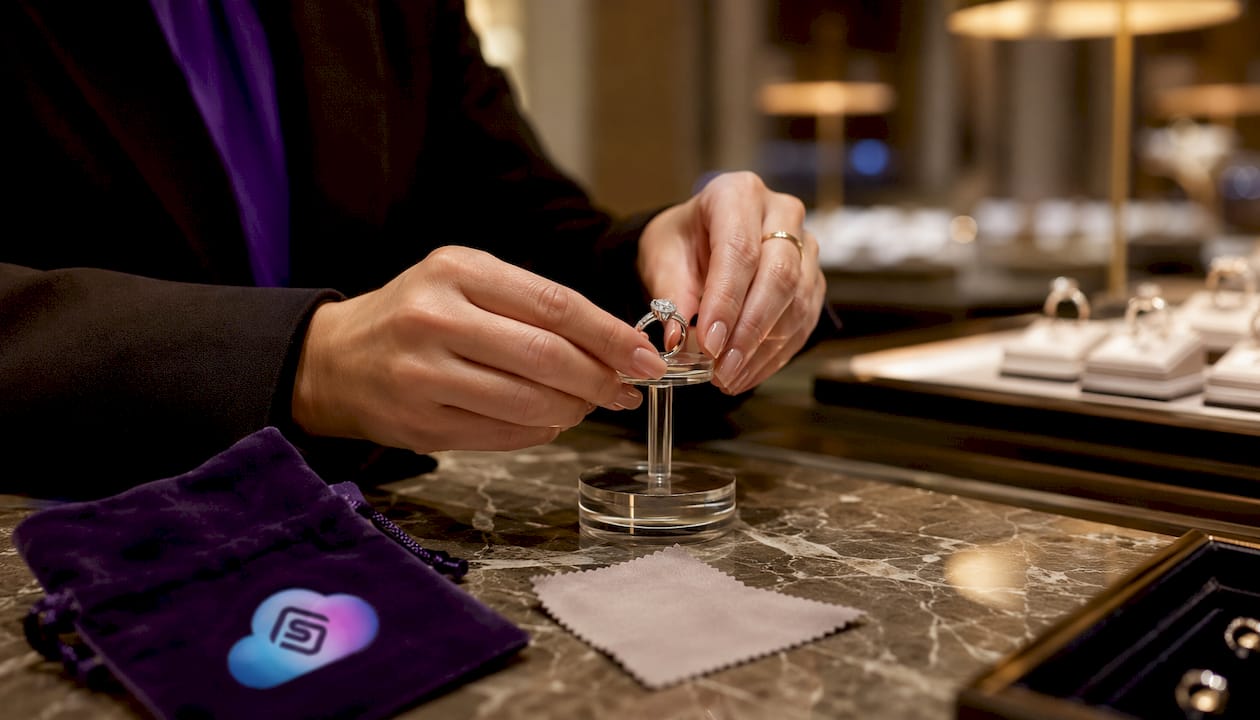
Social and mobile commerce have created entirely new sales channels. TikTok Shop and Instagram are projected to achieve very high U.S. transaction volumes by the mid-2020s, with jewelry among the top categories. Short-form video showing craftsmanship and authentic try-on moments consistently outperforms polished studio content.
AI and machine learning now power personalization engines, sales forecasting, and customer service chatbots. Interactive tools like ring size estimators, style quizzes, and metal-to-skin-tone matchers also generate structured data that AI search algorithms favor, increasing brand visibility in tools like ChatGPT and Perplexity.
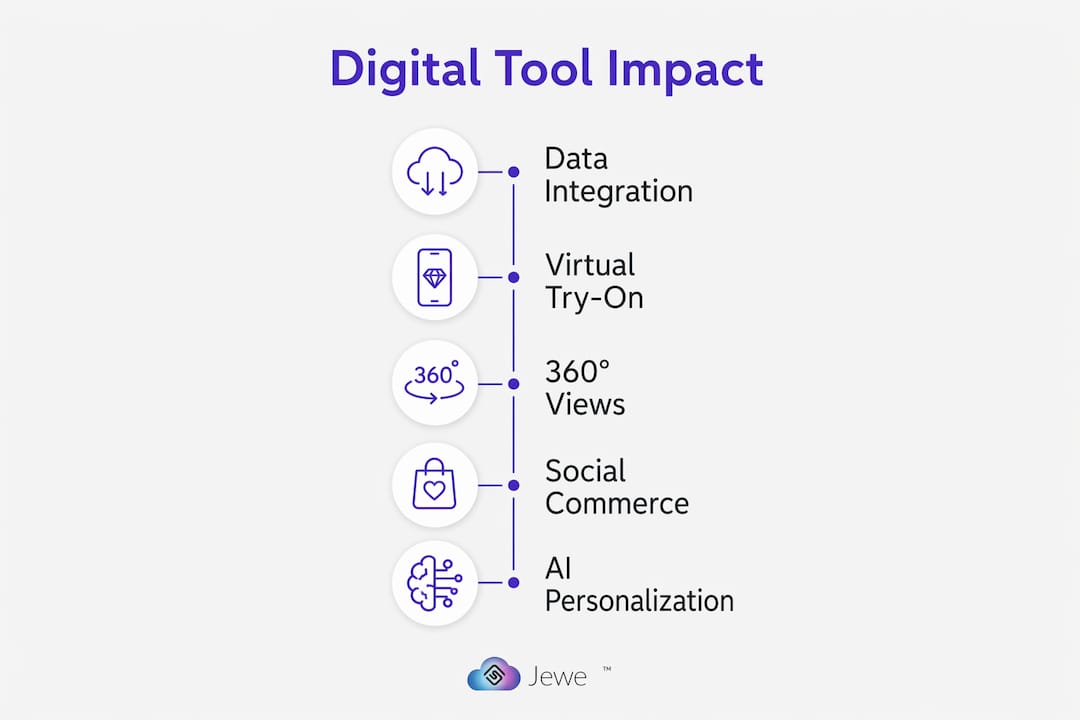
Specialized e-commerce platforms and digital inventory management round out the stack. Platforms like Shopify Plus and Adobe Commerce handle the storefront layer, while solutions like Jewelcloud handle the product data layer, giving retailers access to wholesale inventory they can showcase digitally without stocking it physically.
How digital tools enhance customer engagement and drive sales
The data connecting digital tools to actual sales outcomes is specific enough to act on.
| Digital Tool | Primary Benefit | Measured Impact |
|---|---|---|
| Virtual Try-On / AR | Reduces purchase hesitation | Engagement increases by 30% according to Technavio research |
| 360-degree views and video | Replaces in-store sensory experience | Conversion rates can rise by up to 30% with visual tools |
| Narrative product descriptions | Builds emotional connection and SEO authority | Raises conversion rates by about 28% and improves AI search citations |
| Messaging apps (WhatsApp) | Conversational commerce, reduces buyer hesitation | About 20% of total sales for some retailers originate from WhatsApp |
| Email and CRM marketing | Retention, upsell, lifetime value | Account for 28% of total revenue when segmented and automated |
The conversion gap is real. Jewelry e-commerce averages a 1.0%–1.7% conversion rate, the lowest among all online retail categories. Brands that layer in narrative content, visual tools, and conversational commerce close that gap measurably.
Customer engagement goes deeper than conversion rates. Shoppers today have attention spans shaped by short-form video, which means both your product pages and your social presence need to deliver value within seconds. AI-driven personalization helps by surfacing the right product to the right shopper at the right moment, rather than presenting a generic catalog. When you combine that with peer-driven social proof, the effect compounds: research shows that social media marketing shapes brand perception, but peer influence and perceived luxury value are what actually close the sale. Your digital tools should amplify both.
Best practices for using digital tools to grow jewelry sales
Getting the most from your digital investment comes down to how you integrate and prioritize these tools, not just which ones you adopt.
- Treat VTO and CRO as growth investments, not software purchases. Retailers that integrate VTO through open APIs into a headless commerce setup avoid vendor lock-in and position the technology as a digital sales associate guiding buyers through each step, rather than a feature that sits unused on a product page.
- Build AI search visibility now. With ChatGPT at 900 million weekly active users and 49% of them seeking purchase advice, being cited in AI responses is a real acquisition channel. Product schema, original product description copy, and brand authority signals all feed into this.
- Write for people and search engines at the same time. Narrative descriptions that explain why you chose a specific setting or how a band width balances a finger shape serve both buyer motivation and semantic search. Spec sheets alone do not.
- Use social media to tell stories, not just post products. Peer influence is the strongest driver of luxury jewelry purchase intent. User-generated content, micro-influencer partnerships, and behind-the-scenes craftsmanship content build the social proof that moves shoppers from interest to purchase.
- Activate your CRM and email programs. These channels connect every other digital effort into a closed loop. Lifecycle automation tied to milestone moments like anniversaries, birthdays, and engagement seasons keeps your brand present when purchase intent is highest.
- Measure what matters. Track conversion rate per product page, add-to-cart rate, and revenue attributed to each digital channel. Use an ROI framework to evaluate whether each tool is earning its place in your stack.
Pro Tip: If you’re building or rebuilding your e-commerce stack, a headless commerce architecture with open APIs gives you the flexibility to swap out individual tools, like your VTO provider or your search layer, without rebuilding your entire storefront. That flexibility pays off as the technology keeps evolving.
Avoid the common mistake of treating digital tools as isolated additions. A jewelry e-commerce platform that handles VTO but has poorly structured vendor data will still underperform. Every layer needs to work together.
How Jewelcloud supports digitally-enabled jewelry retail
Jewelcloud is built specifically for the complexity of jewelry data, and that specificity is what separates it from general-purpose product feed solutions.
- Structured, standardized product data. Jewelry attributes like metal type, stone shape, carat weight, and setting style require a data model that general e-commerce platforms do not handle well. Jewelcloud’s data is organized and optimized for these complexities, so product information displays accurately and consistently across every channel.
- Expand your assortment without carrying inventory. Retailers can access wholesale merchandise from designers, manufacturers, and diamond dealers through Jewelcloud and showcase it digitally to shoppers without purchasing stock upfront. That flexibility lets you test new categories and price points with real risk reduction.
- Launch collections faster. When supplier data is already structured and standardized in Jewelcloud, adding new pieces to your online catalog takes hours rather than weeks. That speed matters when you’re trying to align product launches with seasonal demand or trend cycles.
- Richer shopping experiences through real-time data. Shoppers see accurate inventory, current pricing, and complete product details because the data flows directly from suppliers. There’s no lag, no manual update cycle, and no risk of selling a piece that’s no longer available.
- Stronger supplier-retailer relationships. For suppliers, Jewelcloud functions as a digital distribution channel that puts their products in front of qualified retail partners. For retailers, it means access to a broader, curated wholesale selection without the overhead of managing dozens of individual vendor relationships.
Whether you’re a retailer looking to grow your digital assortment or a manufacturer seeking wider retail reach, Jewelcloud connects both sides of that equation with clean, reliable product data.
Ready to see how Jewelcloud can support your digital sales strategy? Explore the platform and find out how structured product data can become the foundation of a stronger online presence.
Key Takeaways
Digital tools drive measurable jewelry sales growth when they work together as an integrated system, not as isolated add-ons.
| Point | Details |
|---|---|
| VTO drives engagement | 67% of luxury jewelry buyers use VTO before purchase, and engagement rises by 30% with AR/VTO integration. |
| Narrative content converts | Narrative-driven product descriptions increase conversion rates by about 28% and improve AI search citation authority. |
| Messaging apps close sales | About 20% of some retailers’ total sales now originate from WhatsApp and similar apps. |
| Email and CRM anchor revenue | Email and CRM marketing contribute 28% of total revenue when properly segmented and automated. |
| Structured data scales growth | Jewelcloud’s standardized product data lets retailers expand assortments and launch collections without holding physical inventory. |