


The role of digital tools in the jewelry production workflow is to connect what a supplier makes to what a retailer can actually sell, using structured product data instead of PDFs, spreadsheets, and phone calls. PIM systems, inventory sync, and catalog syndication act as the operational bridge between the manufacturer’s bench and the retailer’s storefront.
That bridge only works if the data crossing it is clean and standardized. A ring listed by one supplier as “14k gold, .5ct diamond, VS clarity” and another as “14K/.50CT/VS2” looks like two different products to a search engine or an AI shopping agent, even when it’s the same design.
- PIM (Product Information Management): the central repository for metal, gemstone, and certification data
- Inventory synchronization: keeps stock counts accurate across wholesale and retail channels
- Digital wholesale catalogs: present standardized SKUs to buyers in a format they can act on
- Syndication APIs and feeds: push that data automatically into platforms like Shopify, WooCommerce, and Magento
Jewelry is one of the hardest product categories to catalog well because a single SKU carries a dozen interdependent attributes. Get metal purity, gemstone specs, and certification fields wrong once, and that error replicates across every channel the listing touches.
Retailers and suppliers who standardize this data early move faster to market, list with fewer errors, and show up better in both traditional search and the newer AI-driven shopping tools that depend on machine-readable attributes.
Key Takeaways
Standardized product data, synchronized inventory, and automated catalog syndication together form the operational backbone that moves jewelry from production to retail sale.
| Point | Details |
|---|---|
| Structured data beats free text | Metal, gemstone, and certification fields must be structured, not prose, or shopping engines can’t read them. |
| Close the completeness gap | Push catalog completeness from the industry average near 80% toward a 90% target to lift visibility and cut returns. |
| Model variants correctly | Treat ring sizes and similar options as variants, not separate SKUs, to avoid catalog explosion. |
| Pilot before full rollout | Test your syndication chain with one retail partner and one SKU segment before scaling broadly. |
| Jewelcloud standardizes the handoff | Jewelcloud syncs inventory and syndicates standardized catalogs to retailers across Shopify, WooCommerce, Magento, and custom APIs. |
Table of Contents
- What Digital Product-Data Tools Actually Cover
- What Business Benefits Come From Standardized Product Data?
- How Do You Roll Out Catalog Syndication Step By Step?
- Which KPIs Prove the Investment Is Working?
- What Mistakes Derail Jewelry Catalog Projects?
- How Does Supply Chain Software Extend Beyond Product Data?
- What Security Risks Come With Digital Jewelry Tools?
- Ready to Standardize Your Jewelry Catalog Data?
- Sources
What Digital Product-Data Tools Actually Cover
Five categories do the heavy lifting in a modern jewelry data workflow, and each solves a different failure point in the old spreadsheet-and-email approach.
- PIM (Product Information Management) centralizes diamond specs, metal types, pricing, and certifications in one system of record, which is what makes consistent catalog output possible across every channel a supplier sells through, according to Magneto IT Solutions.
- Catalog builders turn raw PIM data into buyer-ready listings, grouping variants, applying imagery, and formatting descriptions to match each channel’s requirements.
- Inventory synchronization / OMS integration keeps stock levels accurate as pieces move between wholesale reserves, retail floor stock, and online orders. Jewelry inventory is genuinely harder to manage than most retail categories because a single item can be reserved, resized, or consigned across multiple channels at once, which is exactly why syncing stock in real time matters more here than in apparel or electronics.
- Feed and syndication engines push standardized data out via APIs, CSV feeds, or merchant feeds so retailers don’t have to manually re-enter anything.
- E-commerce connectors link that feed to Shopify, WooCommerce, Magento, or a custom API, so a supplier update appears on a retailer’s site without a support ticket.
The attributes that matter most for jewelry specifically:
- Metal type and purity (14k, 18k, platinum, sterling)
- Gemstone type, carat weight, clarity, and cut
- Certification fields (GIA, IGI, or equivalent)
- SKU and variant modeling (especially ring sizes)
- High-resolution imagery with descriptive alt text
- GTIN data, or a documented process for GTIN-exempt items
A typical data flow looks like this: supplier PIM captures and validates attributes, a catalog builder assembles them into shoppable listings, a syndication feed distributes them, and the retailer’s platform ingests the feed automatically. Jewelcloud’s manufacturer tools are built around exactly that sequence.
What Business Benefits Come From Standardized Product Data?
The payoff shows up in five places suppliers and retailers both care about.
- Faster time-to-market: new SKUs go live in days instead of weeks once a feed template exists.
- Fewer listing errors and returns: structured certification and gemstone fields eliminate the guesswork that drives mismatched expectations.
- Better discoverability: clean attributes help both traditional search and AI shopping agents parse a listing correctly.
- Scalable assortment: a retailer can add hundreds of SKUs without adding headcount to manage them.
- Stronger wholesale relationships: suppliers who deliver clean feeds become the easiest partners to work with, which shapes who gets reordered.
That ten-point gap is where most of the missed sales hide, because thin attribute data suppresses visibility, confuses AI shopping tools, and drives returns when buyers get a piece that doesn’t match what they thought they ordered.
Large retail operations illustrate the scale this reaches. Joyalukkas used a middleware layer to unify 120 stores and more than 10,000 SKUs across marketplaces, pushing price and inventory updates in minutes rather than days. A manufacturer sees the benefit as faster reorders. A diamond dealer sees it as fewer certification disputes. A retail buyer sees it as a catalog they can trust enough to list sight unseen.
How Do You Roll Out Catalog Syndication Step By Step?
Adding standardized product data and syndication isn’t a weekend project, but it’s also not the multi-quarter overhaul some suppliers fear. Here’s the realistic sequence.
- Audit existing data and systems. Inventory every spreadsheet, PDF spec sheet, and legacy database currently holding product information.
- Define your attribute schema and controlled vocabularies. Decide once how metal purity, clarity grades, and certification types will be written, then enforce it everywhere.
- Map supplier fields to that schema. This is where most of the manual work lives, especially if multiple suppliers use different naming conventions.
- Normalize and enrich data inside a PIM or catalog system. Fill gaps, standardize units, and attach imagery and alt text.
- Set up inventory sync and feed templates. Connect the catalog to your syndication engine and target platforms.
- Test feeds with a small group of pilot retail partners. Catch formatting and mapping issues before they hit your full network.
- Roll out broadly and monitor performance. Watch error rates and completeness scores in the first few weeks closely.
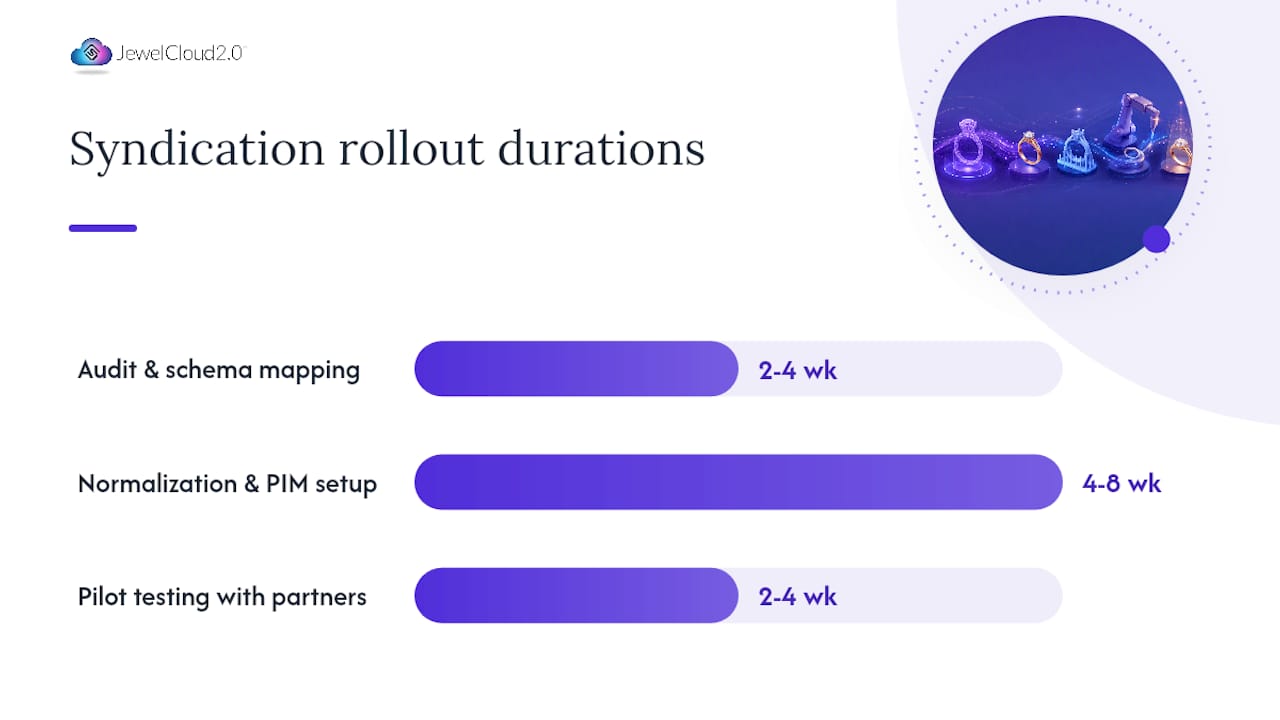
For a mid-size supplier, expect roughly:
- 2 to 4 weeks for audit and schema mapping
- 4 to 8 weeks for data normalization and PIM setup
- 2 to 4 weeks for pilot testing with retail partners
That puts a conservative end-to-end timeline at two to four months, depending on catalog size and how messy the starting data is.
Ownership matters as much as sequence. A data owner approves the attribute schema. A catalog manager oversees enrichment and completeness. An integration engineer builds and maintains the feed connections. A QA tester validates output before launch. A wholesale account manager manages the pilot retailer relationships.
Before calling it launched, confirm: every SKU has complete required attributes, variants are grouped correctly instead of exploded into duplicate listings, images carry alt text, pricing updates on a defined cadence, and inventory counts match physical stock within an acceptable margin.
Which KPIs Prove the Investment Is Working?
Track these to know whether your catalog project is actually paying off, not just technically complete:
- Time-to-list: days from new product creation to live listing
- Catalog completeness score: percentage of SKUs with all required attributes filled
- Feed error rate: percentage of feed submissions rejected or flagged
- Conversion lift: change in browse-to-purchase rate after standardization
- Return rate change: especially returns tied to mismatched specs
- Sell-through rate: how quickly listed inventory actually sells
- Wholesale order lead time: days from retailer order to fulfillment
- Retailer adoption rate: percentage of your retail partners actively pulling your feed
A workable ROI formula: incremental gross margin from improved discoverability, divided by total project cost. Estimate the margin side from conversion lift and sell-through improvements on a representative SKU sample; estimate cost from PIM licensing, integration labor, and QA time.
Reasonable short-term goals: move catalog completeness from the industry average of roughly 80% toward 90% within two quarters, and cut feed error rates by half within the first pilot cycle. Medium-term, aim for measurable movement in return rate and retailer adoption, since those lag a bit behind the data cleanup itself.
What Mistakes Derail Jewelry Catalog Projects?
Most catalog failures trace back to the same handful of shortcuts.
- Leaving metal and gemstone data as free text instead of structured fields
- Treating each ring size as a separate SKU instead of a variant, which quietly explodes your catalog and confuses shopping engines
- Delaying feed testing until after launch, when fixes are far more expensive
- Syncing inventory on a long batch cadence instead of near real time
- Skipping image alt text and certification fields because they seem optional
When suppliers send gemstone and material attributes as unstructured prose, import tools often dump that text straight into description fields, and shopping engines simply can’t read the mandatory attributes they need to classify the listing. The fix is enforcing controlled vocabularies from day one, modeling variants correctly, syncing inventory on a cadence that matches your sales velocity, and documenting who owns updates when something changes.
Pro Tip: Run a two-week pilot with a single retail partner and one narrow SKU segment before rolling out broadly. It’s the fastest way to validate your entire syndication chain, from schema to feed to storefront, without risking your full catalog on an untested pipeline.
How Does Supply Chain Software Extend Beyond Product Data?
Product-data syndication solves the “what does this piece look like to a buyer” problem. It doesn’t solve raw material sourcing, which is a separate but connected layer of the same workflow.
Supply chain management software tracks where metal and gemstones originate, monitors purchase orders against supplier lead times, and flags shortages before they become missed retail commitments. For a diamond dealer, that might mean linking sourcing records to certification data so a stone’s paper trail stays intact from rough to finished piece. For a manufacturer, it means production scheduling that accounts for material availability instead of assuming raw stock will show up on time.

The connection to catalog syndication matters because a feed is only as good as the inventory behind it. If your supply chain software shows a shortage of a particular gemstone size, that should flow through to your inventory sync so retailers don’t keep selling a SKU you can’t fulfill. Suppliers running these systems in isolation, one for sourcing and a separate disconnected one for catalog data, end up with the exact stock drift and overselling problems that centralized inventory management is supposed to prevent.
This is also where wholesale relationships get tested. A retailer who orders a piece only to learn the gemstone is backordered three weeks later loses trust fast, even if the catalog listing itself was accurate. Tying sourcing visibility to your product-data workflow keeps that promise intact.
What Security Risks Come With Digital Jewelry Tools?
Jewelry product data carries a specific kind of sensitivity most retail categories don’t deal with. Certification numbers, high-value SKU pricing, and supplier-specific sourcing details are all attractive targets, and a breach doesn’t just expose customer information, it can expose exactly which high-value pieces exist where.
A few risks deserve direct attention. Feed and API credentials that connect your PIM to retailer platforms need the same access controls you’d apply to financial systems, not a shared login passed around by email. Certification data tied to specific stones should be handled carefully since it links directly to insurable value. And inventory sync systems that show real-time stock levels across locations create a map of where valuable merchandise physically sits, which needs to stay restricted to people who actually need that visibility.
Practical steps that hold up: use role-based access on your PIM and catalog systems so not every team member can edit pricing or certification fields, require API keys with expiration and rotation policies for any syndication feed, and audit who has access to inventory data on a regular schedule rather than assuming old permissions are still appropriate. None of this is exotic. It’s the same discipline you’d apply to a financial system, applied to a catalog that happens to describe six-figure inventory.
An authoritative perspective from a B2B jewelry data platform
Standardized product-data syndication changes the supplier-retailer relationship from a series of one-off data requests into a continuous, automated handoff. That shift matters more than most suppliers realize until they’ve lived through both versions. Jewelcloud’s manufacturer platform was built around that continuous handoff, and the distribution reach it gives suppliers is worth verifying directly against your own catalog before assuming a spreadsheet still works.
Ready to Standardize Your Jewelry Catalog Data?
Every checklist and KPI in this guide points to the same underlying need: a system that treats your product data as an asset instead of a recurring cleanup project. Jewelcloud was built specifically for that, standardizing metal, gemstone, and certification fields once and syndicating them everywhere your retail partners need them.
For suppliers, that means your catalog updates flow automatically to participating retailers instead of sitting in an email inbox waiting to be manually re-entered. For diamond dealers specifically, DiamondLink handles the certification and stone-specific data structure this article walks through, so grading and sourcing details stay attached to the SKU across every channel. A typical onboarding runs an initial data audit in the first two weeks, followed by feed setup and a pilot retailer test within 30 to 60 days, matching the rollout timeline covered above.
Jewelcloud integrates with Shopify, WooCommerce, Magento, and custom APIs, so your existing storefront doesn’t need to change to benefit from a cleaner feed. If you’re a manufacturer or diamond dealer ready to see what standardized syndication looks like for your catalog, start with the jewelry vendor benefits page to see what a pilot onboarding includes.
Sources
- The Power of Product Information Management for Jewelry and Diamond Businesses
- Jewelry & Watches brands have a product-data problem — and 2026 is when it costs sales
- Online Jewelry Management: Sync Inventory Across Store, Website & B2B
- Shopify Product Import for Jewellery and Accessories Stores | Importier Blog
For hands-on implementation guidance, Jewelcloud’s catalog management guide for retailers and supplier field mapping guide walk through the tactical steps this article outlines at a strategic level.