


What wholesalers actually do in the jewelry supply chain
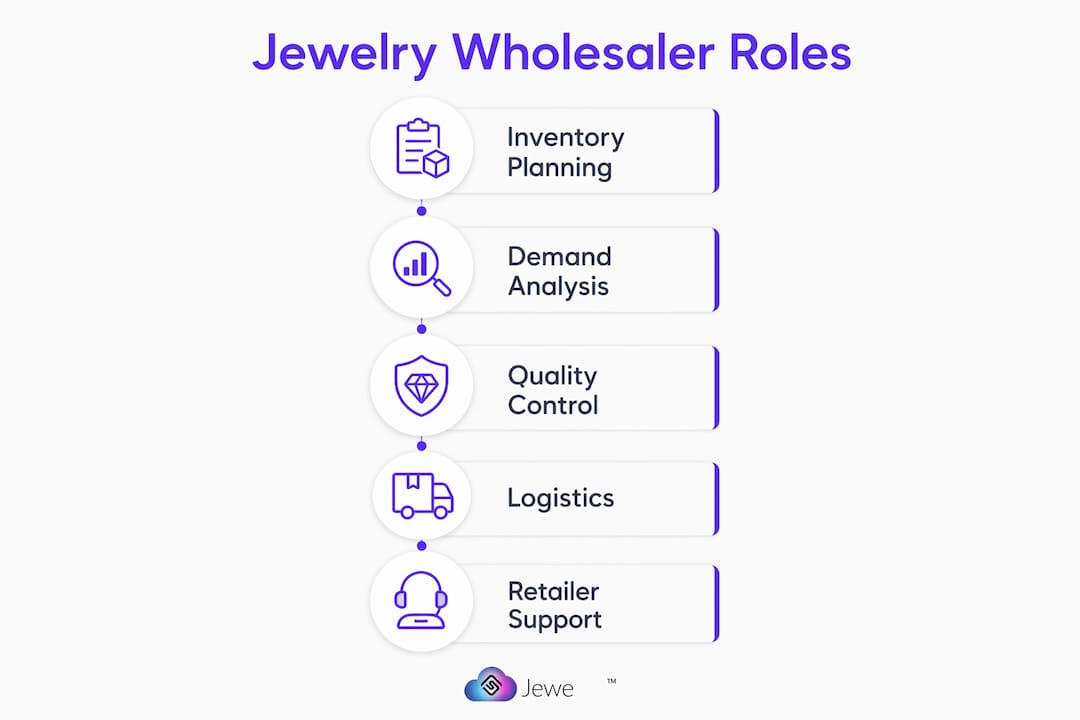
Jewelry wholesalers are the operational backbone connecting manufacturers to retail jewelers. They buy in bulk from producers, manage inventory at scale, negotiate pricing on both ends, and coordinate the physical distribution that keeps retail shelves stocked. Without them, most independent jewelers would face the impossible task of sourcing directly from dozens of manufacturers across multiple countries.
The role of wholesalers in the jewelry supply chain goes well beyond moving product from point A to point B. Their core responsibilities include:
- Bulk purchasing from manufacturers to achieve lower per-unit costs through economies of scale
- Inventory management across large, varied catalogs spanning metals, gemstones, and finished pieces
- Price negotiation with both manufacturers and retail buyers to maintain workable margins throughout the chain
- Logistical distribution to retail locations, including warehousing, order fulfillment, and shipping coordination
- Market intelligence on trends, consumer demand shifts, and pricing movements that inform both manufacturers and retailers
Gold prices increased 37.7% and silver by 30.5% in 2025, and wholesalers absorbed much of that volatility before passing adjusted costs downstream. That buffer function, absorbing commodity swings and supply disruptions before they hit retail, is one of the most underappreciated things a good wholesaler does. The Jewelry Wholesaling industry in the United States operates under NAICS code OD6081, purchasing fine and costume jewelry, precious metals, and stones from manufacturers and reselling them to retailers.
Key functions and responsibilities of jewelry wholesalers
Wholesalers perform a set of interlocking functions that, taken together, make retail jewelry businesses viable. Understanding each one helps you identify where a wholesaler relationship adds the most value for your operation.
- Economies of scale purchasing: Buying in volume gives wholesalers pricing leverage that individual retailers cannot replicate. That discount gets passed down, allowing retailers to stock competitively priced inventory without tying up capital in manufacturer-direct minimums.
- Warehouse and inventory management: Wholesalers maintain the physical infrastructure to store large, varied catalogs. For retailers, this means access to broad product ranges without the overhead of a large stockroom.
- Price negotiation on both ends: A skilled wholesaler negotiates favorable terms with manufacturers and then structures tiered pricing for retail buyers based on order volume and relationship history.
- Logistical coordination: From order processing to carrier selection and delivery scheduling, wholesalers manage the distribution flow that keeps retail replenishment predictable.
- Design and trend intelligence: Many wholesalers track seasonal demand patterns and feed that data back to manufacturers, shaping production runs before a trend peaks at retail.
Modern wholesalers increasingly rely on demand-driven inventory planning, using retailer sales data to reverse-plan orders with factories. That approach reduces dead stock and accelerates turnover, which is a direct improvement on the traditional push model where manufacturers produced speculatively.
Pro Tip: Track sell-through rates by SKU category, not just overall inventory levels. Wholesalers who segment demand by product type and retail format can forecast reorder timing with far greater accuracy, cutting both overstock and stockout risk.

What skills make a jewelry wholesaler successful?
The competencies that separate high-performing wholesalers from average ones are specific and learnable. Generic sales ability is not enough in a market where commodity prices swing sharply and retail buyers have more sourcing options than ever.
- Negotiation and price sensitivity: Wholesalers must hold firm on margin while keeping retail buyers satisfied. That balance requires knowing your cost floor precisely and understanding what a retailer’s market can actually bear.
- Supply chain and logistics expertise: Coordinating shipments across international suppliers, domestic warehouses, and retail delivery points demands real operational knowledge, not just vendor relationships.
- Market intelligence and trend awareness: Knowing which styles are gaining traction before they peak at retail gives wholesalers a sourcing advantage. Jewelers of America notes that wholesale career paths often include inventory control, quality assurance, and product management roles that build exactly this kind of market fluency.
- Relationship management: Long-term retailer loyalty comes from reliability, not just price. Wholesalers who provide consistent service, flexible terms, and honest communication retain accounts that purely transactional competitors lose.
- Adaptability to e-commerce shifts: Online retailers increasingly bypass traditional wholesale routes, sourcing directly or building their own supply relationships. Wholesalers who cannot offer faster delivery, smaller order minimums, or digital integration lose ground quickly.
The career trajectory in wholesale often starts in inside sales or inventory roles and moves toward account management or independent representation. Many successful wholesalers eventually use their supplier contacts and retail relationships to launch their own operations.
How wholesalers differ from manufacturers in the supply chain
Manufacturers and wholesalers are often conflated, but their roles, risk profiles, and capital requirements are genuinely distinct. Confusing the two leads to misaligned expectations on both sides of a sourcing relationship.
- Manufacturers focus on creating jewelry: sourcing raw materials, running production, managing quality at the fabrication stage, and developing new designs. Their capital is tied up in equipment, labor, and raw material inventory.
- Wholesalers focus on buying finished or near-finished product in bulk, storing it, and distributing it to retail buyers. Their capital is tied up in inventory and logistics infrastructure.
- Risk profiles differ sharply: A manufacturer carries production risk. A wholesaler carries inventory and market risk, holding product whose value can shift with commodity prices or trend cycles.
- Pricing and customization: Manufacturers can offer custom production runs; wholesalers typically sell from existing inventory. A retailer needing a proprietary design goes to a manufacturer. A retailer needing reliable stock replenishment goes to a wholesaler.
- Value added beyond manufacturing: Wholesalers consolidate product from multiple manufacturers, giving retailers a single source for diverse catalog needs. That consolidation function saves retailers the time and cost of managing dozens of direct manufacturer relationships.
Matthew Stuller built a billion-dollar wholesale business from Lafayette, Louisiana, by combining manufacturing capability with wholesale distribution and an obsessive focus on fast delivery. His model blurs the line between manufacturer and wholesaler, but the core insight holds: logistics and service reliability, not product alone, determine wholesale success.
Benefits and limitations of working with jewelry wholesalers

For retailers, the case for working with wholesalers is strong, but it comes with real trade-offs worth understanding before you commit to a sourcing relationship.
Benefits:
- Diverse product access: A single wholesale relationship can give you access to hundreds of SKUs across multiple manufacturers, styles, and price points, without the overhead of managing those manufacturer relationships yourself.
- Lower per-unit cost: Bulk purchasing economics mean wholesalers can offer prices below what most retailers could negotiate directly, especially at lower order volumes.
- Logistical support: Wholesalers handle warehousing, shipping, and order fulfillment, reducing the operational burden on retail buyers.
- Pricing stability buffer: When commodity costs spike, wholesalers often absorb short-term increases before adjusting retail pricing, giving buyers time to plan.
Limitations:
- Minimum order requirements: Most wholesalers set minimum order quantities that can tie up capital in inventory a retailer may not move quickly.
- Dependency on wholesaler stock: If your wholesaler runs out of a key item, your retail availability suffers. Diversifying across two or three wholesale sources reduces that exposure.
- Margin compression: Wholesalers add a layer of markup between manufacturer and retailer. For high-volume retailers with direct manufacturer access, that markup may not be justified.
For retailers looking to expand their online jewelry assortment without heavy inventory investment, wholesaler relationships, especially those with drop shipping capability, offer a practical middle path.
How wholesale logistics and support services actually work
The logistical infrastructure behind wholesale jewelry distribution is more complex than most retailers realize. It goes well beyond picking and packing orders.
- Warehouse management systems: Wholesalers use inventory management platforms to track stock levels, flag reorder points, and manage product across multiple storage locations.
- Order fulfillment and shipping: From carrier selection to insurance on high-value shipments, wholesalers coordinate the physical movement of jewelry with security and speed as primary concerns.
- Drop shipping: Wholesalers ship directly to a retailer’s end customer on the retailer’s behalf, eliminating the need for the retailer to hold physical stock. This model has grown significantly as e-commerce retailers seek to expand catalogs without inventory risk. Digital drop shipping tools now allow wholesalers to integrate directly with retailer storefronts, automating order routing.
- Private labeling: Some wholesalers offer private label programs, allowing retailers to sell wholesale product under their own brand name.
- Retail system integration: Advanced wholesalers connect their inventory systems directly to retail point-of-sale or e-commerce platforms, enabling real-time stock visibility and automated reordering.
Wholesalers increasingly function as off-site warehouses for their retail partners, providing just-in-time delivery that reduces the capital retailers tie up in on-hand inventory. That shift changes the wholesale relationship from a transactional vendor arrangement to something closer to a supply chain partnership. Proper vendor data sync between wholesalers and retailers is what makes that kind of real-time coordination possible.
How jewelry wholesalers are adapting to modern market trends
The pressure on traditional wholesale models is real and growing. Online retailers increasingly bypass established distribution networks, sourcing directly from manufacturers or building their own supply chains. Wholesalers who have not adapted are losing ground.
- Smaller, more frequent orders: Retailers no longer want to commit to large seasonal buys. Wholesalers who can fulfill smaller, just-in-time orders win the accounts that larger, inflexible operations lose.
- Digital platforms and data analytics: Leading wholesalers now use sales data from retail partners to forecast demand and plan production orders in reverse, from client to factory rather than factory to client.
- Flexible payment terms: Extended net terms, consignment arrangements, and installment options have become competitive differentiators as retailers manage tighter cash flow.
- Drop shipping and online order integration: Connecting wholesale inventory directly to retailer e-commerce platforms lets wholesalers participate in online sales without requiring retailers to carry physical stock.
- Value-added services: Product photography, digital content, and structured data feeds are increasingly part of what wholesalers offer, because retailers need more than product to sell effectively online.
“Successful wholesalers focus on enabling customer profitability rather than extracting maximum margin.” — Martin Rapaport, veteran diamond analyst, via Forbes
That orientation, toward retailer success rather than margin extraction, is what separates wholesalers who build durable retail partnerships from those who compete purely on price and eventually get bypassed. The Global Jewelry Sourcing Index gives wholesalers a data-driven framework for evaluating sourcing costs and risks across markets, which is increasingly necessary as trade tensions and supply disruptions make single-source strategies fragile.
Legal and regulatory considerations for US jewelry wholesalers
Operating as a jewelry wholesaler in the United States carries specific legal and compliance obligations that go beyond standard business licensing.
Federal and state requirements include obtaining a resale certificate or seller’s permit in each state where you conduct wholesale transactions, which exempts you from paying sales tax on inventory purchased for resale. The Federal Trade Commission’s Jewelry Guides set disclosure standards for metal purity, gemstone treatments, and country of origin claims. Misrepresenting karat weight, gemstone identity, or treatment status exposes wholesalers to FTC enforcement action.
Import compliance is a major operational concern for wholesalers sourcing internationally. US Customs and Border Protection requires accurate country of origin labeling, and the Kimberley Process Certification Scheme applies to rough diamond imports to prevent conflict diamond trade. Ongoing trade tensions with major sourcing countries, including China and India, have added tariff complexity that wholesalers must factor into landed cost calculations.
Anti-money laundering (AML) obligations apply to dealers in precious metals and stones under the Bank Secrecy Act. Wholesalers who conduct cash transactions above $10,000 must file Currency Transaction Reports with FinCEN. Maintaining Know Your Customer (KYC) records for significant buyers is a practical compliance step that also protects against fraud exposure.
How wholesalers manage quality control and authenticity verification
Quality control at the wholesale level protects the entire downstream supply chain. A retailer who sells a misrepresented stone or an understated karat piece faces customer returns, reputational damage, and potential FTC liability. The wholesaler who supplied that product shares responsibility.
Effective wholesale quality control typically involves several layers. Incoming product from manufacturers is inspected against purchase order specifications, including metal purity testing using X-ray fluorescence (XRF) analyzers, which provide non-destructive karat verification. Gemstone lots are graded against agreed standards, with significant purchases often accompanied by laboratory certificates from organizations like the Gemological Institute of America (GIA) or the American Gem Society (AGS).
Authenticity verification for branded or designer pieces requires documented chain of custody from the manufacturer. Wholesalers who source through multiple intermediaries face greater authenticity risk and need stronger documentation practices. Structured, standardized product data for jewelry wholesale helps wholesalers maintain accurate records across large catalogs, reducing the risk of specification errors that compound downstream.
Returns and warranty handling also fall within the wholesaler’s quality management scope. Clear policies on defective merchandise, with defined inspection windows and replacement procedures, protect both the wholesaler and the retail buyer.
Key Takeaways
Wholesalers are the supply chain layer that makes retail jewelry businesses operationally viable, and their role is expanding, not shrinking, as digital tools give them new ways to serve retail partners.
| Point | Details |
|---|---|
| Wholesalers as intermediaries | They connect manufacturers to retailers through bulk purchasing, inventory management, and logistics coordination. |
| Commodity price buffering | Gold rose 37.7% and silver by 30.5% in 2025; wholesalers absorb short-term cost swings before adjusting retail pricing. |
| Demand-driven planning | Leading wholesalers use retailer sales data to reverse-plan factory orders, cutting dead stock and improving turnover. |
| Legal compliance scope | US wholesalers must navigate FTC Jewelry Guides, Kimberley Process rules, AML obligations, and state resale licensing. |
| Jewelcloud’s role | Jewelcloud gives wholesalers a structured digital distribution channel to reach qualified retail partners without physical inventory burden. |
The future of jewelry wholesalers depends on how they use data
The conventional view of jewelry wholesalers as passive middlemen is wrong, and it has been wrong for a while. The wholesalers gaining ground right now are the ones treating data as a core business asset, not an afterthought.
What most industry commentary misses is that the threat to traditional wholesale is not e-commerce itself. It is the information gap. When a manufacturer can see retail sell-through data directly, the wholesaler’s market intelligence function disappears. The wholesalers who survive that shift are the ones who get to that data first and use it to offer something a manufacturer cannot: curated, demand-calibrated inventory with fast fulfillment and retailer-specific service.
Ethical sourcing and supply transparency are also moving from marketing language to operational requirements. Retailers are increasingly asked by their own customers to verify origin and labor conditions. Wholesalers who build that traceability into their documentation now will have a genuine competitive advantage within a few years, not just a talking point.
The wholesalers I find most credible are the ones who talk about retailer profitability before they talk about their own margins. Rapaport’s observation that successful wholesalers focus on enabling customer profitability rather than extracting maximum margin is not idealistic. It is a description of how durable wholesale relationships actually work. A retailer who makes money with your product keeps buying. One who does not, eventually finds another source.
Jewelcloud connects wholesalers to retail partners through structured digital distribution
Wholesalers who want to grow their retail network without adding sales headcount or managing complex data feeds have a direct path forward with Jewelcloud. The platform lets designers, manufacturers, and diamond dealers load their merchandise at wholesale, giving retail jewelers immediate access to a broad, well-organized product catalog they can source, sell, or showcase digitally without carrying physical inventory.
For suppliers, Jewelcloud functions as a digital distribution channel that puts your product in front of qualified retail partners who are actively looking to expand their assortments. Product data is structured and standardized to handle the specific complexities of jewelry, including metal type, gemstone specifications, and variant attributes, so retailers get accurate, consistent information that actually supports online selling. The vendor benefits are built around what wholesale suppliers need most: visibility, data accuracy, and retail relationships that convert.
If you are a wholesaler ready to expand your retail reach or a retailer looking to source from verified suppliers, explore Jewelcloud’s platform and see how structured wholesale distribution works in practice.