


For jewelry designers, manufacturers, and diamond dealers, the right Shopify jewelry app isn’t a nice-to-have — it’s the infrastructure your wholesale business runs on. The most effective approach for B2B jewelry professionals is a Jewelcloud-powered Shopify integration that delivers structured product data, real-time inventory sync, and variant management across your entire catalog.
The short version: A Jewelcloud-backed Shopify integration gives you live diamond feeds (VDB/RapNet-style), variant image filtering, and normalized product data — the three things that separate a catalog shoppers trust from one they abandon. Fewer mis-ships, fewer returns, and faster SKU onboarding are the measurable payoffs. Request an integration demo to see it in action.
Two facts drive this recommendation. First, a single ring design can generate hundreds of SKU permutations across metal, size, and stone — and without combined listings and variant filtering, your product pages collapse under that weight. Second, live diamond feeds require active margin management in the integration layer so retail prices reflect your target markup, not just the supplier’s base price.
Table of Contents
- What must a Shopify jewelry app do for B2B wholesale?
- How does a Jewelcloud → Shopify integration actually work?
- How do you implement a Jewelcloud → Shopify rollout?
- What does a Shopify jewelry integration cost, and what’s the ROI?
- What technical pitfalls should you watch for before go-live?
- Jewelcloud gives you a direct path to Shopify-ready B2B distribution
- Key Takeaways
- Why data cleanliness is the real competitive advantage
- Useful sources for deeper research
What must a Shopify jewelry app do for B2B wholesale?
The checklist below is prioritized for wholesale and B2B use cases. If an app or integration can’t satisfy the top items, it won’t scale with your catalog.
Variant management (highest priority)
- Combined listings that group metal, karat, stone, and size under one SEO-friendly URL
- Variant image filtering so shoppers see the correct photo when they select yellow gold vs. platinum
- SKU consolidation with metafield support for certification fields (certificate ID, lab, grade)
Real-time inventory and dynamic pricing
- Live feed connectivity: VDB, RapNet, and Nivoda for diamond inventory
- Account-specific pricing, tiered discounts, and volume pricing hooks for wholesale accounts
- Margin rules applied at the integration layer — never pass supplier base prices directly to the storefront
Structured product data
- Extensible attribute schemas covering metal type, karat, gemstone, carat weight, cut, clarity, and color
- Standardized units, multi-currency fields, and certificate links
- Consistent data across every SKU so wholesale product data stays accurate at scale
B2B flows and permissioning
- Wholesale catalogs with customer-group visibility controls
- Net terms, quote requests, and manual order approval routing
- Storefront gating so retail pricing is never exposed to wholesale accounts
Customer experience features
- Virtual try-on and AR for earrings and necklaces — now considered standard for high-value categories
- Ring-size charts placed directly on product pages to cut sizing-related returns
- Made-to-order and preorder support with clear lead-time indicators
Performance and security
- Apps that load conditionally on relevant pages only — global loading tanks page speed for image-heavy jewelry stores
- Secure API access to supplier feeds with data access controls appropriate for U.S. B2B commerce
Pro Tip: Prioritize apps that separate SEO-friendly product URLs from frontend combined listings. You want shoppers to see one clean product page, but search engines should still be able to index per-metal variants where they carry distinct search demand.
How does a Jewelcloud → Shopify integration actually work?
Jewelcloud acts as the authoritative product-data source. Shopify consumes normalized feeds or API payloads to render storefronts and B2B catalogs. Here’s what moves between systems.

| Data Layer | What Moves | How It’s Used in Shopify |
|---|---|---|
| Supplier feeds | Raw SKUs, images, certificates, pricing | Ingested by Jewelcloud normalizer |
| Jewelcloud normalizer | Standardized metafields, attribute schemas | Mapped to Shopify product API |
| Product API payload | Metal, gem, size, cert ID, price tiers | Populates product pages and B2B catalogs |
| Inventory sync | Stock levels, availability flags | Real-time webhooks or scheduled delta pulls |
| Pricing rules | Margin overlays, account-group pricing | Applied before storefront render |
Variant handling works through combined listings: one parent product URL per design, with metafield-driven selectors for metal and stone. When a shopper picks yellow gold, the variant image filter swaps the photo automatically. This keeps your jewelry inventory management clean and your product pages readable.
Inventory sync runs on real-time webhooks for diamond feeds where latency matters, and on scheduled delta pulls for broader catalog updates. Conflict resolution policies — price overrides, margin rules, back-in-stock flags — are configured in the integration layer, not patched in Shopify’s admin after the fact. Made-to-order items carry fulfillment flags that route custom orders to the appropriate production workflow, keeping standard and bespoke orders from mixing in the same fulfillment queue.
How do you implement a Jewelcloud → Shopify rollout?
A typical B2B jewelry integration runs 4–8 weeks from discovery to monitored production. The table below shows realistic phase durations.
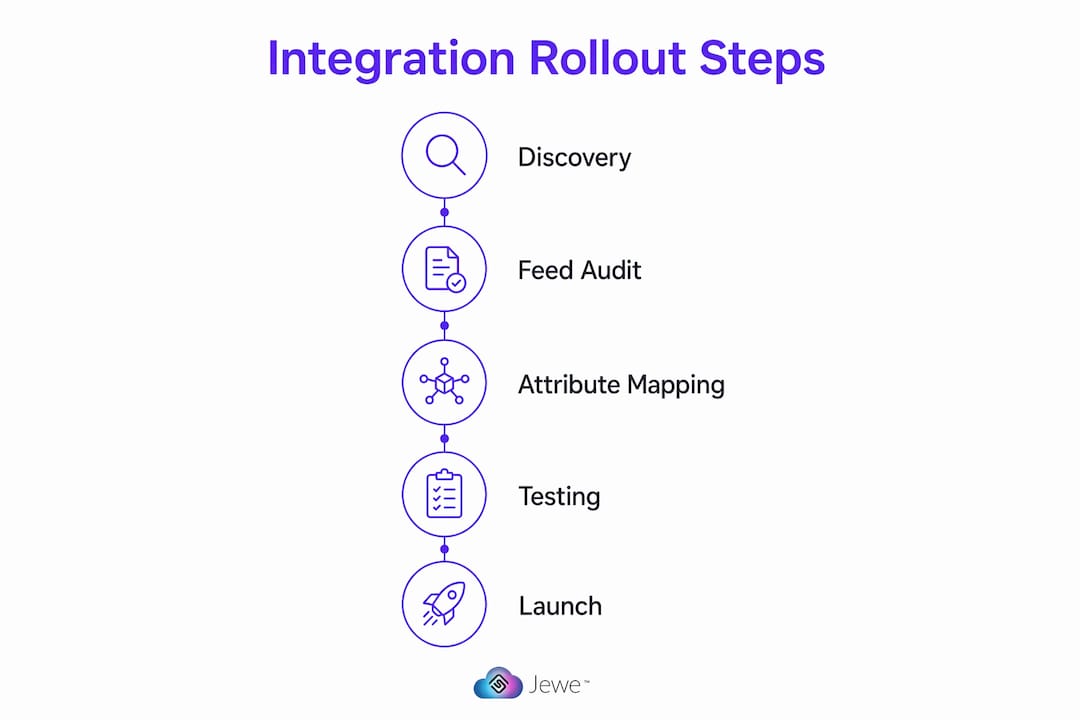
| Phase | Typical Duration | Owner |
|---|---|---|
| Discovery and feed audit | Week 1 | Retailer + Jewelcloud |
| Attribute mapping and metafield schema | Week 1–2 | Jewelcloud + Shopify dev |
| Feed ingestion and normalization | Week 2–3 | Jewelcloud |
| Storefront configuration (theme, filters, pricing rules) | Week 3–4 | Shopify dev team |
| QA and data validation | Week 4–6 | All parties |
| Staged launch by product family | Week 6 | Retailer |
| Post-launch monitoring and reconciliation | Week 8+ | Retailer + Jewelcloud |
Some ring-builder and configurator apps advertise setup-included options that compress timelines for simpler catalogs, but B2B wholesale projects with live diamond feeds and customer-group pricing consistently need the full runway above.
Step-by-step responsibilities:
- Suppliers deliver: high-resolution images matched to each variant, certificate files with lab and grade, and feed access credentials (VDB/RapNet/CSV).
- Jewelcloud delivers: data normalization, attribute mapping, and a sample feed of 50–100 SKUs for validation.
- Shopify team configures: theme metafield rendering, variant image filtering, B2B pricing rules, and storefront visibility controls.
- QA checkpoints: verify image-to-variant matching, certificate field accuracy, wholesale pricing by account group, and AR/try-on smoke tests.
- Staged rollout: launch one product family first, validate order and fulfillment flows, then expand.
What does a Shopify jewelry integration cost, and what’s the ROI?
Cost has several components, and understanding each one prevents budget surprises in month three.
| Cost Component | Typical Range | Notes |
|---|---|---|
| Platform subscription (Jewelcloud) | Varies by tier | Contact Jewelcloud for current pricing |
| Shopify plan | a range of monthly subscription tiers | Advanced or Plus plans support B2B features |
| Ring-builder / configurator apps | various monthly pricing tiers | Per published app pricing like Keyideas and Pencil |
| Diamond feed access (VDB/RapNet) | Varies by feed provider | Separate from platform fees |
| Setup / integration | One-time project fee | Depends on catalog complexity |
ROI comes from four levers. Faster SKU onboarding means new collections reach retail partners in days rather than weeks. Accurate variant data and size guides cut sizing-related returns. Virtual try-on increases buyer confidence for high-value items, lifting conversion. And wholesale upsells through bundling and accessory carousels raise average order value per B2B transaction.
A simple year-one framing: if reducing mis-ships and returns saves your team 10 hours per week, and improved catalog accuracy closes two additional wholesale accounts, the subscription and setup cost typically pays back within the first two quarters. Budget a 6–12 month runway for feed cleanup and staff training when you’re forecasting payback on a large catalog.
What technical pitfalls should you watch for before go-live?
The most common failure mode is SKU bloat from creating a separate Shopify product for each metal variation. A single design in white gold, yellow gold, and rose gold across eight ring sizes produces 24 individual product pages — a catalog complexity problem that combined listings exist to solve.
Pre-launch checklist:
- Confirm your Shopify plan supports the metafield schema and API rate limits your feed volume requires
- Validate image-to-variant assignments on a 50–100 SKU pilot before full ingestion
- Check every certificate field: certificate ID, lab name, and grade must be present and consistently formatted
- Test made-to-order flows end-to-end, including lead-time display on the product page and fulfillment routing on the backend
- Set automated inventory alerts so out-of-stock diamonds don’t remain visible on the storefront
- Schedule a post-launch reconciliation between your feed source and Shopify product listings at 30 and 60 days
Apps that load globally rather than conditionally are a common product page performance mistake for jewelry stores with heavy image assets. Scope every app to the pages and templates where it’s actually needed.
Pro Tip: Enforce a canonical product ID for each logical item at the integration layer. This single discipline prevents duplicate listings, protects your SEO structure, and makes post-launch reconciliation straightforward.
Jewelcloud gives you a direct path to Shopify-ready B2B distribution
Jewelcloud is built specifically for the wholesale jewelry pipeline: structured product feeds, live inventory syncing, and digital distribution to retail partners on Shopify and beyond. Where generic Shopify apps require you to stitch together variant filtering, feed connectivity, and pricing rules from separate tools, Jewelcloud delivers them as a coordinated platform.
For diamond dealers, DiamondLink® provides specialized feed distribution with the margin controls and certification data your retail partners need. For designers and manufacturers, vendor web design services give you a professional digital showcase that presents your catalog the way retail buyers expect to see it. Onboarding follows a clear path: discovery call, sample feed mapping with 50–100 SKUs, pilot ingestion, and staged rollout by product family. Request a demo at Jewelcloud.com and bring your feed credentials — the scoping call moves fast when the data is ready.
Key Takeaways
Structured product data, live inventory sync, and variant management are the three non-negotiable foundations of any Shopify integration built for B2B jewelry wholesale.
| Point | Details |
|---|---|
| Variant management is the priority | Combined listings and variant image filtering prevent SKU bloat and keep product pages functional at scale. |
| Margin rules belong in the integration layer | Apply price markups before the storefront renders — never pass supplier base prices directly to retail accounts. |
| Plan for a 4–8 week rollout | Discovery, mapping, ingestion, QA, and staged launch each need dedicated time; budget 6–12 months for feed cleanup. |
| Virtual try-on drives conversion | AR tools for earrings and necklaces reduce return rates and increase buyer confidence for high-value items. |
| Jewelcloud coordinates the full pipeline | From DiamondLink® feeds to vendor web design, Jewelcloud handles structured data distribution to Shopify retail partners. |
Why data cleanliness is the real competitive advantage
The jewelry industry has spent years debating which platform, which app, or which feed provider wins. The honest answer is that the platform matters far less than the quality of the data flowing through it. A well-configured Shopify store fed by clean, normalized, certificate-accurate product data will outperform a technically sophisticated setup running on inconsistent vendor feeds every time. Retailers trust suppliers who deliver accurate data consistently. That trust translates directly into reorder rates, preferred-vendor status, and faster sell-through. The businesses that will scale their wholesale distribution fastest in the next few years aren’t the ones with the most apps installed — they’re the ones who treated data cleanliness as a business discipline from day one. Jewelcloud’s structured approach to product data and inventory sync is designed around exactly that discipline.
Useful sources for deeper research
- Jewelcloud B2B Platform — primary landing page for demos, trials, and integration scoping
- DiamondLink® by Jewelcloud — specialized diamond feed distribution and vendor capabilities
- Jewelry Vendor Benefits — supplier-side platform benefits and distribution network details
- Structured Product Data for Jewelry Wholesale — technical guidance on metafields and attribute schemas
- Brand-to-Retailer Pipeline Explained — how supplier feeds support wholesale distribution
- Diamond Selector For Jewelry on Shopify App Store — CSV and live feed (VDB/RapNet/Nivoda) diamond catalog app
- Keyideas RingBuilder on Shopify App Store — ring builder with GIA/IGI support and multi-supplier feed connectivity
- Pencil Custom Jewelry Apps on Shopify App Store — ring builder, pendant builder, and made-to-order catalog tools