


Jewelry retailers generally choose among five buying models: the retail storefront, direct-to-consumer (DTC) online sales, custom and bespoke commissions, dropship and pre-order systems, and wholesale or consignment distribution. Each one answers a different question about how much capital you can risk and how much control you want over the customer relationship.
A storefront suits high-trust, high-touch sellers who need foot traffic and a place for customers to try things on. DTC fits brands with the marketing budget to fund customer acquisition and the design identity to justify 3x to 5x cost pricing. Custom and bespoke work rewards ateliers serving bridal and high-net-worth clients willing to wait for a piece. Dropship and pre-order suit entrepreneurs seeking to test new SKUs with minimal upfront cash commitment. Wholesale and consignment fit brands with production scale looking for volume through stockists.
A platform like JewelCloud now lets retailers blend several of these at once, testing an assortment through dropship-style vendor feeds before committing to inventory.
- Retail storefront: best for local luxury and high-trust bespoke sales
- DTC online: best for brands funding their own acquisition and design IP
- Custom/bespoke: best for bridal, high-net-worth, and commission-heavy work
- Dropship/pre-order: best for testing SKUs with $500 to $1,000 in startup capital
- Wholesale/consignment: best for brands with proven demand and production scale
Key Takeaways
Retailers who match their buying model to their actual capital, risk tolerance, and customer experience goals build more resilient jewelry businesses than those who commit to one model by default.
| Point | Details |
|---|---|
| Five core models exist | Retail storefront, DTC, custom/bespoke, dropship/pre-order, and wholesale/consignment each fit different capital and risk profiles. |
| Pricing must stay connected | Set wholesale near 2x cost and DTC near 4x cost so partner keystoning does not undercut your own site. |
| Dropship lowers the entry bar | Startup costs can run as low as $500 to $1,000 since production happens after payment. |
| Bespoke rewards structure | Standardized deposit tiers and production windows make commission work repeatable, not chaotic. |
| Platforms enable hybrids | JewelCloud lets retailers test assortments through synced supplier data before committing to inventory. |
Table of Contents
- Types of Jewelry Retail Buying Models: Where Storefronts Fit
- Direct-to-Consumer Online Sales and Fulfillment Control
- Custom and Bespoke Commissions: Structure and Lead Times
- Dropship and Pre-Order: Selling Without Holding Inventory
- Wholesale and Consignment: Selling Through Stockists
- How Do You Choose the Right Jewelry Buying Model?
- How Digital Wholesale Platforms Support Low-Inventory Models
- What I’ve Learned Watching Retailers Switch Models
- Expand Your Assortment Without Expanding Your Risk
- Sources
Types of Jewelry Retail Buying Models: Where Storefronts Fit
A retail storefront remains the highest-trust way to sell jewelry, and it’s also the most expensive commitment on this list. You’re leasing space, building out display cases and security systems, running a point-of-sale system, and staffing at least one salesperson who can talk knowledgeably about cut, clarity, and metal purity. Inventory sits on your books the entire time it’s on the sales floor, which means you’re carrying insurance costs and tying up cash in pieces that may not move for months.
The upside is real. Customers trust what they can touch, and a well-run showroom converts browsers into buyers in a way no website replicates yet. The downside is equally real: rent, insurance, and initial inventory can require a substantial upfront investment before you sell a single ring, and every unsold piece is capital sitting idle in a case.
- Pros: highest conversion on high-consideration purchases, in-person trust building, ability to do fittings and adjustments on the spot
- Cons: high fixed costs, inventory carrying risk, staffing overhead, geographic limits on your customer base
This model works best for local luxury retailers, brands built on bespoke bridal work, and any business where foot traffic is genuinely part of the sales pitch.
Pro Tip: Run a merchandising calendar tied to trunk shows and small pop-up events. Rotating in a designer’s collection for a weekend gives you a reason to bring in new faces without buying a season’s worth of inventory outright.
Direct-to-Consumer Online Sales and Fulfillment Control
DTC gives you the most control over your brand story, your pricing, and your customer data, but that control comes with a bill attached: you own customer acquisition cost (CAC) entirely. Every click, every ad, every influencer partnership is money out of your pocket before a sale happens.
The payoff is margin. Jewelry brands selling DTC often price at 3x to 5x cost, translating to roughly 67% to 80% gross margin, because there’s no wholesale partner taking a cut in the middle. The tradeoff shows up on the back end: returns. Ring sizing, chain length, and stone color all look different on a screen than on a hand, and jewelry has one of the highest fit-related return rates of any product category sold online.
- Pros: highest margin potential, full ownership of customer relationships and data, brand control
- Cons: you fund all acquisition costs, returns and sizing complaints land squarely on you, requires ongoing marketing investment
Fulfillment decisions matter here too. Smaller brands often start with in-house fulfillment and shift to third-party logistics once order volume outpaces what a small team can pack and ship reliably.
Pro Tip: Invest in accurate, standardized product data and, where you can, virtual try-on tools. A shopper who can preview a pendant at actual scale on their own neck returns fewer items and buys with more confidence.
Custom and Bespoke Commissions: Structure and Lead Times
Bespoke work operates on a different rhythm than off-the-shelf retail. A typical commission moves through consultation, design sketches or CAD renderings, a deposit, then a production window before the finished piece reaches the client. That sequence protects your cash flow, since the deposit covers materials, but it also means your revenue arrives in a trickle rather than a lump sum.
The margins can be excellent. Clients paying for a one-of-a-kind engagement ring or anniversary piece are not price-shopping the way a browser on a marketplace is. The complexity comes from managing production capacity. One overloaded goldsmith can turn a six-week promise into a twelve-week apology.
- Pros: premium pricing, strong customer loyalty, differentiated positioning
- Cons: long lead times, production bottlenecks, higher back-office coordination
Some of the most interesting growth here is happening at the intersection of digital and physical. Department stores are now piloting in-store bespoke bars paired with virtual atelier appointments, letting a customer start a design conversation on a screen and finish it with a live jeweler. This model fits high-net-worth clients, bridal buyers, and any retailer building an experiential floor.
Pro Tip: Standardize your bespoke packages into two or three tiers with fixed deposit percentages and stated production windows. It keeps client expectations honest and keeps your goldsmith’s calendar from becoming a guessing game.
Dropship and Pre-Order: Selling Without Holding Inventory
Dropship and pre-order systems flip the retail sequence: you take the order and the payment first, then production or fulfillment happens after. That single change is why this model can launch on roughly $500 to $1,000 covering a website and initial marketing, since you’re never buying inventory speculatively.
The catch is that you’ve handed fulfillment reliability to someone else. If a supplier ships late, ships the wrong stone color, or runs out of a popular setting, the customer complaint lands in your inbox regardless of whose warehouse the mistake happened in.
- Pros: minimal startup capital, broad catalog without carrying inventory, low financial risk when testing new designs
- Cons: longer lead times for customers, supplier quality control sits outside your hands, backorders and shipping inconsistencies are common
This model rewards patience with vendor vetting. A supplier who looks great on a catalog page but ships inconsistently will cost you far more in refunds and one-star reviews than you saved on inventory.
Pro Tip: Before listing a supplier’s catalog, order samples yourself and check their service-level agreement on shipping windows. Standardized, synchronized product data between you and the supplier is what actually prevents the “that’s not what the picture showed” complaint. Our guide on consignment versus dropship tradeoffs breaks down when each low-inventory option makes more sense.
Wholesale and Consignment: Selling Through Stockists
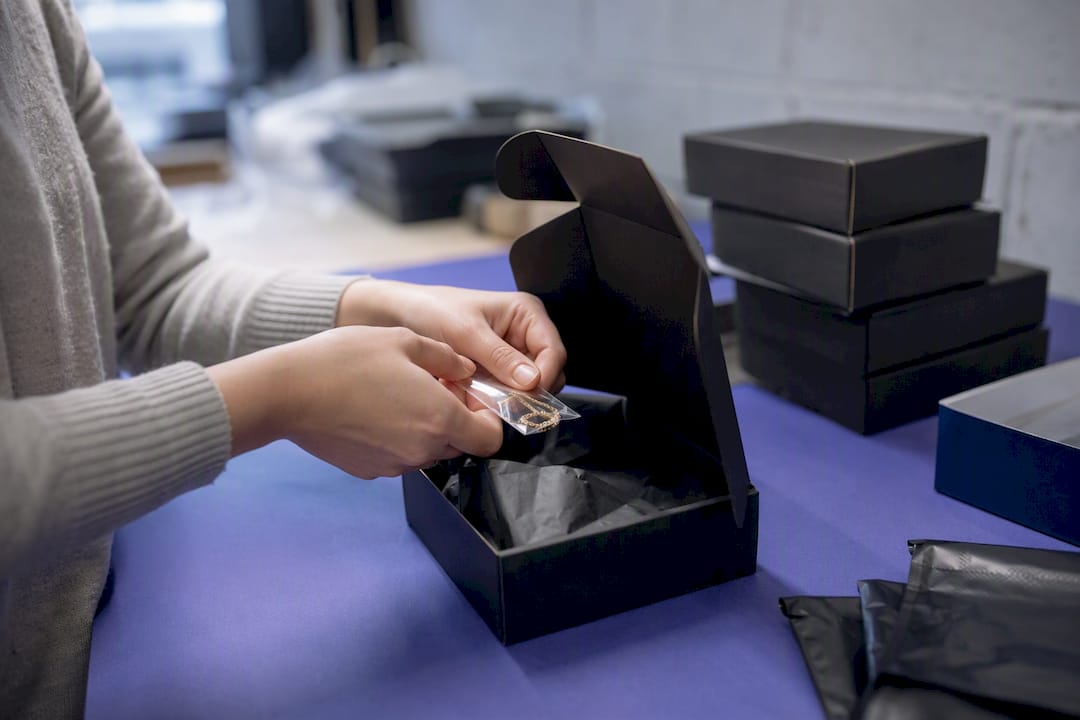
Wholesale flips your customer from an individual shopper to a business buyer, and that changes almost everything about how you price and operate. Wholesale is B2B, built around bulk orders, minimum order quantities, and trade terms, while retail is built around individual customer experience and higher per-unit margin.
Within wholesale, you have real choices about how goods move. Memo arrangements let a stockist display your piece and pay only if it sells, with the item returnable otherwise. Consignment is a longer-term version of the same idea, where you retain ownership while the retailer holds the goods. Outright purchase transfers full ownership to the stockist immediately, which is best for your cash flow but requires the retailer to commit capital upfront.
- Pros: predictable larger order volumes, access to a stockist’s existing customer base, reduced marketing burden per unit sold
- Cons: lower per-unit margin than DTC, negotiation complexity around terms, less control over how your product is presented
Pricing is where wholesale gets tricky for brands that also sell DTC. If you set both without coordination, a stockist’s keystoned retail price can undercut your own website, training your best customers to buy elsewhere.
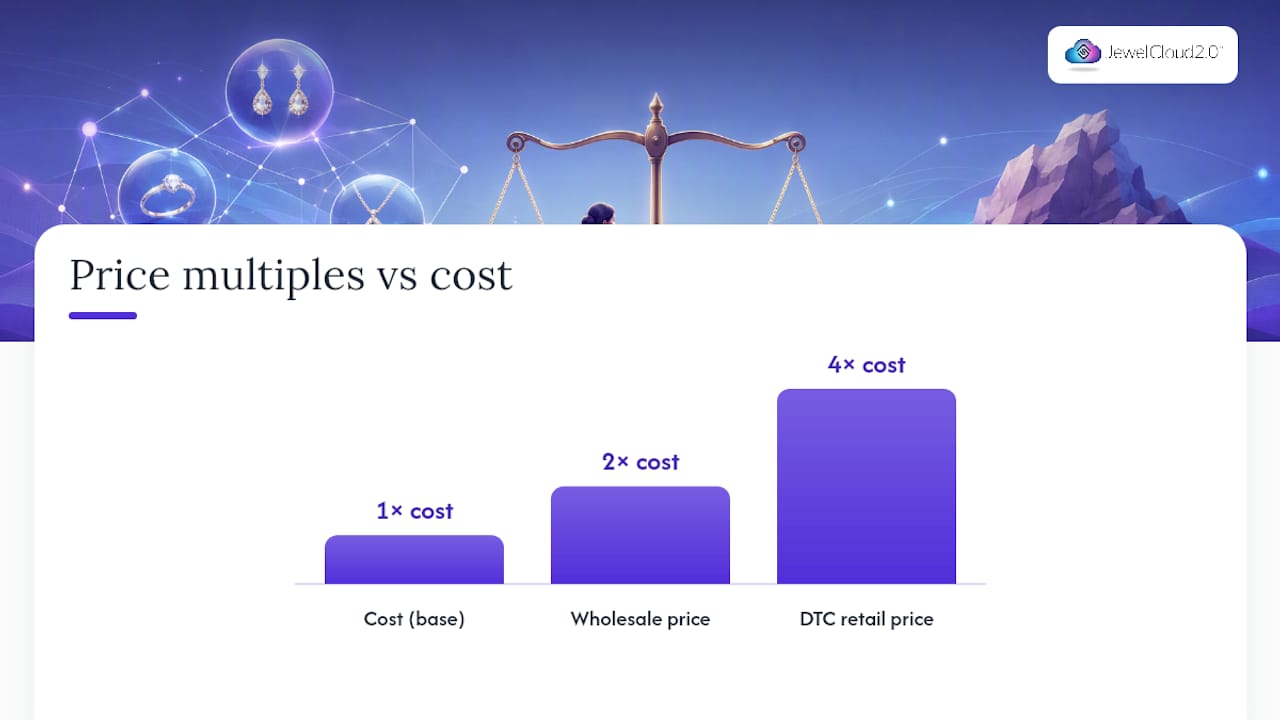
Pro Tip: Treat wholesale and DTC pricing as one connected system. Set wholesale near 2x cost and DTC near 4x cost so a partner’s keystone markup lands close to your own retail price instead of beneath it. Explore our wholesale expansion guide for a deeper walkthrough.
How Do You Choose the Right Jewelry Buying Model?
Start with four honest questions: How much startup capital can you risk without touching payroll? How much inventory sitting unsold for months can your cash flow absorb? What customer experience are you actually equipped to deliver, in person or online? And what margin do you need to hit to keep the business healthy?
Most retailers don’t land permanently on one model. A common progression starts small in retail or DTC, then adds wholesale only after demand and production are repeatable, avoiding the trap of overcommitting to bulk orders before the product is proven.
| Model | Startup capital | Inventory risk | Margin potential | Control over design |
|---|---|---|---|---|
| Retail storefront | High | High | Moderate to high | High |
| DTC online | Moderate | Moderate | High (3x–5x cost) | High |
| Custom/bespoke | Low to moderate | Low | High | Very high |
| Dropship/pre-order | Low ($500–$1,000) | Very low | Moderate | Low |
| Wholesale/consignment | Moderate to high | Varies by terms | Lower (~2x cost) | Low to moderate |
Before switching models, ask your suppliers directly about fulfillment SLAs, ask your team what returns volume they can realistically handle, and ask your finance side what inventory carrying cost the balance sheet can absorb. Watch for red flags: a wholesale partner pricing below your DTC storefront, a dropship supplier with no clear shipping guarantee, or a returns policy nobody wrote down. Sound inventory management practices apply across every one of these models, not just the ones where you’re physically holding stock.
How Digital Wholesale Platforms Support Low-Inventory Models
Platforms built specifically for jewelry data are what make hybrid strategies practical instead of theoretical. JewelCloud structures supplier product feeds, syncs inventory in real time, and hosts digital wholesale catalogs so a retailer can showcase pieces from participating vendors without ever taking possession of the stones or metal.
That structure solves a problem that plagues dropship and hybrid sellers: inconsistent product data. A carat weight that’s wrong by a few points, or a stone color code that doesn’t match across systems, is exactly what triggers a “this isn’t what I ordered” return. Consistent, standardized data closes that gap.
- Retailer benefits: test new assortments before committing capital, launch collections faster, keep digital showcases current without manual catalog updates
- What to check before choosing a platform: data quality standards, integration with Shopify, WooCommerce, or Magento, size of the supplier network, and the support team’s responsiveness on SLA questions
A retailer running a hybrid DTC and dropship program can, for example, list a supplier’s full ring collection through JewelCloud’s synced feed, sell directly on their own site, and only settle inventory logistics once an order actually comes in. That’s the low-inventory promise of dropship married to the brand control of DTC.
What I’ve Learned Watching Retailers Switch Models
Every retailer I’ve talked with who tried to force one buying model to do everything eventually hit a wall, usually a cash-flow wall or a customer-trust wall. The businesses that hold up best treat these five models as a toolkit, not a single decision made once and never revisited.
My honest recommendation: pilot a hybrid approach before you overhaul anything. Run your storefront as it is, but test one dropship or platform-fed collection alongside it for a season and watch what the return rate and margin actually tell you.
Expand Your Assortment Without Expanding Your Risk
If the wholesale and dropship sections above got you thinking about how to add inventory-light collections without a warehouse full of unsold stock, that’s exactly the gap JewelCloud fills. Retailers using the platform pull structured, standardized product data straight from participating designers, manufacturers, and diamond dealers, then showcase it on their own site through Shopify, WooCommerce, Magento, or a custom build.
Suppliers get a distribution channel that puts their catalog in front of qualified retail partners, and retailers get a faster way to launch new collections without carrying the goods themselves. If you’ve been weighing a hybrid model against a full inventory commitment, take a look at JewelCloud’s vendor membership options and see which tier fits how much of your catalog you want to run this way.
Sources
- Jewelry Pricing Strategy: Beyond Keystone Markup | Eightx
- Top 5 Types of Jewelry Business Models - Sarkissian Luxury Studio
- Diamond Memo vs Consignment vs Purchase: Wholesale Guide (2026)
- Wholesale vs. Retail: Which Jewelry Business Model Is Right for You? - feelstylejewelry
- Fenwick Model: Omnichannel Bespoke Jewelry Commissions