


What vendor data management means for your jewelry business
Vendor data management is the process of consolidating, standardizing, and governing product information from multiple suppliers so your catalog stays accurate, consistent, and discoverable across every digital wholesale channel. For jewelry wholesalers, that definition carries real weight. A ring is not just a ring. It carries a metal type, purity grade, stone clarity, carat weight, hallmark status, and certification. Every one of those attributes must be captured as structured data, not buried in a description field.
Here is what effective vendor information management covers in a jewelry wholesale context:
- Product attribute standardization: Metal type, purity (e.g., 14K, 18K, 925 silver), gemstone characteristics, and weight recorded in consistent, machine-readable fields
- Pricing accuracy: Correct data at the attribute level prevents costly mispricings tied to metal weight or stone grade
- Compliance tracking: Certifications for precious metals and gemstones must be current and accessible across all sales channels
- AI and platform discoverability: Structured metadata ensures AI tools and platforms like Google Shopping categorize your products correctly; prose descriptions alone do not
- Inventory control: Piece-level tracking with complete attribute recording drives reliable margin reporting and customer service
- Risk reduction: Manual spreadsheets and tribal knowledge create serious continuity risks when key staff are unavailable
Table of Contents
- Common challenges jewelry businesses face with their data
- Best practices for managing vendor data in the jewelry industry
- How Jewelcloud empowers jewelry vendors with better data management
- Why prioritizing vendor data management matters right now
- Governance and data quality go hand in hand
- What integrated digital platforms do that spreadsheets cannot
- Onboarding vendors and keeping data accurate over time
- What successful vendor data management looks like in jewelry wholesale
- Jewelcloud gives your product data a digital wholesale home
- Key Takeaways
Common challenges jewelry businesses face with their data
Managing product data across multiple suppliers is genuinely hard. Jewelry makes it harder.
- Fragmented sources: Each vendor delivers data in a different format, forcing your team to reconcile inconsistencies manually
- Jewelry-specific complexity: Attributes like carat, clarity, and metal weight require piece-level inventory tracking with complete attribute recording; software lacking this produces unreliable reports
- Data silos: Without governance rules, the same product can carry conflicting information across your ERP, your storefront, and your wholesale platform
- Tribal knowledge risk: Many jewelry retailers depend on one or two people who know where everything lives. When they are out, operations stall
- Compliance gaps: Scattered records make it difficult to confirm that certifications are current, which creates legal exposure
- Data security: Vendor contracts, pricing tiers, and sourcing terms are sensitive; fragmented systems increase the risk of unauthorized access
- Scale limitations: Manual management across spreadsheets becomes a significant growth bottleneck beyond 750 SKUs; at this scale, a dedicated Product Information Management (PIM) system is essential to avoid manual bottlenecks.
Best practices for managing vendor data in the jewelry industry
Strong vendor data management is as much a governance decision as a technical one. Business, procurement, and compliance teams all need a seat at the table.
- Define survivorship rules: Business stakeholders must document which system is the authoritative source for each product attribute. Without these rules, conflicting records and manual reconciliation delays are inevitable.
- Deploy a jewelry-specific PIM: A Product Information Management system centralizes enrichment, validation, and syndication. Retailers who struggle with disjointed product data management can face significant drops in operational efficiency and increases in time-to-market for new collections.
- Standardize your taxonomy: Build a consistent attribute library for metals, stones, and certifications. Every supplier’s data should map to the same field names and value formats.
- Automate ingestion and validation: Manual data entry multiplies errors. Automated workflows catch missing fields and format mismatches before bad data reaches your catalog.
- Commit to ongoing stewardship: Golden records degrade to initial data quality without continuous monitoring. Assign data owners and schedule regular audits.
- Train your team on data ownership: Everyone touching the catalog should understand which fields they own and what the approval workflow looks like.
Pro Tip: Treat jewelry attributes like carat weight, clarity grade, and metal purity as structured data fields, not text. AI-powered platforms and search engines read field values, not paragraphs. Structured attributes are what get your products found and recommended.
How Jewelcloud empowers jewelry vendors with better data management

Jewelcloud is built specifically for the B2B jewelry market, and that specificity shows in how it handles vendor data integration and product syndication.
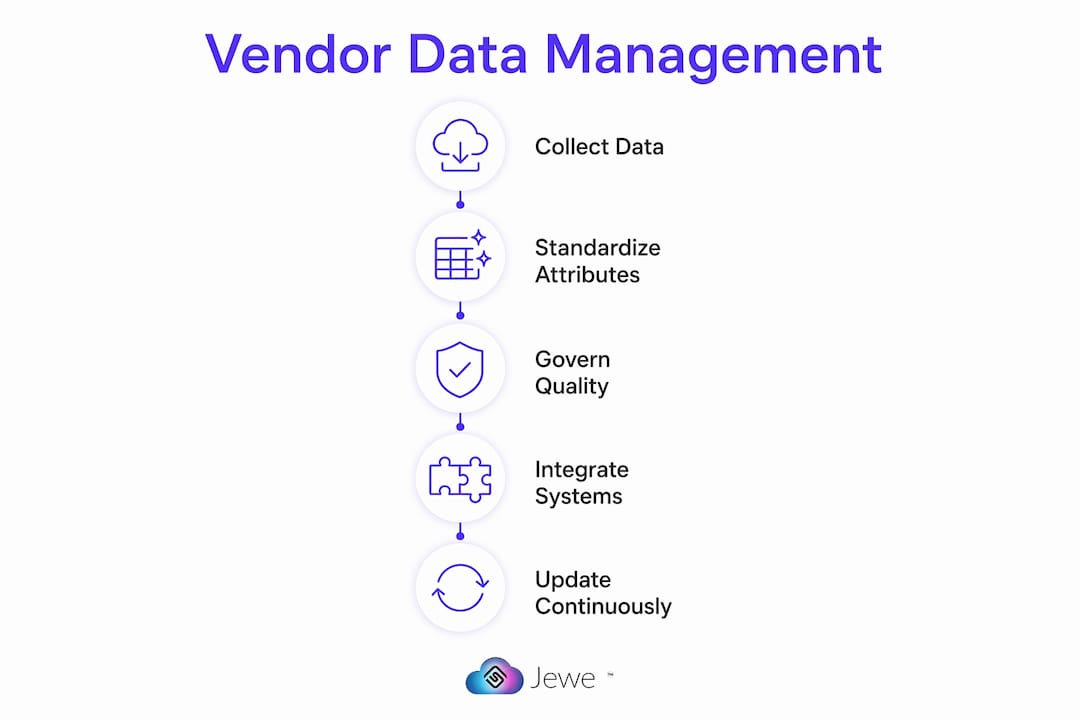
| Capability | What it means for you |
|---|---|
| Structured, standardized product data | Jewelry attributes are captured in consistent fields optimized for wholesale discovery |
| Multi-supplier catalog management | Designers, manufacturers, and diamond dealers load merchandise in one place |
| Digital wholesale distribution | Retail jewelers access your products without carrying physical inventory |
| Richer retailer experiences | Accurate data from multiple suppliers powers better online assortments and faster collection launches |
| Stronger retailer relationships | Qualified retail partners discover and source your products through a trusted channel |
Jewelry wholesalers using integrated platforms like Jewelcloud expand online assortments faster and provide richer shopping experiences by leveraging accurate product data from multiple suppliers. That leads to increased visibility and stronger retailer partnerships.
Why prioritizing vendor data management matters right now
The U.S. digital wholesale market is moving fast. Retailers expect accurate, complete product data before they commit to sourcing. AI-powered discovery tools are raising the bar further, favoring structured, machine-readable catalogs over generic listings.
Here is why acting now gives you an advantage:
- Operational efficiency: Clean, centralized data cuts the time your team spends reconciling supplier information
- Compliance confidence: Current certifications and sourcing records are accessible when auditors or retail partners ask
- Discoverability: Structured attributes make your products visible to AI agents, search engines, and wholesale platforms
- Risk mitigation: Transitioning away from tribal knowledge and manual processes to integrated digital platforms protects operational continuity
- Competitive positioning: Vendors with clean, structured data onboard retail partners faster and launch collections with less friction
Governance and data quality go hand in hand
Governance is the framework that keeps data quality from slipping over time. It defines who can create, edit, and approve product records, and what rules apply at each step. For jewelry wholesalers, that means assigning clear ownership over attributes like metal purity and stone grading, building validation rules that flag incomplete records before they publish, and reviewing your taxonomy regularly as your supplier base grows. Without this structure, even a well-implemented PIM drifts toward inconsistency within months.
What integrated digital platforms do that spreadsheets cannot
An integrated platform connects your supplier data, your catalog, and your retail distribution channel in a single governed environment. Spreadsheets break at scale and rely on individual memory. A platform like Jewelcloud enforces consistent field structures, automates updates across channels, and gives every stakeholder a single version of the truth. For online sales through vendor management, that consistency directly affects conversion: many consumers report abandoning a purchase when product details are unclear or inconsistent.
Onboarding vendors and keeping data accurate over time
Start every vendor onboarding with a data template that maps their fields to your taxonomy. Require structured values for every jewelry-specific attribute before a product goes live. After launch, schedule quarterly data reviews to catch attribute drift, expired certifications, and pricing discrepancies. Pair those reviews with automated alerts for missing or out-of-range values. The goal is a living catalog that reflects your actual inventory, not a snapshot from six months ago. Jewelry-specific ERP systems that track metals by weight and purity can reduce inventory costs and speed custom order turnaround when integrated with your data governance workflow.
What successful vendor data management looks like in jewelry wholesale
Consider a diamond dealer managing hundreds of stone listings across multiple retail partners. Without structured data governance, stone grades and pricing tiers live in separate spreadsheets, certifications expire unnoticed, and retailers receive inconsistent information. With a governed platform, every stone carries a complete, validated record: cut, color, clarity, carat, certification body, and price. Retailers access that data directly, trust it, and source with confidence. The dealer spends less time answering data questions and more time growing the relationship. That shift, from reactive data cleanup to proactive governance, is what structured product data for jewelry wholesale makes possible at scale.
Jewelcloud gives your product data a digital wholesale home
Your products deserve to be seen by the right retail partners, with the right information, at the right time. Jewelcloud gives jewelry designers, manufacturers, and diamond dealers a purpose-built platform to load wholesale merchandise with structured, standardized product data that retail jewelers can source, showcase, and sell without carrying physical inventory.
The platform handles the data complexity that makes jewelry wholesale uniquely demanding: metal purity, gemstone attributes, certifications, and pricing, all organized so retail partners can trust what they see. For vendors, that means stronger visibility, faster retailer onboarding, and a distribution channel built for the digital wholesale era. Visit Jewelcloud’s vendor benefits page to see how your catalog can reach qualified retail partners today.
Key Takeaways
Effective vendor data management in jewelry wholesale requires structured attributes, clear governance, and an integrated platform to stay accurate, compliant, and discoverable at scale.
| Point | Details |
|---|---|
| Structure beats description | Jewelry attributes like carat and purity must be structured data fields, not text, for AI and platform discoverability. |
| Governance is a business decision | Survivorship rules and data ownership must be defined by business and compliance teams, not just IT. |
| Scale demands a PIM | Manual spreadsheet management becomes a growth bottleneck beyond 750 SKUs; a PIM is the practical solution. |
| Ongoing stewardship is required | Golden records degrade without continuous monitoring; assign data owners and schedule regular audits. |
| Jewelcloud for wholesale distribution | Jewelcloud provides structured, jewelry-specific product data management for vendors reaching qualified retail partners digitally. |