


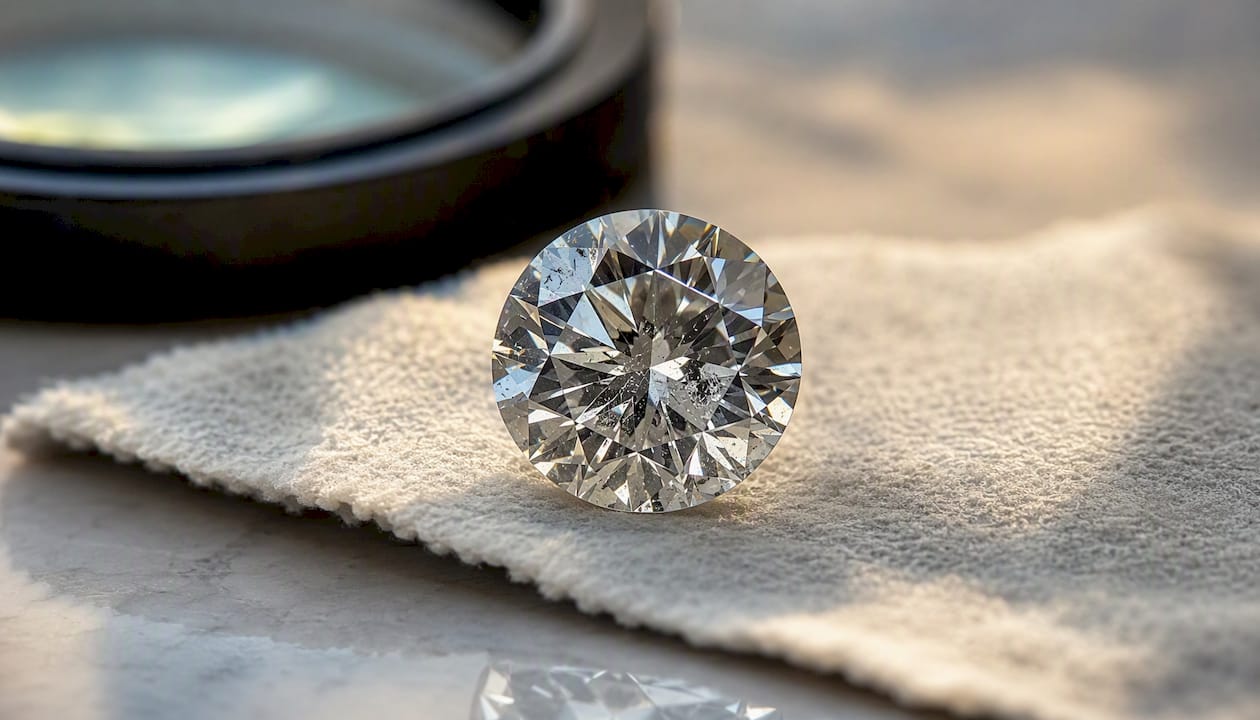
An “eye-clean” diamond is one whose inclusions are not visible to the unaided eye when viewed face-up under normal lighting at a typical viewing distance from the eye. That definition sounds precise, but the term itself is not an official lab grade. It is a practical, buyer-facing standard that shifts depending on the viewer’s visual acuity, the lighting conditions, the diamond’s cut, and how far away you hold it.
Key Takeaways
An eye-clean diamond has no inclusions visible to the unaided eye at 6–12 inches under normal lighting, but that judgment depends on the stone’s cut, size, and inclusion type, not the lab grade alone.
| Point | Details |
|---|---|
| Eye-clean is not a lab grade | GIA and IGI grade under 10x magnification; “eye-clean” is a practical buyer standard, not a certificate term. |
| VS2 is a reliable threshold | Round brilliants at VS2 and above are reliably eye-clean for most buyers under normal conditions. |
| SI1 requires case-by-case review | Inspect the clarity plot and face-up photos; off-center, low-relief inclusions often leave the face-up appearance clean. |
| Step cuts need higher clarity | Emerald and Asscher cuts expose inclusions that would disappear in a round brilliant of the same grade. |
| Online buyers should request three things | A grading report, face-up photos at scale, and a 360-degree video under normal lighting before committing to a purchase. |
Table of Contents
- What jewelers actually mean when they call a diamond eye-clean
- Which clarity grades are most likely to be eye-clean?
- How to check whether a diamond is eye-clean in person
- How to tell if a diamond is eye-clean when buying online
- Common inclusion types and how visible they tend to be
- How carat size, shape, and cut style affect inclusion visibility
- When a lower-clarity eye-clean diamond is the smarter buy
- How laboratory clarity grading works vs. what the eye sees
- Red flags and questions to ask before you buy
- Sources
What jewelers actually mean when they call a diamond eye-clean
The phrase “eye-clean” lives outside the lab. According to the International Gemological Institute, an eye-clean stone appears free of inclusions or blemishes to a person with 20/20 vision, face-up, under normal lighting at a standard distance. That is the working definition most reputable sellers use, though not all of them spell it out.
GIA grades clarity under 10x magnification, evaluating the number, size, relief, nature, and location of every characteristic in the stone. Many of those features simply cannot be seen without a loupe. A diamond graded SI1 by GIA may carry inclusions that are perfectly invisible to you in a jewelry store, or they may be obvious the moment you tilt the stone toward the light. The grade alone does not tell you which.
Several factors determine whether a diamond reads as eye-clean:
- Inclusion size: Larger features are easier to spot without magnification.
- Relief: High-contrast inclusions (dark crystals against a white body) stand out more than low-relief ones.
- Location: An inclusion under the table facet is far more visible than one near the girdle or pavilion edge.
- Number: Multiple small inclusions can collectively draw the eye even when each one is minor.
- Viewer acuity: Someone with above-average or corrected vision may catch what others miss entirely.
Because IGI notes that visual acuity varies between viewers, any seller claiming a stone is eye-clean should specify the distance, lighting, and vision baseline they used to make that call.
Which clarity grades are most likely to be eye-clean?
Grade thresholds give you a useful starting point, not a guarantee. Here is how the most common grades tend to perform for a standard round brilliant at 1.0–2.0 carats:
| Clarity Grade | Eye-Clean Likelihood | Notes |
|---|---|---|
| FL / IF | Highly likely | Flawless or internally flawless; no inclusions to see |
| VVS1 / VVS2 | Highly likely | Inclusions extremely difficult to see even under 10x |
| VS1 / VS2 | Highly likely | Minor inclusions; VS2 is often the sweet spot for value |
| SI1 | Often, case-by-case | Depends heavily on inclusion type and location |
| SI2 | Rarely without inspection | Inclusions frequently visible; inspect carefully |
| I1 / I2 / I3 | Unlikely | Inclusions visible and often affect brilliance |
Whiteflash’s buyer guidance confirms that round brilliants at VS2 and higher are reliably eye-clean for most buyers, while SI1 requires a case-by-case check based on the specific stone’s plot and photos.
Pro Tip: When hunting for value in the SI1 range, pull up the GIA clarity plot and look for inclusions positioned near the girdle or pavilion rather than under the table. A cloud or twinning wisp in a low-visibility location can leave the face-up appearance completely clean while saving you a meaningful amount on price.
How to check whether a diamond is eye-clean in person
The in-store test is straightforward, but most buyers rush it. Follow these steps:
- Hold the diamond face-up at arm’s length (roughly 25–30 cm) under the store’s ambient lighting, not directly under a spotlight.
- Look straight down through the table facet for 10–15 seconds before moving to any other angle.
- Tilt the stone slowly to about 45 degrees and scan for any dark spots, haziness, or visible lines.
- Check the pavilion view by flipping the stone over briefly; inclusions near the culet can reflect upward into the face-up view.
- Only then pick up the loupe to confirm what the lab plot describes. The loupe is for verifying the report, not for deciding whether the stone looks clean to the eye.
- Ask a trained gemologist on staff to repeat the face-up check if your own vision is corrected or if you are uncertain. Their baseline matters too.
Note that a setting can work both ways. A bezel or prong can hide a girdle-edge inclusion, but a high-clarity stone set in a dirty or scratched mounting can look worse than it actually is. Ask to see the loose stone when possible.
Pro Tip: Avoid evaluating a diamond directly under a jewelry store’s halogen spotlights. Those lights are designed to maximize sparkle, and they can mask inclusions that would be obvious in daylight or standard indoor lighting. Step away from the display case and check the stone in a more neutral spot.
How to tell if a diamond is eye-clean when buying online
Online purchases require a different set of tools because you cannot hold the stone yourself. Whiteflash recommends requesting high-quality face-up photos, a rotating or 360-degree face-up video with a visible scale, and the lab clarity plot before committing to any purchase.
Here is what to request from any online seller:
- The grading report (GIA, IGI, or equivalent) with the full clarity plot showing inclusion locations.
- Face-up photos at a known scale, ideally with a ruler or coin for size reference.
- A 360-degree or rotating video under normal room lighting, not studio spotlights.
- A face-up video with the diamond set in a ring, because the setting changes how inclusions present in real wearing conditions.
- A clear return and exchange policy with a minimum 7-day inspection window.
Reading the clarity plot takes a little practice. Inclusions marked under the table (the large flat facet on top) are the ones most likely to be visible face-up. Inclusions marked near the girdle or toward the pavilion edges are far less likely to show during normal wear. When a plot shows an inclusion under the table but the face-up photos look clean, ask the seller for a specific explanation and a video that shows that area directly.
Pro Tip: Insist on a no-questions-asked return window of at least seven days for any online diamond purchase. A seller confident in their eye-clean claim will offer this without hesitation. One who pushes back is a red flag worth taking seriously.
Common inclusion types and how visible they tend to be
Not all inclusions behave the same way. Knowing the terminology on a lab report helps you judge whether a listed feature is likely to affect what you see.
| Inclusion Type | Typical Visibility | Effect on Appearance |
|---|---|---|
| Pinpoint | Low | Tiny white dot; rarely visible without magnification |
| Cloud | Low to medium | Hazy group of pinpoints; can reduce brilliance if large |
| Feather | Medium to high | Small fracture; visibility depends on orientation |
| Crystal | Medium to high | Mineral inclusion; dark crystals are more visible |
| Twinning wisp | Low to medium | Ribbon-like; often low relief and hard to spot |
| Needle | Low | Thin rod-shaped crystal; usually low visibility |
| Cavity | High | Open void; catches light and is often noticeable |
Arete Diamond notes that two diamonds with identical clarity grades can look completely different to the naked eye depending on which inclusion types are present. A stone with several small pinpoints and twinning wisps may look cleaner than one with a single dark crystal sitting under the table.
Clouds and twinning wisps in small amounts are often a value opportunity. They lower the clarity grade without leaving a visible mark on the face-up appearance, which means you can sometimes find a VS2 or SI1 stone that looks as clean as a VVS at a noticeably lower price.
How carat size, shape, and cut style affect inclusion visibility
Size changes everything. An inclusion that disappears inside the facet pattern of a 1.0 ct round brilliant can become obvious in a 3.0 ct stone of the same grade, simply because the larger surface area gives it more room to show. For stones above roughly 3 carats, moving up at least one clarity grade is a practical safeguard, and a live inspection or higher-quality video becomes non-negotiable.
Shape matters just as much:
- Round brilliants mask inclusions well. The 57 or 58 facets create constant light return that competes with and often overwhelms small inclusions.
- Emerald and Asscher cuts (step cuts) have broad, open facets that act like windows into the stone. An inclusion that would vanish in a round can be clearly visible in an emerald cut of the same grade.
- Oval, pear, and marquise shapes have elongated bodies where inclusions near the tips or center can be more exposed than in a compact round.
- Princess cuts fall between brilliants and step cuts; they mask inclusions better than emerald cuts but not as effectively as rounds.
A VS2 round at 1.0 ct is almost always eye-clean. A VS2 emerald at 1.0 ct may or may not be, depending on where the inclusions sit. Whiteflash’s guidance specifically calls out step cuts as shapes that require closer scrutiny, and that advice holds whether you are shopping in person or online.
When a lower-clarity eye-clean diamond is the smarter buy
The practical rule most experienced buyers follow: prioritize cut first, then color, then clarity. Choose the lowest clarity grade that still reads as eye-clean for your chosen shape and size. Spending money on a VVS1 when a VS2 looks identical to the naked eye is paying for a feature you will never see.
A few quick rules of thumb:
- For round brilliants under 2.0 ct, VS2 is usually a reliable and cost-effective choice.
- SI1 can be a genuine value play when the inclusion is off-center, low-relief, or near the girdle. Always verify with the clarity plot and a face-up photo.
- Avoid SI2 and below without a thorough inspection; inclusions at that level frequently affect face-up appearance and, in some cases, durability (particularly feathers that reach the surface).
- Dropping from VS1 to VS2 or from VS2 to a clean SI1 often frees up budget for a better cut grade or a larger carat weight, both of which have a more visible impact on the diamond’s beauty.
Pro Tip: If you are comparing two stones at the same price point and one has a better cut grade with lower clarity, take the better cut. Cut drives brilliance, fire, and scintillation far more than a clarity grade that is invisible to the eye anyway.
How laboratory clarity grading works vs. what the eye sees
Labs and buyers are looking at the same stone under very different conditions. GIA assigns clarity grades based on five factors: the number, size, relief, nature, and location of characteristics, all evaluated under 10x magnification by a trained grader. That standard exists to create consistency across millions of stones, not to predict what you will see at arm’s length.
| Condition | Lab Grading | Unaided Eye |
|---|---|---|
| Magnification | 10x loupe or microscope | None |
| Lighting | Controlled, fiber-optic | Normal indoor or daylight |
| Viewing angle | Multiple, systematic | Primarily face-up |
| Grader | Trained gemologist | Buyer with variable acuity |
GIA itself acknowledges that “eye-clean” is an industry term, not a grade it assigns. The lab report tells you what is in the stone; it does not tell you whether you will see it. That gap is exactly why the practical eye-clean check exists alongside the formal grading system.
Red flags and questions to ask before you buy
A seller’s willingness to answer these questions directly is itself a signal of confidence in their inventory.
Questions to ask every seller:
- Can you provide face-up photos at a known scale?
- Is there a 360-degree video available under normal room lighting?
- Where are the inclusions located on the clarity plot?
- Does this stone come with a GIA or IGI grading report?
- What is your return policy, and how many days do I have to inspect the stone?
Red flags that suggest a diamond may not be eye-clean:
- A verbal “eye-clean” claim with no photos or video to back it up.
- Photos taken exclusively under high-intensity spotlights with no ambient-light option.
- No lab report, or a report from an unrecognized lab with no verifiable grading standards.
- Heavily edited or filtered images that obscure the stone’s natural appearance.
- A seller who refuses to share the clarity plot or describe inclusion locations.
- No return window, or a return policy that requires the stone to be “unaltered” in ways that make returns impractical.
If a seller declines to share photos or a clarity plot, treat that as a firm reason to walk away. A stone that is genuinely eye-clean is easy to demonstrate.
An informed buyer’s perspective on the eye-clean check
Most buyers spend too much time worrying about the clarity grade printed on a certificate and not enough time looking at the actual stone. The grade tells you what a gemologist found under magnification. What matters to you is what you see when you hold the ring at a normal distance in ordinary light.
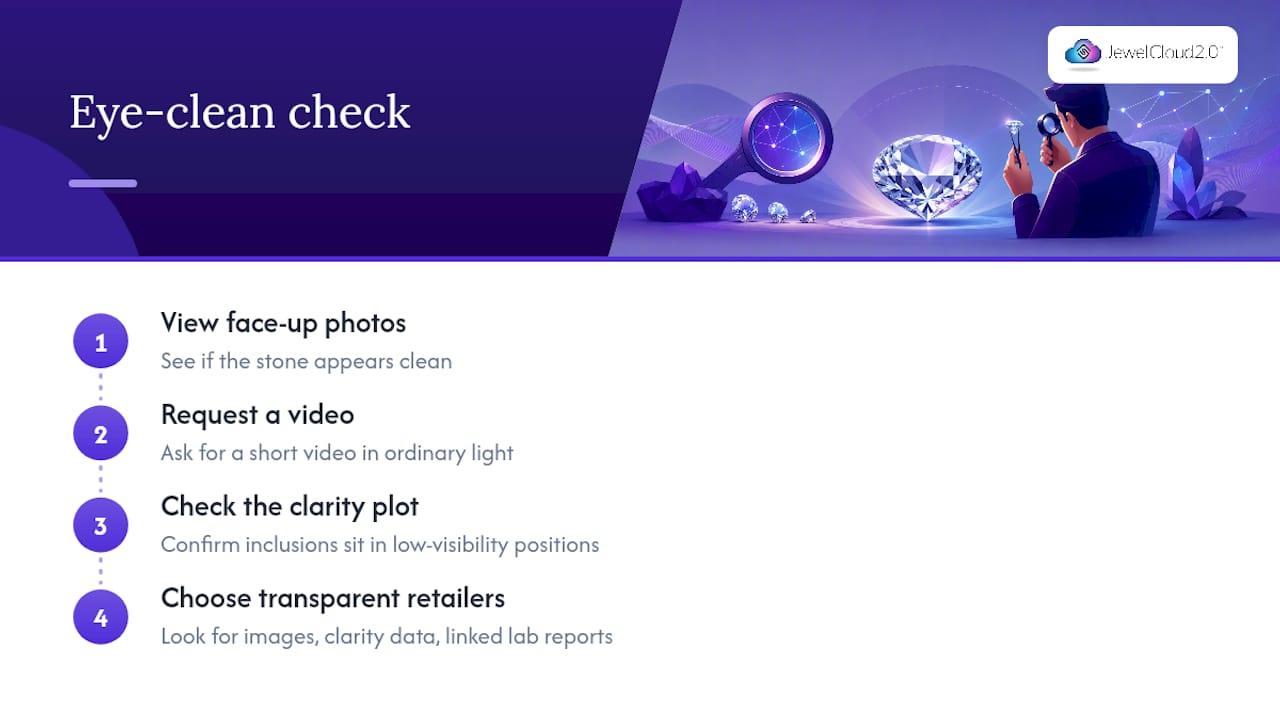
Start with the face-up photos. If the stone looks clean there, ask for a video. Then pull up the clarity plot and confirm that any marked inclusions are in low-visibility positions. That three-step sequence catches the vast majority of cases where a stone’s grade and its real-world appearance diverge.
Retailers who present their inventory with accurate clarity data, high-quality images, and linked lab reports make this process far easier for buyers. Jewelcloud’s DiamondLink® platform is built around exactly that kind of structured, standardized product data, giving retail jewelers the tools to present diamond inventory with the detail buyers need to make confident decisions. If you are a retailer looking to offer that level of transparency, the Jewelcloud platform overview is a practical starting point.

Jewelcloud helps jewelry retailers and diamond suppliers present inventory with the accuracy and detail buyers expect. Structured product data, lab-report linking, and high-quality image support are built into the platform. Learn more about Jewelcloud and see how standardized diamond data can reduce buyer hesitation and support confident purchasing decisions.
Sources
- Diamond Clarity | GIA 4Cs
- Diamond Clarity Chart with Eye-Clean Definition - IGI
- How is Eye-Clean Defined and How to tell if a Diamond Online is Eye-Clean? | Whiteflash
- Eye-Clean: What It Means and Doesn’t | Arete Diamond