


Jewelry brand content syndication is the deliberate distribution of non-product brand content, such as blog posts, care guides, styling tips, and brand stories, across third-party platforms and partner channels to grow your audience, build authority, and support the long consideration cycles that define jewelry purchases. This is distinct from product syndication, which focuses on distributing accurate product data like images, pricing, and inventory levels across sales channels. Content syndication targets education and emotional connection rather than transactional accuracy.
The core goals of jewelry brand content syndication are:
- Expand reach beyond your owned website and social channels to new, qualified audiences
- Build authority by placing expert content where shoppers are already researching
- Support long sales cycles by keeping your brand visible during weeks or months of consideration
- Drive discoverability through SEO, social search, and earned media placements
- Educate shoppers on quality, provenance, and styling to reduce trust gaps before purchase
Jewelcloud, as a B2B platform connecting jewelry designers, manufacturers, and retailers, sits at the intersection of product and content distribution, making it a natural partner for brands looking to extend their digital footprint across qualified retail channels.
Why content syndication matters for jewelry brands
Jewelry is not an impulse category. A shopper deciding between a sapphire pendant and a diamond solitaire might spend weeks reading, comparing, and revisiting brand websites before committing. That consideration window is both your challenge and your opportunity.

Emerging jewelry brands must build a content and creative engine that uses digital PR, social search, and SEO to be discoverable early in the research phase, because brand search volume starts low and grows only through consistent presence. Syndication accelerates that process by placing your content on platforms where shoppers are already looking, rather than waiting for them to find you organically.
Key benefits of content syndication for jewelry brands include:
- Authority building: Publishing care guides and provenance stories on respected third-party sites signals expertise to both readers and search engines
- Trust at scale: Educational content that addresses quality, fit, and provenance closes more sales by reducing the trust gap that prevents online jewelry purchases
- Algorithm favorability: Consistent content presence across interconnected channels builds audience expectations and improves platform algorithm performance
- Retargeting fuel: Content engagement on partner platforms creates warm audiences you can reach again through paid campaigns
Stat to know: A mid-sized jewelry brand that ran a data-led PR campaign paired with short-form creator videos saw organic product CTR rise significantly within eight weeks, with AI answer modules beginning to surface the brand for relevant queries.
The brands gaining ground right now are not simply posting beautiful product photos. They are running content ecosystems that address specific customer needs at every stage of the decision process, and syndication is what carries those ecosystems beyond their own channels.

How jewelry brand content syndication works
The syndication process follows a clear sequence, though the execution varies by model and platform. Understanding the mechanics helps you build a repeatable system rather than a one-off campaign.
The core process:
- Content creation: Produce evergreen, brand-aligned content such as care guides, styling articles, or brand origin stories
- Content adaptation: Adjust tone, format, and length to fit each target platform’s audience and editorial standards
- Partner selection: Identify third-party publishers, retail partners, trade publications, or platform networks that reach your target shoppers
- Distribution: Publish or share content through direct partnerships, syndication networks, or platform-native tools
- Measurement: Track traffic, engagement, and conversions using UTM parameters and analytics to assess what is working
Common syndication models:
- Direct partnerships: You negotiate placement with a specific publisher or retail partner, such as a jewelry lifestyle blog or a trade outlet
- Network-based syndication: A content distribution network places your articles across multiple partner sites simultaneously
- Platform-based distribution: Social platforms, email newsletters, and B2B platforms like Jewelcloud distribute your content to their existing audiences
Technology plays a supporting role throughout. Content management systems keep your assets organized and version-controlled. APIs can automate distribution to multiple endpoints. Structured data markup, including product schema and FAQ schema, helps AI answer engines and search platforms surface your content at the right moment. The goal is accuracy and consistency across every touchpoint, because fragmented messaging across channels erodes the trust you are working to build.
What types of content work best for jewelry brand syndication
Not every piece of content you create belongs in a syndication program. The formats that perform best share three qualities: they are evergreen, they carry genuine educational or emotional value, and they work for readers who do not yet know your brand.
Effective jewelry content types for syndication include:
- Care guides: “How to clean your gold jewelry at home” answers a real question, builds trust, and stays relevant year-round
- Style guides: Pairing tips, layering advice, and occasion-based styling content helps shoppers visualize your pieces in their lives
- Brand stories: The origin of a collection, the artisan behind a technique, or the sourcing story for a gemstone creates emotional resonance that product photos cannot
- Gift guidance: A large share of jewelry is purchased as a gift by someone unfamiliar with the category. Content that reduces their anxiety converts well
- Educational explainers: Articles on gemstone grading, metal types, or hallmarking standards position your brand as the credible source in your market
- Customer moments: Real stories from real buyers, not staged testimonials, carry more weight than studio photography and travel well across platforms
Criteria for selecting content to syndicate:
- Evergreen topics that remain useful beyond a single season
- Informational intent that matches what shoppers search for early in their research
- Emotional appeal tied to life events, personal identity, or gift-giving
- Formats that translate across channels without losing their core message
Pro Tip: A single well-researched care guide can be repurposed into a newsletter feature, a short-form video script, a social post series, and a FAQ page section. That compounding effect is what makes syndication cost-effective over time.
How to effectively implement jewelry brand content syndication
Implementation is where most brands stall. The strategy makes sense on paper, but execution requires coordination, discipline, and a clear process. Here is how to build a program that holds together.
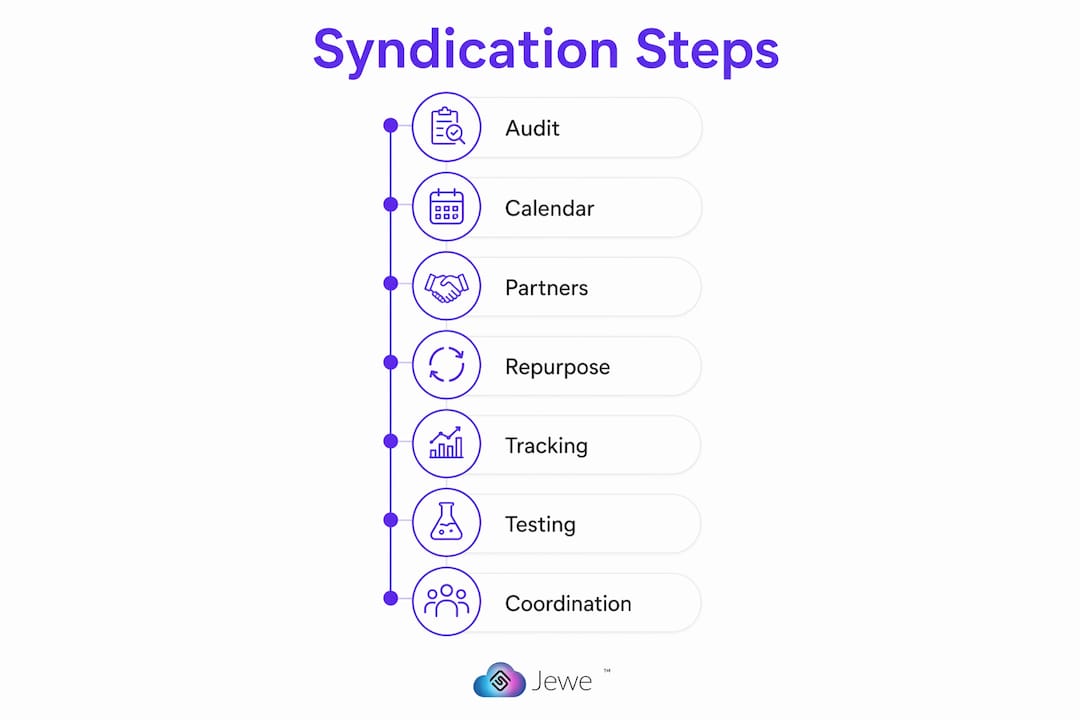
1. Audit your existing content first. Before distributing anything, identify which pieces are genuinely strong enough to represent your brand on a third-party platform. Thin or promotional content will not earn placement and may damage your credibility.
2. Build a content calendar aligned with seasonal demand. Jewelry has predictable peaks: Valentine’s Day, Mother’s Day, engagement season, and the holiday quarter. Planning content around these moments, then repurposing core assets across channels, improves both consistency and algorithm performance.
3. Select distribution partners carefully. Your syndication partners should reach audiences who are genuinely in the market for jewelry or adjacent categories. Trade publications, lifestyle blogs, retail partner newsletters, and platforms like Jewelcloud all offer qualified audiences. For inspiration on how cohesive content strategy supports seasonal campaigns, waterproof jewelry brand guides demonstrate how niche content builds category authority across channels.
4. Repurpose content systematically. A blog post becomes a newsletter, a video script, and a set of social posts. This compounding approach extracts maximum value from each asset and maintains consistent messaging across every platform where your brand appears.
5. Use UTM parameters on every syndicated link. Tracking traffic growth, engagement metrics, and conversion rates through consistent UTM tagging is what separates a content program from a content experiment. Without this data, you cannot prove impact or prioritize future investment.
6. Test organic content before amplifying it. Social content that earns saves and shares organically performs better when amplified through paid campaigns, and at lower cost. This organic-to-paid pipeline is one of the most underused tactics in jewelry marketing.
7. Coordinate across teams. PR, social, SEO, and email need to share a single content calendar and asset pack. When each team operates in isolation, messaging fragments and the compounding benefit of syndication disappears.
A unified digital marketing approach that integrates social, PR, SEO, and syndication builds a digital footprint that works across every discovery touchpoint, from a Reddit thread to an AI answer panel.
Unique considerations for jewelry brands in content syndication
Jewelry occupies a specific position in the purchase landscape. Pieces often mark engagements, anniversaries, and personal milestones. That emotional weight shapes every content decision you make, and it creates both opportunities and risks in a syndication program.
The emotional dimension of jewelry content
Storytelling and emotional connection are not optional extras in jewelry content. They are the mechanism by which a shopper moves from awareness to purchase. A care guide that explains the provenance of a stone does more than inform. It validates the purchase as meaningful. Syndicated content that carries this emotional specificity travels better than generic product promotion, because it gives readers something worth sharing.
Integrating product syndication with content syndication
Product syndication and content syndication serve different functions, but treating them as entirely separate programs creates fragmented brand messaging. Your product data, accurate descriptions, images, and pricing distributed through a PIM system, should align with the brand voice and educational content you are syndicating. When a shopper reads your care guide on a partner site and then clicks through to a product page with inconsistent descriptions or missing provenance details, the trust you built evaporates. Integrating both disciplines under a single brand standard is what creates a coherent digital footprint.
Copyright and legal safeguards
Every piece of content you syndicate needs clear licensing terms. Establish written agreements with partners that specify how your content can be used, whether it can be modified, and how attribution works. Protect your visual assets with watermarks or usage restrictions where appropriate. This is not a formality. Unauthorized repurposing of jewelry photography or brand stories is common, and recovering control after the fact is costly.
Measuring ROI for jewelry brand content syndication
ROI measurement in content syndication requires a framework built around the full consideration cycle, not just last-click conversions. Useful metrics include:
- Traffic growth from syndicated placements tracked via UTM parameters
- Engagement metrics such as time on page, saves, and shares on partner platforms
- Conversion lift among users exposed to syndicated content versus those who were not
- AI answer inclusion: appearances in Google AI Overviews or platform-native AI snippets indicate your content is being recognized as authoritative
- Brand search volume growth over time, which reflects the cumulative effect of consistent syndication
Stat to know: A luxury jeweler that standardized product SKUs and embedded manufacturer provenance on product pages saw paid search spend drop 23% after a major platform updated its AI shopping schema to favor provenance signals, demonstrating how content and product data alignment pays off in measurable ways.
Risks to manage
- Inconsistent messaging: When syndicated content does not match your current brand voice or product positioning, it confuses shoppers who encounter your brand across multiple channels
- Over-reliance on a single channel: Brands that syndicate only to one platform miss the earned placements that feed AI answers and long-term SEO authority
- Poor metadata: Missing product SKUs or inconsistent copy in syndicated content prevents AI modules from connecting editorial mentions to your product pages, reducing the conversion value of every placement
Jewelcloud’s structured product data infrastructure helps brands maintain the accuracy and consistency that makes both product and content syndication work together, rather than pulling in opposite directions.
Key Takeaways
Jewelry brand content syndication works when you distribute evergreen, emotionally resonant content through aligned partner channels, track every placement with UTM parameters, and integrate your content strategy with accurate product data.
| Point | Details |
|---|---|
| Content vs. product syndication | Content syndication builds authority through stories and guides; product syndication distributes accurate data like pricing and inventory. |
| Long consideration cycles | Jewelry shoppers research for weeks; syndicated educational content keeps your brand visible throughout that window. |
| Repurpose systematically | One blog post can become a newsletter, video script, and social series, compounding the value of each asset. |
| Measure with UTM parameters | Track traffic, engagement, and conversion lift from every syndicated placement to prove impact and guide future investment. |
| Align content and product data | Fragmented messaging between your brand stories and product pages erodes trust; a unified standard across both disciplines builds a stronger digital footprint. |