


The jewelry brand to retailer pipeline is the coordinated, end-to-end process of moving product data and physical inventory from jewelry brands through distributors to retail partners. It is not simply a logistics chain. It is a living system that governs how product information is structured, enriched, governed, and delivered so that retailers can sell with confidence and shoppers can buy with trust.
At its core, the pipeline connects several key stakeholders:
- Jewelry brands and manufacturers who create and own the product catalog
- Wholesale distributors who aggregate inventory and manage fulfillment
- Retail partners who list, merchandise, and sell to end customers
- Data managers who maintain the accuracy and consistency of product records across every channel
The pipeline’s effectiveness depends on four interconnected elements: a well-structured product data model, integration of multiple supplier feeds, AI-powered content enrichment, and CMS-driven governance. When these elements work together, retailers get accurate inventory, clean product descriptions, and consistent imagery. When they break down, you get mismatched SKUs, outdated pricing, and lost sales. Understanding how jewelry reaches retailers through this pipeline, and where it tends to fail, is the first step toward managing it well.
Table of Contents
- What does a jewelry-specific product data model actually look like?
- How do you integrate multiple supplier feeds into one clean pipeline?
- How does AI enrich jewelry product content at scale?
- Why does CMS governance matter for jewelry distribution?
- What are the most common challenges in jewelry brand-retailer pipelines?
- What does the system architecture of a jewelry data pipeline look like?
- What modern shifts are reshaping how jewelry brands reach retailers?
- Key Takeaways
- How Jewelcloud supports your pipeline from brand to retail
What does a jewelry-specific product data model actually look like?
Jewelry product data is more complex than almost any other retail category. A single ring can exist in dozens of configurations: yellow gold, white gold, or rose gold; 14K or 18K; size 5 through size 12; with a round, princess, or oval center stone; in SI1 or VS2 clarity. Each of those combinations is a distinct variant, and each variant needs its own accurate, complete record.
A jewelry-specific product data model captures all of that complexity in a structured, normalized format. The core attributes that require standardization include:
- Metal type and purity (e.g., 14K yellow gold, sterling silver, platinum)
- Gemstone details (species, cut, carat weight, color grade, clarity grade)
- Size and configuration (ring size, chain length, bracelet width, setting style)
- SKU and variant identifiers that map each combination to a unique, trackable record
- Imagery metadata linking the correct photo to the correct variant
Variant normalization is what makes this manageable at scale. Without it, one supplier might label a stone “round brilliant” while another calls it “RB cut,” and a third simply writes “round.” Those three records describe the same thing, but a system treating them as distinct will create duplicate listings, confuse faceted filters, and frustrate shoppers. Normalization collapses those inconsistencies into a single canonical value, so your structured product data stays clean across every retail channel.
Standardized SKUs and metadata also matter for integration. When a retailer’s system expects a specific field format and your feed delivers something different, the data either fails to load or loads incorrectly. A well-designed jewelry data model anticipates those requirements and maps to them from the start, reducing errors and making your catalog genuinely usable for retail partners.

How do you integrate multiple supplier feeds into one clean pipeline?
Most jewelry brands and distributors source from more than one supplier. Each supplier sends data in its own format: some use spreadsheets, some use XML feeds, some offer REST APIs, and some still email CSV files. The challenge is not just collecting that data. It is reconciling it.

Inconsistent supplier schemas are the most common source of pipeline errors. One supplier might use a field called “metal_color” while another uses “alloy_type,” and a third omits the field entirely. When those feeds are ingested without normalization, the downstream catalog becomes unreliable. Retailers see missing attributes, incorrect variants, and pricing that does not match what was agreed.
The solution is a centralized feed integration layer that handles:
- Schema mapping to translate each supplier’s field names into your canonical data model
- Deduplication logic to catch the same product arriving from multiple sources
- Validation rules that flag records with missing required fields before they reach the catalog
- API-based real-time updates for inventory levels and pricing, so retailers always see current availability
Real-time API connections are particularly valuable for jewelry, where pricing moves with metal spot rates and inventory can shift quickly on high-demand pieces. Brands that prioritize EDI integration and structured product feeds give retailers instant access to accurate inventory and high-quality imagery, which is a genuine competitive advantage in digital marketplaces. A centralized integration layer also means that when a supplier updates a product, that change propagates to every retail channel automatically rather than requiring a manual update cycle.
Pro Tip: Set up automated validation alerts at the point of feed ingestion, not after data reaches the catalog. Catching a missing gemstone clarity field at intake costs seconds to fix; catching it after it has published to 50 retailer storefronts costs hours.
How does AI enrich jewelry product content at scale?
Raw supplier data is rarely retail-ready. A manufacturer’s product record might include a SKU, a metal type, and a stone weight, but it will not include a compelling product description, properly tagged imagery, or the kind of rich metadata that helps a shopper find the piece through search. AI-powered enrichment fills that gap.
Here is what AI does well in a jewelry pipeline:
- Generating consistent product descriptions from structured attributes, so a 14K white gold diamond solitaire ring gets a description that is accurate, readable, and formatted to your brand standards rather than copied from a supplier sheet
- Automated image tagging that labels photos with metal color, stone type, setting style, and orientation, making imagery searchable and filterable
- Variant matching that identifies when two records from different suppliers describe the same product, preventing duplicate listings
- Error detection that flags records where the described attributes conflict (e.g., a listed weight that is inconsistent with the stated stone size)
The SEO impact of enriched content is real. Product pages with complete, unique descriptions and properly tagged images rank better in organic search and convert at higher rates than pages with thin or duplicated content. Duplicate product data, in particular, carries an SEO risk: search engines may penalize pages that appear to copy content from other listings, which is a common outcome when brands publish raw supplier data without enrichment.
AI also accelerates the pipeline. Enriching thousands of product records manually is not practical for most teams. With AI handling the first pass, your data managers can focus on reviewing and approving rather than writing from scratch, which compresses the time from supplier intake to live retail listing considerably.
Why does CMS governance matter for jewelry distribution?
A content management system built for jewelry does more than store product records. It governs the entire lifecycle of a product from intake through publication, enforcing data quality at every step and giving your team a single source of truth for every retail channel.
Jewelry-specific CMS features that matter most in a brand-to-retailer context include:
- Approval workflows that require a data manager to review and sign off on new or updated records before they publish
- Role-based access controls so suppliers can submit data without being able to overwrite approved records
- Channel-specific publishing rules that format and deliver data differently depending on whether the destination is a retailer’s e-commerce platform, a wholesale portal, or a print catalog
- Branded packaging and routing information stored alongside product records, so fulfillment teams always have the correct labeling and carton requirements for each retail partner
- Audit trails that log every change to a product record, making it easy to trace errors back to their source
Centralized governance is what makes the pipeline scalable. Without it, product data tends to fragment: one version lives in a spreadsheet, another in an email thread, and a third in the retailer’s system, and none of them match. With a governed CMS at the center, every stakeholder works from the same record. Retailers get consistent data, brands maintain control over how their products are presented, and data managers have the visibility to catch problems before they reach the shopper.
The Jewelcloud product feed is built on exactly this principle: structured, standardized data governed centrally and delivered to retail partners in a format they can actually use.
What are the most common challenges in jewelry brand-retailer pipelines?
Even well-designed pipelines run into problems. The challenges in jewelry distribution are specific to the category, and understanding them helps you build systems that account for them rather than react to them after the fact.
The most common operational and technical challenges include:
- Inconsistent supplier schemas that require manual mapping every time a new supplier is onboarded, slowing down catalog expansion
- Manual data entry and update cycles that introduce errors and create lag between what a supplier has in stock and what a retailer sees in the feed
- Duplicate product records from multiple supplier sources, which create SEO risks and confuse shoppers comparing listings
- Routing guide non-compliance, where shipments fail to meet a retailer’s labeling, packaging, or EDI requirements, triggering chargebacks that erode wholesale margins
- Pricing inconsistencies caused by metal spot rate changes that are not reflected in real-time across all retail channels
- Customer experience failures when a shopper orders a piece that is listed as available but is actually out of stock, or receives a product that does not match the description
Routing guide compliance deserves particular attention. Large retailers enforce strict requirements on label formats, ASN submissions, and carton markings. Non-compliance does not just create friction; it creates direct financial penalties in the form of chargebacks. Brands that automate their compliance workflows, rather than managing them manually, significantly reduce that risk.
The SEO dimension is also worth taking seriously. When the same product description appears across dozens of retailer storefronts without any enrichment or differentiation, search engines may treat those pages as duplicate content. The result is lower organic visibility for your retail partners, which reduces sell-through and weakens the case for keeping your brand in their assortment.
What does the system architecture of a jewelry data pipeline look like?
A well-built jewelry product data pipeline has five core components, each with a defined role in the flow from supplier to retailer.
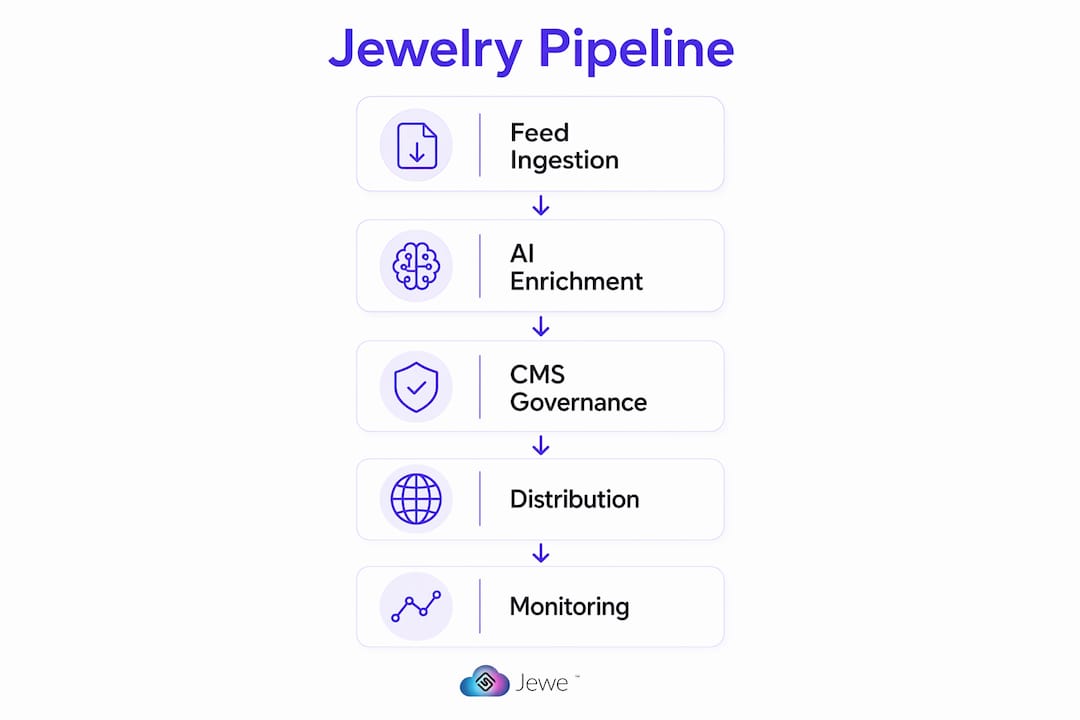
1. Supplier feed ingestion layer This is where raw data enters the system, whether from API connections, EDI transactions, XML feeds, or flat files. The ingestion layer handles schema mapping, deduplication, and initial validation before passing records downstream.
2. AI enrichment engine Validated records move into the enrichment layer, where AI generates descriptions, tags imagery, matches variants, and flags anomalies. The output is a retail-ready product record that meets your content standards.
3. CMS and governance layer Enriched records enter the CMS for human review and approval. Governance workflows enforce data quality, manage approval routing, and maintain the audit trail. This is also where channel-specific formatting rules are applied.
4. Distribution and API output layer Approved records are published to retail channels via API, EDI, or direct feed delivery. This layer handles channel-specific formatting, real-time inventory updates, and pricing synchronization.
5. Monitoring and feedback layer Performance data flows back into the system: sell-through rates, data error reports, retailer feedback, and compliance alerts. This layer closes the loop and gives data managers the visibility to improve the pipeline continuously.
The integration of EDI and PIM (Product Information Management) systems fits primarily in layers one and three. EDI handles the transactional data exchange with retailers, including purchase orders, advance ship notices, and invoices. PIM systems serve as the master record for product attributes, feeding into the CMS governance layer. Platforms like Jewelcloud are designed to connect these components into a unified flow, so brands and distributors are not managing separate systems for each function.
Pro Tip: Treat your monitoring layer as a first-class component, not an afterthought. A pipeline that delivers data without measuring what happens to it is flying blind. Track error rates by supplier, publish latency by channel, and chargeback frequency by retailer to know exactly where to focus improvement efforts.
Here is a simplified view of the data flow:
Supplier Feeds (API / EDI / CSV)
        ↓
Ingestion & Schema Mapping
        ↓
AI Enrichment & Variant Normalization
        ↓
CMS Governance & Approval Workflows
        ↓
Distribution Layer (API / EDI / Direct Feed)
        ↓
Retail Channels (E-commerce / Wholesale Portals / Marketplaces)
        ↓
Monitoring & Feedback Loop
What modern shifts are reshaping how jewelry brands reach retailers?
The jewelry brand distribution process has moved decisively from physical logistics chains to data-centric integrated flows. That shift changes the economics, the operational requirements, and the competitive dynamics for everyone in the pipeline.
Several developments are worth understanding closely:
Direct sourcing and margin recovery Bypassing multi-tier intermediaries increases retailer gross margins by 8–15 percentage points and reduces lead times from 8–12 weeks to 2–4 weeks. Middlemen often add 20–50% to final costs without adding design or craftsmanship value, so direct distribution improves retailer competitiveness and margins. The trade-off is that direct sourcing transfers quality control, inventory management, and logistics responsibility from wholesalers to the brand or retailer, which demands digitized, accurate product data to manage effectively.
B2B dropshipping as a distribution model Modern jewelry pipelines increasingly use B2B dropshipping, enabling retailers to list a brand’s full assortment without holding physical inventory. When an order comes in, the fulfillment partner ships directly to the end customer under the retailer’s or brand’s packaging. This model reduces the retailer’s inventory burden and lets brands scale distribution without requiring retail partners to commit capital upfront. It is a fundamentally different model from consumer dropshipping platforms: pieces are manufactured to spec, pass jewelry-grade quality control, and ship on defined service-level agreements in full brand packaging.
EDI and real-time inventory access Jewelry brands that prioritize EDI integration give retailers the ability to place purchase orders, receive advance ship notices, and reconcile invoices without manual data entry. Combined with real-time inventory feeds, EDI creates a pipeline where a retailer’s system always reflects current availability. That accuracy matters for custom watches and other luxury accessories brands operating in adjacent categories, where B2B wholesale programs face the same data accuracy challenges as fine jewelry.
Jewelry-specific logistics requirements Specialized jewelry fulfillment includes chain-of-custody documentation and secure logistics integrated with value-added services such as engraving and sizing. These services reduce the number of handoffs a piece goes through before reaching the retailer, which directly reduces the risk of loss or damage. High-value pieces often require signature confirmation, declared value documentation, and insured shipping, none of which a generic third-party logistics provider handles well.
Routing guide compliance as a competitive factor Retailers typically apply a markup of 2x to 5x on landed wholesale costs to cover operational expenses including marketing and customer experience. Non-compliance with routing guides, whether a missing label, an incorrect carton format, or a late ASN submission, generates chargebacks that come directly out of the brand’s wholesale margin. Brands that automate compliance workflows and treat routing guide requirements as a data management problem rather than a shipping problem consistently outperform those that manage it manually.
The brands winning in retail distribution right now are the ones that have built pipelines where data accuracy, compliance automation, and fulfillment quality are managed as a single integrated system rather than three separate problems.
Key Takeaways
The jewelry brand to retailer pipeline succeeds when product data accuracy, supplier integration, AI enrichment, and CMS governance operate as one connected system rather than isolated functions.
| Point | Details |
|---|---|
| Data model complexity | Jewelry variants require normalization across metal type, gemstone grade, size, and configuration to prevent catalog errors. |
| Direct sourcing impact | Bypassing multi-tier intermediaries increases retailer gross margins by 8–15 percentage points and cuts lead times from 8–12 weeks to 2–4 weeks. |
| AI enrichment value | AI generates retail-ready descriptions, tags imagery, and detects variant mismatches, reducing manual workload and SEO risk from duplicate content. |
| Routing guide compliance | Non-compliance with retailer labeling and EDI requirements triggers chargebacks that erode wholesale margins directly. |
| CMS governance | A centralized content management system with approval workflows and audit trails keeps every retail channel working from the same accurate product record. |
How Jewelcloud supports your pipeline from brand to retail
Managing a jewelry brand distribution process at scale requires more than good intentions. It requires infrastructure built specifically for the complexity of jewelry product data. Jewelcloud was designed for exactly that: a B2B platform where designers, manufacturers, and diamond dealers load their merchandise at wholesale, and retail jewelers access a structured, standardized catalog they can sell from without carrying physical inventory.
For brands and distributors, Jewelcloud functions as the data governance and distribution layer of your pipeline. Product data is structured to jewelry-specific standards, enriched for retail usability, and delivered to retail partners in a format their systems can consume directly. For retailers, it means access to real product data from participating brands, accurate inventory, and the ability to expand assortments without the overhead of managing supplier relationships individually.
If you are building or rebuilding your pipeline and want to understand what a purpose-built platform looks like in practice, explore Jewelcloud’s vendor benefits or learn more about what Jewelcloud does for brands at every stage of the distribution process.