


Jewelry collection development is the structured process of designing and launching a cohesive group of pieces that share a common aesthetic, materials, and theme. Rather than creating standalone items, you’re building a family of pieces that tell one story together. A well-built collection typically includes a number of pieces enough to offer variety without losing the visual thread that holds everything together.
Done well, collection development is equal parts creative vision and business strategy. You’re not just designing beautiful jewelry. You’re planning inventory, managing timelines, profiling your customer, and coordinating production months before a single piece hits a display case. The designers who treat this as a deliberate process, rather than a series of spontaneous decisions, are the ones who launch on time, sell through cleanly, and build recognizable brands.
Here’s what that process looks like from start to finish:
- Design theme: A unifying concept, motif, or material that runs through every piece
- Target audience alignment: Pieces designed for a specific customer’s style, budget, and values
- Market research: Trend awareness and competitive context before sketching begins
- Production planning: Timelines, manufacturer relationships, and cost controls built in from day one
- Marketing preparation: Photography, storytelling, and launch strategy developed alongside the product
What does the jewelry collection development process look like?
The collection development process moves through six distinct stages, and skipping any one of them tends to create problems downstream.
1. Inspiration and market research. Every strong collection starts with research, not sketching. You need to know what your customer is buying, what trends are gaining traction, and where the white space is in your category. Trend forecasting should begin 2–3 months before launch to leave enough room for sampling, production, and marketing.
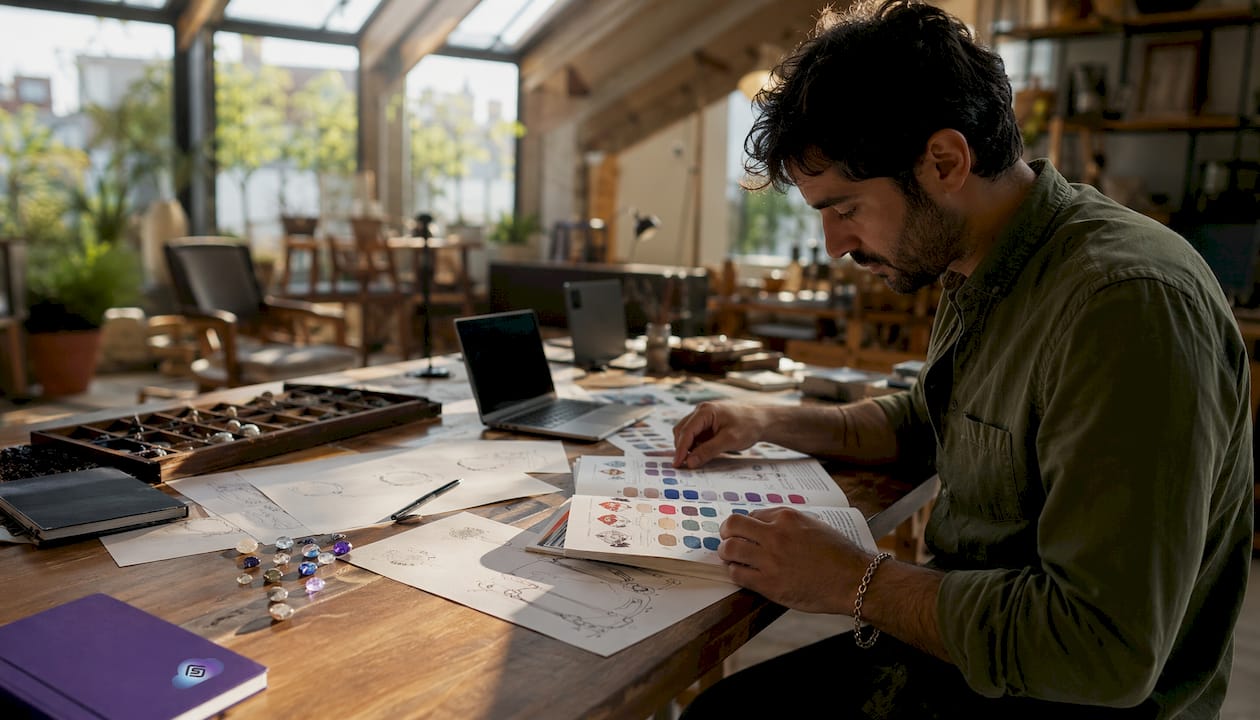
2. Concept development and sketching. Once you have a theme, you sketch variations, exploring shape, proportion, and balance. CAD software like Rhino or Matrix helps convert those sketches into manufacturable 3D models, giving both you and your production partner a precise view of what’s being built.
3. Material selection and sourcing. Your material choices define the collection’s price point, durability, and visual consistency. Whether you’re working with sterling silver, gold vermeil, or mixed metals, locking in your specifications early prevents costly revisions later. Establishing relationships with reliable suppliers also protects quality as you scale.
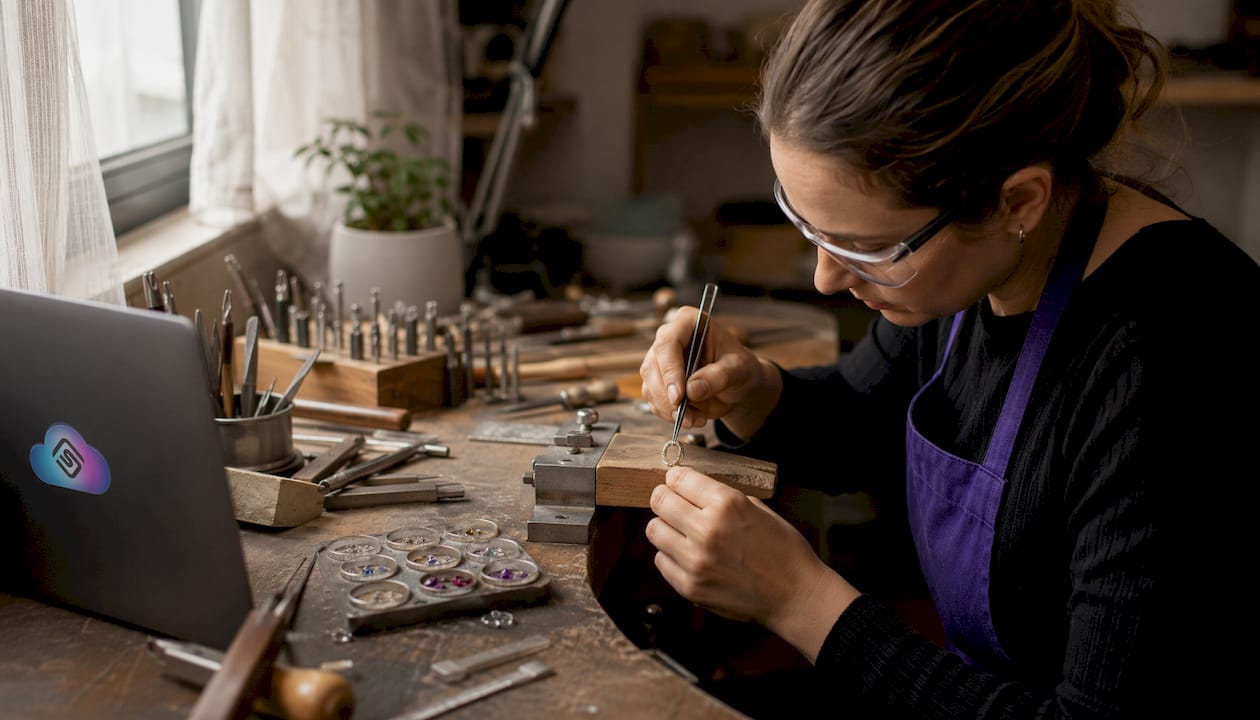
4. Prototyping and sampling. This is where concept meets reality. A prototype tests weight, drape, durability, and manufacturability before you commit to bulk production. Sample development typically takes 7–15 days depending on design complexity, so build that window into your calendar.
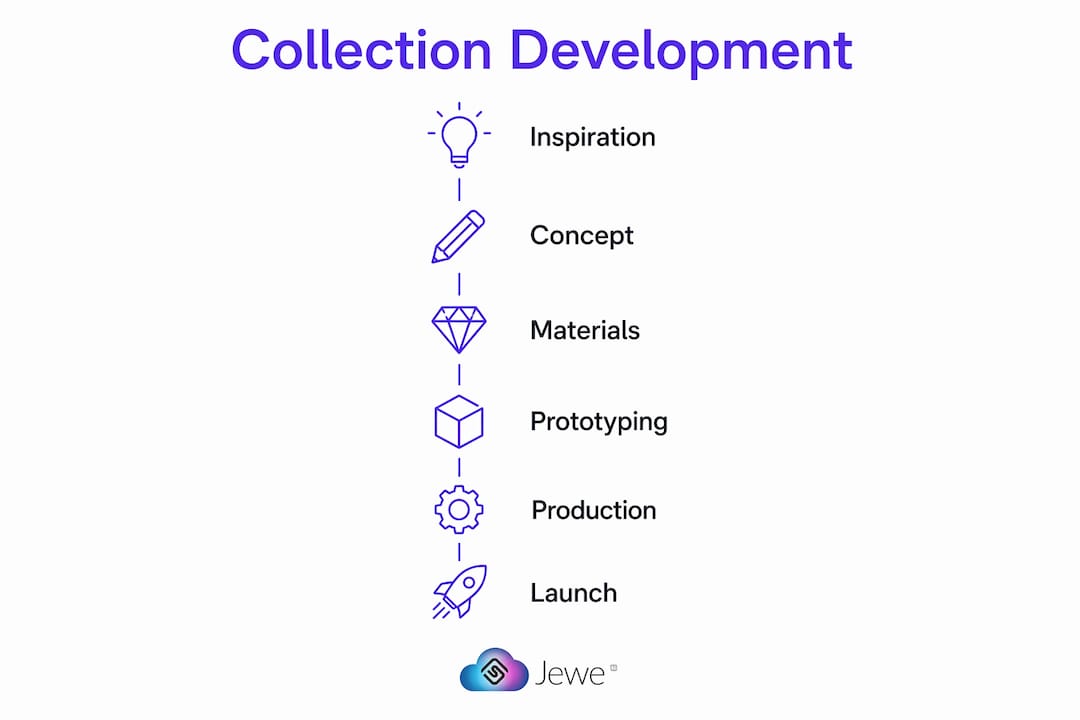
5. Production planning and budgeting. After sample approval, you move into production scheduling. This means confirming manufacturer capacity, setting order quantities by SKU, and building your cost structure. Pricing needs to account for materials, labor, overhead, and a margin that can support wholesale later.
6. Marketing and launch preparation. Professional photography, product descriptions, and a launch plan should be ready before inventory arrives. A well-timed launch, with social teasers and a clear go-live date, converts the work of the previous five stages into actual sales.
- Treat each stage as a gate: don’t move forward until the current stage is complete
- Keep a shared timeline document with your manufacturer updated throughout
- Budget for at least one round of sample revisions before approving bulk production
Pro Tip: Share your annual production forecast with your manufacturer early. Brands that do this secure production slots earlier and reduce the risk of delays during peak factory seasons, which often means lower air freight costs too.
How do you design a cohesive jewelry collection?
Cohesion is what separates a collection from a random assortment of pieces. The most widely cited framework for achieving it comes from Marlene Richey, who identified the 4Cs of collection design: Clear, Concise, Cohesive, and Consistent.
Each of the 4Cs does specific work. Clear means your theme is immediately readable. A customer should understand what the collection is about without needing an explanation. Concise means every piece earns its place. One ambiguous piece can throw off the entire aesthetic. Cohesive means the pieces work together and can be worn together, not just displayed together. Consistent means your design language, materials, and finishing stay uniform across the full range.
Beyond the framework, a few practical design decisions shape how cohesion actually feels:
- Anchor your collection to one design element: a shape, a texture, a motif, or a material treatment that repeats across pieces
- Build in variety within the theme: rings, necklaces, earrings, and bracelets that share the same DNA but serve different wearing occasions
- Profile your customer before you finalize designs: their style, budget, and values should influence every decision from stone selection to price point
- Use recurring finishes and proportions to create visual rhythm across the collection
Strong collections also balance signature pieces with accessible entry points. A statement necklace draws attention; a simple stud or a delicate ring converts the browser into a buyer. Wynwood Blvd’s necklace collection and earring range are good retail examples of how that balance plays out across a live product line.
How do timelines work for a jewelry collection launch?
Most designers underestimate how early the clock starts. A seasonal collection that hits the floor in december requires decisions made in july or earlier. The real decision deadline is not the purchase order date. It’s the date your product must be photographed, merchandised, and available for sale. Work backward from that date, and you’ll find the actual window for each stage.
A typical reverse-engineered timeline looks like this:
| Milestone | Approximate lead time before retail launch |
|---|---|
| Trend forecasting begins | 4–6 months out |
| Design finalized, materials sourced | 3–4 months out |
| Sample development (7–15 days) | 4–6 months out |
| Sample approval and revisions | 2–3 months out |
| Bulk production | — |
| Quality inspection and packing | 3–4 weeks out |
| Inventory arrives at warehouse | 1–2 weeks out |
| Retail launch | — |
Many successful seasonal collections require 4–6 months of preparation before the actual sales event. Delays at the sample approval stage, not production itself, are where most timelines slip. Multiple design revisions or late material changes can consume weeks that were never budgeted.
Evergreen collections follow a different rhythm. Because they don’t anchor to a selling window, you have more flexibility on timing, but you still need to plan reorder cycles and safety stock from day one. Brands that blend evergreen hero products with seasonal drops tend to sustain steadier revenue and avoid the sharp production fluctuations that strain manufacturer relationships.
- Confirm manufacturer capacity before finalizing your launch date, not after
- Build at least one revision round into your sample timeline
- For seasonal drops, treat the merchandising date as the hard deadline, not the ship date
What advanced strategies separate good collections from great ones?
Inventory planning is where collection strategy either pays off or quietly drains cash. The most common mistake is applying a single turnover target across every SKU in the collection, which leads to over-buying limited items and stocking out on bestsellers in the same month.
The better approach is to plan by SKU class. Signature pieces typically target 2–3 inventory turns per year, which translates to 120–180 days of inventory. Core replenishable styles run faster at 3–4 turns, or 90–120 days. New launches and limited drops don’t use a days target at all. They’re planned on forward-weeks-of-supply, because they have no replenishment tail once the selling window closes.
Safety stock calculations matter most for high-value SKUs. A three-unit buffer on a $30 stud is rounding error. That same buffer on a $3,000 signature ring is $9,000 of frozen cash per SKU. Set your buffer to the service level each SKU actually needs, not to a comfort number. For high-AOV pieces with irregular demand, simulation models outperform standard formulas.
The prototype stage feeds directly into these decisions. A prototype that reveals a structural flaw or a weight problem before bulk production saves not just the cost of a bad run, but the reputational cost of a piece that fails in the field. Rushing the prototype stage to hit a deadline is one of the most expensive shortcuts in collection development.
What do successful jewelry collections have in common?
Real-world collections offer clearer lessons than any framework. A few patterns show up consistently across brands that build lasting recognition.
Aethera Design structures every collection around a cultural or architectural concept, then carries that concept through material selection, photography, and product descriptions. The result is a collection where every touchpoint, from the piece itself to the copy on the product page, reinforces the same story. That consistency builds the kind of brand recognition where a customer can identify the designer’s work across a room.
Seasonal capsule brands that plan 2–3 months ahead for trend forecasting consistently outperform those that react to trends after they peak. By the time a trend is visible in retail, the production window for capitalizing on it has often already closed. The brands winning on seasonal drops are the ones who spotted the direction early and locked in materials before demand spiked.
Evergreen-first brands use a different model entirely. They build a core collection of hero products designed to sell year-round, then layer seasonal drops on top to drive discovery and repeat purchases. This approach creates operational stability for manufacturers and steadier cash flow for the brand. It also means the brand isn’t starting from zero with every new season.
The common thread across all three approaches is intentionality. The collection development process is not a creative exercise that happens to produce inventory. It’s a business decision that happens to require creativity. Brands that treat it that way build collections that sell through, reorder cleanly, and grow with each season.
Key Takeaways
Jewelry collection development succeeds when creative vision, production planning, and inventory strategy work together from the first sketch through the final reorder.
| Point | Details |
|---|---|
| Collection size and cohesion | A well-built collection runs a moderate number of pieces, unified by a shared theme, material, and design language. |
| The 4Cs framework | Marlene Richey’s Clear, Concise, Cohesive, Consistent framework is the most reliable guide to collection unity. |
| Timeline planning | Most seasonal collections require several months of lead time; work backward from the merchandising date, not the ship date. |
| SKU-class inventory targets | Signature pieces target a moderate inventory turnover; core styles target a faster turnover; drops use forward-weeks-of-supply. |
| Jewelcloud’s role | Jewelcloud gives designers and manufacturers a digital distribution channel to reach retail partners faster and manage product data at scale. |
The case for treating collection development as a system
Most of the advice in this space focuses on the creative side, and that’s where most designers feel comfortable. The harder conversation is about the operational side, and that’s where most collections quietly fail.
A collection that launches two weeks late misses its selling window. A collection with no SKU-class inventory plan ties up cash in slow-moving signature pieces while stocking out on the studs that actually drive volume. A collection without a prototype stage ships pieces that fail in the field. None of these are creative failures. They’re planning failures, and they’re entirely preventable.
The shift happening in 2026 is that more designers are treating collection development as a system rather than a series of individual decisions. That means building the production calendar before the design is finalized, not after. It means having the inventory conversation with your manufacturer at the same time you’re choosing materials. It means knowing your customer’s price sensitivity before you select your stone grades.
The creative work is still the heart of it. A collection without a strong theme and genuine design intention won’t build a brand, no matter how well the inventory is planned. But creativity without operational discipline is just expensive art. The designers building durable businesses in this market are the ones who’ve figured out how to hold both at once.
Jewelcloud connects your collection to retail partners at scale
Getting a collection developed is one challenge. Getting it in front of qualified retail buyers, with accurate product data that’s ready to merchandise, is another one entirely. That’s the gap Jewelcloud was built to close.
Jewelcloud is a B2B jewelry platform where designers and manufacturers load their merchandise at wholesale, giving retail jewelers direct access to source, sell, or digitally showcase your products without carrying physical inventory. Your product data is structured and standardized for jewelry’s specific complexities, so retailers can act on it immediately. No reformatting, no back-and-forth on specs.
For designers launching new collections, Jewelcloud means faster retail distribution and stronger visibility with the buyers who matter. For manufacturers, it’s a digital channel that deepens relationships with qualified retail partners. If you’re building a collection and want it to reach the right retailers efficiently, explore Jewelcloud’s vendor benefits or learn more about how the platform works for manufacturers.