


For fine jewelry, antique pieces, and authenticated diamonds, consignment (also called memo) is almost always the stronger model. Your supplier retains ownership, you display the stock, and you pay only after a piece sells. Dropshipping works better for lower-value fashion or costume jewelry, where authentication and insured transit matter less and speed to market matters more. The difference between consignment and dropship comes down to three things: who holds the physical inventory, who controls the customer experience, and who absorbs the risk when something goes wrong.
Quick orientation before you read further:
- Read the definitions in sections two and three, then run the decision checklist in section seven.
- Before signing any agreement, review the contract terms section for the clauses that protect you most.
Key Takeaways
Consignment suits high-value, authenticated jewelry where branding and fulfillment control matter; dropshipping fits lower-value fashion pieces where speed to market outweighs experience control.
| Point | Details |
|---|---|
| Consignment for fine jewelry | Memo windows of 30–90 days let you display authenticated pieces without upfront purchase, with retailer margins commonly in the 40–50% retail range. |
| Dropshipping for fashion lines | Works for lower-value items where authentication and insured shipping are not required. |
| Insurance is non-negotiable | Retailers holding consigned stock must carry on-premises coverage for pieces they do not own. |
| Contract terms protect both parties | Require theft/damage liability, GIA documentation, and a defined return window before signing any memo. |
| Jewelcloud for assortment expansion | Jewelcloud’s syndication network lets retailers list more vetted jewelry with accurate data, without carrying physical inventory. |
Table of Contents
- What is jewelry consignment, and how does the memo process work?
- How does dropshipping work for jewelry sellers?
- How do consignment and dropshipping compare for jewelry?
- How does each model affect your day-to-day jewelry operations?
- What contract terms and fee ranges should you expect?
- How do you choose between consignment and dropshipping?
- What hybrid models and alternatives are available to jewelry sellers?
- Key legal, insurance, and U.S. tax considerations
- How Jewelcloud helps you expand your assortment without inventory risk
- The advice most jewelry sellers get on this topic is incomplete
- Sources
What is jewelry consignment, and how does the memo process work?
Consignment is an arrangement where a supplier places goods with a retailer who sells them on the supplier’s behalf. Ownership stays with the supplier until the moment of sale, and the retailer pays only after a piece sells. In the jewelry trade, this arrangement is almost universally called a memo, and the two terms are used interchangeably.
In practice, a supplier ships a selection of pieces to your store. You display them, store them securely, and return anything unsold within the agreed window. Memo windows for jewelry typically run 30–90 days, though high-value or custom pieces sometimes carry longer terms. At the end of the window, you either remit payment for sold items or return the unsold stock.
Commission structures vary by category and relationship. For fine jewelry, retailer margins on consigned pieces are commonly in the 40–50% retail margin range, though the exact split depends on the supplier, the piece’s value, and your sales volume. For antique or estate pieces, the consignor may set a minimum price and let you keep everything above it.
What makes consignment especially suited to jewelry is the operational reality of the category:
- Authentication and appraisal: Fine and antique pieces need documented valuations before they enter your store. GIA grading standards are the recognized benchmark for diamonds and gemstones; a GIA report attached to a consigned piece protects you during the memo window and supports any insurance claim.
- Secure on-site storage: You are responsible for the physical security of pieces you do not own. A locked display case and an alarm system are baseline expectations; many consignors require proof of on-premises coverage before releasing stock.
- Returns and unsold handling: Pieces that do not sell are returned in the same condition they arrived. Photograph every item on receipt and document any existing wear.
Statistic callout: Consignment typically offers faster fulfillment than dropshipping because you hold the stock on-site, but retailer margins are usually 40–50% for fine jewelry, which are thinner than wholesale margins due to commission payments compensating the supplier for retaining inventory risk.
Pro Tip: When negotiating memo terms, ask the supplier to specify in writing who bears the loss in the event of theft or damage during the memo window. Many standard memo agreements place that liability on the retailer by default. Clarifying this before signing protects both parties and prevents disputes after a loss.
Consignment also tends to return more value than selling outright to a buyer or pawn shop because consignors reach buyers willing to pay retail prices. The tradeoff is time: pieces may sit for weeks or months before selling.
How does dropshipping work for jewelry sellers?
Dropshipping removes physical inventory from your operation entirely. You list items on your website or marketplace, a customer places an order, and your supplier ships directly to that customer. You never touch the product. For a small jewelry business testing new categories or launching quickly, that sounds appealing.
The operational reality is more complicated. Dropshipping is not a passive business model. Your supplier controls packaging, shipping speed, and product quality, and your customer holds you responsible for all three. A delayed shipment in generic packaging with no brand identity is a customer service problem that lands on your desk, not your supplier’s.
For jewelry specifically, the model has clear category limits:
- Where it can work: Fashion jewelry, costume pieces, and lower-value sterling silver items where authentication is not required and the customer’s price expectation is modest. Speed to market and low capital requirements make dropshipping viable here.
- Where it usually fails: Fine jewelry, diamonds, and antique pieces where GIA grading, insured transit, and chain-of-custody documentation are expected. A customer paying $2,000 for a diamond ring expects a branded box, a grading report, and tracked insured shipping. Most dropship suppliers cannot reliably deliver that.
Stockouts, inconsistent product quality, and supplier reliability problems are the most common reasons dropship jewelry businesses lose momentum. A stockout mid-campaign can kill ad performance and erode customer trust quickly.
Pro Tip: Before listing any dropship supplier’s inventory, order samples of at least five SKUs. Evaluate packaging, shipping time, product accuracy, and whether the item matches the supplier’s photos. Set written quality and shipping SLAs in your supplier agreement before you go live.
How do consignment and dropshipping compare for jewelry?
Both models let you avoid large upfront inventory purchases, but they diverge sharply on who holds the stock, who controls the experience, and who absorbs the risk.
| Decision Dimension | Consignment (Memo) | Dropshipping |
|---|---|---|
| Who owns inventory | Supplier retains ownership until sale | Supplier retains ownership until sale |
| Where stock is stored | At your location (store or warehouse) | At supplier’s location |
| Fulfillment responsibility | You pack and ship to the customer | Supplier ships directly to customer |
| Upfront capital required | Low (no purchase until sale) | Very low (no stock held at all) |
| Branding and packaging control | High (you control the unboxing) | Low (supplier controls packaging) |
| Risk exposure | Theft, damage, and loss while in your care | Stockouts, quality inconsistency, counterfeit risk |
| Speed to fulfillment | Fast (stock on hand) | Variable (depends on supplier lead time) |
| Typical fees | Commission split (commonly 40–50% retail margin for fine jewelry) | Markup over supplier cost (margin varies widely) |
| Suitability for fine/authenticated jewelry | High (supports GIA documentation, insured shipping, appraisals) | Low (difficult to guarantee authentication and insured transit) |
Two quick seller profiles illustrate the split. A boutique retailer carrying estate and antique pieces benefits from consignment: the pieces are high-value, authentication matters, and the retailer controls the full customer experience. A new online seller testing a line of sterling silver pendants under $75 can reasonably start with dropshipping to validate demand before committing to inventory.
How does each model affect your day-to-day jewelry operations?
The operational gap between consignment and dropshipping is widest in three areas: authentication workflows, fulfillment control, and customer experience.
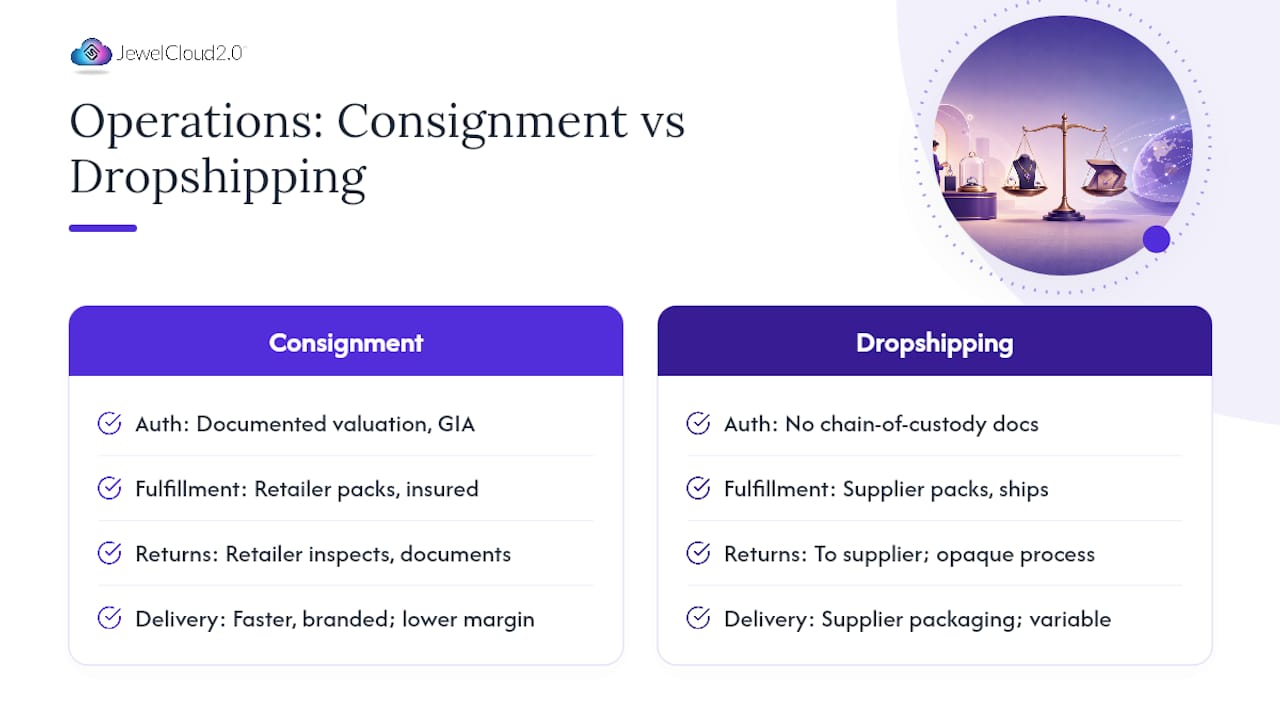
Authentication and appraisal add real time and cost to consignment. Before accepting a piece on memo, you need a documented valuation, ideally backed by a GIA grading report for diamonds and gemstones. That documentation supports your insurance coverage during the memo window and protects you if a dispute arises over a piece’s value. Dropshipping sidesteps this process entirely, which is exactly why it is unsuitable for fine jewelry: without chain-of-custody documentation, you cannot credibly guarantee authenticity to your customer.
Fulfillment control is where consignment earns its margin cost. You pack the piece, choose the carrier, purchase insured shipping, and present your brand through the unboxing experience. For a $3,000 diamond pendant, that control is worth the commission split. With dropshipping, your supplier makes every one of those decisions, and your customer’s first physical impression of your brand is whatever box your supplier chose.
Statistic callout: Consignment provides faster shipping and better control over the customer experience than dropshipping because the retailer physically holds stock, though margins are often thinner due to commission payments.
Returns and repairs expose another gap. When a consigned piece comes back, you inspect it, document its condition, and return it to the supplier or process an exchange from your own stock. With dropshipping, a return means the customer ships back to your supplier, and you are coordinating a process you cannot see. Warranty promises and repair services are nearly impossible to deliver reliably through a dropship model.
Pro Tip: Standardized product data and syndication reduce friction when you carry mixed inventory. Consistent SKU attributes, accurate metal weights, stone grades, and high-resolution images improve customer trust and reduce returns across both consigned and dropshipped items.
What contract terms and fee ranges should you expect?
Whether you are setting up a memo agreement or a dropship arrangement, the contract terms define your exposure. Here are the key clauses and typical ranges to know before you sign.
| Contract Element | Consignment (Memo) | Dropshipping |
|---|---|---|
| Ownership transfer point | At point of sale to end customer | At point of sale to end customer |
| Memo / return window | 30–90 days (standard); longer for high-value pieces | N/A (no stock held by retailer) |
| Theft and damage liability | Typically retailer’s responsibility during memo window | Supplier’s responsibility until shipped; retailer’s after delivery |
| Insurance requirement | Retailer must carry on-premises coverage for consigned stock | Retailer should require supplier to carry transit insurance |
| Authentication clause | Require GIA or equivalent documentation per piece | Require written authenticity guarantee per SKU |
| Reporting cadence | Weekly or monthly sales reports to consignor | Order-by-order confirmation; periodic SKU availability updates |
| Payment settlement timing | After sale, per memo terms (often net 30) | At order placement or net terms with supplier |
| Termination / return terms | Unsold items returned in original condition at memo expiry | Cancel listings; no physical return required |
Commission ranges for fine jewelry consignment commonly fall around the 40–50% retail margin range for the retailer, though this varies by category, piece value, and supplier relationship. Dropship margins depend entirely on your markup over supplier cost and can range from 20% to 60% depending on the category and competition.
Pro Tip: Every memo agreement should include four non-negotiable clauses: a clear statement of who bears theft and damage liability, a specific insurance minimum the retailer must carry, a GIA or equivalent authentication requirement for each piece, and a defined return window with condition standards. If a supplier resists any of these, treat that as a red flag.
How do you choose between consignment and dropshipping?
Work through this checklist before committing to either model.
- What is the average retail price of your pieces? Items above $500 generally warrant consignment. Authentication, insured shipping, and customer experience expectations at that price point are difficult to meet through dropshipping.
- Does your product require authentication or grading documentation? Diamonds, colored gemstones, and antique pieces need GIA or equivalent documentation. If your supplier cannot provide it, consignment with a vetted partner is the safer path.
- How much capital can you commit upfront? Both models avoid large inventory purchases, but consignment requires you to carry insurance and secure storage costs. Dropshipping has lower operational overhead but higher quality risk.
- How important is branding and packaging to your customer? If your brand identity depends on a premium unboxing experience, consignment gives you that control. Dropshipping does not.
- What is your operational capacity? Consignment requires you to receive, photograph, store, and ship physical pieces. If you are a one-person operation without secure storage, dropshipping may be the practical starting point for lower-value items.
- How quickly do you need to test new SKUs? Dropshipping lets you list new items in hours. Consignment requires negotiating memo terms, receiving stock, and documenting each piece before listing.
Questions to ask potential partners before signing:
- What insurance coverage do you carry on pieces in transit, and what is the minimum coverage you require from me during the memo window?
- Can you provide GIA grading reports or equivalent authentication documentation for every piece?
- What is your process for handling returns, damaged items, and disputes?
- How do you handle stockouts or discontinued SKUs, and what is your lead time for restocking?
- What does your settlement process look like, and what reporting do you provide?
Red flags to watch for: missing or vague insurance language, no authentication documentation offered, settlement terms that favor the supplier heavily, and any supplier who cannot provide sample orders for quality review.
What hybrid models and alternatives are available to jewelry sellers?
Most established jewelry retailers do not run a pure consignment or pure dropship operation. They blend models based on category, price point, and supplier relationship.

Partial consignment is the most common hybrid. You carry your highest-value, most authenticated pieces on memo terms while maintaining owned inventory for your core bestsellers. This limits your capital exposure on slow-moving fine pieces while keeping your most profitable SKUs fully in your control.
Managed inventory programs sit between consignment and wholesale. A supplier ships stock to a third-party fulfillment center, which ships on your behalf. You get faster fulfillment than pure dropshipping and more branding control, without holding physical stock yourself. These programs are more common in fashion jewelry than fine jewelry.
Digital product syndication is where platforms like Jewelcloud change the equation. Instead of physically holding consigned stock or relying on a dropship supplier’s feed, you access structured, standardized product data from participating suppliers and display it on your site. When a customer orders, you fulfill from your actual inventory relationship with that supplier, whether that is a memo arrangement, a wholesale purchase, or a managed program. Consistent SKU attributes and accurate product data reduce returns and improve customer trust regardless of which fulfillment model sits underneath.
When to move from dropshipping to consignment: If your dropship category is generating consistent sales and your supplier relationship is stable, moving those SKUs to a memo arrangement gives you better margin control, faster fulfillment, and a stronger brand experience. The trigger is usually when a single supplier accounts for more than 20% of your dropship revenue and you want to protect that relationship with a more formal structure.
Key legal, insurance, and U.S. tax considerations
The legal and tax implications of consignment and dropshipping differ in ways that affect your recordkeeping, insurance costs, and sales tax obligations.
Sales tax and ownership: In most U.S. states, sales tax is collected at the point of sale to the end customer, regardless of whether the piece was consigned or dropshipped. The consignment structure does not eliminate your sales tax obligation as the selling retailer. State rules vary, particularly for marketplace facilitators and multi-state sellers, so confirm your specific obligations with a CPA familiar with jewelry retail.
Insurance during memo windows: When you hold consigned jewelry, you are responsible for pieces you do not own. Your standard business property policy may not automatically cover consigned stock at full value. You need a policy that explicitly covers goods held on consignment, and many suppliers will require a certificate of insurance naming them as an additional interested party before releasing pieces.
Key insurance and documentation requirements:
- Transit insurance: Insured shipping is expected for any fine jewelry piece. USPS Registered Mail and carriers like FedEx and UPS offer declared-value coverage; for high-value pieces, specialized jewelry shippers or Lloyd’s-backed policies are common.
- On-premises coverage: Your policy should cover the full replacement value of all consigned pieces in your store, not just your owned inventory.
- Appraisal records: A current, written appraisal for each high-value piece supports both insurance claims and sales documentation. GIA grading reports are the standard for diamonds and gemstones.
Recordkeeping for dropshipping: Because you never hold the physical product, your documentation burden is lighter. You still need accurate records of each transaction for sales tax reporting, and you should maintain supplier invoices and product authenticity guarantees in case of a customer dispute.
Pro Tip: For every consigned piece, photograph it on receipt against a white background, record the serial number or hallmark, and keep a signed copy of the memo agreement. This three-step documentation practice takes five minutes per piece and protects you in every scenario: theft, damage, dispute, or insurance claim.
How Jewelcloud helps you expand your assortment without inventory risk
Retailers who want the assortment depth of dropshipping with the product accuracy that fine jewelry demands have a practical option in Jewelcloud’s vendor membership and syndication network.

Jewelcloud connects retail jewelers with designers, manufacturers, and diamond dealers through structured, standardized product data feeds. Instead of negotiating individual memo agreements for every new supplier or managing inconsistent dropship feeds, you access a network of vetted vendors whose product data is already formatted for your Shopify, WooCommerce, or Magento storefront. Metal weights, stone grades, dimensions, and high-resolution images are standardized across the catalog, which means fewer returns and more confident shoppers. For suppliers, the platform is a direct channel to qualified retail partners without the overhead of managing individual retailer relationships. Explore the vendor benefits or review the platform overview to see how Jewelcloud fits your current inventory model.
The advice most jewelry sellers get on this topic is incomplete
Most guides frame the consignment versus dropshipping decision as a capital question: which model requires less money upfront? That framing misses the real issue for jewelry sellers.
The more important question is: what does your customer expect when they spend $500, $1,500, or $5,000 on a piece from your store? At those price points, the customer expects authentication documentation, a branded presentation, insured delivery, and someone who can answer questions about the piece’s provenance and quality. Consignment gives you the tools to deliver all of that. Dropshipping, by design, removes most of those tools from your hands.
The conventional advice also underestimates how much authentication and appraisal requirements change the operational math. A GIA grading report is not a nice-to-have for a diamond piece; it is the foundation of your customer’s trust and your insurance coverage. Any model that makes it harder to attach that documentation to a specific piece in your catalog is a liability, not a convenience.
Where dropshipping genuinely earns its place in a jewelry business is as a testing mechanism for new categories, not as a long-term fulfillment strategy for your core assortment. Use it to validate demand for a new style or price point, then move successful SKUs to a memo arrangement or owned inventory once you have the sales data to justify it.
The retailers who get this right treat their inventory model as a customer experience decision first and a capital decision second.
Sources
The following sources were used to build this guide and are worth bookmarking for further research.
- How to Dropship Jewelry and Find Reliable Suppliers | Shopify
- GIA (Gemological Institute of America)
- Consignment Inventory: How It Works (BlueCart blog)
- Consignment inventory for ecommerce: How it works in 2026 | nVEntory
- Uploadify
- Jewelry Dropshipping: Profit margins, suppliers & how to get started | BuckyDrop
- How to Buy Wholesale Jewelry for Resale? (SJ Jewellery blog)
- Jewelry Consignment Guide: How to sell your jewelry safely & get the best price (Osideoac)