


A jewelry pricing strategy is a repeatable system that converts your full landed cost into a retail (and wholesale) price built to fund operations, cover acquisition costs, and hit a target net margin. It’s not a formula you set once and forget. It’s a discipline you revisit every time metal prices move or your customer acquisition cost creeps up.
Here’s where to start today:
- Calculate full COGS: materials by gram, labor by minutes, and a slice of overhead per piece.
- Pick a target operating margin, not just a gross margin, since operating margins in jewelry are often close to zero or only marginally positive even when gross margins look healthy at 40 to 57.5%.
- Set a retail markup that covers customer acquisition cost (CAC), returns, and payment fees, then define triggers for when you’ll reprice.
Key Takeaways
A jewelry pricing strategy works when it prices to operating margin first, uses tiered multipliers by category, and reprices automatically once material costs cross a set threshold.
| Point | Details |
|---|---|
| Price to operating margin | Gross margin alone hides CAC, returns, and overhead; solve for operating margin instead. |
| Use tiered multipliers | Apply 3.5x to 4x for fine gold, 2.2x to 2.5x for stone-set fashion, higher for prestige lines. |
| Set repricing triggers | Reprice when primary material costs shift 10 to 15% from your last price point. |
| Separate wholesale from DTC | Quote wholesale as cost-plus, not a discount off retail, to protect both channels. |
| Disclose metal and stone details | Accurate hallmarking and treatment disclosure protect the premium you charge. |
| Automate with structured data | Jewelcloud’s product data feeds and ROI calculator help sync pricing and test margin scenarios across channels. |
Table of Contents
- What Is Jewelry Pricing Strategy Explained, and Why Does It Matter for Profit?
- How Do You Calculate Jewelry Pricing Step by Step?
- What Are the Most Common Jewelry Pricing Models?
- How Should Wholesale Prices Differ from Retail?
- What Pricing Tricks Actually Protect Your Margin?
- What Worksheets and Tools Help You Price Faster?
- How Do Product Data and ROI Calculators Validate Your Prices?
- What Legal Rules Affect How You Price and Label Jewelry?
- Try a Product-Data Platform to Test Your Pricing Before You Commit
- Where to Learn More About Jewelry Pricing Formulas
- Frequently Asked Questions
- Sources
What Is Jewelry Pricing Strategy Explained, and Why Does It Matter for Profit?
Gross margin lies to you. A ring that costs $200 to make and sells for $500 looks like it’s carrying a 60% gross margin, and on paper it is. But once you subtract packaging, payment processing fees, a returns reserve, and what you spent to get that customer in front of the piece, the operating margin can shrink to nearly nothing, or go negative.
That’s the core failure mode in jewelry pricing: keystone-only markups (doubling your cost) work fine for cheap fashion pieces, but they routinely underfund fine jewelry and custom work where CAC and overhead eat deeper into the margin stack. A margin-first approach that models CAC and net margin up front, rather than backing into it after the sale, is what separates businesses that scale from ones that stay perpetually undercapitalized.
Weak pricing strategy creates specific, avoidable damage:
- Undercapitalized inventory because reordering material never generates enough cash.
- Brand positioning that drifts downward when discounting becomes the default lever.
- CAC spend that quietly outpaces what your margin dollars can support.
How Do You Calculate Jewelry Pricing Step by Step?
Full landed cost has four components, and skipping any one of them is the single most common pricing mistake jewelers make.
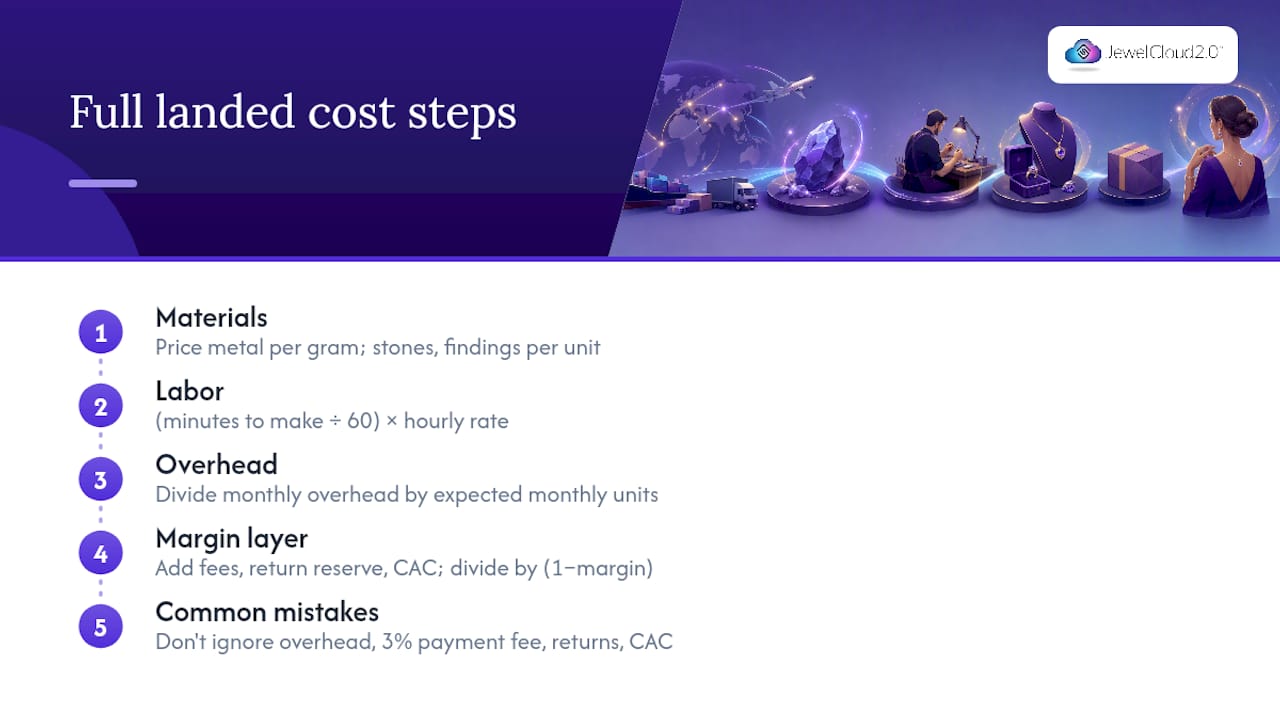
Materials. Price metal by the gram at current market rate, not what you paid six months ago. Price stones per stone, including cutting and setting costs. Findings (clasps, jump rings, posts) get costed per unit even though they feel trivial individually.
Labor. Time each piece and multiply minutes by your hourly rate: (minutes to make ÷ 60) × hourly rate. Include tool amortization if you’re running a wire bender or laser welder that needed real capital.
Overhead. Take your monthly studio rent, software, insurance, and utilities, then divide by expected monthly unit sales. If overhead runs $3,000 a month and you sell 60 pieces, each piece carries $50 of overhead before you’ve touched profit.

The margin layer. Layer in packaging, fulfillment, payment processing fees, a return reserve, and CAC, then divide the total by (1 minus your target net margin) to find your minimum retail price.
Here’s a worked example for a mixed-metal pendant:
Common mistakes that quietly wreck this math: forgetting overhead entirely, ignoring the 3% payment processing fee, skipping a returns reserve, and treating CAC as a marketing-only line item instead of folding it into the price.
What Are the Most Common Jewelry Pricing Models?
Different pieces call for different formulas. Using one multiplier across your whole catalog is how fine jewelry ends up underpriced and fashion pieces end up overpriced for their perceived value.
- Keystone (2× cost): a reasonable floor for low-cost fashion jewelry, but usually too thin for anything metal-heavy or handmade.
- Tiered multipliers: fine gold without stones often needs 3.5× to 4× cost, stone-set fashion sits around 2.2× to 2.5×, and premium branded pieces can command 5× to 10× because absolute dollar margin matters more than the multiple itself.
- Value-based or prestige pricing: price to what a collector or gift-buyer perceives the piece is worth, common with signature or limited-run collections.
- Cost-plus: a straightforward markup over full landed cost, useful when you need a defensible, auditable price for wholesale partners.
- Dynamic or seasonal pricing: adjust prices at the collection or bundle level around holidays, but apply dynamic tactics cautiously since jewelry buyers are highly sensitive to perceived value on hero SKUs.
A custom engagement ring shop leans on value-based pricing. A fashion earring line built for volume leans on keystone. A bridal collection with branded packaging often blends cost-plus with a prestige premium.
How Should Wholesale Prices Differ from Retail?
Wholesale and direct-to-consumer (DTC) pricing need a deliberate gap, or your retail partners undercut your own storefront. Wholesale markups typically run in the 2× to 2.5× range on cost, while DTC retail often lands at 2.5× to 4× or higher depending on category. Applying a flat keystone as your wholesale anchor is risky once metal costs climb, because that thin margin evaporates the moment gold or platinum spikes.
A more durable method: calculate wholesale as cost plus overhead plus your minimum acceptable margin, rather than working backward from a percentage of retail. That cost-plus wholesale floor protects you when material costs move, where a percent-of-retail formula does not.
Negotiation tactics that hold up in practice:
- Reserve your highest-metal-content pieces for DTC, where you control the full margin.
- Quote wholesale partners a cost-plus number, not a discount off your retail price.
- Ask what the partner plans to retail the piece at, so you know the eventual shelf price isn’t undercutting your own site.
For a piece with a landed cost near $427, a cost-plus wholesale quote at a little over double cost provides a price that supports a retailer markup to final retail without collapsing margins.
What Pricing Tricks Actually Protect Your Margin?
Small display and quoting decisions add up fast. A few rules worth following:
- Rounding: premium pieces read as more credible priced at clean numbers like $650 or the nearest $5, not $649.99. Handcrafted work loses trust with .99 endings that feel mass-produced.
- Promotions: run limited-time bundles instead of blanket percentage-off sales, and set a hard sale floor you never cross, since material volatility already puts pressure on your price floor without discounting making it worse.
- Custom work quotes: itemize the deposit, any revision fees, and the final balance in a written quote template so nothing gets negotiated away informally.
Pro Tip: Free shipping and no-questions returns feel generous, but they’re a hidden discount. Build both into your cost stack before you set the price, not as an afterthought once a customer asks.
What Worksheets and Tools Help You Price Faster?
A pricing worksheet needs specific inputs to be useful: material cost by gram, labor minutes, overhead allocation per unit, payment processing fees, and CAC. The outputs should spit out retail price, wholesale price, and margin percentage automatically once you plug in the numbers.
Your options range from a simple spreadsheet template to dedicated jewelry pricing calculators to POS systems that sync live metal spot prices. For metal-heavy SKUs, automating replacement-cost pricing saves you from manually rechecking gold prices every week. Set repricing to trigger only when material costs move past a set threshold rather than on every minor fluctuation.
How Do Product Data and ROI Calculators Validate Your Prices?
Run the numbers before you commit to a price change, not after. Take a $500 average order value piece with a $120 CAC: a pricing strategy that models LTV to CAC on margin dollars, not revenue, tells you whether that markup can sustain paid acquisition. A 3:1 ratio on margin dollars is a reasonable target; anything thinner means your ad spend is quietly subsidized by your own capital.
Structured, standardized product data lets you sync live material costs across every channel at once, so a repricing decision made in one place doesn’t require manually updating five different listings.
JewelCloud’s product data infrastructure supports exactly this kind of scenario testing:
- Standardized catalog data that stays consistent across wholesale and retail channels.
- Faster repricing when metal spot prices cross your trigger threshold.
- An ROI calculator framework for testing CAC and margin assumptions before a price goes live.
What Legal Rules Affect How You Price and Label Jewelry?
Pricing decisions can’t be separated from disclosure obligations, and getting this wrong creates liability that no margin calculation can offset. If you sell gold, silver, or platinum pieces, you’re required to accurately state metal purity, commonly through hallmarking or a stamped karat/fineness mark, and that mark has to match what’s actually in the piece.
Gemstone disclosure matters just as much. Lab-grown diamonds and stones, treated stones (heated, irradiated, or clarity-enhanced), and simulants all need to be disclosed clearly at the point of sale, not buried in fine print. Pricing a lab-grown diamond piece at natural-diamond rates without disclosure isn’t just an ethical problem, it’s a labeling violation in most jurisdictions.
This intersects with pricing strategy in a direct way: transparent disclosure protects the premium you charge for natural stones and higher-karat metals, because customers who trust your labeling are more willing to pay for verified quality. Vague labeling erodes that trust and makes every price you set look negotiable, even the fair ones.
Keep documentation on metal content, stone treatment, and origin for every SKU you price. It’s not just compliance. It’s the paperwork that lets you justify a premium price when a customer asks why.
A Practitioner’s Note on Margin Discipline
Pricing to operating margin, not gross margin, is what actually solved recurring cashflow gaps in businesses that tried it. The lesson that sticks: track replacement cost on metals weekly, and reprice your top sellers the moment costs cross your trigger, not at the next quarterly review.
Try a Product-Data Platform to Test Your Pricing Before You Commit
Spreadsheets and standalone calculators get the job done for a small catalog. But once you’re managing pricing across wholesale partners, your own site, and multiple metal-heavy SKUs, keeping everything synced by hand becomes the bottleneck. Jewelcloud gives suppliers and retailers structured, standardized product data feeds that sync material costs and pricing across every channel at once, so a repricing decision made in one place doesn’t require touching five separate listings.

That matters most when gold or diamond prices shift and you need every SKU updated before margin erosion sets in. Combined with an ROI calculator built for jewelry businesses, you can model CAC and margin scenarios before a new price goes live, rather than discovering the math was wrong after a sales quarter. If you’re a vendor or designer weighing whether structured catalog data would simplify your pricing workflow, check out JewelCloud’s vendor benefits to see what a synced price feed looks like in practice.
Where to Learn More About Jewelry Pricing Formulas
For deeper formulas and benchmarks, Craftybase’s pricing formula guide walks through labor and materials math with worksheets. Branvas covers profit margin benchmarks with a layered cost-stack calculator. For metal volatility context, Plumbclub’s analysis of price swings explains why repricing triggers matter, and Diamonds by Daisy breaks down handcrafted cost drivers worth reading before you price labor-intensive pieces.
Frequently Asked Questions
What is jewelry pricing strategy explained in the simplest terms?
It’s a repeatable method for turning your full cost (materials, labor, overhead) into a price that funds your business’s operating expenses and target profit, rather than a guess based on what competitors charge.
What’s the best pricing method for jewelry?
There isn’t one universal method. Fine jewelry generally needs tiered multipliers by category, custom work needs value-based pricing, and high-volume fashion pieces often work fine with keystone or cost-plus formulas.
How often should I reprice my jewelry?
Review pricing quarterly at minimum, and reprice immediately when a primary material’s cost moves 10 to 15% from where you last set your price.
Do I need to disclose lab-grown diamonds separately from natural stones?
Yes. Lab-grown diamonds, treated stones, and simulants all require clear disclosure at the point of sale, separate from how you’d label a natural, untreated stone.
How is wholesale pricing different from retail pricing?
Wholesale price should be calculated as cost plus overhead plus your minimum margin, not as a discount off your retail price, so metal cost spikes don’t erase your margin on either side.
This article is general information, not a substitute for advice from a qualified financial advisor. Consult a qualified financial professional about your own circumstances before acting on anything here.
Sources
- Jewelry Brand Pricing Strategy — Eightx
- The Jewelry Pricing Formula Every Maker Needs to Know — Craftybase