


Consistent, structured product data plus synchronized inventory is the operational backbone that prevents revenue loss, delistings, and retailer friction. Start by creating a canonical attribute list covering every required diamond field (SKU, GIA/IGI certificate ID, carat, cut, color, clarity). Then map your supplier feeds into that canonical model, and enforce a 60-second inventory sync SLA for status changes. Platforms like Jewelcloud and its DiamondLink® distribution network give you a structured path to push those normalized feeds directly to retail partners and marketplaces.
Key Takeaways
Consistent, structured product data and synchronized inventory are the foundation that protects revenue, prevents delistings, and builds lasting retailer trust for diamond wholesalers.
| Point | Details |
|---|---|
| Error rates from manual workflows | Fragmented spreadsheet workflows commonly exceed 30% manual-entry error rates; a PIM cuts that and saves ~12 minutes per SKU. |
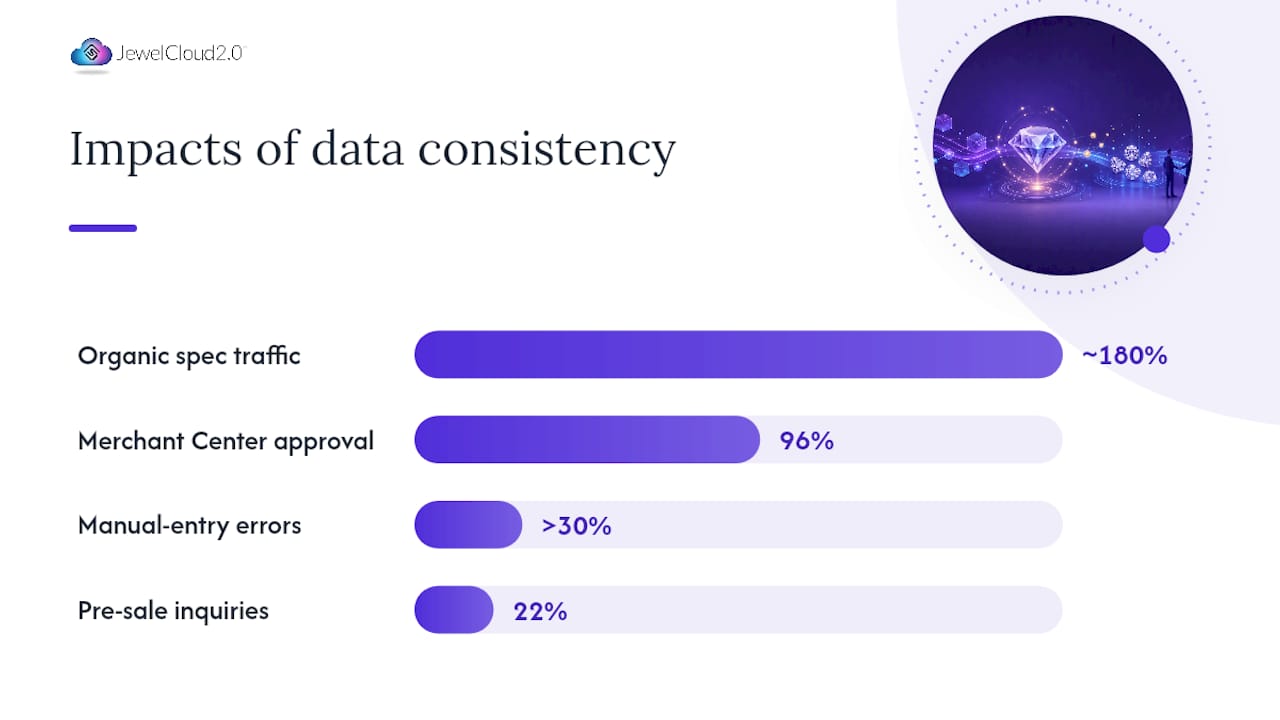
| Merchant Center approval impact | A normalization remediation moved one retailer’s approval rate from 71% to 96% and lifted organic spec traffic ~180%. |
| Inventory sync SLA | Status changes must fire within 60 seconds; memo-return events are the most common failure point to test first. |
| Top KPI to monitor | Track listing error rate (target under 2%) and double-sell incidents (target zero) from the first day of your pilot. |
| Jewelcloud and DiamondLink® | Jewelcloud provides the canonical attribute store, normalization layer, and DiamondLink® distribution to push clean feeds to retail partners. |
Table of Contents
- Why product data consistency matters for diamond wholesalers
- What a consistent diamond listing actually looks like
- Where inconsistency actually comes from
- How to implement product-data consistency step by step
- Which tools and integration patterns keep your data consistent
- KPIs and a simple ROI model to justify the investment
- Your immediate checklist and a CSV template to start today
- What a real supplier turnaround looks like
- Why U.S. wholesalers can’t afford to wait on this
- Jewelcloud gives you the infrastructure to get there faster
- Sources
Why product data consistency matters for diamond wholesalers
The business case for product reliability in the diamond trade comes down to three compounding risks: oversells, delistings, and broken retailer trust. When a stone shows as available in your feed but is already out on memo, you either cancel the order or scramble to substitute. Either outcome costs you the relationship.
The upside is equally concrete:
- Fewer order errors. Centralizing diamond data in a PIM reduces manual-entry error rates that commonly exceed 30% in fragmented spreadsheet workflows, and saves roughly 12 minutes of listing time per SKU.
- Higher Merchant Center approval. A normalization remediation that built a custom canonical table moved one retailer’s Merchant Center approval from 71% to 96% and increased organic specification traffic by roughly 180%.
- Stronger retailer conversion. Integrating live GIA/IGI certificate links into product pages is associated with a reported 22% reduction in pre-sale customer inquiries, which means fewer friction points between the shopper and the buy button.
- Faster time-to-market. Normalized feeds let you push new inventory to multiple retail storefronts simultaneously rather than re-entering data channel by channel.
On the risk side, inconsistent listings generate chargebacks, trigger marketplace delistings, and force manual reconciliation that pulls your ops team away from higher-value work.
Pro Tip: Before investing in new tooling, pull a 30-item sample of your live listings and check each one for missing attributes, mismatched certificate IDs, and stale inventory status. That audit will tell you exactly where your biggest exposure sits.
What a consistent diamond listing actually looks like
“Product consistency” in this context means structured product data — every SKU carrying the same fields, in the same format, every time. Here are the canonical fields every diamond listing should publish:
| Field | Description | Example value |
|---|---|---|
| SKU | Unique internal identifier | DIA-RD-1.02-VS1-G |
| Certificate number | GIA or IGI report number | GIA certificate ID |
| Carat | DECIMAL(5,2) precision | 1.02 |
| Cut grade | Canonicalized vocabulary | Excellent |
| Color grade | GIA D-to-Z scale | G |
| Clarity grade | Canonicalized vocabulary | VS1 |
| Measurements | L × W × D in mm | carat dimensions |
| Fluorescence | Standardized label | None |
| Polish / Symmetry | Standardized grades | Excellent / Very Good |
| Price | USD, two decimal places | price |
| Inventory status | Live boolean or enum | Available |
| Vendor code | Supplier reference | supplier code |
| Certificate URL | Live API link to lab report | https://www.gia.edu/report-check?reportno=… |
| Last modified | ISO timestamp format | timestamp |
| Image set | Min. 3 angles, high-resolution images, named by SKU | DIA-RD-1.02-VS1-G_01.jpg |
Store carat as DECIMAL(5,2) and canonicalize cut, color, and clarity to a single controlled vocabulary. Certificate URLs should point to live lab API endpoints where possible. A canonical attribute dictionary prevents supplier vocabulary fragmentation, duplicate filter paths, and unstable structured data that harms both search and faceted navigation.
Where inconsistency actually comes from
Most data quality problems in wholesale diamond feeds trace back to a handful of root causes:
- Supplier vocabulary fragmentation. One supplier writes “EX,” another writes “Excellent,” a third writes “Ideal.” All three mean the same cut grade, but your system treats them as three distinct values.
- Inconsistent decimal precision. A carat weight of “1.0” versus “1.00” versus “1.02” creates duplicate listings and filter mismatches.
- Missing attributes. Fluorescence, polish, and symmetry fields are frequently omitted from supplier feeds, leaving gaps that block marketplace approval.
- Delayed inventory updates. Stones moving between memos, branches, and workflows faster than records update is the most common source of double-sell risk. A stone on memo in New York can still show as available in your Chicago feed.
- Disparate data sources. Spreadsheets, WhatsApp messages, and emailed CSVs each carry their own formatting assumptions. Merging them manually introduces errors at every step.
- Feed-mapping errors. When a supplier’s “Color” column maps to your “Clarity” field, every downstream listing is wrong until someone catches it manually.
The data flow that prevents these problems looks like this: Supplier feed → Staging (raw, audited) → Normalization rules → Canonical attribute store → Marketplace feeds / retailer APIs → Storefront.
Pro Tip: Keep a staging audit log that preserves raw supplier values before normalization. When a mapping error surfaces downstream, you can trace it back to the source record without guessing.
How to implement product-data consistency step by step
A phased rollout keeps risk low and gives you measurable checkpoints.
- Discovery (weeks 1–2). Audit your current feeds. Measure error rate, missing-field rate, and inventory sync latency across your top 5 suppliers. Assign an ops lead.
- Canonical dictionary (weeks 2–3). Define controlled vocabularies for cut, color, clarity, fluorescence, polish, and symmetry. Document acceptable input variants and their canonical mappings.
- Staging and mapping (weeks 3–6). Build a staging layer that accepts raw supplier feeds, validates each record against your dictionary, and flags rejections before writing to the canonical store.
- PIM/IMS integration and testing (weeks 4–8). Connect your PIM (canonical product master) to your IMS or ERP. Set inventory status webhooks to fire promptly after a status change. Price updates should sync within 15 minutes during volatile periods. Run a daily full-feed reconciliation.
- Pilot (weeks 8–12). Select 100 SKUs that include one-of-a-kind stones, frequently memod items, and high-volume repeatable SKUs. Run legacy and normalized flows in parallel. Measure time-to-list, error rate, and Merchant Center approval before switching the full catalog.
- Full rollout and monitoring (week 12+). Migrate remaining SKUs. Set alert thresholds on your KPI dashboard and assign a weekly data-quality review.
Pro Tip: Your pilot SKU set should include at least one stone with certificate variations and one multi-piece lot. Edge cases that break your normalization rules are far cheaper to fix at 100 SKUs than at 10,000.
Which tools and integration patterns keep your data consistent
The manufacturer-to-retailer pipeline runs cleanest when each tool has a single, well-defined role:
- PIM (Product Information Manager): holds the canonical attribute store and drives all downstream outputs.
- IMS/ERP: manages inventory counts, memo status, cost, and location. ERP e-commerce integration syncs inventory across channels in real time and prevents overselling by deducting sold items automatically.
- Feed middleware: accepts raw supplier feeds, applies normalization rules, and writes clean records to the PIM.
- Marketplace connectors / API syncs: push canonical data to Google Merchant Center, retail storefronts, and B2B portals on the SLA schedule.
- Certificate API integrations: GIA and IGI both offer report-check APIs; link directly rather than storing static PDFs.
The integration pattern in plain terms: PIM → normalization rules → IMS/ERP → marketplace feeds/API → retailer storefront.
Jewelcloud’s DiamondLink® platform fits into this architecture as the distribution and connectivity layer. Suppliers load structured feeds into Jewelcloud, and DiamondLink® pushes those normalized listings to connected retail partners and marketplaces, removing the need to build and maintain individual channel integrations.
KPIs and a simple ROI model to justify the investment
Track these metrics from day one of your pilot:
- Listing error rate (target: under 2% of active SKUs with a critical field error)
- Double-sell incidents per month (target: zero)
- Merchant Center approval rate (target: 95%+)
- Time-to-list per SKU (baseline vs. post-PIM)
- Order correction cost per incident (labor + chargeback fees)
- Percentage of listings with live certificate links
- Inventory sync latency (target: under 60 seconds for status changes)
A simple ROI formula: (revenue protected from avoided oversells + labor saved from automation + conversion uplift from trusted listings) − implementation cost = annualized ROI.
Stat to anchor your business case: Integrating live lab certification links is associated with a reported 22% reduction in pre-sale customer inquiries, and a normalization remediation can move Merchant Center approval from 71% to 96% while lifting organic specification traffic by roughly 180%.
Your immediate checklist and a CSV template to start today
Run through this before your next supplier feed update:
- [ ] Pull a 30-item live-listing audit and score each SKU for missing fields and stale inventory status
- [ ] Create a canonical attribute dictionary covering cut, color, clarity, fluorescence, polish, and symmetry
- [ ] Map your 5 highest-volume supplier feeds into the canonical model
- [ ] Set normalization rules for every known vocabulary variant (e.g., “EX” → “Excellent”)
- [ ] Add certificate URL fields and link to live GIA/IGI API endpoints
- [ ] Enable inventory status webhooks with a 60-second SLA
- [ ] Run a 100-SKU pilot to one marketplace and measure error rate and approval rate
Minimal CSV header row (paste into your PIM or spreadsheet to start):
Refer to the diamond supplier software guidance for field-by-field normalization notes your technical team can use during mapping.
What a real supplier turnaround looks like
A mid-size U.S. wholesaler’s feeds came from four suppliers using different cut-grade vocabularies, two of which sent inventory updates by email rather than API.
Actions taken (over 10 weeks):
- Built a canonical attribute dictionary covering all four supplier vocabularies
- Implemented a staging layer with automated validation before writes to the PIM
- Integrated IMS webhooks with a 60-second status-change SLA
- Ran a 100-SKU pilot to their highest-volume retail partner before full rollout
Before/after results:
- Listing error rate: 18% → under 2%
- Merchant Center approval: 74% → 93%
- Time-to-list per SKU: 14 minutes → under 3 minutes
- Order correction incidents: 6% of orders → under 0.5%
The first thing that broke during the pilot was the memo-status sync. Stones returning from memo were updating the IMS correctly but the webhook wasn’t firing to the PIM. Fixing that single integration point eliminated most of the remaining double-sell risk. The lesson: test your inventory event stream with memo returns specifically, not just new-availability events.
Why U.S. wholesalers can’t afford to wait on this
The U.S. retail and marketplace environment has raised the bar for product-data quality faster than most wholesale operations have adapted. Google Merchant Center’s disapproval rates for incomplete or inconsistent diamond feeds are a direct revenue problem, not a technical nuisance. Retail buyers now expect live certification links as a baseline, not a differentiator. And marketplace enforcement on data completeness is tightening.
The single most useful thing you can do this week is run a 30-item live-listing audit and rank your gaps by business impact. That audit takes a few hours and gives you a prioritized fix list that justifies every dollar of implementation spend that follows.
Jewelcloud gives you the infrastructure to get there faster
Fixing product-data consistency from scratch is a multi-week project. Jewelcloud shortens that timeline by giving diamond wholesalers a pre-built infrastructure: a structured canonical attribute store, automated feed mapping, a normalization layer built for diamond complexity, and DiamondLink® to push clean listings directly to connected retail partners.
The platform handles the PIM-to-marketplace pipeline so your team focuses on sourcing and relationships, not spreadsheet reconciliation. Key capabilities that map directly to the implementation steps above:
- Canonical attribute store with diamond-specific field support
- Automated normalization and feed mapping for supplier vocabularies
- Inventory sync with SLA-grade latency for status changes
- DiamondLink® distribution to retail partners and marketplaces
- Dedicated support for certificate API integration (GIA/IGI)
See exactly how it fits your operation on the diamond vendor benefits page, or reach out to schedule a pilot with your own SKU set.
Sources
- Diamond and Gemstone Management: The Professional Guide to Digital Inventory & Sales
- The Data Problem Nobody Warned You About: How Feed Normalisation Failures Are Quietly Destroying Your Diamond Store’s Schema, Rankings, and Agentic Visibility -
- The Diamond Data Normalisation Problem: Reconciling Feed Schema for Google’s Knowledge Graph -
- Diamond Inventory Accuracy and Mismatches | Sarvadhi Solutions