


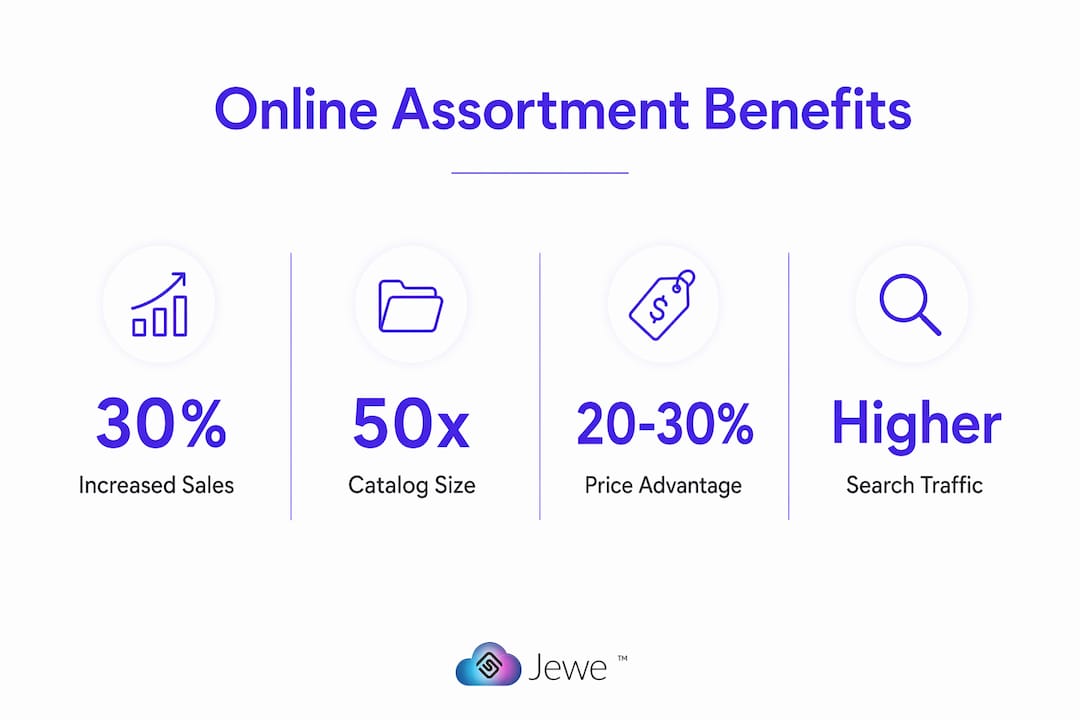
Expanding your online jewelry assortment is the single most effective way to grow sales without adding physical retail space. Online jewelry retailers offer 20–50 times the selection of physical boutiques, with prices running 20–30% lower due to reduced overhead. That gap in selection and price is exactly why over 60% of American jewelry shoppers now prefer buying online, motivated by price comparisons, ethical sourcing transparency, and AR try-ons. For retailers and e-commerce managers, the question is no longer whether to expand the online catalog. The question is how to do it without overextending your budget or losing control of your product data. Jewelcloud exists precisely to solve that problem.
Why expand jewelry online assortment: the core business case
A broader online assortment does more than fill pages on your website. It signals to shoppers that your store is a serious destination, not a limited showcase. Larger assortments make fine jewelry feel more accessible and reduce the “all or nothing” pressure that pushes hesitant buyers away. When a shopper can choose from multiple price points, metal types, and stone options, they are far more likely to find something that fits their budget and taste.

The industry term for this practice is assortment planning, and it covers everything from category breadth to price point distribution. Retailers who treat their online catalog as a living thing, one that grows and adapts with demand, consistently outperform those who treat it as a static list of in-stock items. The benefits of online jewelry sales compound over time as your catalog builds search visibility, repeat traffic, and customer trust.
How does online assortment expansion affect pricing and inventory costs?
Carrying a wide selection online does not require buying all of it upfront. Virtual and drop-ship inventory models let you display a broad range of products without freezing capital in physical stock. Virtual inventory allows showing a broader range without purchasing all stock upfront, which means you can test demand before committing to a full buy.
The cost advantages of a larger online assortment include:
- Lower overhead per SKU. No display case, no security tag, no floor space required for products that live in a vendor’s warehouse.
- Better price point coverage. Stocking entry-level, mid-range, and premium pieces online reduces the risk that a shopper leaves because nothing fits their budget.
- Reduced buyer pressure. When your catalog covers multiple price tiers, no single purchase decision feels make-or-break for the customer.
- Inventory flexibility. Virtual inventory lets you rotate seasonal and trend-driven pieces without the risk of overstock.
Pro Tip: Before adding new categories, audit your current catalog for price point gaps. If your online store jumps from $200 pieces to $2,000 pieces with nothing in between, you are losing the mid-market shopper every single day.
The 20–30% price advantage that online retailers hold over physical stores comes directly from eliminating retail overhead. Passing even part of that savings to your shoppers builds loyalty and repeat purchases.
What merchandising frameworks work best for a growing jewelry catalog?
Disciplined assortment architecture prevents the most common failure in catalog expansion: adding too many products with no clear purpose. The 70/20/10 merchandising framework gives every product in your catalog a defined role.
- 70% core pieces. These are your timeless, evergreen products. Classic solitaire rings, tennis bracelets, and yellow gold hoops belong here. They drive consistent traffic and steady revenue year-round.
- 20% seasonal refreshes. Holiday collections, Valentine’s Day sets, and graduation gifts belong in this tier. They create urgency and give returning shoppers a reason to come back.
- 10% experimental styles. Lab-grown colored stones, mixed-metal designs, and trend-forward pieces belong here. They attract new audiences and signal that your brand is current.
Each product should also carry a performance role beyond its category. Some pieces are traffic drivers, meaning they rank well in search and pull shoppers into your store. Others are margin builders, meaning they convert at high value. A third group serves as gifting staples, meaning they are easy to buy as presents and drive repeat purchases around key dates.
Product data consistency is the hidden foundation of this entire framework. Standardized naming conventions, accurate metal weights, and consistent stone descriptions allow faceted filters to work correctly. When filters work, shoppers find what they want faster, and conversion rates rise.
Pro Tip: Assign every new product a role before it goes live. If you cannot answer “Is this a traffic driver, a margin builder, or a gifting staple?” the product is not ready to publish.
Avoiding buyer paralysis matters just as much as adding variety. A catalog with 500 poorly organized products converts worse than one with 150 well-structured ones. Clear category segmentation, consistent naming, and logical price laddering are what separate a high-performing catalog from a confusing one.
How do technology and content infrastructure support a larger assortment?
Retailers lose market share mostly due to lacking content infrastructure, not product quality. A product with poor images and missing specifications will not sell, regardless of how beautiful it is in person. Systematic visual content is what closes the gap between a large catalog and a high-converting one.
The content requirements for an expanded assortment include:
- Consistent, professional imagery for every SKU. A repeatable imaging workflow, where every product gets the same background, lighting, and angle set, makes your catalog look authoritative at scale.
- 360-degree views and AR try-ons. 60% of buyers hesitate to purchase without contextual images. AR try-ons directly address this hesitation for rings, earrings, and necklaces.
- Structured product data for filtering. Metal type, stone shape, carat weight, and ring size must be tagged consistently so that faceted search works correctly.
- Social media content cadence. New products need promotion. A regular posting schedule tied to your catalog additions keeps your audience engaged and drives traffic to new listings.
| Content type | Primary benefit | Impact on conversion |
|---|---|---|
| Professional product photography | Builds trust and brand consistency | High |
| 360-degree product views | Reduces return rates and hesitation | High |
| AR try-on tools | Addresses fit and scale concerns | Medium to high |
| Structured product data | Powers search filters and comparison | High |
| Social media posts | Drives discovery for new SKUs | Medium |
Retailers who systematize their visual content output close market share gaps faster than those who handle imagery on a case-by-case basis. The goal is a repeatable process, not a one-time photo shoot.
Practical steps to expand your online jewelry assortment safely
Expanding your product range without overextending resources requires a data-first approach. Start with what your sales data already tells you, then use vendor platforms to fill the gaps.
- Use wholesaler feeds and vendor memberships. Platforms like Jewelcloud give you access to structured product data from designers, manufacturers, and diamond dealers without requiring you to purchase inventory upfront. You can access vendor product feeds and display products directly from participating suppliers.
- Analyze sales and social data before buying. Your best-selling categories, your most-saved Instagram posts, and your highest-traffic product pages all point to where demand already exists. Expand there first.
- Test demand before stocking. List a product using virtual inventory before committing to a physical buy. If it sells, stock it. If it does not, remove it with no financial loss.
- Standardize your product data from day one. Every new SKU needs consistent naming, accurate dimensions, and complete attribute tagging before it goes live. Fixing data problems after the fact costs far more time than getting it right upfront.
- Plan replenishment cycles. Core pieces need reliable restocking schedules. Seasonal pieces need clear end dates so they do not clutter your catalog after the season ends.
Retailers who build their assortment on reliable vendor data avoid the two most common expansion mistakes: buying too much of the wrong thing, and publishing products with incomplete information that confuse shoppers and hurt search rankings.
Key Takeaways
Expanding your online jewelry assortment drives sales growth when it is built on disciplined merchandising, consistent product data, and a virtual inventory model that limits capital risk.
| Point | Details |
|---|---|
| Selection advantage | Online catalogs can be 20–50 times larger than physical stores, giving retailers a clear competitive edge. |
| Virtual inventory model | Drop-ship and vendor feed models let you expand your range without purchasing all stock upfront. |
| 70/20/10 framework | Structure your catalog as 70% core, 20% seasonal, and 10% experimental to balance stability and growth. |
| Content infrastructure | Consistent imagery and structured product data are the difference between a catalog that converts and one that does not. |
| Data-driven expansion | Use sales data and social signals to prioritize which categories to grow before committing to new inventory. |
The part most retailers get wrong about assortment growth
I have worked with enough jewelry retailers to know that the catalog expansion conversation almost always starts in the wrong place. Most retailers ask, “What should I add?” The better question is, “What do my shoppers already want that I am not showing them?”
The data is rarely ambiguous. Your top-selling categories, your highest-engagement social posts, and your most-searched terms on your own site all point to the same answer. The problem is that most retailers do not look at that data before they buy. They buy based on what they saw at a trade show or what a sales rep pitched them. That is how you end up with overstock and a catalog full of products that never convert.
The second mistake I see constantly is treating product data as an afterthought. A retailer will spend months sourcing beautiful pieces, then publish them with inconsistent naming, missing weights, and no attribute tags. The result is a catalog that looks great in a spreadsheet and performs terribly online. Shoppers cannot filter for what they want, search engines cannot index the products correctly, and conversion suffers. Fixing bad data after the fact is one of the most expensive things you can do in e-commerce.
The retailers who get assortment expansion right treat their catalog like a high-converting product display. They systematize their imaging, standardize their data, and review performance monthly. They add products with a purpose and remove ones that are not pulling their weight. That discipline is what separates a catalog that grows revenue from one that just grows in size.
— Anthony
How Jewelcloud helps retailers expand their online assortment
Jewelcloud is built specifically for jewelry retailers who want to grow their online catalog without the burden of managing physical inventory for every product they sell.
Through Jewelcloud, retailers connect directly to designers, manufacturers, and diamond dealers who have loaded their merchandise at wholesale. The product data is structured, standardized, and ready to publish, which means you skip the data-cleaning step that slows most catalog expansions down. Retailers can explore the full platform to see how vendor feeds, product data management, and digital showcasing work together. For retailers ready to grow their selection, Jewelcloud’s jewelry vendor membership provides access to a broad, curated inventory that is ready to sell from day one.
FAQ
Why should jewelry retailers expand their online assortment?
A larger online assortment attracts more shoppers, covers more price points, and builds search visibility over time. Online catalogs can be 20–50 times larger than physical stores, giving retailers a significant competitive advantage.
What is the 70/20/10 rule in jewelry merchandising?
The 70/20/10 framework structures a catalog as 70% core evergreen pieces, 20% seasonal products, and 10% experimental styles. This balance keeps revenue stable while creating reasons for shoppers to return.
How can I expand my jewelry product range without overspending?
Virtual inventory and vendor feed platforms let you display a broad range of products without purchasing all stock upfront. Test demand first, then commit to physical inventory for proven sellers.
Does product data quality really affect online jewelry sales?
Poor product data directly reduces conversion because shoppers cannot filter or compare products effectively. Standardized naming, accurate weights, and complete attribute tags are required for search and faceted filters to work correctly.
How does Jewelcloud support online assortment expansion?
Jewelcloud connects retailers to a network of designers, manufacturers, and diamond dealers with structured, standardized product data ready to publish. Retailers can access broad inventory without managing physical stock for every SKU they list.