


Yes, manufacturers need digital distribution, and the businesses that delay it are already bleeding revenue they cannot see on a P&L statement. Digital commerce now accounts for nearly 20% of total manufacturing and distribution sales, which means one in five transactions in this space now runs through a screen instead of a phone call or a rep visit. Meanwhile, roughly 40% of manufacturing orders still get captured through email or spreadsheet, a gap that shows exactly where the friction, and the lost margin, is hiding.
You don’t need a five-year transformation plan to start closing that gap. You need two things in the next 30 to 90 days: a content-to-channel health check that shows you which SKUs look broken, incomplete, or inconsistent on your top three distributor sites, and one pilot, a single high-volume SKU paired with one technically capable distributor, to prove the model works before you scale it.
- Run a content-to-channel audit across your top distributor storefronts this month; you’ll likely find pricing, imagery, or spec mismatches you didn’t know existed.
- Choose one pilot SKU and one distributor partner willing to test a structured data feed within 90 days.
- Benchmark against what the National Association of Wholesaler-Distributors and McKinsey are telling manufacturers in your position right now.
Pro Tip: Before you touch a single line of code, pull three of your best-selling SKUs from your top five distributor sites and screenshot how they actually look to a buyer. That fifteen-minute exercise usually does more to build internal urgency than any slide deck.
Key Takeaways
Manufacturers who delay digital distribution lose measurable revenue to inconsistent product data, manual order friction, and fragmented distributor experiences that consumer-grade buyer expectations no longer tolerate.
| Point | Details |
|---|---|
| Digital is already 20% of sales | Nearly a fifth of manufacturing and distribution revenue now flows through digital channels, and that share keeps growing. |
| Manual processes cost you time | Up to 80% of syndication bandwidth can go to manual reformatting instead of selling activity. |
| Start with one pilot | Pick one SKU and one distributor partner to prove the model before rolling out network-wide. |
| Protect distributor relationships | Territory rules, deal registration, and tiered launches prevent channel conflict during rollout. |
| Jewelry needs structured data | Jewelcloud gives jewelry suppliers standardized feeds and inventory sync built for stone grading, certificates, and variant complexity that generic platforms don’t handle. |
Table of Contents
- Why Manufacturers Need Digital Distribution Right Now
- What Are the Measurable Benefits of Digital Distribution?
- How Have Manufacturers Succeeded With Digital Distribution?
- How Do Unified Platforms Fix Fragmented Distribution Channels?
- How Do You Avoid Channel Conflict When Going Digital?
- What Does a Digital Distribution Rollout Timeline Look Like?
- Which Technologies Should Manufacturers Prioritize First?
- What Do Digital Distribution Projects Typically Cost?
- How Does This Work for Jewelry Manufacturers and Wholesalers?
- When Should Manufacturers Move Fast Versus Slow on Digital Distribution?
- How Jewelcloud Supports Digital Distribution for Jewelry Suppliers
- Frequently Asked Questions
- Sources
Why Manufacturers Need Digital Distribution Right Now
The honest answer is that buyer expectations moved faster than most manufacturers’ back offices did. B2B purchasers, many of whom are the same people buying sneakers and appliances on their phones after work, now expect the same convenience when they’re sourcing bearings, hydraulic hose, or forklifts. They want accurate specs, real inventory counts, and a checkout flow that doesn’t require a fax machine. When manufacturers rely on distributors alone to deliver that experience, and those distributors have wildly uneven digital maturity, the result is a fragmented buyer journey that costs sales nobody notices leaving.
The pandemic didn’t create this pressure, but it exposed it violently. Supply-chain shocks in 2020 forced a reckoning around visibility and resilience that Harvard Business Review called a wake-up call for the entire discipline, and manufacturers who couldn’t show real-time inventory or reroute orders lost customers to competitors who could. That pressure never fully eased. It just became the baseline expectation.
There’s also a brand-protection problem hiding inside the distribution problem. Distributors remain essential go-to-market partners, and no serious digital strategy tries to cut them out, but manufacturers still have to coordinate the digital experience across every place their products show up. When one distributor’s product page shows a discontinued finish, wrong dimensions, or a price that undercuts your MAP policy, that’s not a distributor problem anymore. That’s your brand, your pricing integrity, and your customer’s trust taking the hit.
- Digital commerce sits near 20% of total manufacturing sales, and that share is still climbing.
- Roughly 40% of orders arrive via email or spreadsheet, creating error-prone manual capture at exactly the volume that should be automated.
- Distributor digital sophistication varies enormously, which means your product can look premium on one site and amateurish on the next.
What Are the Measurable Benefits of Digital Distribution?
Talking about “digital transformation” in the abstract doesn’t win budget approval. Specific, trackable metrics do. Manufacturers evaluating digital distribution should build their business case around five value categories: revenue capture, time-to-market, conversion lift, return reduction, and reduced manual labor.
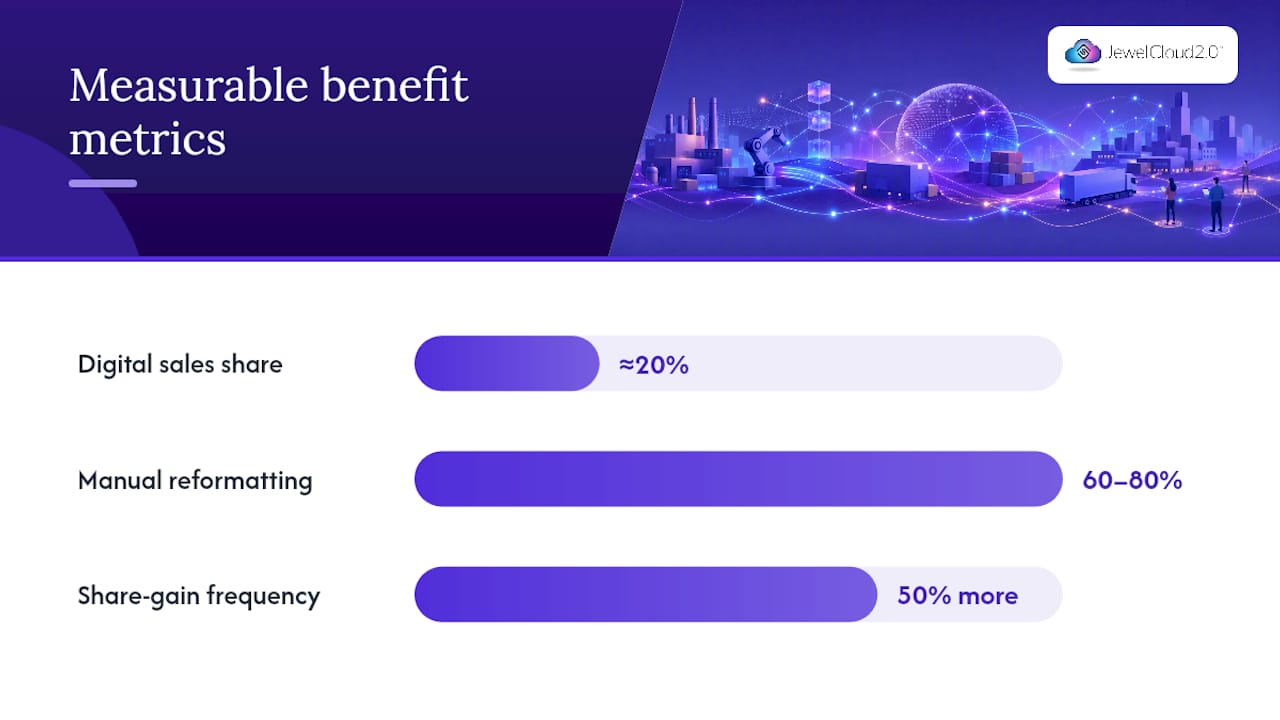
Revenue capture is the most direct one. If digital commerce represents nearly 20% of sector sales, track what percentage of your own revenue currently flows through digital channels versus that benchmark. A gap of even five or ten points against the industry average usually represents real dollars sitting on the table.
Time-to-market matters more than most manufacturers assume. Track the number of days between a SKU being “ready to sell” and actually going live across your distributor network. Manual reformatting for each distributor’s format commonly eats up 60 to 80% of a manufacturer’s syndication bandwidth, which explains why new product launches can take weeks to appear where customers are actually shopping.
- SKU live rate: what percentage of your catalog is accurately represented across all active distributor channels.
- Time-to-live: days between a product being sellable and appearing correctly online.
- Conversion lift: change in conversion rate on pages with complete, structured data versus incomplete listings.
- Return rate: whether structured specs and imagery reduce returns tied to buyer misunderstanding.
- Manual labor hours: staff time spent reformatting product data per distributor per month.
McKinsey’s research adds a strategic layer here: companies using direct, one-to-one marketing channels grew market share 50% more frequently than those that didn’t. Direct digital engagement isn’t just about efficiency. It’s a documented share-growth lever.
Pro Tip: Before you launch anything, capture a 30-day baseline of your current SKU live rate and average time-to-market. Without that number, you’ll have no way to prove the pilot worked, and internal stakeholders will forget how bad things were before you fixed them.
How Have Manufacturers Succeeded With Digital Distribution?
You don’t have to guess whether this works. Several large manufacturers have already proven the model at scale, and their results point to the same pattern: consistent digital data plus network visibility beats fragmented, distributor-by-distributor manual updates every time.
- Grainger built its business around being a digital-first industrial distributor long before most competitors took the shift seriously, using extensive product data and a searchable catalog to become a default sourcing destination for maintenance and repair buyers.
- Caterpillar invested in digital parts lookup and dealer-network visibility tools that let customers and dealers see availability and specs consistently, reducing the friction that used to require a phone call to a local dealer.
- Toyota Material Handling used digital tools to give buyers and dealers clearer visibility into forklift and equipment specifications and availability, cutting the guesswork that used to slow down commercial equipment sales cycles.
- Manufacturers using orchestration platforms like Mirakl have shown that a consolidated catalog with network-wide availability can coexist with, rather than replace, existing distributor relationships.
The common thread across these examples isn’t that any of them abandoned their distributor networks. It’s that they refused to let inconsistent digital execution across those networks define the customer experience. Consolidated data won the trust battle, not consolidated ownership.
How Do Unified Platforms Fix Fragmented Distribution Channels?
Most manufacturers didn’t design their distribution mess on purpose. It accumulated one distributor onboarding, one spreadsheet template, one ad hoc data request at a time, until the product team was maintaining a dozen slightly different versions of the same catalog. A unified orchestration platform fixes this without requiring you to blow up existing partner relationships.

The pattern works in four layers: a single source of truth for product data, automated syndication out to every channel, per-distributor formatted outputs that match each partner’s technical requirements, and a visibility dashboard that shows adoption and data drift across the network. A unified commerce orchestration approach lets manufacturers show consolidated catalogs and true network-wide availability while distributors continue handling local fulfillment, which is exactly the role they’re best positioned to play.
| Feature | What It Does |
|---|---|
| Data normalization | Converts raw product attributes into one consistent structure regardless of source format. |
| Per-endpoint formatting | Automatically reshapes data to match each distributor’s or marketplace’s required schema. |
| Continuous delivery | Pushes updates automatically instead of requiring manual resubmission for every change. |
| Adoption visibility | Shows which distributors have live, accurate data and which are lagging or stale. |
| API and EDI support | Connects to modern APIs and legacy EDI systems so no partner is excluded by their tech stack. |
The strategic upside is that manufacturers keep the distributor relationships that give them local reach and fulfillment strength, while gaining the pricing intelligence and buyer feedback that come from more direct visibility into how products actually perform in market.
Pro Tip: Sequence your rollout by starting with API-capable distributors first, then layer in file-based or EDI partners afterward. Trying to standardize everyone simultaneously usually means you end up building for the slowest, least technical partner in the room.
How Do You Avoid Channel Conflict When Going Digital?
Every manufacturer worried about digital distribution asks some version of the same question: won’t this make our distributors furious? It can, if you handle it carelessly. But channel conflict is manageable with the right structural guardrails, and most distributors actually welcome cleaner data once they understand it reduces their workload too.
- Territory rules: define which digital channels serve which geographic or account segments so distributors don’t feel undercut in their own patch.
- Deal registration: let distributors register active opportunities so they retain credit and commission even when a buyer discovers the product digitally first.
- Handling fees or margin protection: build in compensation structures that keep distributor economics intact even as more discovery happens online.
- Tiered launch plans: roll digital capabilities out to your most cooperative, technically ready partners first, then expand once the model is proven.
- Shared incentives: tie distributor bonuses to accurate, timely adoption of your syndicated data rather than treating digital as a threat to their book of business.
A tiered launch, in practice, might mean your top three distributors by volume get early access to a syndicated feed and a dashboard showing their listing accuracy, while smaller partners join in a second wave once you’ve ironed out the format issues. That sequencing alone prevents the “why do they get this and we don’t” resentment that kills distributor trust fastest. Communication matters as much as the mechanics here. Distributors who hear about a digital initiative from a sales rep after it’s already launched will treat it as a threat. Distributors who get looped in during the pilot phase, with a clear explanation of how it protects their margin, tend to become your fastest adopters.
What Does a Digital Distribution Rollout Timeline Look Like?
A realistic pilot runs six to nine months from discovery to validated results, broken into three phases with clear ownership at each stage.
- Discovery and data audit (Months 0 to 3): Map your current product data quality, identify which distributors have technical capacity to receive structured feeds, and select your pilot SKUs.
- Pilot selection and implementation (Months 3 to 6): Choose one to three SKUs and one distributor partner, connect the data feed, and begin monitoring the SKU live rate and time-to-live metrics.
- Validation and scale (Months 6 to 9): Measure conversion lift and error reduction against your baseline, then expand to additional SKUs and distributors based on what worked.
Before you pick your pilot, check three things: is the SKU’s data actually complete and accurate today, does the distributor partner have the technical slack to test a new feed without disrupting their existing operations, and have you agreed on the specific KPIs, SKU live rate, time-to-live, conversion lift, you’ll use to judge success. Skipping any one of these three checks is the most common reason pilots stall.
Which Technologies Should Manufacturers Prioritize First?
Not every platform in the digital distribution stack deserves equal attention out of the gate. Prioritize in this order: a product information management (PIM) system as your single source of truth, a syndication or orchestration layer that pushes that data outward, network inventory visibility so buyers see real availability, and commerce or order orchestration that ties the whole thing together.
- PIM/MDM as source of truth: centralizes attributes, specs, and imagery so you’re not maintaining five different spreadsheets for the same product.
- Syndication/orchestration layer: automates the reformatting and delivery work that otherwise consumes enormous manual bandwidth.
- Network inventory visibility: shows real-time stock across your distributor network instead of static, outdated numbers.
- Commerce/order orchestration: routes and tracks orders across channels so nothing falls into an email inbox and gets lost.
| Integration Point | Why It Matters |
|---|---|
| ERP | Keeps pricing, availability, and order status synchronized with financial and inventory systems. |
| PIM/MDM | Supplies the structured, validated product content that everything downstream depends on. |
| DAM | Ensures approved imagery and marketing assets stay consistent across every channel. |
| Distributor portals | Receives formatted feeds so partners don’t have to manually re-enter your data. |
| Marketplaces and EDI | Extends reach to legacy trading partners and larger e-commerce networks without excluding older systems. |
Approaches that pair a strong PIM with a dedicated syndication layer tend to reduce rejected feeds and update lags compared to relying on PIM alone, because syndication handles the last-mile formatting work that PIM systems typically weren’t built to manage. When you’re evaluating vendors, ask specifically whether they support both API connections and scheduled file feeds, since forcing every distributor onto the same integration method is one of the fastest ways to stall a rollout.
What Do Digital Distribution Projects Typically Cost?
Cost and timeline both hinge on the same handful of variables, so it’s worth understanding them before you build a budget request. The biggest cost drivers are the number of system integrations required, the size and complexity of your SKU catalog, how much custom data modeling your products need (jewelry and industrial equipment both require unusually detailed attribute sets), the number of distributor endpoints you’re connecting to, and whether you choose a managed service or a self-serve platform.
A focused pilot, one to three SKUs and a single distributor, can go live in a matter of weeks once your data is clean. Network-wide rollout across dozens of distributor endpoints typically takes several months, and the timeline stretches further when your product catalog has heavy variant complexity or when you’re integrating with older EDI systems rather than modern APIs.
- Limit your initial endpoint count to two or three distributors rather than trying to onboard your entire network at once.
- Focus your first wave on high-impact, high-volume SKUs rather than your full catalog.
- Reuse your existing PIM investment instead of building a parallel data system from scratch.
The manual reformatting labor that eats 60 to 80% of syndication bandwidth at manufacturers without automation is often the single biggest hidden cost of staying manual, since that time never shows up as a line item even though it’s consuming your team’s capacity every week.
How Does This Work for Jewelry Manufacturers and Wholesalers?
Jewelry brings its own data complexity to the digital distribution problem, and it’s worse than most industries realize. A single ring SKU might have a dozen metal and stone variants, certificate numbers tied to specific stones, grading details that affect price and legal representation, and imagery that has to accurately reflect carat weight and clarity. Get any of that wrong on a retailer’s site, and you’re not just looking at a bad customer experience. You’re looking at a potential compliance or trust issue tied to how a diamond or gemstone is represented.
This is precisely the kind of structured-data challenge Jewelcloud was built around. The platform gives suppliers, designers, manufacturers, and diamond dealers a way to load merchandise at wholesale with standardized, structured product data that stays accurate and consistent no matter how many retail partners are displaying it. Retailers get access to that catalog without carrying physical inventory, and suppliers get a distribution channel that strengthens relationships with qualified retail partners instead of diluting brand control.
- Structured stone grading and certificate data prevent the kind of representation errors that create compliance risk.
- Variant-heavy SKUs (metal type, stone size, setting style) need a data model built specifically for jewelry rather than a generic retail template.
- Plugins for Shopify, WooCommerce, and Magento let retailers pull accurate catalog data directly into their existing storefronts without manual re-entry.
- Diamond dealers benefit from dedicated storefront guidance built around how virtual diamond inventory actually gets sourced and sold.
A jewelry SKU is really a bundle of interdependent facts, metal, stone, certificate, price, that has to stay synchronized across every retailer showing it. When that synchronization breaks, the damage isn’t a bad listing. It’s a customer holding a certificate that doesn’t match what they were shown online.
When Should Manufacturers Move Fast Versus Slow on Digital Distribution?
Not every manufacturer should sprint toward digital distribution at the same pace, and pretending otherwise is how good programs turn into expensive failures. The honest signal for moving fast is obvious once you see it: large, measurable conversion leakage on your top SKUs, or a single distributor relationship that’s underperforming badly enough that you’re losing sales you can trace directly back to bad data. When those conditions exist, delay is the actual risk, not speed.
The case for moving deliberately is just as clear, though it gets ignored more often. If your products carry complex regulatory attributes, think safety certifications, or in jewelry’s case, grading and provenance documentation, rushing a syndication rollout without validating that data pipeline first is how you end up with compliance headaches instead of revenue gains. The same caution applies if you’re running multiple ERPs across business units; integration complexity compounds faster than most project timelines account for.
A few governance principles hold regardless of pace. Don’t let one department “own” digital distribution in isolation; it touches sales, IT, and legal, and a program without cross-functional sponsorship stalls the moment it hits its first distributor objection. Do communicate with distributor partners before launch, not after. Don’t treat a pilot’s early metrics as final results; three months of data on one SKU tells you whether the mechanics work, not whether the strategy scales.
Pro Tip: Assign a single executive sponsor who has authority across sales and IT before you start the pilot. Programs that report into one function alone almost always stall when they need a decision the sponsor doesn’t have the authority to make.
How Jewelcloud Supports Digital Distribution for Jewelry Suppliers
If you’re a jewelry manufacturer, designer, or diamond dealer weighing how to actually execute on everything above, the gap between strategy and implementation is usually structured data. Jewelcloud closes that gap specifically for the jewelry vertical: standardized product feeds, inventory syncing, and digital wholesale catalogs that let your retail partners source and sell your merchandise without you managing a dozen inconsistent spreadsheets.
The platform gives you syndication to qualified retail partners, plugins that push accurate catalog data straight into Shopify, WooCommerce, and Magento storefronts, and inventory sync that keeps your product representation consistent no matter how many retailers are showcasing it. That consistency is what protects your brand and your certificate accuracy downstream, the exact risk the rest of this article has been walking through. Instead of spending months reformatting spreadsheets for every retailer request, you load your catalog once and let it reach a wider qualified network. If you’re ready to see what that looks like for your own catalog, start with a jewelry vendor membership and get your first structured feed live.
Frequently Asked Questions
What is digital distribution for manufacturers? Digital distribution means delivering accurate product content, real-time inventory availability, and digital ordering flows to distributor and retail partners rather than relying on manual, partner-by-partner updates. Definitions vary across industries, but for manufacturers it specifically centers on structured product data and syndication.
What is the purpose of a distribution company today? Distributors still provide reach, local fulfillment, and customer relationships manufacturers can’t easily replicate alone. Their role is shifting from being the sole source of product information to being a fulfillment and service partner working from manufacturer-supplied, standardized data.
Do manufacturers still need distributors if they go digital? Yes. Digital distribution coordinates and standardizes the buyer experience across channels; it doesn’t replace distributor relationships. The strongest results come from manufacturers who preserve distributor partnerships while fixing the data inconsistency that undermines those partnerships.
How long does a digital distribution pilot take? A focused pilot with one to three SKUs and a single distributor partner typically takes weeks to go live once product data is clean, with a full validation cycle running six to nine months before scaling network-wide.
What’s the biggest risk of not adopting digital distribution? Lost revenue from inconsistent or incomplete product listings, brand and pricing integrity damage from unmonitored distributor pages, and continued reliance on manual order capture that increases errors and delays fulfillment.
Sources
- Digital Commerce 360 — Manufacturing & distribution report
- What Is the Purpose of Distribution in the Digital Age?